
Annapurna Base Camp in November, December and Winter: Cold, Snow and Honest Odds

The short answer: November is a good month for the Annapurna Base Camp trek, early December is possible if you take the cold seriously, and from mid-December to February it is a hard trek that I would not sell to anyone's first winter. The reasons are the night temperatures at 4,130 m, snow above Deurali, and an avalanche-prone stretch of the route. I will give you the numbers and tell you plainly what to ask before you book.
This post covers the late season only. For October, see ABC in October, and for the autumn guide as a whole, ABC in autumn. For the effort of the walk itself, read how difficult the ABC trek is.
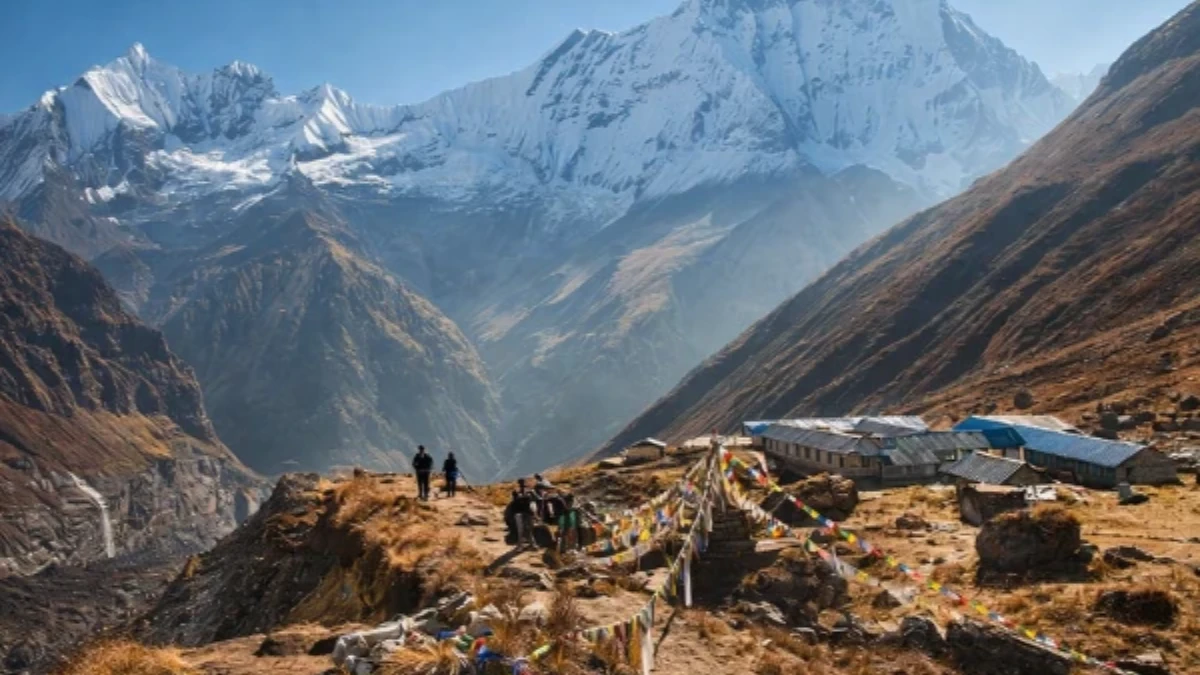
What is the weather at Annapurna Base Camp from November to February?
I used ten years of daily weather-model data (2015 to 2024) for Annapurna Base Camp at 4,130 m and Deurali at 3,174 m. This is a computer model, not readings from a thermometer at a lodge, and it counts any day with 1 mm of precipitation as a wet day. So use it to compare months, not to forecast a day. Snowfall is the model's estimate of the month's snowfall in centimetres.
| Place | Month | Day high (°C) | Night low (°C) | Wet days | Precipitation (mm) | Snowfall (cm) |
|---|---|---|---|---|---|---|
| Annapurna Base Camp, 4,130 m | October | 4.5 | -1.5 | 16 | 102 | 26 |
| Annapurna Base Camp, 4,130 m | November | 1.6 | -5.6 | 4 | 15 | 8 |
| Annapurna Base Camp, 4,130 m | December | -1.5 | -9.4 | 3 | 25 | 17 |
| Annapurna Base Camp, 4,130 m | January | -5.0 | -13.6 | 6 | 58 | 40 |
| Annapurna Base Camp, 4,130 m | February | -4.1 | -12.2 | 7 | 57 | 39 |
| Deurali, 3,174 m | October | 10.9 | 4.1 | 23 | 148 | 2 |
| Deurali, 3,174 m | November | 8.0 | -0.2 | 9 | 38 | 2 |
| Deurali, 3,174 m | December | 5.5 | -3.4 | 5 | 28 | 13 |
| Deurali, 3,174 m | January | 2.6 | -7.2 | 6 | 49 | 32 |
| Deurali, 3,174 m | February | 3.6 | -5.9 | 11 | 64 | 34 |
What the figures show. November is dry: four wet days at ABC against sixteen in October, with night lows around -6 °C. December is colder again at about -9 °C. January and February are the extreme months, with nights near -13 °C at ABC and about 40 cm of modelled snowfall a month. The first half of October is still wet in this model; the dry spell starts after it. For the half-month figures, see the October post.
The same archive for the lower villages shows that the cold is a feature of the top section only. Chomrong at 2,170 m has night lows of 7 °C in November, 4 °C in December and about 1 °C in January, with almost no snow. Pokhara at 820 m has night lows of 12 °C in November and 8 °C in December, and it is dry in November (3 wet days) and December (about 4).
What does an outside study say about the cold?
Plan for the colder numbers in the table, because nights at ABC in January and February are near -13 °C in the model.
The only outside figure is a study of snow cover in the winter of 1999 to 2000. It found winter air temperatures at about 4,400 m ranged from -4.65 to -6.06 °C, and that areas above 3,000 m were snow-covered until the end of March, and above 4,400 m until May. The temperature figure is the same order as the model's December average at ABC (about -5 °C, the midpoint of the day high and night low). It does not capture the nights, which are far colder than the mean, so do not read -5 °C as the temperature you will sleep in. And note that the snow cover is for one winter, 25 years ago. I would not treat it as a rule, but it is the reason I say that snow can lie on the upper trail long after December.
Is there an avalanche risk on the trail?
Yes, and I cannot put a number on it. Deurali lies in an avalanche-prone region. Its most recent reported casualties there were on 17 January 2020, and The Himalayan Times of 18 January 2020 ran the headline "Six trekkers including 4 Koreans missing in avalanche in Annapurna region". I can't give you more detail than the headline.
There is no official avalanche-risk calendar for the sanctuary, so no date can be called safe. The stretch between Deurali and ABC runs below steep slopes. After fresh heavy snow, the risk goes up, and the right decision is to wait or turn back, whatever the schedule says. If your guide says stop, you stop. That is the rule I would want any guide to follow, and it is one reason winter ABC needs spare days in your plan.
Are the lodges open at Machhapuchhre Base Camp and ABC in winter?
I cannot tell you which lodges at Machhapuchhre Base Camp and ABC are open in winter. Our own winter trekking guide says that in winter some teahouses close for the season and that those still open offer the basics, but it does not say which ones close in the sanctuary. Ask us before you book, and ask any other operator the same question in writing.
How short are the days?
This is a calculation, not a measurement: the length of daylight at the latitude of Annapurna Base Camp (about 28.5 degrees north), ignoring the mountains.
| Date | Hours of daylight |
|---|---|
| 15 October | about 11.3 |
| 15 November | about 10.5 |
| 1 December | about 10.3 |
| 21 December | about 10.2 |
| 15 January | about 10.4 |
| 15 February | about 11.0 |
The change is only an hour from October to the shortest day. The real effect comes from the mountains: the sanctuary is enclosed by high peaks, so direct sun reaches the lodges later in the morning and leaves earlier in the afternoon than this table suggests. That is my own observation of how the valley works, not a figure. Our itinerary has a walking day of about 7 hours (Chomrong to Deurali), so in winter you start at first light and plan to arrive before the cold sets in.
What should you pack for winter ABC?
Pack for nights well below zero. Beyond the normal kit list: a warm hat and liner gloves plus insulated mittens, thermal base layers, a down jacket that you will wear from late afternoon until morning, and a sleeping bag with a comfort rating clearly below the night lows in the table. For January, that means well below -13 °C; this is my own judgement, not a standard. Our package gives sleeping bags and down jackets if you tell us at your briefing that you need them. Our winter guide notes that the trail above Deurali can be icy, so bring microspikes for that section. Trekking poles help on frozen stairs on the way down. For the full gear list, see our December Everest guide, where the cold-weather kit is the same in principle.
Which months work, and which do not?
| Month | My view for ABC | Why |
|---|---|---|
| November | Good | Dry by the model; nights about -6 °C at the top; shorter days |
| Early December | Possible, with care | Colder nights; our winter guide says early December and late February are possible but demanding |
| Late December and January | Hard; not a first winter trek | Nights near -10 to -14 °C by the model; snowfall; avalanche-prone ground |
| February | Hard; late February possible | Still very cold; snow lies on the upper trail |
I would add one point about November. It is the month I would choose over December if you want the sanctuary at its clearest, and it is the better balance of cold and risk. Our November 2026 guide has the position for every route, and our December 2026 guide says plainly that ABC works if you take the cold seriously and is not a first-winter choice.
What about the altitude and the road?
Cold and altitude add together. Our 9-day plan gains about 1,004 m of sleeping altitude on day 4 and about 956 m on day 5, more than three times the 300 m a day that is the rule of thumb, and I would add a night in winter. The trails were reported open on 29 September. The Pokhara to Baglung road lost about 150 m at Sahasradhara on 27 September (Kathmandu Post, 28 September), and there is no report that it has reopened. By November the position may be different, and we confirm the road 48 hours before departure. The full trail account is in our difficulty guide.
What does it cost, and are there fixed departures?
The 9-day trek is USD 1,250 on Budget, USD 1,725 on Standard and USD 3,465 on Luxury, per person for one traveller; larger groups pay less each. The price does not change by month. We have no fixed group departures for ABC in November or December that I can promise you; contact us for dates, and we will run a private departure for even one person. Budget has no porter and no meals, which in snow means carrying your own bag. Standard has all meals and one porter for every two trekkers, and a solo Standard trekker has no porter, as the guide carries up to 10 kg. Luxury has your own porter and private deluxe rooms where available. The Annapurna Conservation Area permit and TIMS card are included; Kathmandu hotels are not, though the two Pokhara nights are.
A 10 per cent deposit holds your dates and the balance is paid in Kathmandu. You can reschedule free of charge with at least 72 hours' notice to any date within one year, and if we cannot run the trip we refund what you paid less taxes, bank and card charges and money already spent. The deposit itself is not refunded if you cancel. That matters in winter, when snow can change a plan.
When should you not choose winter ABC?
Do not choose it if this is your first trek, or if you have never slept in temperatures below freezing. Do not choose it if you cannot spare a few extra days for a snow delay. Do not choose it on Budget if you mind carrying a pack on icy stairs. And do not choose it if you dislike the cold, because there is no way around it at 4,130 m in January. The alternatives are the 6-day Poon Hill trek in December and January, which stays below 3,300 m, and, for experienced winter trekkers, the Annapurna Circuit in winter. Both are written up on our site, and our winter trekking guide compares them.
Sources: a climate model, daily data 2015 to 2024, for ABC (4,130 m), Deurali (3,174 m), Chomrong (2,170 m) and Pokhara (820 m), with snowfall an estimate; a winter snow-cover study (1999 to 2000) for air temperature and snow cover; The Himalayan Times, 18 January 2020 (headline). Day length is calculated from the sunrise equation at 28.5 degrees north, without terrain. Road status: Kathmandu Post, 28 September 2026 and ekantipur, 29 September 2026. That some teahouses close in winter and that the trail above Deurali can be icy come from our own winter trekking guide. There is no official source for avalanche windows or for which lodges close at Machhapuchhre Base Camp and ABC.
About The Everest Holiday
We are a family company in Kathmandu, three generations of Himalayan guides, registered in 2016 and a member of the Trekking Agencies' Association of Nepal, number 1586. When you book with us you deal with the family, not a call centre.
WhatsApp: +977 9810351300
Email: [email protected]
Written by Shreejan Simkhada, CEO of The Everest Holiday, from a family of three generations of family guides. TAAN Member #1586.
Thinking about ABC in the cold months? Our Annapurna Base Camp Trek (9 Days) is private (your group only, no strangers), from USD $725. WhatsApp us for dates and the current road position.
Short on time over the holidays? Our guide to Christmas and New Year treks from Pokhara, 3 to 5 days compares Panchase, Poon Hill and Mardi Himal, with prices and what is open.
Planning a trip to Nepal?
Drop us your details and tell us what you have in mind. We will put together a personalised plan and get back to you.
Not sure which Nepal trek is right for you?
Take our free 2-minute quiz and get personalised recommendations based on your fitness, experience, and travel style.
Find Your Perfect Trek →
Island Peak Itinerary and Summit Day 2027: 14 Days, Base Camp to the Top
The 14-day Island Peak itinerary day by day, what summit day is like from base camp, where sources disagree on heights, best months and 2027 prices.
Read More
How Difficult Is the Mardi Himal Trek? An Honest Day-by-Day Rating for 2027
An honest day-by-day rating of the Mardi Himal trek: the steep climb to High Camp, the 4,500 m push to Base Camp, altitude risk, who finds it hard and 2027 prices.
Read More
Manaslu Circuit Reopened: What Changed After the 2026 Floods and How to Plan 2027
The Manaslu Circuit over the Larke Pass is open again with extreme caution. What changed in the lower valley after the two 2026 floods, 2027 prices and permits, and how I would plan.
Read More Chat with Shreejan