

Last updated 3 October 2026. I rewrote this post around the 9-day itinerary we actually run, which goes up through Ghandruk and Chomrong. The old version described ten days on a Ghorepani route with a flight of 3,300 steps at Ulleri on day 2. That is not our trek, so those claims are gone. The trails were reported open on 29 September, with a road problem on the way to the trailhead, set out near the end.
The short answer: the Annapurna Base Camp trek is moderate. We rate it Moderate on our 9-day Annapurna Base Camp trek page, and most reasonably fit people can do it after some training. The difficulty is not technical. There are no ropes and no scrambling. It comes from long days on stone steps, and from two days in a row, days 4 and 5, when you sleep roughly 1,000 m higher than the night before. That second point is the part most guides skip, so I have put the numbers below.
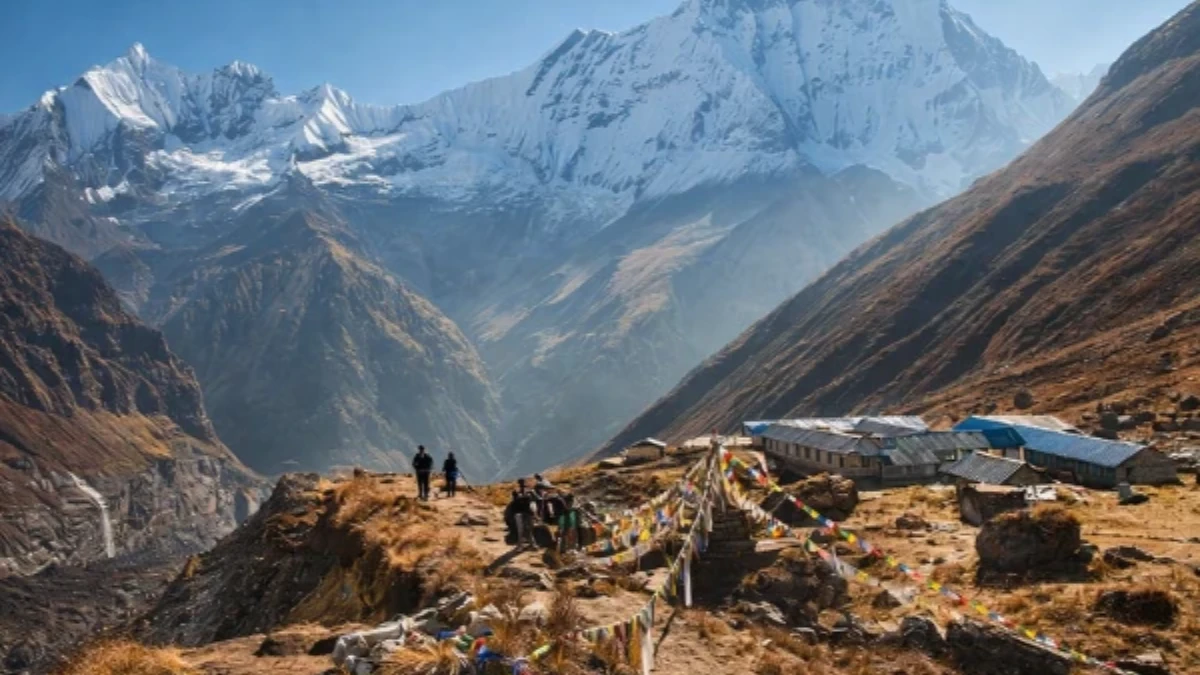
How hard is each day of the Annapurna Base Camp trek?
This is our live 9-day plan. The sleeping altitudes, times and distances are the figures printed on our itinerary, so treat them as approximate. The change in sleeping altitude is my own subtraction of one night's altitude from the night before.
| Day | Route | Sleep | Change in sleeping altitude | Walking time | Distance |
|---|---|---|---|---|---|
| 1 | Drive Kathmandu to Pokhara | 820 m | Start | 7 to 8 hours by road | 200 km by road |
| 2 | Drive to Nayapul, jeep to Kimche, walk to Ghandruk | 1,940 m | +1,120 m, mostly by vehicle | 3 hours | Not printed |
| 3 | Ghandruk to Chomrong | 2,170 m | +230 m | 4 hours | 10 to 13 km |
| 4 | Chomrong to Deurali | 3,174 m | +1,004 m | 7 hours | 10 to 12 km |
| 5 | Deurali to Annapurna Base Camp via Machhapuchhre Base Camp | 4,130 m | +956 m | 2 to 3 hours (printed) | 7 to 8 km |
| 6 | Annapurna Base Camp to Bamboo | 2,310 m | -1,820 m | 6 hours | 15 to 19 km |
| 7 | Bamboo to Jhinu Danda | 1,780 m | -530 m | 4 hours | 8.5 to 11.7 km |
| 8 | Jhinu Danda to Nayapul, drive to Pokhara | 820 m | -960 m | 4 hours | 4 km (as printed) |
| 9 | Drive Pokhara to Kathmandu | 7 to 8 hours by road | 210 km by road |
Two figures in that table are not solid. The printed time for day 5 is 2 to 3 hours, but another operator gives the Deurali to ABC walk as 7.7 km and about 4 to 5 hours. The printed distance for day 8 looks too short for the walk down from Jhinu Danda. I have flagged both for our guides to check, and until they confirm, use them as an order of magnitude. The full distance breakdown is in our distance guide.
Which are the hardest parts?
Day 4, Chomrong to Deurali. It is the longest day in time, about 7 hours, and the first one with a big altitude gain. It opens with the Chomrong staircase. Our itinerary describes roughly 2,500 stone steps that drop into the Modi Khola gorge before climbing out the other side. That figure is an estimate from our own notes, not a count. Then the trail climbs through bamboo forest and past Himalaya Hotel (2,890 m) to Deurali at 3,174 m.
Day 5, the sanctuary. You walk up past Machhapuchhre Base Camp (MBC) at 3,720 m and across the moraine into the amphitheatre at 4,130 m. The distance is short, 7 to 8 km, but you are sleeping 956 m higher than the night before.
Day 6, the long way down. ABC to Bamboo is 15 to 19 km and a drop of about 1,820 m, in roughly 6 hours. The stone steps that were hard going up are harder going down, especially when wet. Our itinerary strongly recommends trekking poles for this day. Your knees will notice it more than your lungs.
What about the Ulleri steps? Those belong to the Poon Hill route through Ghorepani, not to our ABC itinerary. Trekkers can now reach Ulleri by bus or jeep. If you take a different operator's ABC route via Ghorepani, ask for the day-by-day plan and compare it to ours.
Is altitude sickness a risk on the Annapurna Base Camp trek?
Yes, it is a real risk, even at 4,130 m. Medical reviews say altitude sickness is prevented by raising your sleeping altitude by no more than about 300 m per day, and that acute mountain sickness affects about 20 per cent of people who go rapidly to 2,500 m and about 40 per cent of those who go rapidly to 3,000 m. The medical standard for prevention and treatment is the Wilderness Medical Society's 2019 guidelines (Luks and colleagues, Wilderness and Environmental Medicine, PubMed 31248818).
Now compare that with the table. Our day 4 gains about 1,004 m in sleeping altitude and day 5 gains about 956 m. That is more than three times the 300 m rule of thumb on both days, with no rest day in the nine. I would rather say so than hide it. The mitigations are real but they are not a substitute for time. On day 4 your guide checks your oxygen saturation with a pulse oximeter at Deurali, and the guide's judgement comes first. The standard approach is to stay hydrated, go slowly, and report any headache or nausea at once, and if you feel unwell at Deurali the answer is to stay or go down, not to push on.
If you have never slept above 3,000 m, I would add a night. A night at Deurali or MBC splits the two big gains. Ask us when you book and we will tell you what the extra day costs. It is the change I would make first, before any extra training.
What does the weather add?
Cold and rain add to the effort. A weather model for the village heights (ten years of data; a model, not lodge thermometers) puts ABC nights at about 0 to 1 °C in the first half of October, about -4 °C in the second half and about -5 °C in early November. Deurali, at 3,174 m, lies in an avalanche-prone region. Its most recent reported casualties there were on 17 January 2020, and The Himalayan Times of 18 January 2020 ran the headline "Six trekkers including 4 Koreans missing in avalanche in Annapurna region". I can't give you more detail than that. That was mid-winter, and there is no published autumn avalanche rate, so I won't quote one. It is the reason I would not call this a first-winter trek. See ABC in October for the half-month weather figures.
How fit do you need to be?
You should be able to walk 12 km on hilly ground with a light daypack, and then do it again the next day and the day after. That is my own baseline from the days we run, not a published standard. Stairs matter more than running. Find a building or a stadium stair and climb for an hour, then come down slowly, because the descents are what tire people on day 6. Six to eight weeks of regular walking, with one longer hike a week, is enough for most people. If you want a structured plan, our 12-week training plan was written for Everest Base Camp, which is harder, so you can use it as a ceiling, and our training guide has the reasoning.
The tier changes how hard it feels. On Budget you carry your own bag. On Standard, one porter carries the luggage of two trekkers, with a limit of 10 kg each, and a solo Standard trekker has no porter, so the guide carries up to 10 kg. On Luxury you have your own porter and carry only a daypack.
How does the Annapurna Base Camp trek compare with other treks?
These are the trip grades printed on our own package pages. They are a rough guide, not a measured scale, and the grade says nothing about the altitude, which you should compare separately.
| Trek | Days | Trip grade on our site |
|---|---|---|
| Poon Hill | 6 | Easy |
| Langtang | 8 | Moderate |
| Annapurna Base Camp | 9 | Moderate |
| Everest Base Camp | 12 | Strenuous |
| Mardi Himal | 7 | Moderate |
| Annapurna Circuit | 12 | Strenuous |
Read the labels with care. Everest Base Camp is labelled Strenuous because it climbs far higher than ABC and runs longer, while Mardi Himal shares the Moderate label with ABC even though it is shorter, so compare the day-by-day plans as well. For a head-to-head with Everest, see Everest Base Camp or Annapurna Base Camp, and for the quieter ridge trek see ABC against Mardi Himal.
Can a complete beginner do it?
Yes, if you give yourself time to train and you are honest about the stairs. The people who struggle are rarely the unfit ones. They are the ones who underestimate several long days in a row, or who rush the two big altitude days. Train for consistency, not for speed, and think about the spare night. We rate the trek Moderate on our package page, with steep climbs and descents on stone stairs and no technical climbing.
Who should not do the Annapurna Base Camp trek?
Anyone who cannot spare nine days. Anyone who has never slept above 3,000 m and will not add a spare night. Anyone whose knees or ankles struggle with long descents on steps, because day 6 is long. And anyone who dislikes cold nights, because ABC is below freezing at night by late October. If any of these is you, the 6-day Poon Hill trek or the 7-day Mardi Himal trek is the honest alternative. For anything medical, such as a heart or lung condition, ask your own doctor before you book. We cannot judge that for you.
Is the trek open now, and what does it cost?
The trails were reported open on 29 September, after a flood on 11 and 12 July and a landslide-blocked stream on 8 September that cleared by 13 September (our account). The Pokhara to Baglung road lost about 150 m at Sahasradhara on 27 September (Kathmandu Post, 28 September), and it has not been reported reopened since repair began on 29 September. We confirm the road to the trailhead 48 hours before you go, and if it is shut we find you an alternative route or starting point and tell you before you travel.
The 9-day trek is USD 499 on Budget, USD 799 on Standard and USD 1,400 on Luxury, per person for one traveller; larger groups pay less each. Budget has no porter and meals are not included. Standard has all meals and one porter for every two trekkers. Luxury has your own porter, all meals and private deluxe rooms where available. The Annapurna Conservation Area fee (NPR 3,000) and the TIMS card (NPR 2,000) are included. Kathmandu hotels are not, though the two Pokhara hotel nights are part of the plan. A 10 per cent deposit holds your dates and the balance is paid in Kathmandu. If you must move, you can reschedule free with at least 72 hours' notice to any date within one year. The deposit itself is not refunded if you cancel. If we cannot run the trip, we refund what you paid less taxes, bank and card charges and money already spent.
Sources: Wilderness Medical Society guidelines, 2019 update (Luks et al.); The Himalayan Times, 18 January 2020 (January 2020 avalanche); Nepal Tourism Board. Road status: Kathmandu Post 28 September 2026 and ekantipur 29 September 2026. Night temperatures are from a climate model, 2015 to 2024. The change in sleeping altitude is worked out from the altitudes in our itinerary.
About The Everest Holiday
We are a family company in Kathmandu, three generations of Himalayan guides, registered in 2016 and a member of the Trekking Agencies' Association of Nepal, number 1586. When you book with us you deal with the family, not a call centre.
WhatsApp: +977 9810351300
Email: [email protected]
Written by Shreejan Simkhada, CEO of The Everest Holiday and third-generation Himalayan guide. TAAN Member #1586.
ABC difficulty: 9 days, moderate. Our Annapurna Base Camp Trek (9 Days) is private (your group only, no strangers), from USD $499. WhatsApp us for dates and the current road position.

 Chat with Shreejan