
Autumn ABC is the sweet spot. Clear skies, the amphitheatre glowing in October light, and half the crowds of EBC.
Govt Regd. No.: 147653/072/073
Travel Agency Licence: 2838/072
Annapurna Base Camp Trek in Autumn: Your October and November Guide

Annapurna Base Camp Trek in Autumn: Your October and November Guide
Most people stop talking for about ten minutes the first time they walk into the Annapurna Sanctuary in October. But when the trail opens up and the amphitheatre reveals itself, this wall of 7,000 and 8,000-metre peaks curving around you in every direction, words feel small. The light at seven in the morning turns Machhapuchhre gold, then pink, then white. Annapurna South fills half the sky. You stand at 4,130 metres in a natural arena that took millions of years to form, and for a few minutes, nothing else in your life matters.
That is autumn at Annapurna Base Camp. And there is a reason it is the season I recommend most often for this particular trek.
Is autumn the best time to trek Annapurna Base Camp?
Nepal has four trekking seasons, and each has merit. But for ABC specifically, October and November offer a combination that no other window matches.
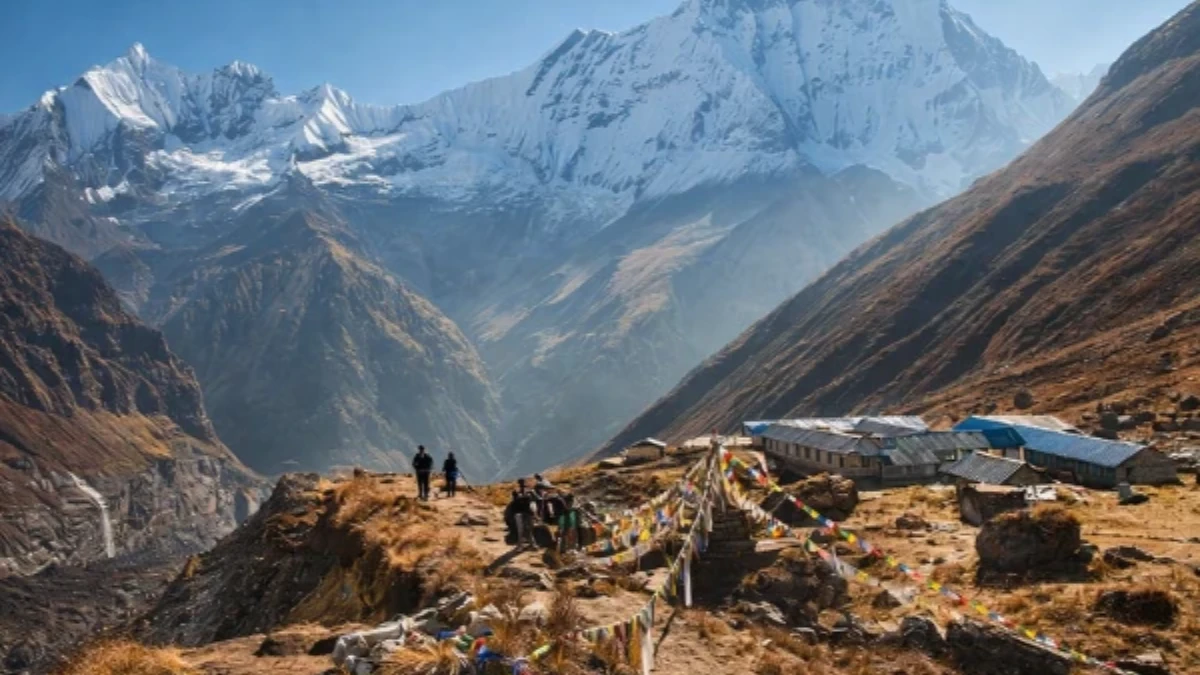
The monsoon ends in late September. By the first week of October, the rain has stopped, the skies have cleared, and the mountains are still carrying fresh snow from the monsoon's final storms. This means the peaks are at their most dramatic, white and sharp against deep blue sky, while the lower forests are lush and green from four months of rainfall. You get the best of both worlds.
Temperatures at ABC itself hover between minus five and five degrees Celsius in October, dropping to minus ten to zero in November. Cold, certainly, but nothing like the Everest Base Camp region, which sits over a thousand metres higher. The ABC trail maxes out at 4,130 metres, which means you sleep warmer, acclimatise easier, and carry less heavy cold-weather gear than on most high-altitude treks in Nepal.
How cold is the Annapurna Base Camp trek in autumn?
I find that generic "the weather is great in autumn" advice is not very helpful when you are trying to pack. Here is what our guides report at each major stop during October and November.
Nayapul to Ghandruk (1,070m to 1,940m)
Warm. Daytime temperatures of 18 to 24 degrees in October, dropping to 14 to 20 in November. You will trek in a t-shirt and light trousers. Mornings may have low cloud or mist that burns off by 10am. Rain is unlikely but possible in early October, so keep a rain jacket accessible. The trail passes through villages, rice paddies, and subtropical forest. It feels more like a countryside walk than a Himalayan trek at this stage.
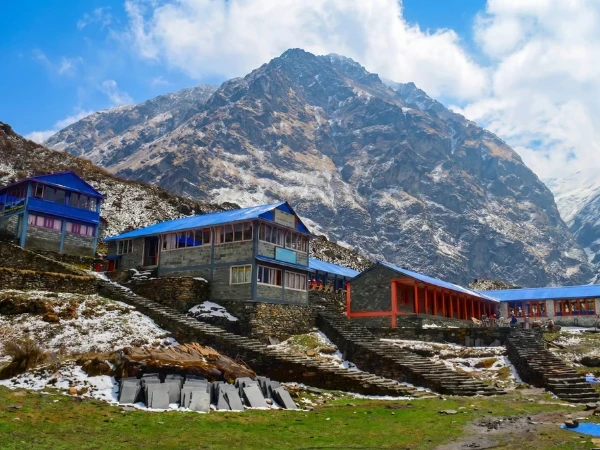
Ghandruk to Chhomrong (1,940m to 2,170m)
Still comfortable. This section follows stone steps carved into the hillside, dropping into the Modi Khola valley and climbing back out. The steps are the real challenge here, not the temperature. Your knees will have opinions about this section. Evenings cool to around 8 to 12 degrees, and a fleece over dinner is enough.
Chhomrong to Bamboo to Dovan (2,170m to 2,600m)
You enter the Annapurna Sanctuary through dense bamboo and rhododendron forest. The trail descends steeply from Chhomrong to the river, then climbs through a valley that narrows and darkens with tree cover. Temperatures remain mild during the day (12 to 18 degrees) but the shade makes it feel cooler. Leeches are gone by October, so do not worry about that particular horror.
Dovan to Machhapuchhre Base Camp (2,600m to 3,700m)
The temperature shift begins here. Mornings are cold, around 2 to 6 degrees. The forest thins, the valley opens, and you get your first clear views of Machhapuchhre and Hiunchuli. By MBC, nights drop to minus two to minus five. You will want your down jacket for evenings and a good sleeping bag rated to at least minus ten.
Machhapuchhre Base Camp to Annapurna Base Camp (3,700m to 4,130m)
This is the final push, and it is done early in the morning for the best light. Predawn temperatures at MBC sit around minus five to minus eight in October, colder in November. The walk to ABC takes two to three hours across an open, rocky plateau. When the sun hits the amphitheatre, the temperature rises quickly, and by midmorning it can feel genuinely warm in the sheltered bowl of the sanctuary. Related: Machhapuchhre Base Camp: The Sacred Mountain You Cannot Climb and the View That Makes You Grateful.
What does Annapurna Base Camp look like at sunrise?
I want to spend a moment on what makes ABC visually unique, because photographs do not capture it fully.
Most high-altitude viewpoints in Nepal show you mountains stretching along a horizon. Kala Patthar gives you a panorama. Poon Hill gives you a sunrise spread. ABC is different. You are inside the mountains, not looking at them from outside. The Annapurna Sanctuary is a glacial basin surrounded on all sides by peaks: Annapurna I (8,091m), Annapurna South (7,219m), Machhapuchhre (6,993m), Hiunchuli (6,441m), Gangapurna (7,455m), and several more. You stand in the centre and turn slowly, and there is no direction that is not a mountain wall.
In October, the early morning light enters the sanctuary from the east, catching Annapurna South first. The peak turns from grey to gold to blazing white in about fifteen minutes. Then the light moves across the amphitheatre, reaching Machhapuchhre, then Annapurna I. The whole cycle takes about forty-five minutes, and it is the best natural light show I know of anywhere in Nepal.
By November, the sun angle is lower, which means longer shadows and more dramatic contrast. Photographers often prefer November for this reason, though October's warmer mornings make the predawn wait less painful.
Is Annapurna Base Camp less crowded than Everest Base Camp?
One of the most common questions I receive is whether ABC is as crowded as EBC in autumn. The short answer: no, not even close.
EBC receives roughly three to four times more trekkers than ABC during peak season. In October 2025, the Everest region saw record numbers, with teahouse shortages and queues at viewpoints. The Annapurna Sanctuary, by contrast, remained busy but manageable. You will share teahouses with other trekkers, certainly. You will not be alone on the trail. But you will not feel herded, and you will not struggle to find a bed if you arrive at a reasonable hour.
The reason is partly geographical. EBC has become a bucket-list item, heavily promoted on social media. ABC, despite being equally spectacular in its own way, flies under the radar of the Instagram crowd. This is, frankly, to your advantage.
If crowd avoidance is your priority, aim for late November rather than mid-October. By the last week of November, the autumn season is winding down, temperatures are dropping, and trekker numbers thin significantly. You sacrifice a few degrees of warmth for notably quieter trails.
What is the difference between Annapurna Base Camp and the Circuit?
Both treks are in the Annapurna region, but they offer fundamentally different experiences. If you are deciding between them, here is a straightforward comparison.
| Factor | Annapurna Base Camp | Annapurna Circuit |
|---|---|---|
| Duration | 7 to 11 days | 12 to 18 days |
| Maximum altitude | 4,130m (ABC) | 5,416m (Thorong La Pass) |
| Terrain | Valley trek into a glacial basin | Full circumnavigation of the massif |
| Cultural variety | Gurung villages | Hindu lowlands, Buddhist highlands, Mustang desert |
| Physical difficulty | Moderate | Moderate to strenuous |
| Best for | Mountain views, shorter timeframe | Cultural diversity, longer adventure |
| Crowd level (autumn) | Moderate | Lower (spread over longer route) |
ABC is the better choice if you have seven to ten days and want the most dramatic mountain scenery per day of walking. The Annapurna Circuit is the better choice if you have two weeks or more and want a trek that changes landscape and culture every few days. Neither is better overall. They serve different appetites.
Is the Annapurna Base Camp trek good for beginners?
I often recommend ABC for people on their first or second Himalayan trek, and autumn is the ideal season for that. Here is why.
The maximum altitude of 4,130 metres is high enough to feel the effects of altitude but low enough that serious altitude sickness is uncommon with proper acclimatisation. You gain altitude gradually over several days, and most itineraries include rest days or flexible days that allow your body to adjust. Compare this to the Three Passes Trek, where you cross passes above 5,300 metres, or even the Kanchenjunga Base Camp trek, which requires sustained time above 5,000 metres.
The trail infrastructure on the ABC route is excellent. Teahouses are well maintained, food is varied, and the distances between stops are manageable (four to six hours of walking on most days). If you are wondering what teahouses are actually like, our honest guide covers everything from beds to showers to squat toilets.
For a complete beginner's perspective on planning, read our guide on trekking in Nepal for the first time.
Day-by-Day Highlights of Autumn ABC
- Nayapul to Ghandruk: Warm walk through rice terraces. First views of Annapurna South and Machhapuchhre from Ghandruk village. Gurung cultural museum worth visiting.
- Ghandruk to Chhomrong: Stone steps. Lots of stone steps. Beautiful but tough on the knees going down. Chhomrong has the last proper village feel before the sanctuary.
- Chhomrong to Bamboo: Steep descent to the river, then gradual climb through forest. Quiet, shaded trail. Good birdwatching if you are into that.
- Bamboo to Deurali: Bamboo forest gives way to rhododendron. The valley narrows. You start to feel enclosed by the mountains.
- Deurali to Machhapuchhre Base Camp: The treeline ends. The landscape opens. First full views of the sanctuary. This is the day that catches your breath.
- MBC to ABC and back to Bamboo: Early morning walk to ABC. The amphitheatre sunrise. Then a long descent back to Bamboo, losing almost 1,500 metres in a day. Your knees will remember this.
- Bamboo to Jhinu Danda: Hot springs. After days of cold mornings and no showers, the natural hot springs at Jhinu Danda are the best reward on any trek in Nepal. Soak your aching legs and watch the river below.
What permits do you need for the Annapurna Base Camp trek?
For autumn 2026, you need two permits for the ABC trek: the Annapurna Conservation Area Permit (ACAP) and the TIMS card. Both are arranged in Kathmandu or Pokhara. Since April 2023, a licensed trekking guide is required for foreign trekkers in the Annapurna area under the Nepal Tourism Board rule. Our complete permit guide has current fees and the process.
Most trekkers fly into Pokhara from Kathmandu (25 minutes) and drive to Nayapul (1.5 hours) to start the trek. The return is to Pokhara via Nayapul or Phedi. Our Annapurna Base Camp trek package includes all permits, transport, guide, and accommodation.
What should you pack for the Annapurna Base Camp trek in autumn?
Autumn ABC does not require extreme cold-weather gear. Here are the essentials specific to this season:
- Down jacket for evenings above MBC and for the early morning ABC push.
- Sleeping bag rated to minus ten. Teahouse blankets exist but are not always sufficient at MBC and ABC.
- Rain jacket and waterproof pack cover. Early October can still see occasional showers.
- Trekking poles. The stone steps between Ghandruk and Chhomrong will convince you these are essential, not optional.
- Sun protection. The autumn sun at altitude is strong. SPF 50, sunglasses, and a hat.
For the complete list, see our full packing guide.
Frequently Asked Questions
Is the Annapurna Base Camp trek difficult?
It is moderate. You need reasonable fitness, the ability to walk five to seven hours a day on uneven terrain, and comfort with basic teahouse accommodation. It does not require technical skills, previous trekking experience, or exceptional athleticism. The stone-step sections test your knees more than your lungs. If you can walk uphill for four hours without stopping, you are fit enough for ABC.
Can I do the ABC trek in October without a guide?
No. Since April 2023, the Nepal Tourism Board rule has required foreign trekkers in the Annapurna area to hire a licensed guide. This is a requirement, not a recommendation. Solo trekking without a guide is not permitted on this route. Read about why guides and porters matter beyond just regulations.
Is altitude sickness a risk on the ABC trek?
It is possible but less common than on higher treks. ABC sits at 4,130 metres, which is below the threshold where most people experience serious problems. Mild symptoms like headaches and fatigue are common above 3,500 metres. Proper acclimatisation, hydration, and a sensible pace reduce the risk significantly. Our itineraries are designed with altitude gain in mind.
How does ABC compare to the Mardi Himal Trek?
The Mardi Himal Trek reaches a similar altitude (4,500m) and offers close-up views of Machhapuchhre. It is shorter (five to seven days), quieter, and has a more ridge-walking character compared to ABC's valley approach. Mardi Himal is a good alternative if you want fewer people and do not need the full amphitheatre experience.
What is the best month for ABC: October or November?
October offers warmer temperatures, greener landscapes, and slightly better odds of clear mornings. November offers quieter trails, crisper air, and more dramatic light for photography. Both are excellent. If this is your first trek, October is more forgiving. If you have trekked before and want quieter conditions, aim for November.
The Final Word
Annapurna Base Camp in autumn is one of the most rewarding treks in Nepal for the time and effort it requires. Seven to ten days of walking brings you into one of the most dramatic mountain amphitheatres on Earth, at an altitude that is challenging but not extreme, on a trail that is well supported by teahouses and experienced guides. If you are looking for your first big Himalayan trek, or if you have done EBC and want something different, autumn ABC should be at the top of your list.
Guides who have walked into that sanctuary many times tell me it still makes them stop talking for a few minutes.
WhatsApp:+977 9810351300
Email:[email protected]
Written by Shreejan Simkhada, CEO of The Everest Holiday and third-generation Himalayan guide. Licensed by TAAN (Trekking Agencies' Association of Nepal) #1586. Leading treks across Nepal since 2016.
Autumn travellers who want trek, culture and safari in one trip should read our 2-week Nepal itinerary, which uses October-November weather to fit all three.
Autumn ABC (Oct-Nov) is our peak season. Our Annapurna Base Camp Trek (9 Days) is private (your group only, no strangers), 2027 dates open, From USD $725. WhatsApp us for tailored 2027 dates and current departures.
Planning a trip to Nepal?
Drop us your details and tell us what you have in mind. We will put together a personalised plan and get back to you.
Not sure which Nepal trek is right for you?
Take our free 2-minute quiz and get personalised recommendations based on your fitness, experience, and travel style.
Find Your Perfect Trek →Need Help? Call Us+977 9810351300orChat with us on WhatsApp
Related Trek Packages
Latest Travel Blogs
Thamdanda and Surke: The Road Head for Everest Base Camp by Road
Thamdanda is the road head where our Everest Base Camp trek by road starts and ends on foot. How to get there from Phaplu and what the first walk to Paiya is like.
Read More
Poon Hill Trek Permits 2027: ACAP, TIMS, Cost and What You Need
Poon Hill needs two permits: ACAP at NPR 3,000 and a TIMS card at NPR 2,000. Who arranges them, where they are checked, SAARC rates and the 2027 trek prices.
Read More
Mera Peak Climbing Itinerary 2027: 14 Days, Day by Day
Mera Peak in 14 days, night by night. The Hinku valley, a full rest day at Khare, Mera High Camp at 5,780 m, summit day, 2027 prices and the best months.
Read More Chat with Shreejan