
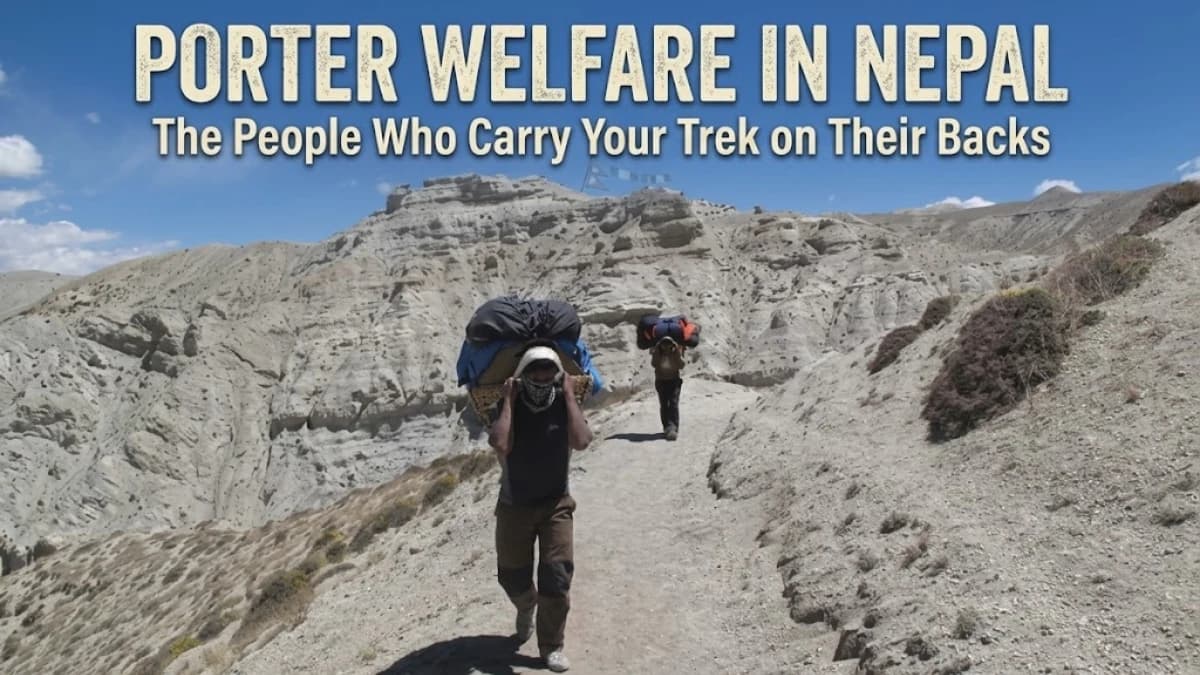
He is eighteen or perhaps twenty, age is approximate in the hills of eastern Nepal, where birth certificates arrived later than roads. He weighs fifty-five kilograms. The basket on his back, secured by a strap across his forehead in the traditional Nepali style, weighs thirty kilograms. He is wearing flip-flops. Not trekking boots. Not running shoes. Flip-flops, the cheap foam kind you buy in a Kathmandu market for two hundred rupees. He is walking uphill, at 3,800 metres, carrying more than half his body weight, in footwear that would not survive a walk to the shops.
He is a porter. He is one of roughly fifty thousand people who carry the trekking industry on their backs, literally, every season. Without him, your sleeping bag would be on your back instead of in a teahouse waiting for you. Without him, the teahouse would have no food, every kilo of rice, every tin of tuna, and every gas canister at altitude was carried up by someone like him. Without porters, there is no trekking industry in Nepal. There are only mountains, trails, and tourists who cannot carry enough to survive.
The story of Nepal's porters is a story of extraordinary physical capability, structural economic necessity, and, historically, exploitation that the industry is slowly, imperfectly, but genuinely working to correct. Understanding this story is not optional for the responsible trekker. It is the price of ethical participation in an industry that depends on human labor in a way that no other tourism sector does.
What Do Trekking Porters Actually Do?
Trekking porters carry clients' gear, the duffel bags, the extra clothing, and the luxury items that make teahouse life comfortable, from one point on the trail to the next. The standard load limit is fifteen to twenty kilograms per porter for trekking companies, though this limit is widely exceeded in practice. A porter typically carries two clients' duffel bags plus their own personal gear.
The distances are the same as when you walk. The terrain is the same. The altitude is the same. But the porter has to get to the teahouse first to drop off your bags, so they walk faster and carry more. The typical EBC trekker walks five to seven hours per day carrying a three-to-five-kilogram daypack. Their porter walks the same route in four to five hours, carrying twenty to thirty kilograms.
Porters also carry supplies for the teahouses themselves. The "commercial porters" who carry goods rather than trekker gear are the backbone of the high-altitude economy. Every can of Coca-Cola at Gorak Shep, every roll of toilet paper at Lobuche, and every sheet of corrugated metal used to repair a teahouse roof was carried up from the roadhead on someone's back. The loads are heavier, sixty, eighty, sometimes over one hundred kilograms for commercial porters using the traditional dokko basket and namlo headstrap system. These loads are visible on the trail, towers of goods strapped to a conical basket, the porter bent almost double under the weight, moving steadily uphill with a rhythm that suggests the situation is not exceptional but routine.
The History of Exploitation
Porter welfare has not always been a concern of the trekking industry. For decades, particularly during the rapid growth of trekking tourism in the 1990s and 2000s, porters were treated as expendable labor.
Wages were minimal. Many porters earned less than five dollars per day. They received no insurance. No medical coverage. No equipment. They carried excessive loads in inadequate clothing, sleeping outside or in unheated storage rooms, while the trekkers they served slept in teahouses. When a porter fell ill with altitude sickness, which happened frequently because the porters often ascended faster than their clients and had less acclimatisation time, they were sometimes simply left behind while the group continued.
The death rate among porters was, and to some extent still is, higher than among the trekkers they serve. A 2003 study published in the wilderness medicine literature found that porter deaths on Nepal's trekking routes were significantly underreported and that altitude sickness, hypothermia, and falls were the primary causes. Many of these deaths were preventable with basic equipment, reasonable load limits, and medical awareness.
The exploitative pattern was driven by economics. Trekkers, particularly those booking the cheapest packages, created price pressure that companies passed down the chain. The guide's wage was protected by skill scarcity. The porter's wage was not, porters were abundant, replaceable, and had minimal negotiating power. The result was a system where the person doing the heaviest physical work received the lowest compensation and the least protection.
How Has Porter Welfare Changed in Nepal?
The situation has improved significantly, driven by a combination of government regulation, international advocacy, industry self-regulation, and trekker awareness.
Government regulation. Nepal's government has established minimum wage standards for porters, though enforcement is inconsistent. The minimum daily wage for porters is approximately eight hundred to one thousand Nepali rupees (roughly seven to nine dollars) plus food and accommodation, but many companies now pay above this minimum in response to market competition and advocacy pressure.
International advocacy. The International Porter Protection Group (IPPG), founded in 1997, has been instrumental in establishing standards for porter welfare. The IPPG's guidelines, which include load limits (twenty to twenty-five kilograms for trekking porters at altitude), adequate clothing and equipment, medical insurance, and shelter standards, have been adopted by many reputable trekking companies and serve as a benchmark for the industry.
TAAN standards. The Trekking Agencies' Association of Nepal requires member companies to meet minimum porter welfare standards. These include fair wages, insurance, and adequate equipment. Enforcement varies, but TAAN membership signals a minimum commitment to ethical practice.
Company differentiation. Many trekking companies now use porter welfare as a competitive differentiator. Companies that provide proper gear, fair wages, insurance, and load limits market these practices to ethically conscious trekkers, and the growing demand for responsible tourism makes this marketing effective. The economic incentive to treat porters well is now aligned with the ethical imperative.
Porter lodges and shelters. The Porters' Progress programme and similar initiatives have established shelters and equipment stores along major routes where porters can borrow warm clothing, sleeping bags, and other gear. These facilities address the immediate problem of porters arriving at altitude without adequate protection.
What Still Needs to Change for Nepal's Porters?
Despite genuine progress, problems persist.
Load limits are still violated. Commercial porters routinely carry supplies to teahouses, often exceeding fifty kilograms, sometimes far more than that. The distinction between "trekking porter" (carrying client gear, subject to company standards) and "commercial porter" (carrying goods, subject to fewer regulations) creates a loophole that the most physically demanding and dangerous porterage exploits.
Equipment gaps remain. Some budget operators still send porters to altitude without adequate clothing. The porter in flip-flops at 3,800 metres is not a historical anecdote, it is a current reality on less-regulated routes and with less reputable companies. The equipment gap is most visible at high altitude and in bad weather, when the difference between proper boots and flip-flops, between a down jacket and a cotton sweatshirt, becomes the difference between safety and danger.
Wage disparities exist. Porters working for premium companies earn significantly more than those working for budget operators. The market has stratified, ethical companies pay well, attract better porters, and serve a higher-paying clientele, while budget operators pay poorly, rely on the most economically desperate porters, and serve price-sensitive trekkers who may not ask about working conditions.
Medical coverage is inconsistent. Not all porters are insured. Not all companies provide medical support if a porter falls ill. The porter who develops altitude sickness on the way to Gorak Shep may or may not receive the same medical attention, the oximeter check, the descent decision, the helicopter evacuation, that a trekker would receive.
What Trekkers Can Do
Ask about porter policy before booking. This is the most powerful tool you have. Before committing to a trekking company, ask: What do you pay your porters? What is the maximum load per porter? What clothing and equipment do you provide? Do porters have insurance? Where do porters sleep, in the teahouse with the group, or elsewhere? A company that answers these questions openly and specifically is a company that takes porter welfare seriously. A company that deflects, generalises, or becomes defensive may not be effective.
Check your porter's equipment at the start of the trek. Look at what your porter is wearing. Do they have proper footwear? A warm jacket? Sunglasses (snow blindness is a real risk at altitude)? If your porter is inadequately equipped, raise the issue with your guide. If the company has not provided adequate gear, the result is a fundamental failure that you have the right, and the responsibility, to challenge.
Limit your bag weight. The lighter your duffel, the lighter your porter's load. Most companies specify a maximum duffel weight of twelve to fifteen kilograms per person. Packing within this limit, and resisting the temptation to bring "just a few extra things",directly reduces the physical burden on the person carrying your bag.
Ensure your porter sleeps indoors. At every teahouse stop, verify with your guide that your porter has a bed in the teahouse, not a storage room, not a kitchen floor, and not outside. If the teahouse is full, the solution is to double up or find additional space, not to leave the porter without shelter. This is non-negotiable in ethical trekking.
Tip fairly. Porter tips are a significant portion of their income. The convention, eight to twelve dollars per day per porter, provided directly to the porter at the end of the trek, exists because base wages, even at improved levels, are not enough to support a family year-round. Tip directly, in cash, with thanks. The porter earned it.
Do not photograph porters as a spectacle. The image of a porter carrying an enormous load makes a dramatic photograph. It is also a photograph of a person doing a physically punishing workout of economic necessity. Ask permission before photographing. Consider whether the image serves the porter's dignity or your Instagram feed.
The Ethical Dimension
The porter question sits at the centre of responsible trekking because it exposes the fundamental economic relationship of tourism: people with money paying people without money to facilitate an experience for people with money. This relationship exists in every tourism context, but in porter labor, it is visible, physical, and undeniable. The porter carries your bag up the same mountain you climb with a light pack and a guide. The work is harder. The pay is less. The recognition is minimal.
This does not make trekking wrong. Porter employment is genuine employment, sought after, competed for, and valued by the people who do it. Many porters work as porters by choice, as a pathway to becoming guides, as seasonal income that funds education or agriculture, or as young men testing their strength against the mountains before settling into other work. The labor is laborious, but it is not forced, and the income, while insufficient by Western standards, is significant in the communities where porters live.
What makes the relationship ethical or unethical is not the work itself but the conditions under which it is done. Fair wages, reasonable loads, adequate equipment, proper shelter, medical insurance, and respectful treatment, these are the conditions that transform porter employment from exploitation into legitimate labor. And the trekker who insists on these conditions, through their booking choices, their on-trail vigilance, and their willingness to pay the slightly higher price that ethical treatment requires, is a trekker who participates in the industry without participating in its historic abuses.
The Porter Who Became a Guide
The trajectory from porter to guide is one of the trekking industry's most important mobility pathways. Many of Nepal's most experienced guides began as porters, carrying bags at sixteen, learning the trail, observing how guides managed clients and altitude and weather, and eventually earning the certification and language skills to guide independently.
This pathway matters because it means that porter welfare is not just a humanitarian concern but an investment in the industry's future. The eighteen-year-old in flip-flops carrying thirty kilograms up to Namche today is, if he survives, if he is treated well, if he is given the opportunity, the guide leading your trek in ten years. The conditions he works under now determine whether that potential is developed or destroyed.
When you choose a trekking company that treats its porters well, you are not just making an ethical booking decision. You are investing in the person who will carry the next generation of trekkers up the same trail. The mountain does not change. The trail does not change. But the people who make the trail possible, the porters, the guides, the teahouse families, are shaped by every decision that every trekker makes about how much they are willing to pay, what conditions they are willing to accept, and whether the person carrying their bag matters as much as the person photographing the view.
They do. They carry the weight. They deserve the respect. And the trekker who keeps they receive it is a trekker who leaves Nepal having taken nothing from the mountains except memories and having left nothing on the trail except footprints, including, crucially, the footprint of an industry that works for everyone who walks it.
We pay fair wages and follow TAAN porter welfare guidelines on every trek. See our trek pages for what is included.
Your porter is carrying your world on their back. Thirty kilograms of your belongings, up trails that make your legs shake with nothing on them. They earn less in a day than the meal you had last night in Kathmandu cost. Tipping them properly, packing your bag to a reasonable weight, and learning their name are the bare minimum. They deserve more than the bare minimum.
On all our treks, porters are paid above industry rates, provided with proper gear, and insured. It is not negotiable.
WhatsApp:+977 9810351300
Email:[email protected]
Written by Shreejan Simkhada, CEO of The Everest Holiday and third-generation Himalayan guide. TAAN Member #1586.
Porter welfare matters: we book private with proper loads. Our Everest Base Camp Trek (12 Days) is private (your group only, no strangers), 2027 dates open, From USD $1399. WhatsApp us for tailored 2027 dates and current departures.
 Chat with Shreejan