Ama Dablam Base Camp Trek Cost 2027: Prices, Permits, Tips and Extras

Updated 26 October 2026.
Short answer: The 8-day Ama Dablam Base Camp trek costs USD 1,420 Budget, USD 2,180 Standard and USD 3,630 Luxury per person for two to four people on our live page. A solo trekker pays USD 1,890, USD 2,585 or USD 4,390. The Lukla flights and all three permits (NPR 8,000 in total) are inside those prices. Meals on Budget, tips, insurance, your visa and your Kathmandu hotel are not. Once you add them, plan on roughly USD 2,000 all in for Budget and USD 2,500 for Standard, before international flights.
I am Shreejan. People see 1,420 next to our Everest Base Camp price of 1,399 and ask me why the shorter trek is not cheaper. It is a fair question, and I answer it below with numbers. I also go through the costs that never appear in a package price, because that is where trips go over budget.
This post is only about money. For the route, the altitude and the day-by-day walking, read my full Ama Dablam Base Camp trek guide. For how an Everest budget works in general, see what Everest Base Camp really costs.
How much does the Ama Dablam Base Camp trek cost in 2027?
These are the prices on our Ama Dablam Base Camp trek, 8 days page, read on 26 October 2026. They are per person in US dollars. The price is the same for a private trek and a group, and only the number of people changes it.
| Group size | Budget | Standard | Luxury |
|---|---|---|---|
| 1 person | USD 1,890 | USD 2,585 | USD 4,390 |
| 2 to 4 people | USD 1,420 | USD 2,180 | USD 3,630 |
| 5 to 8 people | USD 1,325 | USD 2,030 | USD 3,630 |
| 9 to 12 people | USD 1,250 | USD 1,950 | USD 3,610 |
| 13 to 20 people | USD 1,195 | USD 1,940 | USD 3,580 |
The deposit is 10 per cent. You pay the rest in Kathmandu, in US dollars or euros, in cash or by card. A card payment of the balance carries a 3.5 per cent bank charge, and cash carries none. We cannot take Nepali rupees from foreign guests.
What is the trek at a glance?
| Fact | Detail |
|---|---|
| Length | 8 days, Kathmandu to Kathmandu |
| Highest point | Ama Dablam Base Camp, 4,570 m |
| Grade | Moderate |
| Flights | Lukla and back, in every price (helicopter on Luxury) |
| Permits | Sagarmatha National Park, Khumbu local fee, TIMS, all in the price |
| Group size | 1 to 20, always private |
What do Budget, Standard and Luxury actually include?
The three tiers walk the same trail with the same kind of licensed guide. What changes is who carries your bag, what you eat, where you sleep and how you reach Lukla.
| Budget | Standard | Luxury | |
|---|---|---|---|
| Porter | None, you carry your own bag | One porter per two trekkers | One porter for each trekker |
| Meals on the trail | Not included, you pay at the teahouse | Breakfast, lunch and dinner, plus fruit once a day | All meals with fruit and nuts, and tea, coffee, soft drinks and water whenever you want them |
| Rooms | Shared teahouse room | Private twin, attached bathroom where possible | Private deluxe room with a bed heater |
| To Lukla | Fixed-wing flight | Fixed-wing flight | Round-trip helicopter from Kathmandu |
| Mobile data | SIM card | SIM with limited data | SIM with unlimited data |
Porter loads are limited by law to 20 kg per porter. On Standard one porter carries the bags of two guests, so your share is 10 kg. On Luxury your porter carries your bag of up to 20 kg. We have seen porters on the trail carry far more than that, which is why we keep to our own lighter standard.
If you book alone, Luxury still gives you your own porter. Standard does not, because porters are shared one per two guests. Your guide carries up to 10 kg of your kit instead. An extra porter on any tier is USD 25 a day plus 13 per cent VAT and the 3.5 per cent bank charge, so never read it as a flat 25.
Every tier also includes airport pick-up and drop-off, the guide's own meals, lodging, insurance and flights, a first aid kit with an oximeter, a farewell meal and free luggage storage in Kathmandu.
Why is Ama Dablam Base Camp not much cheaper than Everest Base Camp?
Our Everest Base Camp trek is 12 days and costs USD 1,399 on Budget for two to four people. Ama Dablam is 8 days and costs USD 1,420. The shorter trek is slightly dearer on Budget, and I understand why that looks odd.
Most of the cost of a Khumbu trek is paid before you take a single step. The Lukla flights are the biggest piece. A foreign passport holder pays about USD 254 each way from Kathmandu, or about USD 209 from Manthali, so the return is roughly USD 417 to 508 (from my Kathmandu to Lukla flight guide). The three permits add NPR 8,000, about USD 52. That is around USD 470 to 560 gone before a guide, a bed or a vehicle is paid for. Four fewer days on the trail saves some guide and lodge cost, but it does not take the flights away.
I have not published a line-by-line cost breakdown, so I will not pretend to one. If you want the cheapest Khumbu trek we run, it is not this one. You pick Ama Dablam because you want a shorter trip and a closer look at one mountain, not to save money.
What is not in the price?
| Cost | What to expect |
|---|---|
| International flights | Not included. Prices vary by country and month |
| Nepal visa | USD 30 for 15 days, USD 50 for 30 days, USD 125 for 90 days, paid in US dollars on arrival |
| Kathmandu hotel | Not in any trek tier. We quote it separately. A night in a hotel matching your tier is USD 45 per person, twin-sharing, and our family homestay is USD 15 per person per night |
| Meals on Budget | About NPR 2,000 per meal in a Khumbu teahouse, including tea or coffee |
| Tips | Guide USD 15 to 20 a day, porter USD 10 to 15 a day |
| Travel insurance | Buy it at home. See the section below |
| Personal spending | The package page suggests about USD 20 a day |
Meals are the line that surprises people on Budget. At NPR 2,000 a meal, three meals come to NPR 6,000 a day. Using the exchange ratio on our trek page (NPR 8,000 is about USD 52), that is about USD 39 a day. Over the seven days when you are eating on the trail, the most you would spend is about USD 270. You will spend less on lighter days or lower down. You will not spend less at altitude, where everything is carried up on a porter's back.
What does the whole trip really cost per person?
This is my own arithmetic from the figures above, for two to four people travelling together. It leaves out international flights, visa, insurance and your Kathmandu hotel, which depend on you. Tips use 8 days at the rates in my tipping guide. For Standard, the porter tip is your half of a shared porter, USD 5 to 7.50 a day.
| Budget | Standard | Luxury | |
|---|---|---|---|
| Package | USD 1,420 | USD 2,180 | USD 3,630 |
| Trail meals | Up to about USD 270 | Included | Included |
| Guide tip | USD 120 to 160 | USD 120 to 160 | USD 120 to 160 |
| Porter tip | None, no porter | USD 40 to 60 | USD 80 to 120 |
| Personal spending, 8 days | About USD 160 | About USD 160 | About USD 160 |
| Roughly in total | USD 1,970 to 2,010 | USD 2,500 to 2,560 | USD 3,990 to 4,070 |
So the real gap between Budget and Standard is about USD 500, not the USD 760 on the price list, once Budget guests pay for their own meals. You also give up the porter and the private room on Budget. If you are happy to carry your bag and share a room, Budget is a real saving.
What permits do you need and what do they cost?
The Khumbu is not a restricted area, so there is no special permit. You need three, and we buy all three for you. The Sagarmatha National Park fee comes from the Nepal Tourism Board park entry fees page and the TIMS fee from the NTB TIMS page.
| Permit | Foreigner | SAARC |
|---|---|---|
| Sagarmatha National Park entry | NPR 3,000 | NPR 1,500 |
| Khumbu Pasang Lhamu Rural Municipality fee | NPR 3,000 | NPR 3,000 |
| TIMS card | NPR 2,000 | NPR 1,000 |
That is NPR 8,000 for a foreign trekker. The local municipality fee is the one cheap quotes leave out. Our Nepal trekking permits guide covers the other regions.
When is the best time to go, and does it change the price?
It does not change our price. A trek in April costs the same as one in October. It changes what you will see, and how hard it is to get a flight and a bed.
| Month | What to expect |
|---|---|
| January and February | Clear and very cold. Some high lodges are shut, so confirm Pangboche before booking. Very quiet |
| March | Cold at first, then warming. The spring season starts building |
| April | Warm days, rhododendrons on the lower forest. Busy |
| May | Warmest trekking month, hazier afternoons as the monsoon nears |
| June to mid-September | Monsoon. Cloud, rain and unreliable flights. I would not book it |
| October | The most reliable weather and the busiest trail. Book early |
| November | Clear and crisp, colder nights, quieter as the month goes on |
| December | Cold, clear and quiet. Early December suits most people |
For a sense of the cold, Wikipedia's climate table for Namche Bazaar (3,450 m) gives a mean daily maximum of about 6.9 degrees Celsius in January and about 16 degrees in July and August. Nights are far colder than the daytime figure. Sources disagree on rainfall totals, so I leave those out.
How do the Lukla flights affect the cost?
The flights are in your price. The risk is the weather. If the airline cancels or delays your flight, the extra nights in Lukla or Kathmandu and any helicopter are paid by you, because we cannot control the weather or the airline. What we can do is move the value of your fixed-wing ticket to a helicopter seat, less the airline cancellation charge, bank charges and tax.
As a guide, a shared helicopter seat costs about USD 640 from Kathmandu to Lukla and about USD 710 back, including government tax and bank charges. An 8-day trek has no spare day built in. Keep a spare day or two before your flight home, and a cushion of a few hundred dollars. The wider picture of how Lukla works is in Lukla flight versus the road.
In the busy windows, roughly 15 March to 15 May and 25 September to 30 November, fixed-wing flights leave from Manthali instead of Kathmandu. That means a pick-up around midnight and a drive of 4 to 5 hours. On Budget and Standard the ground transport is part of the package.
What travel insurance do you need?
Buy it at home before you fly. I do not recommend insurance bought in Nepal. The cover should reach the highest point of the trek rounded up to the next 500 m. Base camp is 4,570 m, so ask for cover to 5,000 m. It must include helicopter evacuation. We arrange a rescue if one is needed, and your insurer pays for it. My guide on trekking insurance with helicopter cover explain what to check in the policy wording. I will not give a price for it, because it depends on your age, your country and the insurer.
What gear do you need to buy or rent?
Less than most people think. Our sleeping bag and down jacket are free on every tier if you ask at the briefing. Standard and Luxury guests also get a duffel bag. Bring your own boots, base layers and daypack. Trekking poles rent for about USD 1 a day in Thamel, or cost USD 10 to 25 to buy. Those are ballpark figures from the shops, and they move with the season and your bargaining. More is in my Thamel gear guide.
Questions people ask about the cost
How much does the Ama Dablam Base Camp trek cost per person?
For two to four people, it is USD 1,420 Budget, USD 2,180 Standard and USD 3,630 Luxury. A solo trekker pays USD 1,890, USD 2,585 or USD 4,390. Larger groups pay less per person, down to USD 1,195, USD 1,940 and USD 3,580 for 13 to 20 people.
How much should I budget for food on the trek?
On Standard and Luxury, trail meals are in the price. On Budget, expect about NPR 2,000 a meal in the Khumbu, so up to about USD 39 a day and about USD 270 over the trek. Lower down it can be cheaper, but not higher up.
How much should I tip my guide and porter?
Guide USD 15 to 20 a day and porter USD 10 to 15 a day, in cash, at the farewell dinner. Over 8 days that is about USD 120 to 160 for the guide and USD 80 to 120 for your own porter. Tips are not in the package price.
Is the Ama Dablam Base Camp trek cheaper than Everest Base Camp?
Not on Budget. Both start around USD 1,400 for two to four people because the flights and permits are a large fixed cost. On Standard it is cheaper, at USD 2,180 against USD 2,785 for Everest, and on Luxury at USD 3,630 against USD 4,999.
Do I need travel insurance, and for what altitude?
Yes, bought in your home country. Ask for cover to 5,000 m with helicopter evacuation. Your highest point is 4,570 m, and we round up to the next 500 m.
Is a Kathmandu hotel included?
No, not on any trek tier. Tell us your budget at the online briefing and we will arrange it. Our family homestay is USD 15 per person per night.
If you want the numbers run for your dates and group size, message me on WhatsApp at +977 9810351300.
Planning a trip to Nepal?
Drop us your details and tell us what you have in mind. We will put together a personalised plan and get back to you.
Not sure which Nepal trek is right for you?
Take our free 2-minute quiz and get personalised recommendations based on your fitness, experience, and travel style.
Find Your Perfect Trek →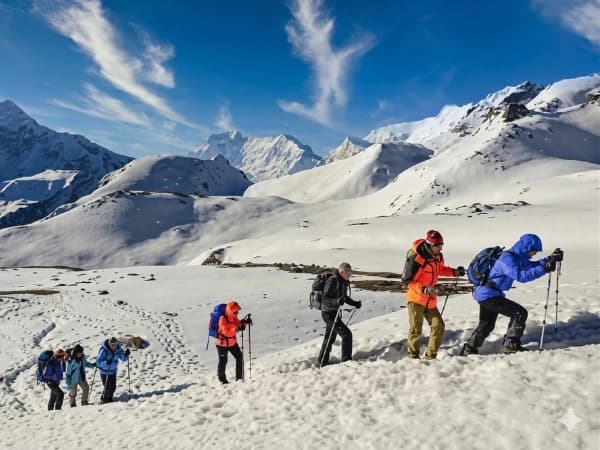
Annapurna Circuit in May 2027: Heat, Haze, Thorong La and the Monsoon Risk
What the Annapurna Circuit is like in May: heat and haze low down, afternoon cloud, Thorong La conditions, when the monsoon can arrive, the latest sensible start date and 2027 prices.
Read More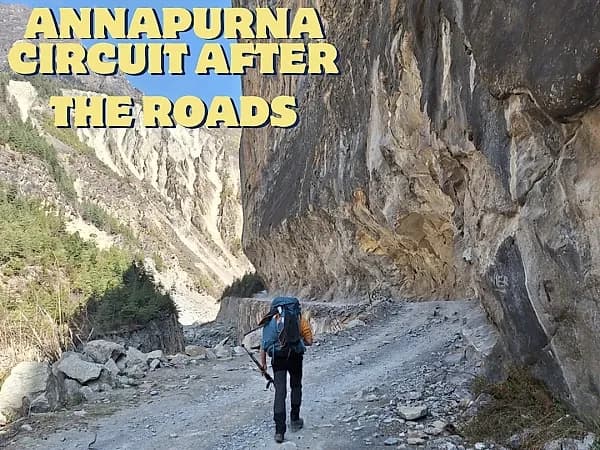
Annapurna Circuit in April 2027: Weather, Thorong La and Flowers
What April 2027 is like on the Annapurna Circuit: station temperatures, Thorong La conditions, rhododendron timing, crowds, Nepali New Year on 14 April, packing and prices.
Read More
Upper Mustang Itinerary: 10, 12 or 14 Days? What Each Extra Day Adds for 2027
Our live 10-day Upper Mustang itinerary day by day, plus suggested 12 and 14 day outlines, with the USD 50 a day permit worked out for each length.
Read More Chat with Shreejan