

Mera Peak is the highest trekking peak in Nepal at 6,476 metres, and it is regularly marketed as a peak that beginners can climb. That claim is mostly true, but it needs context. Mera is not technically difficult. There are no ice walls, no exposed ridges, and no sections where you need previous climbing skills. What Mera demands is physical endurance, tolerance for extreme altitude, and the mental toughness to keep walking uphill for ten to twelve hours on summit day when the air has half the oxygen you are used to.
I have booked dozens of first-time climbers onto Mera Peak and heard their stories when they returned. Most summited. Some did not. The difference was almost always preparation, not talent. Here is an honest assessment of what it takes.
What Makes Mera Peak "Beginner-Friendly"
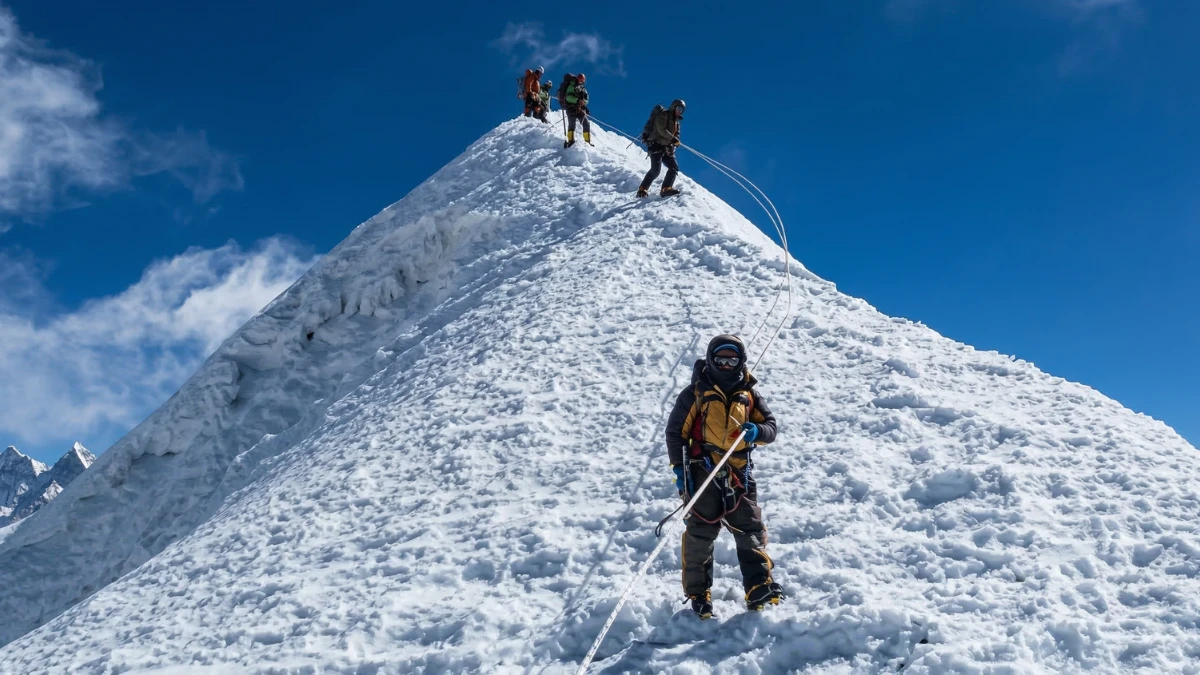
Mera Peak is graded F (facile, or "easy") on the Alpine grading scale. In mountaineering terms, this means the route involves glacier travel on moderate slopes with no steep ice sections, no technical rock climbing, and no exposed ridges requiring rope work beyond basic glacier roping.
In practical terms:
- You walk in crampons on snow. The angle is gentle to moderate. If you can walk uphill, you can walk in crampons on Mera's slopes.
- You are roped to your Sherpa on the glacier. This is for crevasse safety, not because the terrain requires technical rope skills.
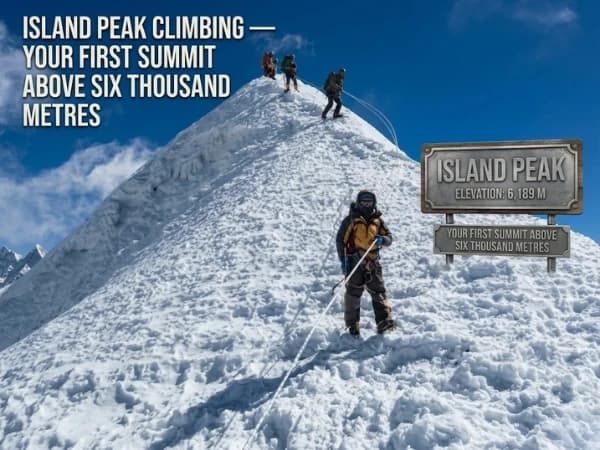
- There is no headwall or steep ice. Unlike Island Peak, which has a 45 to 60-degree ice face, Mera's summit approach is a long, gradual snow slope.
- Your climbing Sherpa teaches you everything. At Khare (5,045 metres), you spend a full acclimatisation and training day practising crampon walking, rope handling, and ice axe use. No previous experience needed.
The "easy" grading is relative to the Alpine scale, which was designed by experienced mountaineers. For a person who has never worn crampons, never slept above 4,000 metres, and never walked for twelve hours without stopping, Mera Peak is hard. It is the easiest 6,000-metre peak in Nepal, but it is still a 6,000-metre peak.
What Experience Do You Need to Climb Mera Peak?
Fitness: This is the single most important factor. Mera's summit day is a ten to twelve-hour round trip from high camp at 5,800 metres to the summit at 6,476 metres and back. You are walking continuously in thin air, through snow, uphill, in crampons, in the dark (you start around midnight). Your cardiovascular fitness needs to sustain this effort.
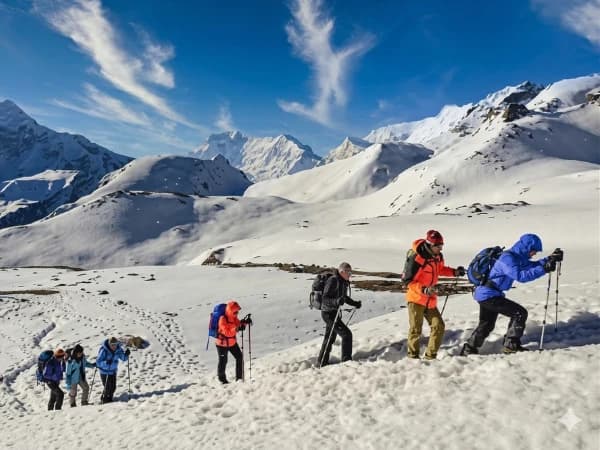
The approach trek through the Hinku Valley requires five to seven hours of walking per day over rough terrain for seven days before you even reach base camp. By the time you attempt the summit, you have already trekked for a week at altitude.
Previous trek itself: Strongly recommended but not strictly required. If you have completed a multi-day trek before (particularly at altitude), you know what your body does over several days of sustained walking. You know how your appetite, sleep, and energy change. This self-knowledge is valuable on Mera. If your longest previous walk is a day hike, consider doing a trek like Annapurna Base Camp or Langtang Valley first.
Previous climbing experience: Not required. Everything you need to know for Mera is taught at base camp. The route is technically simple enough that the training session and your Sherpa's guidance are sufficient.
Mental resilience: Summit day starts at midnight in minus 15 to minus 25 Celsius. You climb by headlamp for four to five hours before dawn. Your body is exhausted. Your brain is oxygen-deprived. Every step requires conscious effort. The people who summit Mera are not necessarily the fittest. They are the ones who keep moving when their body says stop.
How to Train: A 12-Week Plan
Start training at least three months before departure. Here is a realistic plan:
Weeks 1-4: Build your base.
- Walk or hike three to four times per week, building from 5 km to 10 km per session
- Include hills or stairs whenever possible. Flat walking does not prepare you for Nepal terrain.
- Add a loaded pack (8 to 10 kg) on at least one walk per week
- Two strength sessions per week: squats, lunges, step-ups, planks
Weeks 5-8: Build endurance.
- Extend your longest weekly walk to 15 km with 500+ metres of elevation gain
- Increase pack weight to 12 to 15 kg
- Add one longer session per week: five to six hours of continuous walking
- Continue strength work twice per week
Weeks 9-12: Peak and taper.
- Your longest session should reach six to eight hours with a loaded pack over hilly terrain
- Walk on consecutive days at least twice to simulate multi-day trekking fatigue
- Final week: reduce volume by 50 percent. Arrive in Nepal rested, not tired.
If you do not have hills near home, stair climbing with a weighted pack is the best substitute. Twenty to thirty floors of stairs with 10 kg is an excellent workout. Running helps general fitness but does not replicate the sustained low-intensity effort that altitude trekking requires.
How Hard Is Mera Peak for a Beginner?
Mera Peak's summit stands at 6,476 metres. At this altitude, you have roughly 45 percent of the oxygen available at sea level. No gym can prepare your body for this. The only effective preparation is gradual acclimatisation on the approach.
The fourteen-day itinerary builds altitude gradually:
- Days 1-3: Lukla (2,860m) to Pangkoma (3,200m)
- Days 4-6: Kothe (3,600m) to Thaknak (4,350m)
- Day 7: Khare (5,045m), high camp for training
- Day 8: Acclimatisation and climbing training at Khare
- Day 9: Mera High Camp (5,800m)
- Day 10: Summit push (6,476m) and descent
The schedule gives your body eight days of progressive altitude gain before the summit attempt. Two natural acclimatisation days (at Kothe/Thaknak and at Khare) follow the "climb high, sleep low" principle. Our guides carry pulse oximeters and monitor oxygen saturation daily. If your body is not adjusting, you spend an extra day acclimatising before continuing. Read our altitude sickness guide for prevention strategies.
What Is the Success Rate on Mera Peak?
Mera Peak is one of the more forgiving 6,000-metre peaks in Nepal. With experienced operators and well-prepared climbers:
- Overall: most well-prepared, well-acclimatised climbers reach the summit in settled weather
- With optimal preparation and weather: some operators report above 90 percent
- Poorly prepared climbers: the chance of reaching the summit drops sharply
The main reasons people do not summit: altitude sickness (the body simply does not acclimatise well enough), exhaustion on summit day (fitness was insufficient), and weather (high winds or whiteout conditions force a turnaround). Of these, fitness is the only one you can control. Train properly and your chances are excellent.
What Climbing Gear Does The Everest Holiday Provide?
Every tier of our Mera Peak expedition includes all climbing gear (crampons, ice axe, harness, ropes, helmet), a licensed trekking guide, and an expedition-qualified climbing Sherpa. We also provide duffel bags and down jackets at no extra charge. If you need a sleeping bag or other gear, we help you buy quality items affordably in Kathmandu before departure.
The Hinku Valley: Why the Approach Matters
Unlike Island Peak, which follows the crowded Everest Base Camp trail, Mera Peak's approach goes through the Hinku Valley, one of the most remote and beautiful valleys in the Khumbu region. You fly to Lukla like all Everest trekkers, but instead of turning north towards Namche, you head south and east into a valley that very few people visit.
Within a day of leaving Lukla, you leave the crowds behind entirely. The trail passes through dense rhododendron forest, crosses high ridges with views of Everest and Makalu, and descends into alpine meadows where yaks graze beside glacial streams. The Hinku Valley has no permanent settlements above Kothe, and the teahouses are smaller and simpler than on the main Everest trail.
Many climbers say the Hinku Valley approach is the highlight of the trip, sometimes even more than the summit. It gives you the remote, wild Nepal trip that the busy Everest corridor cannot offer. If solitude and wilderness matter to you, this is a significant advantage over Island Peak.
What Should You Pack for Mera Peak?
We provide all climbing gear free, along with a sleeping bag and down jacket on every tier and a duffel bag on the Standard and Luxury packages. You need to bring or buy:
- Trekking boots: Must be sturdy enough for crampon attachment. Break them in well before departure.
- Thermal base layers: Merino wool is ideal. Two sets so one can dry.
- Warm gloves and hat: Your extremities suffer most at altitude. Budget gloves are not enough above 5,000 metres.
- Headlamp with spare batteries: Summit day starts at midnight. Cold drains batteries fast.
- Sunglasses with side shields: Glacier glare causes snow blindness. Category 4 lenses.
- Sunscreen SPF 50+: UV at 6,000 metres burns in minutes.
If you are missing anything, we help you buy quality items affordably in Kathmandu's Thamel district before departure. Read our packing guide for the full checklist.
When Is the Best Time to Climb Mera Peak?
Mera Peak has two climbing seasons:
- Autumn (September to November): Clearest skies, most stable weather, the best odds of a summit. October is the single best month. This is also the busiest season, though "busy" on Mera means you might see two or three other groups in the entire Hinku Valley.
- Spring (March to May): Warmer temperatures, rhododendron blooms on the approach, slightly more cloud cover. April and May are best. Generally quieter than autumn.
Avoid monsoon (June to August) and deep winter (December to February). For seasonal planning across all Nepal treks, see our best time to trek guide.
How Much Does Mera Peak Cost for a Beginner?
Our fourteen-day Mera Peak expedition: Budget 3,499 USD, Standard 4,999 USD, Luxury 9,999 USD. All tiers include climbing gear, permits, guide, and Sherpa. Those are per-person figures for a group of one to four, and they step down with group size to 2,999 USD on the Budget tier for thirteen climbers or more. Add roughly 1,200 to 2,000 USD for international flights, visa, insurance, tips, and personal spending, which puts the all-in figure somewhere between about 4,700 USD on Budget and 12,000 USD on Luxury, depending on where you fly from. For a detailed comparison with Island Peak, read our Mera Peak vs Island Peak guide.
What Can You See from the Summit of Mera Peak?
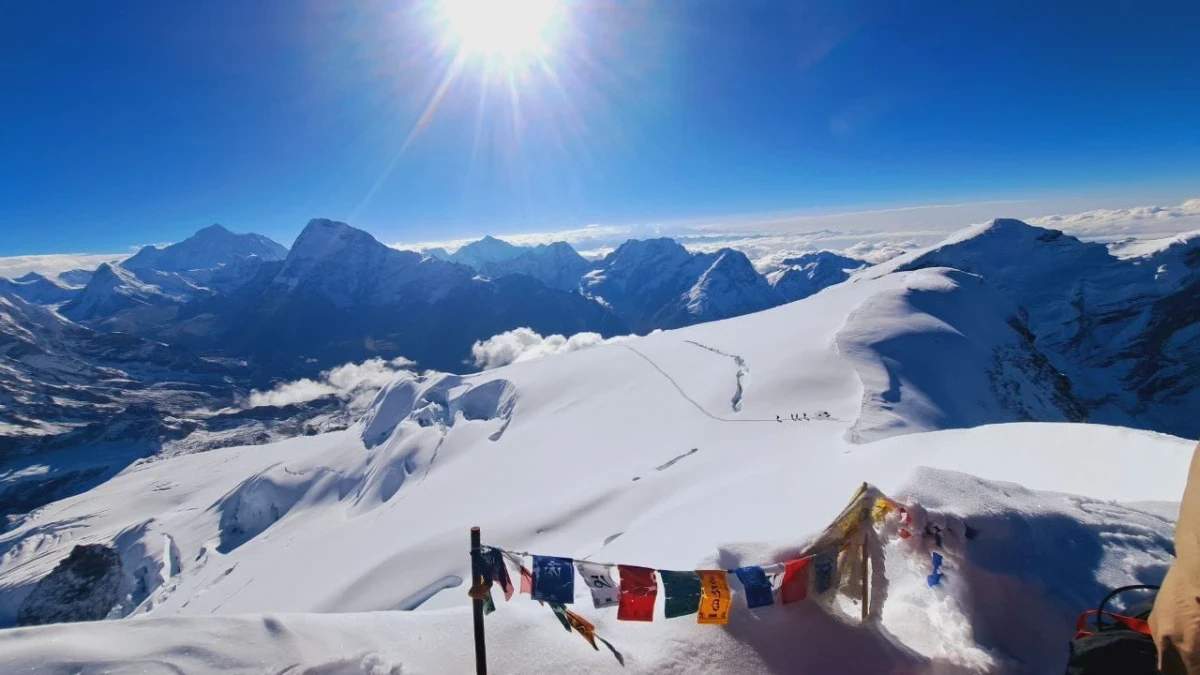
This is what makes the effort worth it. Mera Peak's summit offers arguably the best view in the Himalayas. On a clear day, you see five of the world's fourteen 8,000-metre peaks: Everest (8,849m), Lhotse (8,516m), Makalu (8,485m), Cho Oyu (8,188m), and Kangchenjunga (8,586m). The view stretches from eastern Nepal to the Tibetan Plateau. The scale is difficult to comprehend until you are standing there.
Most summit days arrive at the top around dawn. The peaks catch the first light while you stand above the cloud layer in perfect silence. Every first-time climber I have spoken to describes this moment as one of the most powerful experiences of their life.
Common Questions About Climbing Mera Peak
Is Mera Peak dangerous?
All high-altitude mountains carry risk. The main dangers on Mera are altitude sickness, crevasses on the glacier (mitigated by roping to your Sherpa), and weather. Mera has a strong safety record compared to other 6,000-metre peaks because the route is non-technical and well-established. Our guides carry first aid kits, pulse oximeters, Diamox, and emergency oxygen.
How cold does it get?
At high camp (5,800m), nighttime temperatures drop to minus 15 to minus 25 Celsius. On summit day before dawn, wind chill can make it feel significantly colder. We provide down jackets free of charge. You need warm base layers, insulated gloves, and a balaclava or face covering for the summit push.
Can I do Mera Peak if I am over 50?
Yes. Climbers in their sixties and seventies have summited Mera. Fitness matters far more than age. Train for at least four months, get a medical check from your doctor, and be honest with yourself about your cardiovascular capacity. Our guides monitor every climber daily.
What if the weather prevents a summit attempt?
The itinerary includes one weather buffer day. If both the planned summit day and buffer day have unsafe conditions (rare but possible), the expedition returns without a summit. We offer partial credit toward a future expedition in these cases.
Is Mera easier than Island Peak?
Yes, technically. Mera has no steep ice wall or exposed ridge. Summit chances are generally better. However, Mera is higher (6,476m vs 6,165m), which means more altitude exposure. For a full comparison, read our comparison guide.
Why Climb Mera Peak With Us?
- Over 300 reviews, 4.9-star TripAdvisor rating
- Expedition-qualified climbing Sherpas with mountaineering degrees
- All climbing gear included in every tier
- Duffel bags and down jackets provided free
- Private expeditions only
- TAAN member (#1586)
- Every booking supports the Nagarjun Learning Center
Thinking about Mera Peak? WhatsApp us at +977 9810351300 with your fitness background and I will give you an honest assessment of if you are ready.
View Mera Peak expedition details and book
Beginner Mera? With our training plan, yes. Our Mera Peak Climbing (14 Days) is private (your group only, no strangers), 2027 dates open, From USD $3499. WhatsApp us for tailored 2027 dates and current departures.
 Chat with Shreejan