

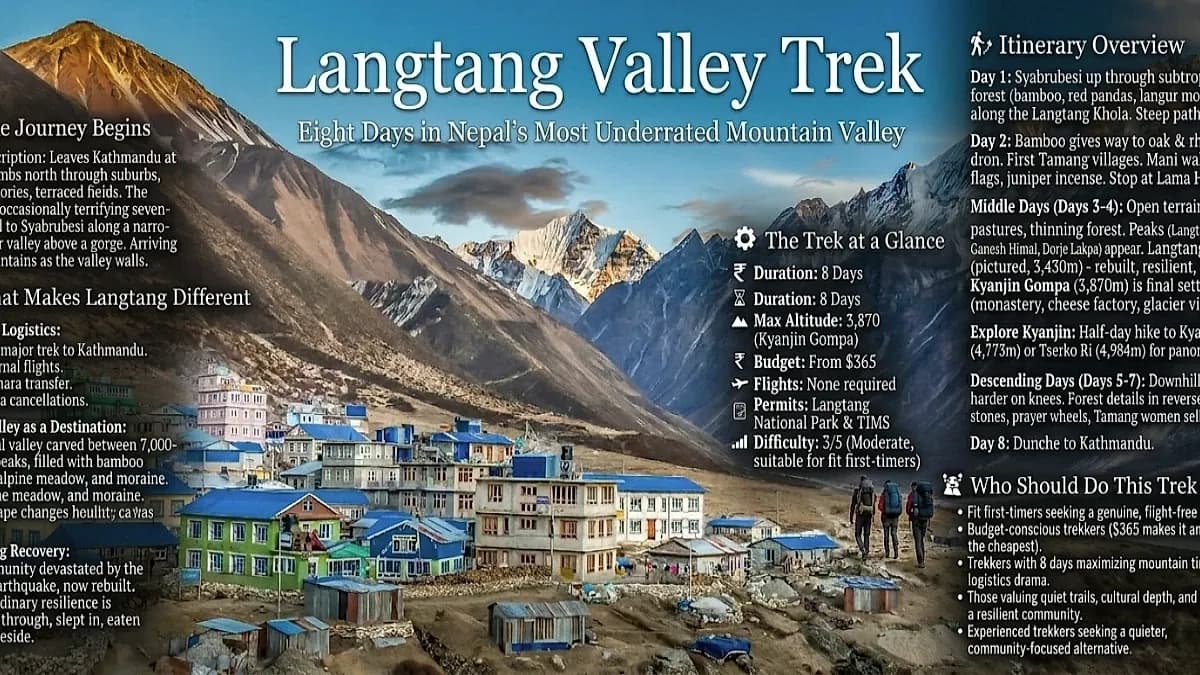
The bus leaves Kathmandu at six in the morning. It climbs north through the city's outer suburbs, past brick factories and terraced fields, and enters the road to Syabrubesi, a winding, occasionally terrifying seven-hour journey along a river valley that narrows as it climbs until the road is carved into a cliff face above a gorge so deep the river below is a white thread of sound.
No flight. No cancellation risk. No pre-dawn drive to a remote airport. Just a bus, a road, and mountains that grow larger with every hairpin turn. By the time you step off at Syabrubesi and shoulder your pack, the Himalayas are not a distant horizon. They are the walls of the valley you are about to enter.
This is how the Langtang Valley trek begins, without fanfare, without logistics drama, without the industry machinery that surrounds Everest and Annapurna. You drive from the capital. You walk into the mountains. And for the next eight days, those mountains give you everything they have.
What makes the Langtang Valley trek unique compared to other Nepal treks?
Langtang is the closest major trek to Kathmandu. No internal flights. No Pokhara transfer. No Lukla cancellations. You leave the capital in the morning and start trekking the same day. This simplicity, logistical, financial, temporal, is the first of Langtang's quiet advantages.
The second is the valley itself. Langtang is not a corridor to a famous destination. It is the destination, a glacial valley carved between 7,000-metre peaks, filled with bamboo forest at the bottom, alpine meadow in the middle, and moraine and ice at the head. The walking is not toward a specific point but through a landscape that changes with every hour of altitude gained.
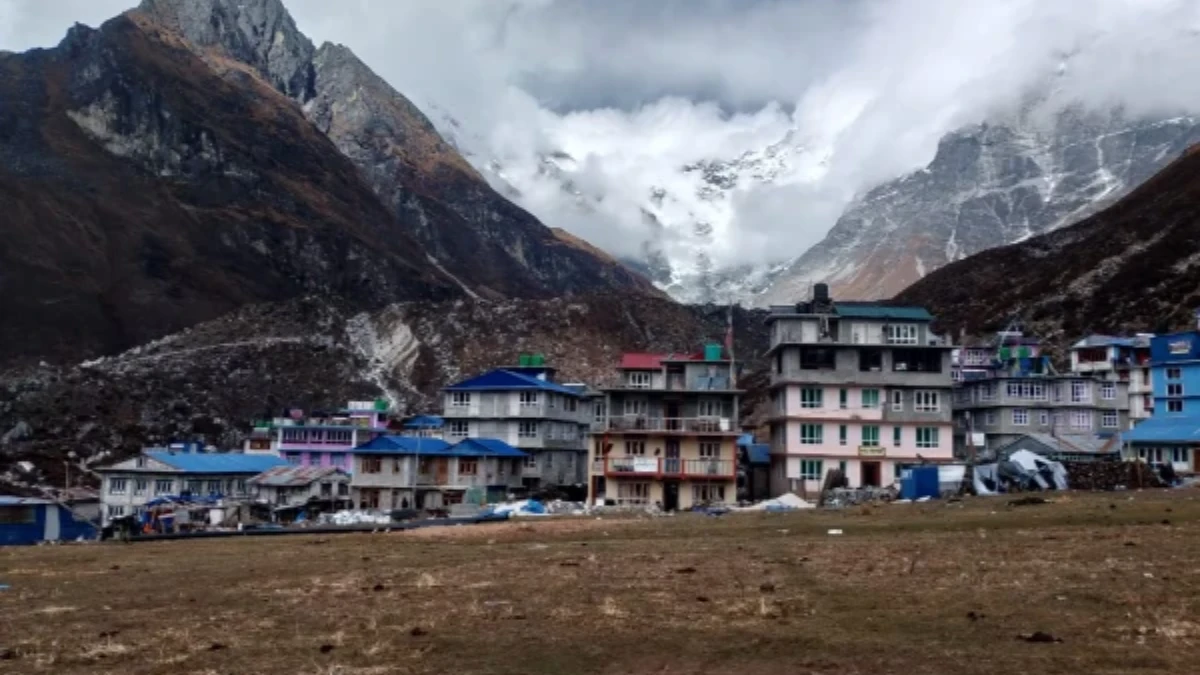
The third is the people. The Tamang and Tibetan Buddhist communities along the Langtang trail were devastated by the 2015 earthquake, the village of Langtang itself was buried by a massive landslide that killed over two hundred people. The rebuilding has been extraordinary. New lodges and homes stand where rubble lay. Prayer flags stretch across reconstructed monasteries. The community's resilience is not a story you read about. It is something you walk through, sleep in, eat beside, and carry away as one of the most profound human experiences available on any trekking trail.
The Trek at a Glance
Eight days. Maximum altitude 3,870 metres at Kyanjin Gompa. Budget from three hundred and sixty-five dollars. No internal flights. Permits: Langtang National Park entry and TIMS. Difficulty three out of five, moderate, suitable for fit first-timers.
What Is the Langtang Valley Trail Like?
The first day walks from Syabrubesi up through subtropical forest along the Langtang Khola river. The trail is steep in places, winding through bamboo groves where red pandas live and langur monkeys swing between branches. The sound of water is constant, the river below, streams crossing the path, waterfalls dropping from cliffs above.
By the second day the bamboo gives way to oak and rhododendron. The valley widens slightly. The first Tamang villages appear, stone houses with prayer flags on the roofs, mani walls along the trail, and the smell of juniper incense drifting from household shrines. Lama Hotel, despite its name, a collection of simple teahouses rather than a hotel, is the common first-night stop.
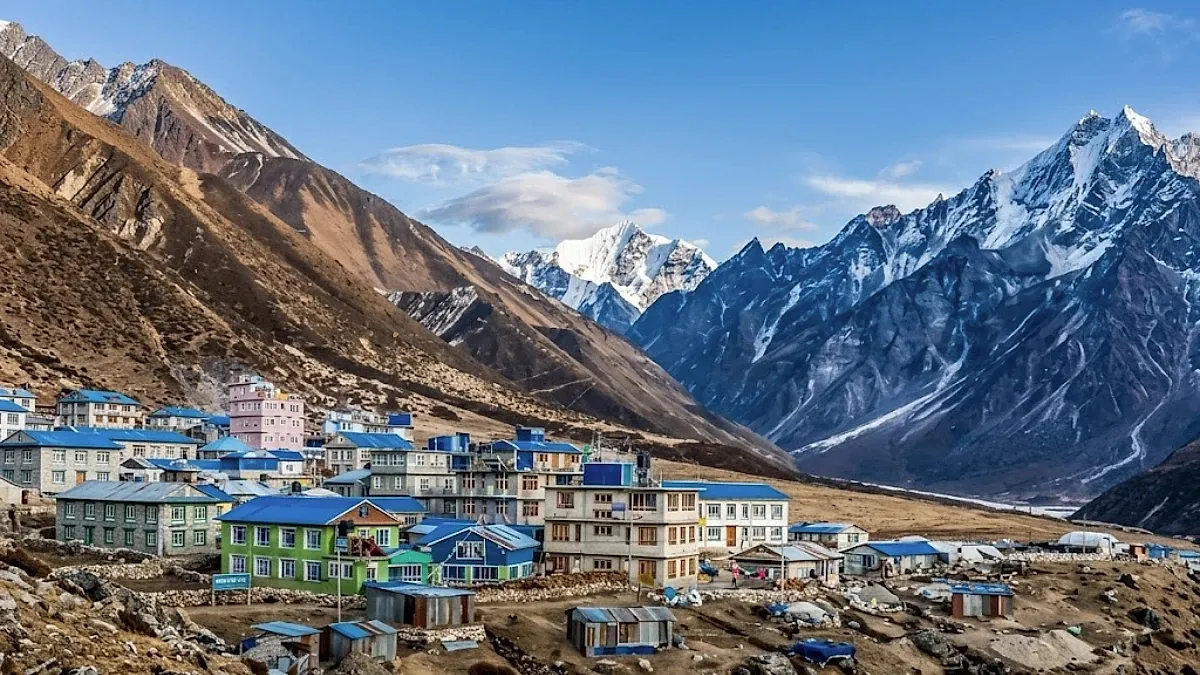
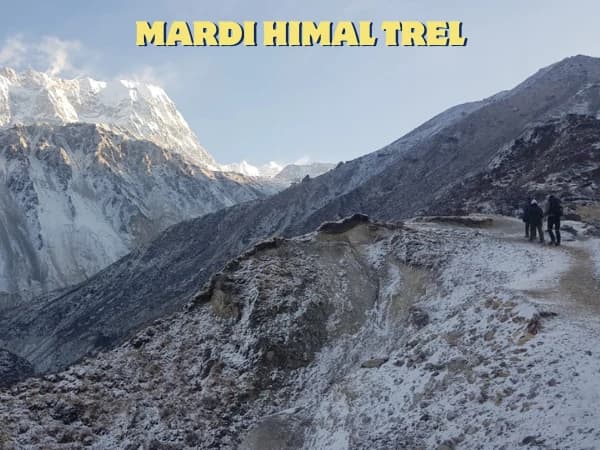
The middle days climb through progressively more open terrain. The forest thins. Yak pastures replace farmland. The peaks, Langtang Lirung at 7,227 metres, Ganesh Himal, Dorje Lakpa, appear above the valley walls with increasing drama as the trees fall away. Langtang Village, rebuilt, resilient, quietly beautiful, sits at 3,430 metres with views up and down the valley that feel like a painting you have walked into.
Kyanjin Gompa at 3,870 metres is the final settlement. A small monastery. A cheese factory established with Swiss assistance decades ago. A handful of lodges. And the glacier, the Langtang Glacier, filling the head of the valley with ice that creaks and shifts and sends meltwater cascading through polished stone channels that have been worn smooth by a thousand years of flow.
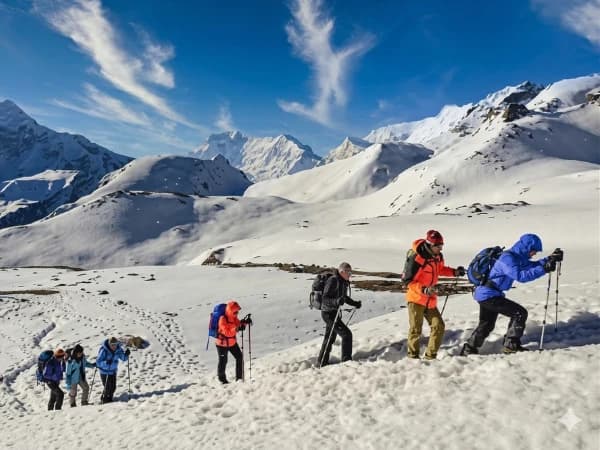
From Kyanjin Gompa, a half-day hike to Kyanjin Ri at 4,773 metres or Tserko Ri at 4,984 metres provides panoramic views of the entire Langtang range, a reward that requires effort but no technical skill.
The return follows the same trail, downhill, faster, easier on the lungs but harder on the knees. The forest that you climbed through on the way up passes in reverse, and the details you missed while gasping uphill reveal themselves on the descent, the carved mani stones, the prayer wheels, the faces of the Tamang women selling yak cheese by the roadside. Related: Ten Treks in Nepal That Will Change How You See the World.
Is Langtang Valley safe to trek after the 2015 earthquake?
On the 25th of April 2015, a 7.8-magnitude earthquake struck Nepal. In the Langtang Valley, the shaking triggered a massive avalanche and landslide that buried the village of Langtang under millions of tonnes of rock and ice. Over two hundred people died, residents, trekkers, guides. The village ceased to exist.
Walking through the rebuilt Langtang today is a profound experience. The memorial stones listing the names of the dead. The new lodges standing where the old village was buried. The families who lost everything and chose to stay, to rebuild, to welcome trekkers back to a valley that had taken so much from them.
This is not tragedy tourism. The people of Langtang do not want pity. They want visitors. They want the economic activity that trekking provides. They want the world to know that their valley is open, their hospitality is intact, and their mountains are as beautiful as they ever were. Trekking in Langtang is not just a walk through a pretty valley. It is an act of participation in a community's recovery, and the community makes sure you know it, not through speeches or signs but through the warmth of their welcome and the quality of the dal bhat they set before you honestly.
Is the Langtang Valley trek suitable for beginners and first-timers?
First-time trekkers who want a genuine Himalayan experience at moderate altitude without flights. Budget trekkers, at three hundred and sixty-five dollars, Langtang is among the cheapest multi-day treks in Nepal. Trekkers with eight days who want to maximise mountain time without the logistical overhead of Everest or Annapurna. Anyone who values quiet trails, cultural depth, and the knowledge that their presence directly supports a community that has rebuilt itself from destruction.
And anyone who has been to Everest Base Camp or Annapurna and wants to see what Nepal looks like when the trail is not a highway, when the mountains are just as tall but the crowd is a handful of trekkers sharing a dining room stove, the village is a living community rather than a service station, and the silence at four thousand metres is so complete that you can hear the glacier moving.
See the full itinerary on our Langtang Trek (8 days) page. For a longer route, the Langtang Gosaikunda Trek (13 days) adds the sacred lakes.
Eight days in Langtang is eight days in Nepal's most underrated valley. The earthquake devastated it. The people rebuilt it. Trekking here now supports families who lost everything and shows them that the world has not forgotten. The views are world-class, the cheese factory at Kyanjin Gompa is charming, and the welcome you receive is warmer than anywhere else in Nepal.
See our Langtang Valley Trek.
WhatsApp:+977 9810351300
Email:[email protected]
Written by Shreejan Simkhada, CEO of The Everest Holiday and third-generation Himalayan guide. TAAN Member #1586.
Langtang Valley 8-day is the most underrated trek. Our Langtang Trek (8 Days) is private (your group only, no strangers), 2027 dates open, From USD $365. WhatsApp us for tailored 2027 dates and current departures.
 Chat with Shreejan