

This is the question I hear from about half the people who enquire about Island Peak: can I actually do this with no climbing experience? The short answer is yes, but with conditions. Island Peak is not a walk. It is a real mountain with real risks, and understanding what you are signing up for matters more than any amount of enthusiasm.
Here is an honest assessment of what it takes to climb Island Peak as a beginner, from someone who has booked dozens of first-time climbers onto this expedition and heard what they said when they came back down.
| Island Peak at a glance | |
|---|---|
| Summit | 6,189 m (Imja Tse) |
| Alpine grade | PD (not very difficult) |
| Trip length | 14 days |
| Technical sections | Glacier, ~45–60° fixed-rope headwall, exposed summit ridge |
| Prior experience | None needed, taught at base camp |
| Summit chances | Good for well-prepared climbers; depends on weather and comfort on the headwall |
| Best seasons | Oct–Nov, Apr–May |
| From price | USD 3,499 Budget; 13+ climbers from USD 2,999 |
What "Beginner" Actually Means
When we say Island Peak is suitable for beginners, we mean beginners to climbing, not beginners to physical activity. You do not need previous mountaineering experience. You do not need to have climbed anything with ropes or crampons before. You do not need to know how to use an ice axe.
What you do need is a solid level of cardiovascular fitness, the ability to walk five to eight hours per day for a week over rough terrain at altitude, and the mental resilience to keep moving when your body is telling you to stop. If you have done multi-day treks before, particularly at altitude, you are starting from a good position. If your most demanding physical activity is a weekly jog around a park, you need several months of serious training first.
How Hard Is Island Peak, Really?
Island Peak is graded PD (peu difficile, or "not very difficult") on the Alpine grading scale. That sounds reassuring until you remember that this grading system was designed by alpinists who consider anything below "very difficult" to be straightforward. For a non-climber, Island Peak is genuinely hard.
The climb breaks into three distinct sections, each with its own challenge:
Section 1: The Trek (8 days). The approach follows the classic Everest Base Camp trail through Namche Bazaar, Tengboche, and Dingboche. This section is trekking, not climbing. The trail is well-established, teahouses provide accommodation, and the altitude gain is gradual with built-in acclimatisation days. If you have trekked in Nepal before, this part will feel familiar.
Section 2: Base Camp to High Camp. From Chhukung (4,730 metres), you trek to Island Peak Base Camp at 5,087 metres. The terrain changes from trails to moraine, loose rock, and glacier. You camp here, and your climbing Sherpa runs through basic rope skills, crampon use, and ice axe technique. This training session is essential. Pay attention, practise every movement, and ask questions.
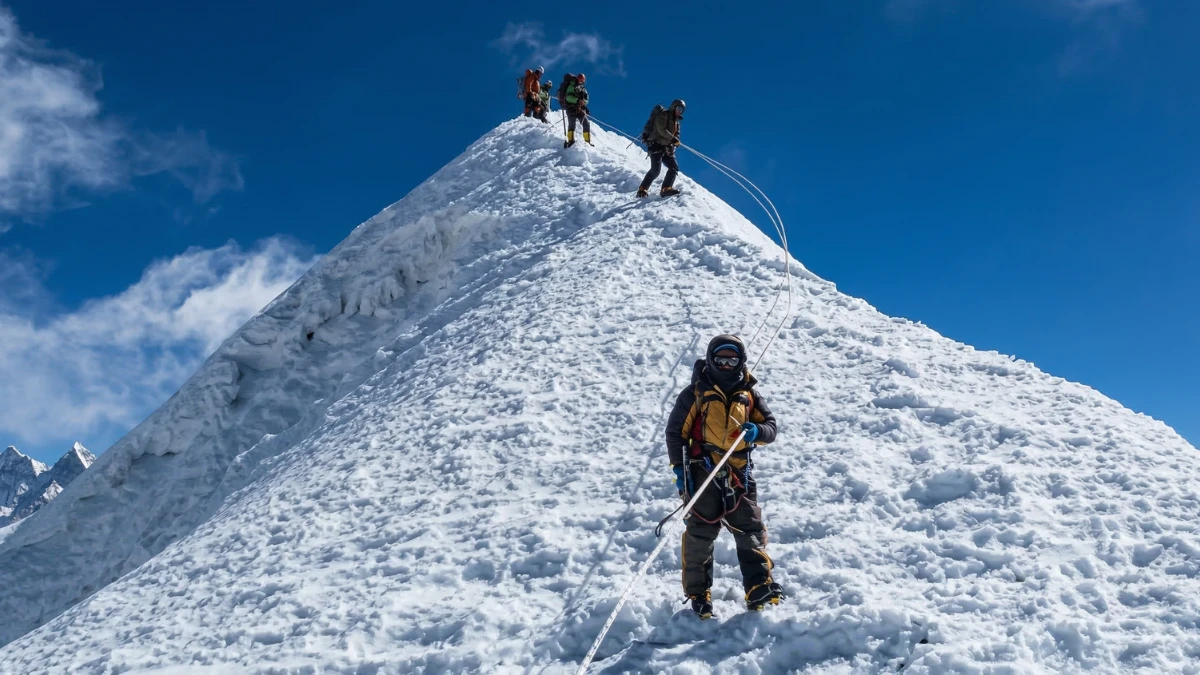
Section 3: Summit Day. You leave camp around midnight and climb through the dark. The first section crosses a glacier with crevasses (you are roped to your Sherpa). Then comes the headwall: a steep ice face of roughly 45 to 60 degrees that you ascend on fixed ropes using a jumar (ascender device) and crampons. At the top, a narrow, exposed summit ridge leads to the peak at 6,189 metres. The ridge has drops on both sides and requires focus and confidence.
Summit day takes eight to twelve hours round trip. It is the hardest single day most first-time climbers have ever experienced. Related: Is Island Peak Dangerous? Deaths, Risks, and Safety (Honest Guide).
What Skills Do You Need?
None before you arrive. All technical skills are taught by your expedition climbing Sherpa during the training session at base camp or on the glacier below. You will learn:
- Walking in crampons on ice and hard snow. This feels strange at first but becomes natural within an hour of practice.
- Using a jumar (mechanical ascender) on fixed ropes. This is how you climb the headwall. You clip the jumar onto the rope, slide it up, step up, repeat.
- Basic ice axe use for balance and self-arrest (stopping a fall).
- Moving while roped to your Sherpa across glacier terrain.
You do not need to master these skills. You need to be comfortable enough with them that your brain does not fight the equipment on summit day. The Sherpa is roped to you throughout and guides every step of the technical sections. Related: Island Peak Climbing: Your First Summit Above Six Thousand Metres.
How do I train for an Island Peak climb?
Start training at least three months before your departure. Four to five months is better if you are starting from a low fitness base. Your training should focus on three areas:
Cardiovascular endurance. Long walks with elevation gain are the single best preparation. If you have hills near your home, walk them with a 10 to 15 kilogram pack, three to four times per week. Build up to six-hour hill walks by month three. If you do not have hills, stair climbing with a pack is an effective substitute. Running helps general fitness but does not replicate the sustained low-intensity effort that trekking and climbing require.
Leg strength. Squats, lunges, and step-ups. The descent from the summit is harder on your legs than the ascent, and tired legs on the exposed ridge are a safety risk. Aim for three strength sessions per week.
Upper body and core. The headwall section requires pulling yourself up fixed ropes using your arms and shoulders. If you cannot do ten pull-ups, work on building that capacity. Planks and core exercises help with balance on uneven terrain and the summit ridge.
Previous trekking stay at altitude is strongly recommended. If you have never been above 4,000 metres, consider doing a trek like Annapurna Base Camp or Langtang Valley first. This builds confidence with altitude, teahouse culture, and multi-day walking before adding climbing on top.
How Hard Is Island Peak for a Beginner?
Island Peak's summit stands at 6,189 metres. Island Peak, or Imja Tse, is one of the trekking peaks officially recognised by the Nepal Mountaineering Association. At this altitude, you have roughly half the oxygen available at sea level. No amount of gym training prepares your body for this. The only effective preparation is gradual acclimatisation on the approach trek.
The fourteen-day itinerary includes two full acclimatisation days: one at Namche Bazaar (3,440 metres) and one at Dingboche (4,410 metres). These days are not rest days. You hike to a higher point, then descend to sleep. This "climb high, sleep low" pattern is how your body adjusts.
Some people acclimatise easily. Others struggle. There is a genetic component you cannot control. What you can control is your pace (slow and steady), your hydration (three to four litres per day), and your willingness to descend if symptoms become serious. Our guides carry pulse oximeters and monitor every climber daily. If your oxygen saturation drops too low or you show signs of HACE or HAPE, you go down. No argument.
Read our altitude sickness prevention guide for detailed advice on what to watch for and what to do.
What is included in your Island Peak expedition?
All climbing gear is included in every tier of our Island Peak expedition: ropes, harness, crampons, ice axe, helmet, and carabiners. We also provide duffel bags and down jackets at no extra charge. If you need a sleeping bag or any other trekking gear, we help you buy quality items affordably in Kathmandu before departure.
Your expedition team includes a licensed trekking guide and a qualified climbing Sherpa. The Sherpa is roped to you on the glacier and headwall sections and stays with you for the entire summit push.
What Is the Success Rate for First-Time Climbers?
Well-prepared climbers with experienced operators do well on Island Peak. For beginners specifically, the odds are a little lower because the headwall and summit ridge create a mental barrier that fitness alone does not overcome. Some first-timers reach the base of the headwall, look up at the steep ice, and decide they are not comfortable continuing. That is a completely valid decision.
The factors that most influence success for beginners:
- Fitness preparation. Under-trained climbers run out of energy before the summit.
- Acclimatisation. Rushing the approach increases altitude sickness risk significantly.
- Weather. High winds or fresh snow on the ridge can force a turnaround regardless of fitness.
- Mental readiness. The exposed ridge is not technically difficult, but it requires confidence and composure. If heights make you freeze, Island Peak is the wrong first climb.
If you summit, you join a relatively small group of people who have stood above 6,000 metres. If you do not summit, you still trekked the Everest trail and attempted a Himalayan peak. Neither outcome is failure.
Is Island Peak or Mera Peak better for beginners?
If the headwall section concerns you, consider Mera Peak as your first 6,000-metre summit instead. Mera is higher (6,476 metres) but less technical. There is no steep ice wall, no exposed ridge, and the route is primarily a high-altitude snow walk. Summit chances are generally better, and the approach through the remote Hinku Valley offers solitude that Island Peak's busy Everest trail does not.
For a full comparison, read our Mera Peak vs Island Peak guide.
How much does it cost to climb Island Peak?
Our Island Peak expedition (fourteen days) starts at 3,499 USD for Budget tier, 4,999 USD for Standard, and 9,999 USD for Luxury. All tiers include climbing gear, permits, Sherpa, and guide. Standard adds all meals, porter, and private transport. Those are per-person figures for a group of one to four and they step down above that, to 2,999 USD on the Budget tier for thirteen climbers or more. Kathmandu hotel nights sit outside all three tiers and are quoted separately. For a complete budget breakdown, see our Island Peak page.
Add roughly 1,000 to 1,800 USD for international flights, visa, insurance, tips, and personal spending, which puts a realistic all-in figure from the UK at about 4,500 to 5,300 USD on the Budget tier.
What is summit day on Island Peak like?
Nobody tells you this part in the brochure. You wake up at midnight in a tent at 5,087 metres. It is minus fifteen outside. Your headlamp cuts a small circle of light in complete darkness. You eat a few biscuits and drink hot tea that your Sherpa prepared, but your appetite is gone at this altitude. Then you start walking.
The first two hours cross the glacier. You cannot see much beyond your headlamp beam and the person in front of you. The crunch of crampons on ice is the only sound. Your breathing is loud and laboured. Every thirty steps you stop and rest. This is normal at 5,500 metres.
Then the headwall appears above you, a dark wall of ice illuminated by the headlamps of climbers already on it. You clip your jumar onto the fixed rope, plant your crampons, and start ascending. The angle feels steep. Your arms work hard. Your Sherpa is directly below you, calm, encouraging, watching every step. This section takes one to two hours depending on your pace and the queue.
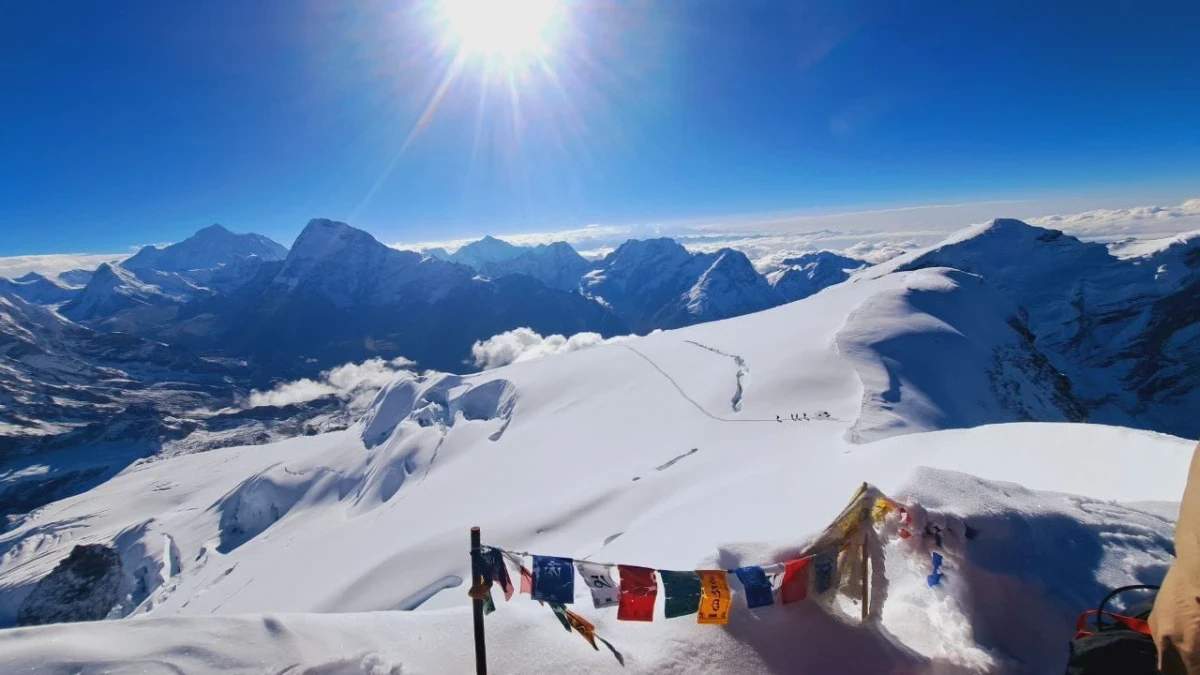
At the top of the headwall, the summit ridge stretches ahead. Dawn is breaking. The Lhotse south face glows pink above you. Ama Dablam rises to the west. You can see the Khumbu Glacier far below. The ridge is narrow but not knife-edge. You place each foot carefully, your Sherpa right behind you, and then suddenly there is nowhere higher to go. You are standing at 6,189 metres.
Most first-time climbers describe the descent as harder than the ascent. Your legs are tired, the steep sections require careful footwork, and the altitude has been working on your body for twelve hours. Take your time. The mountain is not going anywhere.
When is the best time to climb Island Peak?
The optimal climbing windows are October to November (autumn) and April to May (spring). Autumn offers the clearest skies and most stable weather. Spring is warmer but slightly more precipitation. Both seasons give well-prepared climbers their best chance of a summit.
Avoid December through February (extreme cold at altitude makes the headwall dangerous) and June through August (monsoon brings heavy snow and poor visibility). For seasonal planning, see our best time to trek guide.
Should a beginner attempt Island Peak?
Can a beginner climb Island Peak? Yes, if you train seriously for three to five months, acclimatise properly on the approach, and are mentally prepared for the exposed sections. It is not a casual adventure. It is a genuine mountaineering experience compressed into a format that first-timers can access with the right support.
If you are considering it, message us. I will ask about your fitness background, trekking experience, and timeline, and give you an honest assessment of whether Island Peak is right for you right now or whether you would benefit from a high-altitude trek first.
View our Island Peak expedition and secure your spot
Can a beginner climb Island Peak? Yes, with the right preparation and the right guide. You do not need prior climbing experience, but you do need cardiovascular fitness, comfort with heights, and the discipline to follow your guide's instructions on the summit ridge. The technical sections are short but real: crampons, fixed ropes, and exposed ridgeline. A good guide makes the difference between summiting and turning back.
Ask us about our Island Peak packages and we will honestly assess if you are ready.
WhatsApp:+977 9810351300
Email:[email protected]
Written by Shreejan Simkhada, CEO of The Everest Holiday and third-generation Himalayan guide. TAAN Member #1586.
Island Peak for beginners? With our training, yes. Our Island Peak Climbing (14 Days) is private (your group only, no strangers), 2026 dates open, from USD 3,499 per person. WhatsApp us for tailored 2026 dates and current departures.

 Chat with Shreejan