
Last updated 7 October 2026. Fares for Munich were checked on 7 October 2026. For euros I applied EUR 0.887 per US dollar, the ECB reference rate of 6 October 2026, which changes from day to day. We invoice in US dollars and accept euros as well.
Germans who ask about Nepal often assume the trek means Everest. It does not have to. This guide is about choosing a trek by how much experience you have, and about what German rules and German insurance mean for the trip. For the Everest numbers alone, with Frankfurt fares, see the Everest Base Camp cost guide for Germany; a German-language version of this guide also exists.
Which trek for which walker
Six treks are on our price list, and the table runs from the gentlest walk to the longest and most remote. Prices are per person for one to four trekkers, in US dollars with the euro guide beside it.
| Trek | Days | Budget | Standard | Luxury |
|---|---|---|---|---|
| Ghorepani Poon Hill | 6 days | EUR 440 (US$499) | EUR 660 (US$749) | EUR 1,100 (US$1,235) |
| Mardi Himal | 7 days | EUR 400 (US$454) | EUR 750 (US$849) | EUR 990 (US$1,111) |
| Langtang Valley | 8 days | EUR 320 (US$365) | EUR 580 (US$650) | EUR 890 (US$1,000) |
| Annapurna Base Camp | 9 days | EUR 440 (US$499) | EUR 710 (US$799) | EUR 1,240 (US$1,400) |
| Everest Base Camp | 12 days | EUR 1,240 (US$1,399) | EUR 2,220 (US$2,499) | EUR 4,440 (US$4,999) |
| Manaslu Circuit | 12 days | EUR 710 (US$799) | EUR 1,420 (US$1,599) | EUR 1,860 (US$2,099) |
Price per person does not depend on a private or group booking; larger groups pay less. Prices for one to four trekkers on the 12-day Everest Base Camp route: Budget about EUR 1,240 (US$1,399), Standard about EUR 2,220 (US$2,499), Luxury about EUR 4,440 (US$4,999), per person. 2027 is unchanged.
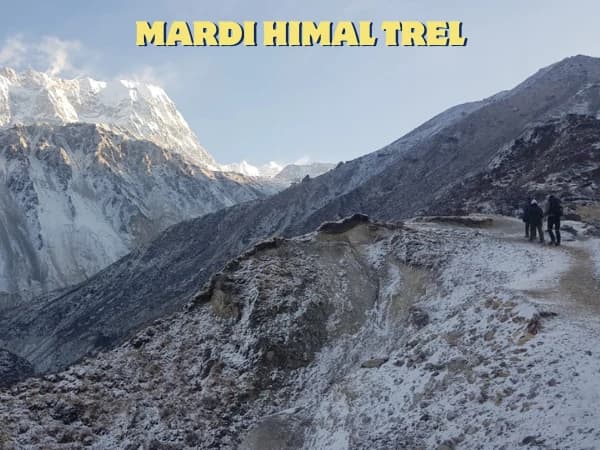
If this is your first Himalayan trek. Ghorepani Poon Hill takes six days and tops out at 3,210 m, so altitude is barely a factor. Mardi Himal (seven days) reaches about 4,500 m and Langtang Valley (eight days) ends at Kyanjin Gompa, 3,870 m; both are good if you want more mountain. We would check the Langtang trail with you first, because the valley was hit by a flash flood in August 2026.
If you have done a multi-day Alpine hut tour. Annapurna Base Camp (nine days, 4,130 m) is the natural step. Everest Base Camp (12 days) goes to 5,364 m and Kala Patthar 5,545 m, which puts it well above the Zugspitze (2,962 m) and above anything in the Alps.
If you want empty trails and have the stamina. The Manaslu Circuit (12 days) crosses the Larkya La at 5,160 m in a restricted area. A licensed guide and an agency-issued permit are required, and you may not walk apart from the guide.
Pick a tier by deciding who carries the bag and who pays for meals. Budget: you on both counts, and rooms are shared. Standard: meals are covered, rooms are private, and a porter takes the bags of two trekkers. Luxury: a personal porter, deluxe private rooms with bathroom, fruit, nuts, unlimited soft drinks and helicopters both ways to Lukla. All have a licensed guide, the permits (NPR 3,000, 3,000 and 2,000), airport transfers and a borrowed down jacket and minus 15 sleeping bag. Lone Standard travellers get no porter, so the guide carries up to 10 kg, with no single supplement. Kathmandu hotels are not included.
Our Europe representative lives in Finland: Shradha Simkhada. Germany is an hour behind Finland all year, so a call in office hours works for both of you. Reach her on +358 45 353 8606 or WhatsApp; she works in English.
What the Auswärtiges Amt says
The Foreign Office's page for Nepal was dated 7 October 2026 and had been unchanged since 8 September, and it carries no formal travel warning. It says that a visa is needed and can be obtained on arrival, that the passport must have six months' validity, and that altitude sickness must not be underestimated above 3,000 m. It also says that since 2023 trekking or climbing in the national parks and the high mountains is allowed only with certified guides, that all trekkers need a TIMS card, and that restricted areas need a trekking permit. It notes that no reliable mountain rescue exists and that phone coverage is patchy. The page recommends health insurance abroad with repatriation cover and registration with the Krisenvorsorgeliste Elefand.
Germany has an embassy in Kathmandu, at Gyaneshwor Marg 690; the embassy's page gives +977 1 421 72 00 and an emergency-only number out of hours, +977 9851137943. The Foreign Office switchboard, staffed around the clock, is +49 30 5000 0.
Why the Krankenkasse is not a plan
The federal health ministry explains that statutory cover outside the EU, for a country without a social security agreement, is limited: treatment that cannot wait, for up to six weeks a year, and only for people who could not get private travel insurance because of age or illness, with the fund's approval before departure. It recommends adding private cover. Costs are repaid only up to what treatment would cost in Germany, and the page says nothing about rescue or repatriation, which is why the Foreign Office tells travellers to add repatriation cover.
Check the policy for these: cover to 6,000 m of trekking altitude (Kala Patthar is 5,545 m; some plans give out at 3,000 to 4,000 m), a helicopter rescue clause (without it, US$3,000 to US$5,000, about EUR 2,660 to EUR 4,440), and illness included with accidents. Buy an Auslandskrankenversicherung with Rückholversicherung at home, and read our helicopter cover to 6,000 m. Do not buy cover in Nepal.
Visa
Germany is not one of the twelve countries whose citizens must apply before travel. Fifteen days: US$30. Thirty days: US$50 (about EUR 45). Ninety days: US$125. In US dollars, multiple entry. Nepal's immigration site lists these fees and the six-month passport rule. Our visa on arrival guide gives the steps.
Flights from Munich
These are the results for economy, one adult carrying one hold bag, leaving Sunday 25 October 2026, returning Wednesday 11 November, on a single ticket with one stop at most each way.
Our Everest Base Camp cost guide prices Frankfurt. For this guide I searched Munich (MUC), which behaves differently: 15 itineraries from EUR 809 to EUR 1,495, every one with a single change, and the cheapest ones are on Air Arabia.
The lowest, EUR 809, is Air Arabia both ways through Sharjah. Munich 21:55, Sharjah 06:55, then 16:00 to Kathmandu at 21:40 on 26 October, about 19 hours. Home leaves Kathmandu at 23:45 and, with a Sharjah wait until 17:10, is in Munich at 21:05 on 12 November, about 26 hours 5 minutes. A morning Sharjah connection out (08:10, in at 13:50) was EUR 813. Air Arabia out with Qatar Airways home through Doha, landing at 06:55 the next morning, was EUR 1,070; with Thai Airways home via Bangkok it was EUR 1,262.
The quickest way back, Turkish Airlines via Istanbul (Kathmandu 12:45, Munich 21:40 the same evening, about 13 hours 40 minutes), cost EUR 1,370 after an Air Arabia outbound. Etihad out through Abu Dhabi was EUR 1,320, Emirates out via Dubai EUR 1,443, and Turkish out via Istanbul EUR 1,495, the dearest. Frankfurt travellers should compare with the Frankfurt fares in the cost guide, and Berlin or Hamburg travellers should run their own airport.
Time off and holidays
The Federal Leave Act gives a minimum of 24 Werktage a year, counted on a six-day week, which works out at 20 days on a five-day week. Work out the trek length plus two travel days and a spare day. In autumn 2026 the holiday dates work against you: 31 October (Reformationstag) is a Saturday and 1 November (Allerheiligen) a Sunday, so no weekday is gained. Spring 2027 is better: Good Friday is 26 March, Easter Monday 29 March and Ascension Day 6 May, with 1 May on a Saturday. Whit Monday, 17 May, falls just after the best part of the spring season.
German clocks go back on Sunday 25 October 2026. The gap to Nepal is 3 hours 45 minutes before that and 4 hours 45 minutes afterwards. Two things shape autumn dates in Nepal. Permits take 48 hours of government working days, and Dashain (17 to 23 October 2026) and Tihar (8 to 12 November) close the offices. And in the busiest weeks, Lukla flights for Budget and Standard run from Manthali: four to five hours by road, pick-up between midnight and 2 am. A helicopter from Kathmandu is part of Luxury.
Money and permits
Booking is 10 per cent of the price, and the remaining 90 per cent is paid in Kathmandu. Dollars and euros are the two currencies; cash is free and cards cost 3.5 per cent extra, and rupees are not accepted. Cancelling yourself forfeits the deposit with no refund, whereas rescheduling costs nothing for any date within a year if you write 72 hours before (seven days for Tibet, Kailash and restricted areas). If it is we who cannot go ahead, the refund is what you paid, less taxes, bank and card charges and spent permit and flight costs.
Permits are bought by us and are inside the price; see our permits guide for the fees.
You pay for your own food only on Budget, at about US$25 to US$40 a day, which comes to US$300 to US$480 in total. The other tiers include meals, so their extra cash is just for showers, charging and snacks (20,000 to 30,000 rupees, or US$130 to US$195, drawn in Kathmandu). Plan a tip of US$15 to US$20 a day for the guide and US$10 to US$15 a day for a porter.
Who we are
The paperwork is public: registrar, TAAN, tourism licence, forex certificate. Ours say Kathmandu, 2016, TAAN 1586, and the reviews (over 300, on TripAdvisor, Google and Trustpilot) say the rest. Three generations of my family have guided. Licensed companies have been part of scams as well, so I would always have a video call before paying anyone. Part of each booking supports the Nagarjun Learning Center.
If you tell me your dates and how many of you are going, I will send a price. Write on WhatsApp +977 9810351300 / [email protected].
See also whether you can trek without a guide and how fit you need to be.
Shreejan Simkhada, CEO of The Everest Holiday. TAAN 1586.
 Chat with Shreejan