
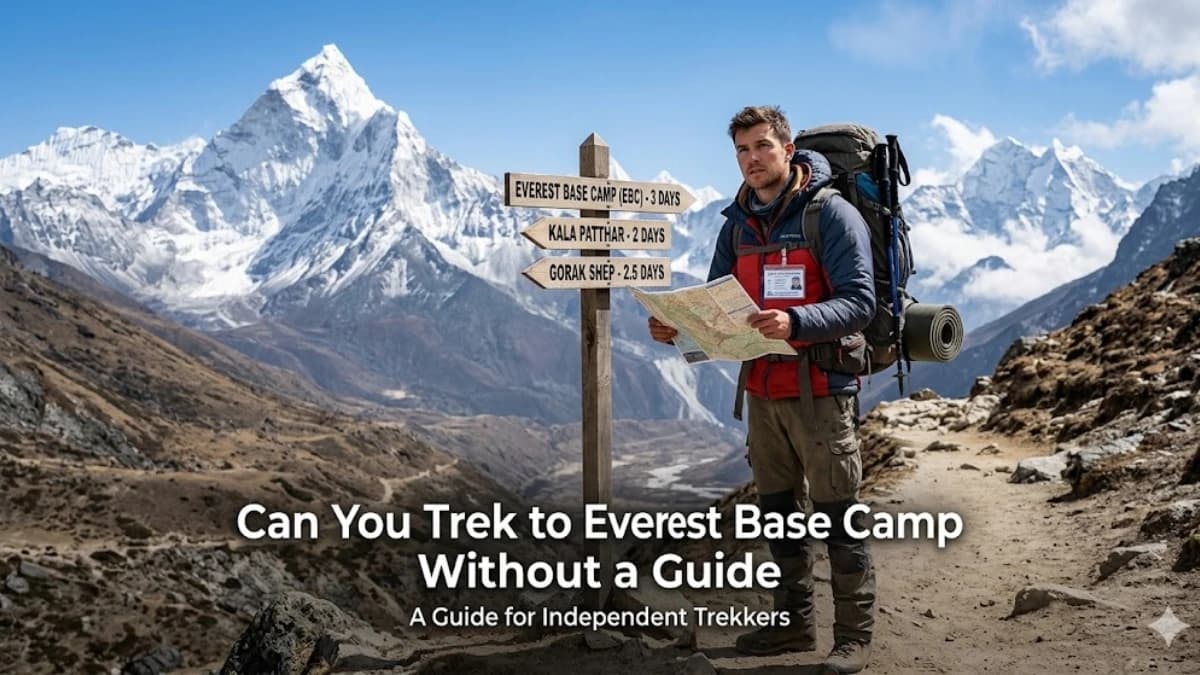
The short answer is that we do not run it, and we would not advise planning one. Every Everest Base Camp trek we run includes a licensed guide, and we arrange the permits (Sagarmatha National Park entry, the Khumbu Pasang Lhamu Rural Municipality permit and the TIMS card) as part of every booking.
That is our answer. The conversation does not end there, because the question "can you trek to EBC without a guide" is really three questions disguised as one. The rules question (the Everest (Khumbu) region does not enforce the Nepal Tourism Board licensed-guide rule locally, but we always trek with a licensed guide). The practical question (what do you lose by having a guide, and what do you gain). And the philosophical question (should experienced trekkers be required to hire guides on well-established trails). All three deserve honest answers.
Do you need a guide to trek Everest Base Camp in 2026?
A licensed guide is required in most trekking areas under the Nepal Tourism Board rule from April 2023. The Everest (Khumbu) region does not enforce it locally, but every EBC trek we run includes a licensed guide.
On our treks the guide holds a valid trekking guide licence from the Department of Tourism, and the company holds an active TAAN membership and a government tourism licence. We arrange the permits for the trek, the Sagarmatha National Park entry, the Khumbu Pasang Lhamu Rural Municipality permit and the TIMS card, as part of every booking.
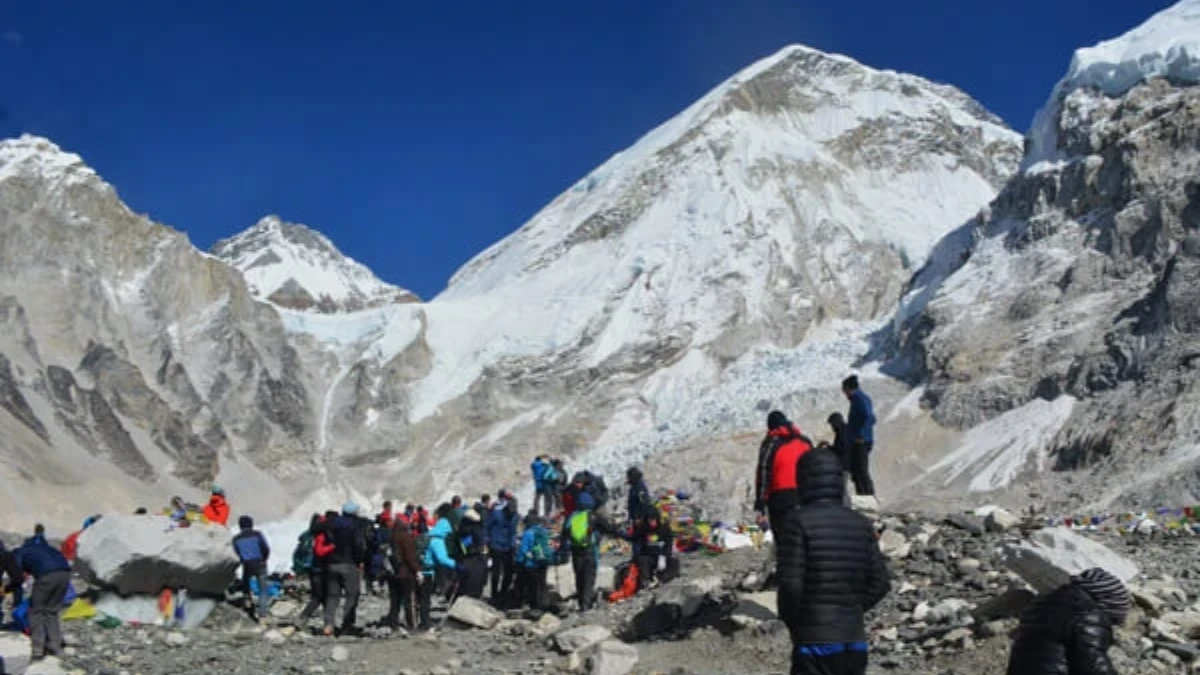
The Everest (Khumbu) region does not enforce the licensed-guide rule locally. The Monjo checkpoint, at the entrance to Sagarmatha National Park, is staffed and functional throughout the trekking season, and additional checks may occur at Namche and at points further up the trail.
Why do we always trek to Everest Base Camp with a guide?
The Nepal government cites two primary motivations for the licensed-guide rule: safety and employment.
Safety. Between 2010 and 2022, unguided foreign trekkers were disproportionately involved in disappearances, altitude sickness emergencies, navigation errors, and deaths on Nepal's trails. The pattern was clear: trekkers without guides made worse decisions at altitude (continuing to ascend with AMS symptoms, taking wrong trails in poor visibility, failing to recognise the onset of HACE or HAPE) and were harder to locate when things went wrong (no itinerary registered with a company, no guide to raise the alarm, no local knowledge of the terrain).
A guide does not make the mountains safe. Nothing makes the mountains safe. But a guide reduces the specific risks that kill unguided trekkers: delayed descent decisions, navigation errors in bad weather, and the absence of anyone to call for help when a solo trekker is incapacitated.
Employment. The trekking industry is one of Nepal's largest employers. The growth of independent, guideless trekking, facilitated by GPS apps, online trail descriptions, and a backpacker culture that valued self-sufficiency, was gradually reducing the demand for professional guides. The licensed-guide rule means that the tourism economy benefits the people who maintain the trails, manage the risks, and carry the economic burden of living in remote mountain communities.
This motivation is economic, not altruistic, and the government does not pretend otherwise. But the economics are real. A guide on the EBC route earns twenty-five to thirty-five dollars a day on TAAN's published 2026 band, income that supports a family, funds education, and sustains a community that has no other significant income source. The trekker who walks to EBC without a guide contributes to the teahouse economy but not to the guiding economy. The rule ensures contribution to both.
What does a guide do on the Everest Base Camp trek?
The practical benefits of a guide on the EBC route go beyond following the rules.
Altitude monitoring. Your guide carries a pulse oximeter and checks your blood oxygen saturation at least twice daily. The guide has seen altitude sickness hundreds of times and recognises the progression from mild AMS to dangerous HACE or HAPE earlier than a trekker experiencing it for the first time. The decision to descend, the most important medical decision on any high-altitude trek, is made by someone with experience rather than by someone whose judgment is being impaired by the very condition requiring the decision.
Logistics. Teahouse booking. Permit processing. Transport arrangement. Meal ordering. Route decisions based on weather and trail conditions. These tasks are not difficult individually, but managing them daily while also walking six to eight hours at altitude and dealing with acclimatisation is cumulative cognitive load that a guide removes. You walk. Your guide handles everything else.
Cultural access. Your guide speaks Nepali and, often, Sherpa. The conversations with teahouse owners, the stories about the villages you pass through, the cultural context of the monasteries and mani walls, these are available only through someone who speaks the language and knows the culture. The EBC trail passes through a living Sherpa community, and a guide is the bridge between your trip as a visitor and the community's life as residents.
Emergency response. If something goes wrong, altitude sickness, injury, severe weather, your guide has the communication equipment (satellite phone or radio), the local knowledge, and the emergency contacts to initiate rescue. A solo trekker with altitude sickness at Gorak Shep faces a potentially fatal delay between the onset of symptoms and the arrival of help. A guided trekker faces a guide who can call a helicopter within minutes.
Local knowledge. Weather patterns that are not in any forecast. Trail conditions that change seasonally. The teahouse at Lobuche that has the best food. The side trail above Dingboche that offers a better acclimatisation hike than the standard route. The viewpoint near Gorak Shep that most trekkers miss because it is not in the guidebook. This knowledge, accumulated over years and hundreds of treks, transforms the EBC trek from a well-marked path to a curated experience.
What You Lose With a Guide
The honest answer: some independence. The guide sets the pace (guided by professional judgment about acclimatisation rather than your impatience). The guide chooses the teahouses (guided by established relationships and quality knowledge rather than your desire to explore). The itinerary is set (guided by safe acclimatisation profiles rather than your ambitious schedule).
For trekkers who value complete autonomy, the ability to change plans on a whim, to walk faster or slower without consideration for anyone else, to choose accommodation by instinct rather than recommendation, the licensed-guide rule removes a dimension of freedom that defined the independent trek itself.
This loss is real and should not be dismissed. The backpacker tradition of arriving in a country with a pack, a map, and no fixed itinerary is a legitimate and valuable way to travel. The licensed-guide rule ends that tradition for most of Nepal's trekking routes. Whether the safety and employment benefits justify the loss of freedom is a genuine philosophical question.
But the practical reality for most trekkers, particularly those on their first high-altitude trek, is that the loss of independence is minimal and the gain in safety, convenience, and cultural access is substantial. The guide does not dictate your trip. The guide enhances it. You still walk the same trail. You still see the same mountains. You still make the same physical effort. The difference is that you make that effort with a professional beside you who has dedicated their career to ensuring that trekkers like you reach the destination safely and return home to talk about it.
How much does a guide cost for Everest Base Camp?
Adding a guide to what would otherwise be an independent EBC trek costs approximately three hundred to five hundred dollars over a twelve-to-fifteen-day trek. This is the incremental cost, the difference between what an independent trekker would spend on accommodation, food, and permits alone versus the cost of a package that includes a guide.
For this cost, you receive: a licensed guide for the entire trek, all permit processing and logistics, teahouse bookings, altitude monitoring, emergency response capability, and cultural interpretation. The guide also handles the TIMS card and national park permit applications, which can only be processed through a registered company.
The cost is not trivial for budget trekkers. But it is modest relative to the total trip cost (flights, insurance, gear, visa, Kathmandu expenses) and relative to the value received. A guide who recognises the early signs of HAPE and initiates descent before you need a helicopter has potentially saved you thousands of dollars in evacuation costs, and possibly your life.
Can You Still Have a "Solo" Experience?
Yes. Emphatically yes. A "solo trekker" in the meaningful sense, a person who chooses to come to Nepal alone, who experiences the trek on their own terms, and who finds the solitude and self-reliance they were seeking, can absolutely have that with a guide.
A private trek, one trekker, one guide, preserves the essential character of solo travel. You walk at your pace. You choose when to stop. You eat when you are hungry. You sit in silence at the teahouse window and watch the mountains without obligation to make conversation. Your guide is a professional who reads your desire for solitude as easily as they read the weather, a good guide knows when to talk and when to be quietly present, walking a few steps behind, available but not intrusive.
The solitude of the mountains is not diminished by the presence of a guide. The sunrise at Kala Patthar is not less beautiful because someone is standing beside you. The silence of the Khumbu Glacier is not less profound because your guide is drinking tea at the same teahouse. The internal feel of the trek, the physical challenge, the mental journey, the specific revelation that comes from walking for twelve days toward a mountain and finally arriving at its base, is entirely your own, guide or no guide.
What the guide adds is not company. It is safety. And safety, on a mountain that has killed experienced mountaineers, is not an imposition. It is a gift.
Should you hire a guide for the Everest Base Camp trek?
We do not run a guideless EBC trek, and we would not advise planning one.
For the trekker who accepts this and books a guide through a reputable company, the EBC trip is excellent, enhanced by professional support, enriched by cultural access, and safer by every measurable metric. For the trekker who resists the rule and arrives in Kathmandu hoping to find a workaround, the trip is stress and uncertainty.
The mountains do not care about the rule. They were there before it and they will be there after it. What the rule changes is not the mountains but the margin between you and them. And on a trail that climbs to 5,545 metres in air that contains half the oxygen your body needs, a wider margin is not a restriction. It is the thing that lets you stand on Kala Patthar at sunrise, breathing thin air, watching the most famous mountain on earth turn gold, and knowing, with the quiet certainty that a guide's presence provides, that you will make it back down alive to remember this moment for the rest of your life.
Our EBC Trek packages include a licensed guide. See all trek options.
So the answer to "can you trek without a guide" is: not with us. Going without a guide is a gamble. The trails are not always marked, altitude decisions require experience, and when things go wrong above 4,000 metres, having someone who knows the mountain is the difference between a story and a disaster.
All our treks include a licensed, experienced guide. It is not optional and it should not be.
WhatsApp:+977 9810351300
Email:[email protected]
Written by Shreejan Simkhada, CEO of The Everest Holiday and third-generation Himalayan guide. TAAN Member #1586.
Trekking EBC solo? Every trek we run includes a licensed guide. Our Everest Base Camp Trek (12 Days) is private (your group only, no strangers), 2026 dates open, From USD $1399. WhatsApp us for tailored 2026 dates and current departures.

 Chat with Shreejan