
Last updated 7 October 2026. The Milan Malpensa fares were checked on 7 October 2026. Euros are converted at the ECB reference rate of 6 October 2026, EUR 0.887 per US dollar, a rate that moves daily. We invoice in dollars and also take euros.
This guide is for Italians weighing up Nepal as a whole, not only Everest. Everest Base Camp is the best-known trek, but a walker with a week of leave, a bad knee or a dislike of crowds has five other choices on our price list, and the right one depends mostly on how many days you can take off. If Everest is already your answer, the Everest Base Camp cost guide for Italy works through every euro; there is also an Italian-language version of this guide.
A contact in Europe: Shradha Simkhada, who lives in Finland. Italy is an hour behind her. Call or message +358 45 353 8606 or WhatsApp for help in planning; she works with all our European travellers and writes in English.
Six treks and what they cost in euros
Prices are per person for one to four trekkers, and the first figure in each cell is the euro guide. The number of days is the length of the trek itself, before you add flights from Milan and a spare day.
| Trek | Length | Budget | Standard | Luxury |
|---|---|---|---|---|
| Ghorepani Poon Hill | 6 days | EUR 440 (US$499) | EUR 660 (US$749) | EUR 1,100 (US$1,235) |
| Mardi Himal | 7 days | EUR 400 (US$454) | EUR 750 (US$849) | EUR 990 (US$1,111) |
| Langtang Valley | 8 days | EUR 320 (US$365) | EUR 580 (US$650) | EUR 890 (US$1,000) |
| Annapurna Base Camp | 9 days | EUR 440 (US$499) | EUR 710 (US$799) | EUR 1,240 (US$1,400) |
| Manaslu Circuit | 12 days | EUR 710 (US$799) | EUR 1,420 (US$1,599) | EUR 1,860 (US$2,099) |
| Everest Base Camp | 12 days | EUR 1,240 (US$1,399) | EUR 2,220 (US$2,499) | EUR 4,440 (US$4,999) |
The price per person is the same for a private trek or a group, and it drops in larger groups. Whichever you choose, a licensed guide, the permits and airport transfers are inside each price.
These are the three tiers. Budget means carrying your own bag, sharing rooms, paying for your meals and flying fixed-wing to Lukla. Standard means every meal paid, a private room, and a porter between two trekkers. Luxury means a porter of your own, a private deluxe ensuite room, fruit, nuts, unlimited soft drinks and helicopters out and back. A licensed guide, the permits (NPR 3,000, 3,000 and 2,000), airport transfers and a borrowed down jacket and sleeping bag (minus 15) come with all of them. For one person on Standard the guide carries up to 10 kg; no single supplement applies. Kathmandu hotels are quoted apart.
Pick by days off, not by fame
Italian employees are entitled by D.Lgs. 66/2003 to at least four weeks of paid annual leave, and the law says the worker may ask for two weeks in a row. Nothing in the national calendar helps with an autumn trek: 1 November 2026 is a Sunday, and 4 November, the day of national unity, is no longer a day off. In spring 2027 only Easter Monday (29 March) helps, because Liberation Day (25 April) falls on a Sunday and 1 May on a Saturday.
Whichever trek you choose, allow two days for the journey, because Kathmandu is about 12 hours from Milan even on the fastest itinerary I found, and one spare day for weather. On Everest, the Lukla flights are the reason for that spare day. Nepali public holidays matter for autumn trips. Dashain is 17 to 23 October 2026 and Tihar is 8 to 12 November, and offices are shut for both. A permit takes 48 hours of working days. When Lukla is busy, planes fly from Manthali and you must drive there for four to five hours, leaving between midnight and 2 am; the Luxury helicopter leaves from Kathmandu.
The six treks in short
Ghorepani Poon Hill, 6 days. The shortest of the six and the one to pick with a week off. It climbs to a viewpoint at 3,210 m for sunrise over the Annapurna and Dhaulagiri ranges, with stone steps and rhododendron forest on the way. The altitude is modest.
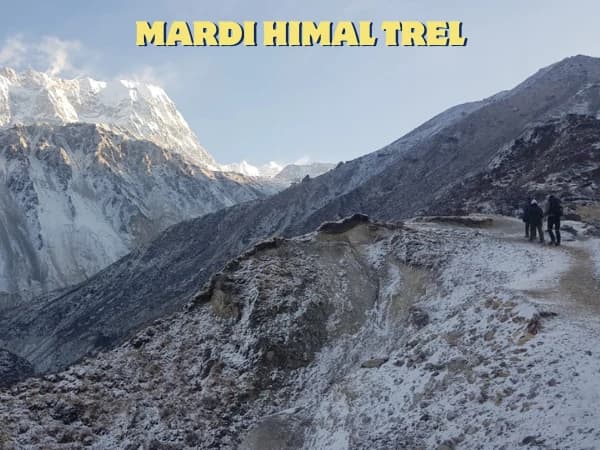
Mardi Himal, 7 days. A ridge walk with a steep final stretch to the base camp at about 4,500 m. It is a steeper walk than Poon Hill.
Langtang Valley, 8 days. It runs up a valley close to Kathmandu and ends at Kyanjin Gompa, 3,870 m. The valley suffered in the August 2026 flood, so ask us for the current state of the trail before you pick dates.
Annapurna Base Camp, 9 days. Stone steps up to Chomrong, then a climb into a ring of peaks at 4,130 m. It is a good first high trek if you have nine days and want more than Poon Hill.
Everest Base Camp, 12 days. Base Camp is 5,364 m, and Kala Patthar, the viewpoint above it, is 5,545 m. It needs the most time, and the flights to Lukla add a small risk of delay.
Manaslu Circuit, 12 days. A remote route over the Larkya La, 5,160 m, through a restricted area, which makes a licensed guide and an agency-issued permit compulsory.
Permits, in short
All permits are bought by us and are part of the price. For reference, the official fees are: Annapurna Conservation Area NPR 3,000 (Poon Hill, Mardi Himal, Annapurna Base Camp), Langtang National Park NPR 3,000, and the TIMS card NPR 2,000. Everest Base Camp needs three permits that add up to NPR 8,000 (Sagarmatha National Park NPR 3,000, the Khumbu local fee NPR 3,000, TIMS NPR 2,000). Manaslu also needs the restricted-area permit: US$100 a week from September to November and US$75 a week from December to August, with extra days charged at US$15 (September to November) or US$10. Since 22 March 2026 one person can hold a restricted-area permit, through an agency and with a licensed guide, with at most seven trekkers per guide. Our permits guide has the details.
Flights from Milan
Fares checked: economy; one adult; one checked bag; out Sunday 25 October 2026; back Wednesday 11 November; no separate tickets; one stop at most per direction.
For this guide I priced Milan Malpensa (MXP); our Everest Base Camp cost guide covers Rome. There were 15 itineraries, from EUR 1,318 to EUR 1,633, all with one change and none on Air Arabia, Turkish Airlines or flydubai.
The cheapest, EUR 1,318, is Emirates out via Dubai (Malpensa 13:10, Dubai 22:15, Kathmandu 06:35 the next morning, about 12 hours 35 minutes) and Air India home via Delhi, leaving Kathmandu at 10:05 and landing in Milan at 19:25 the same evening, about 14 hours. Those two are in most of the cheap results: an evening Emirates departure (21:20, reaching Kathmandu at 18:40) is EUR 1,318 as well. Qatar Airways out via Doha with the same Air India return is EUR 1,348, and a Qatar outbound with a faster Doha connection, in at 16:15, is EUR 1,402.
The only way I found to avoid Delhi on the way back was Qatar Airways through Doha, Kathmandu 11:05 and Milan 20:05 the same day, which came to EUR 1,444 after an Emirates outbound. The highest fare, EUR 1,633, was Qatar out on the 07:20 Doha connection (in at 14:35) with Air India home. A few results list a cabin bag and a checked bag but no personal item.
Visa for an Italian passport
Italy is not one of the twelve countries whose citizens need a visa before travel, so you can pay at Kathmandu airport. The 15-day visa costs US$30, the 30-day visa US$50 (about EUR 45), and the 90-day visa US$125. The fee is in US dollars and entry is multiple. The passport must be valid for six months, and the Farnesina country sheet says the same. See the visa on arrival guide.
Italian help and insurance
Italy has no embassy in Nepal. According to the Farnesina, the Consulate General in Kolkata covers Nepal, and Italy has an honorary consulate in Kathmandu, at R B Tower in Lazimpat. The Farnesina advises registering your trip on Dove siamo nel mondo, and says that since 31 March 2023 trekking in Nepal can no longer be done independently: licensed guides and agencies are required. Its country sheet is dated January 2025, so it predates the August 2026 floods.
The same sheet tells travellers to take health insurance that includes rescue and repatriation. Good wording has three parts: an altitude ceiling of 6,000 m or higher (the Kala Patthar viewpoint is 5,545 m, whereas many plans end at 3,000 to 4,000 m), helicopter evacuation (US$3,000 to US$5,000, or about EUR 2,660 to EUR 4,440, if uninsured), and cover for illness as well as injury. Buy it in Italy; the TEAM card is for the European area and does nothing in Nepal. Our helicopter cover to 6,000 m explains the wording.
Fitness, language and food
Meals: not included on Budget (US$25 to US$40 a day, so US$300 to US$480), included on Standard and Luxury. Spending money for showers, charging and snacks: 20,000 to 30,000 rupees, which is US$130 to US$195, from a Kathmandu cash machine. Tips: US$15 to US$20 a day for a guide, US$10 to US$15 a day for a porter.
A walker used to long Dolomite or Alpine days has the legs for any of these. Altitude is the new part: Kala Patthar is higher than Mont Blanc, and a fit person can feel it. Our how fit you need to be guide covers training.
Guides work in English. If you want an Italian-speaking guide, ask us when you enquire and I will tell you whether we can arrange one for your dates. Teahouse food is rice, lentils, noodles, potatoes, eggs and Tibetan bread, and our dal bhat guide explains why guides eat it twice a day.
When to go, from an Italian calendar
October to mid-November is the most settled period and the busiest. March and April are warmer, with rhododendrons in flower. December to February is clear and very cold. The monsoon runs from June to mid-September, and Ferragosto falls right in it, so August is a poor month for views even though it is when many Italians have time off. See the best time to trek.
Paying from Italy
Deposit first: 10 per cent. Balance second, in Kathmandu, in dollars or euros. A cash payment is exactly the price; a card payment is the price plus 3.5 per cent. We cannot accept rupees. If you cancel, the deposit is not refunded and neither is the rest of what you paid. You may instead rebook for any date within 12 months, free, with at least 72 hours' notice (seven days for Tibet, Kailash and restricted areas). If we cancel, your money comes back less taxes, bank and card charges and permit and flight costs that have already been spent.
Looking us up
Check four things: the company registrar, TAAN, the tourism licence and the forex certificate. Our own details are registration in Kathmandu in 2016, TAAN member 1586 and over 300 reviews on TripAdvisor, Google and Trustpilot, and the family behind us has guided for three generations. Fully licensed operators have been involved in scams too, which is why a video call comes before a deposit. A part of every booking funds the Nagarjun Learning Center.
To get a price for your own dates and group, write to me on WhatsApp +977 9810351300 / [email protected].
Shreejan Simkhada, CEO of The Everest Holiday. TAAN 1586.
 Chat with Shreejan