Nepal Travel Guide & Expert Trekking Tips
Lobuche East Peak Climbing Cost 2027: USD 3,425 to 7,350

Short answer. Climbing Lobuche East (6,119 m) with us is a 15-day trip that costs USD 3,425 (Budget), USD 4,790 (Standard) or USD 7,350 (Luxury) per person for 2 to 4 climbers. A solo climber pays USD 4,480, 5,570 or 8,430. The price includes the Nepal Mountaineering Association royalty, the USD 500 garbage fee, a climbing Sherpa for each climber, all technical gear, camp crew and the food above base camp, on every tier. Every climb is private. See the Lobuche East climbing package. Prices read from our booking system on 3 Nov 2026 at 11:15 Nepal time (package 150). Updated 3 November 2026.
How much does it cost to climb Lobuche East in 2027?
People usually ask me for one number, and it is worth asking what a quote leaves out. The royalty, the garbage fee and the camp food are the lines to check. So here is our price for each group size, and then exactly what sits inside it.
| Group size | Budget | Standard | Luxury |
|---|---|---|---|
| 1 person (solo) | USD 4,480 | USD 5,570 | USD 8,430 |
| 2 to 4 people | USD 3,425 | USD 4,790 | USD 7,350 |
| 5 to 8 people | USD 2,850 | USD 4,205 | USD 7,050 |
| 9 to 12 people | USD 2,835 | USD 4,170 | USD 6,995 |
| 13 to 20 people | USD 2,745 | USD 4,130 | USD 6,975 |
All prices are per person, in US dollars, and include VAT and our service charge. We take USD or EUR, cash or card. A 10% deposit holds your place, and you pay the balance in Kathmandu. Cash in Kathmandu has no fee. A card payment for the balance carries a 3.5% bank charge. If you pay the deposit by card, we absorb the card fee.
What is included on every tier
Compare this list with any other quote you have.
- The Nepal Mountaineering Association climbing royalty for Lobuche East, in every season. The association sets it at USD 350 per person in spring and USD 175 in autumn, winter and summer. It is already in your price.
- The USD 500 garbage fee for the climb.
- Sagarmatha National Park permit, Khumbu Pasang Lhamu Rural Municipality fee and TIMS card, plus all government taxes and official expenses.
- A climbing Sherpa for each climber, who climbs with you from base camp to the summit.
- All technical gear: double mountaineering boots, crampons, harness, jumar, figure-of-eight descender, ice axe and helmet.
- Tents, cooking crew and food at base camp and high camp. Food above the teahouses is included on Budget too.
- Return Lukla transport, a first-aid kit, a pulse oximeter checked daily and emergency oxygen carried on the climb.
If rescue is ever needed, we arrange it and your travel insurance pays for it.
What the three tiers actually give you
| Budget | Standard | Luxury | |
|---|---|---|---|
| Lukla | Flight | Flight | Helicopter, Kathmandu to Lukla and back, on a shared seat |
| Teahouse rooms | Shared, simple | Private twin rooms | Private deluxe rooms in the better lodges |
| Meals on the trail | Not included, you order and pay | Breakfast, lunch, dinner, tea or coffee, fruit | All meals, fruit and nuts, soft drinks, juice and water, everything except alcohol |
| Porter | None, you carry your pack | 1 for every 2 trekkers, 20 kg between them. Solo: none, the guide carries up to 10 kg | One dedicated porter each |
| Guide | One licensed guide, assistant from 8 | One guide for up to 6, assistant from 7 | One guide for every two trekkers |
One thing I should say plainly. Luxury is a big jump because of the helicopter and one guide for every two climbers. If a private charter is needed because no shared helicopter seat is free on your dates, we tell you the price before you book.
What is not included
Drinks other than tea or coffee with meals on Standard, international flights, your Nepal visa (USD 30 for 15 days or USD 50 for 30 days, paid in cash on arrival), Kathmandu hotel nights, travel insurance, tips for the guide, Sherpa and porters, the summit bonus (USD 500 for each climbing Sherpa, only if you reach the summit, paid by you directly to your Sherpa), personal spending, hot showers and charging. An extra porter costs USD 25 a day plus 13% VAT and the 3.5% bank charge. We also do not cover extra costs from delays outside our control, such as weather, landslides, strikes or changes in government rules.
Kathmandu hotels are not in the price, but you can stay at our family homestay for USD 15 per person per night, which supports the learning centre.
The 15-day itinerary with altitudes
| Day | Route | Sleep |
|---|---|---|
| 1 | Fly to Lukla, trek to Phakding | 2,610 m |
| 2 | Phakding to Namche Bazaar | 3,440 m |
| 3 | Acclimatisation day in Namche | 3,440 m |
| 4 | Namche to Tengboche | 3,860 m |
| 5 | Tengboche to Dingboche | 4,410 m |
| 6 | Acclimatisation day in Dingboche | 4,410 m |
| 7 | Dingboche to Lobuche | 4,940 m |
| 8 | Lobuche to base camp, skills session | Tent |
| 9 | Base camp to high camp | Tent |
| 10 | Summit day, Lobuche East 6,119 m, back to base camp | Tent |
| 11 | Down towards Pangboche, or reserve day for a second summit try | Teahouse or tent |
| 12 | Pangboche to Namche | 3,440 m |
| 13 | Namche to Lukla | 2,860 m |
| 14 | Spare day in Lukla | 2,860 m |
| 15 | Fly Lukla to Kathmandu | 1,350 m |
I built three safety margins into this plan: two acclimatisation days, and a reserve day for a second summit attempt plus a spare day at Lukla for the flight. The skills session on day 8 happens in daylight, on ground where a mistake is safe. The climbing Sherpa teaches or refreshes crampon work, fixed rope with jumar and descender, and ice axe use.
On summit day your Sherpa decides whether you go on or turn back, and his decision is final. There is no refund for an unclimbed summit, because the permit, the staff and the flights are spent by then. Read the Lobuche East difficulty and training guide before you commit.
Getting there and real costs on top
You fly to Lukla on day 1, from Kathmandu or, in the busy spring and autumn weeks, from Manthali with the road transfer included. We tell you which airport before you fly. Keep at least one spare day before your international flight, because the Lukla runway needs clear weather. Beyond our price, budget for your international flights, visa, Kathmandu hotel, insurance and tips, plus a USD 500 summit bonus for your climbing Sherpa if you reach the top. You pay that to him directly. Carry some Nepali rupees for hot showers, charging and snacks, because there are no card machines on the trail. You pay us in US dollars or euros, not rupees.
Is Lobuche East hard? Experience and insurance
It is harder than Island Peak. A previous 6,000 m peak, or good experience of snow, ice and cold, is strongly advised, along with excellent cardiovascular fitness. Trail days are 5 to 7 hours, and summit day is much longer. You sleep as high as Lobuche at 4,940 m before the mountain camps, and your guide checks your oxygen level and how you feel every day. If you are not acclimatising, we do not go higher. If you are unsure which peak to start with, read Lobuche East or Island Peak and tell me what you have done. I will say honestly which suits you.
Please buy your travel insurance at home. It must cover climbing to 6,500 m and helicopter evacuation. I do not recommend insurance bought in Nepal. Send us a copy and we will check it fits. You climb only with your guide team and never walk or climb apart from them.
Lobuche East or Island Peak: which costs less?
| Lobuche East | Island Peak | |
|---|---|---|
| Summit | 6,119 m | See our comparison |
| Days with us | 15 | See the Island Peak package page |
| Difficulty | Harder, previous 6,000 m peak or snow and ice experience advised | Easier of the two |
| Standard price, 2 to 4 people | USD 4,790 | See the Island Peak package page |
I would rather you pick the right peak than the cheaper one. The guide on climbing a Nepal trekking peak explains the rules and the first-peak choice.
Best time to climb Lobuche East
| Months | What to expect |
|---|---|
| April and May | Best months. Spring, and the royalty is USD 350. |
| October and November | Best months. Autumn, and the royalty is USD 175. |
| December to February | Very cold. The royalty is USD 175. |
| June to mid-September | Snow, cloud and avalanche risk. Not recommended. The royalty is USD 175. |
The royalty is lower outside spring, but our package price is the same in every season. Message me early with your dates. You can also read about the last village before the mountain in my Lobuche village guide.
Frequently asked questions
How much does it cost to climb Lobuche East?
With The Everest Holiday it is USD 3,425, 4,790 or 7,350 per person for 2 to 4 climbers (Budget, Standard, Luxury). Solo climbers pay USD 4,480, 5,570 or 8,430. Larger groups pay less each.
Is the climbing permit included in the price?
Yes. The Nepal Mountaineering Association royalty (USD 350 in spring, USD 175 in autumn, winter and summer), the USD 500 garbage fee, the national park permit and the TIMS card are all included.
How many days does the Lobuche East climb take?
Fifteen days, including two acclimatisation days, a reserve day for a second summit attempt and a spare day at Lukla.
How high is Lobuche East?
6,119 m. You sleep at Lobuche at 4,940 m before moving to the mountain camps.
Do I need climbing experience for Lobuche East?
A previous 6,000 m peak, or good experience of snow, ice and cold, is strongly advised. It is harder than Island Peak.
Can I climb Lobuche East alone?
You can book as a solo climber, but you never climb alone. You are always with your guide team, with a climbing Sherpa on the rope from base camp to the summit.
When is the best time to climb Lobuche East?
April and May, and October and November.
Is the deposit refundable?
The deposit is 10% and it is non-refundable. If you cannot travel, we reschedule you free to any date within one year with at least 72 hours' notice.
Next step
If you want Lobuche East in 2027, message me on WhatsApp at +977 9810351300 with your dates, group size and what you have climbed before, and I will confirm the price. Or open the package page and send an enquiry. I am Shreejan, and I will reply myself.
Last updated 3 November 2026.
Planning a trip to Nepal?
Drop us your details and tell us what you have in mind. We will put together a personalised plan and get back to you.
Take our free 2-minute quiz and get personalised recommendations based on your fitness, experience, and travel style.
Find your trekMore from the travel blog
All stories and guides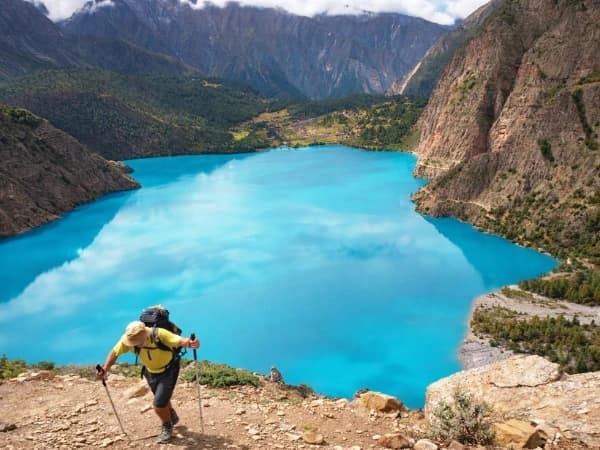 Nepal Travel Guide & Expert Trekking TipsLower Dolpo Trek Cost 2027: From USD 4,680, 15 DaysLower Dolpo trek cost 2027: from USD 4,680 per person for 15 days with flights. Permit fees, itinerary, passes, best time and what is included.
 Nepal Travel Guide & Expert Trekking TipsPikey Peak Trek Cost 2027: USD 380 to 1,815, 6 DaysPikey Peak trek cost 2027: from USD 380 per person, 6 days, no Lukla flight, 4,065 m summit. Prices by tier and group size, itinerary and what is included.
 Nepal Travel Guide & Expert Trekking TipsEverest Base Camp Trek Map 2027: Route, Stops and Heights Day by DayOur route map of the 12-day Everest Base Camp trek, every stop and height day by day, the altitude chart and what the map leaves out.