

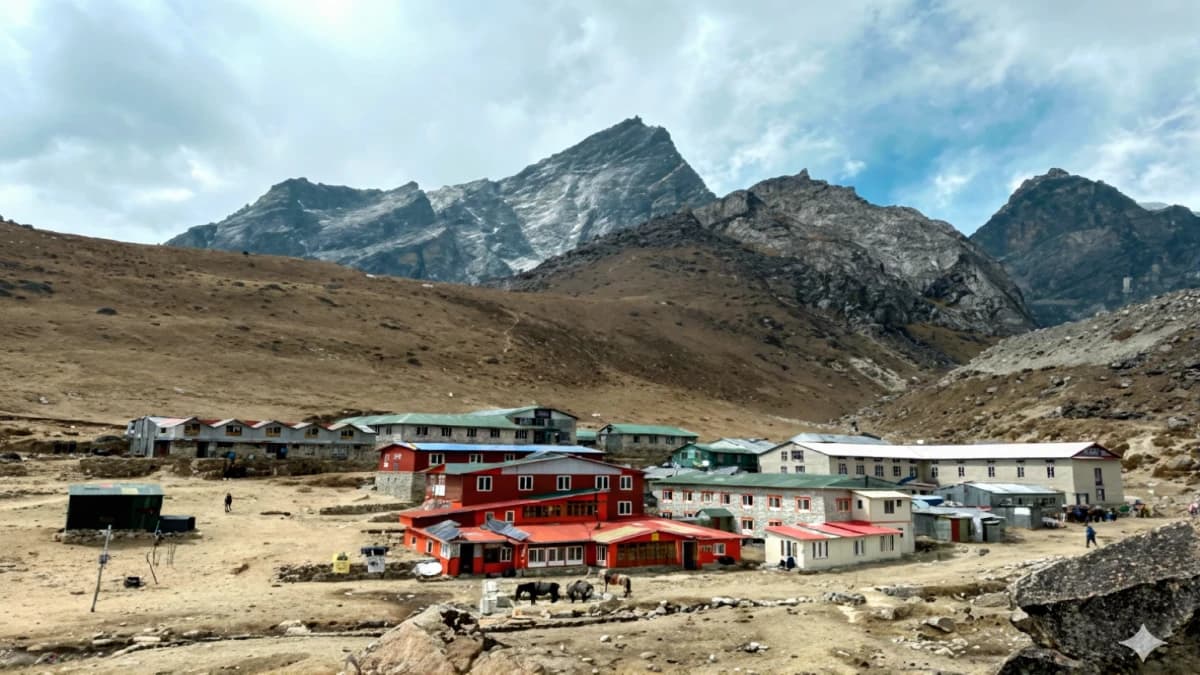
Short answer: Lobuche (4,940 m) is the last village on the Everest Base Camp trail before the Khumbu Glacier and Gorak Shep, reached by passing the climbers' memorials at Thukla. At this height every hundred metres of gain is felt, so most trekkers keep the day short and rest. It is a night on our 12-day Everest Base Camp trek.
You pass the memorial cairns above Thukla, and everything changes. Not the trail: the trail continues its steady, grinding ascent across glacier moraine that has looked the same since Dingboche. Not the altitude, though at 4,940 metres your body has entered the zone where each hundred metres of gain is felt in the chest, the temples, and the specific heaviness of legs that have been climbing for seven days. What changes is the meaning. The cairns are memorials (stone towers topped with prayer flags, metal plaques, and weathered photographs) for climbers and Sherpas who died on Everest and the surrounding peaks. Scott Fischer. Rob Hall. Babu Chiri Sherpa. The sixteen Sherpas killed in the 2014 icefall avalanche. The names are real. The deaths were real. And the memorials stand at the point on the trail where Everest stops being a destination and starts being a mountain that kills people.
Lobuche sits thirty minutes beyond the memorials, on a rocky shelf above the Khumbu Glacier. The village, if four stone teahouses on a windswept moraine qualify as a village, is the last settlement before Gorak Shep and the final push to Everest Base Camp. At 4,940 metres, it is higher than the summit of Mont Blanc. Higher than any point in the contiguous United States. Higher than the altitude at which most commercial aircraft pressurise their cabins. And yet people live here, not permanently, but for eight months of the year, cooking dal bhat, making beds, and welcoming trekkers who arrive in the late afternoon with altitude headaches and the particular expression of someone who has walked a long way and has a long way still to go.
What Is the Walk from Dingboche to Lobuche Like?
Lobuche is reached from Dingboche (4,410 metres) or Pheriche (4,250 metres), a walk of five to six hours that gains roughly five hundred metres and crosses the most barren terrain on the EBC trail. The landscape above Dingboche transitions from alpine meadow to glacier moraine, a grey, rubble-strewn wasteland of rocks deposited by the Khumbu Glacier over millennia. There are no trees. No grass above the Thukla settlement. No colour except the prayer flags at the memorials and the occasional blue of a trekker's jacket against the grey.
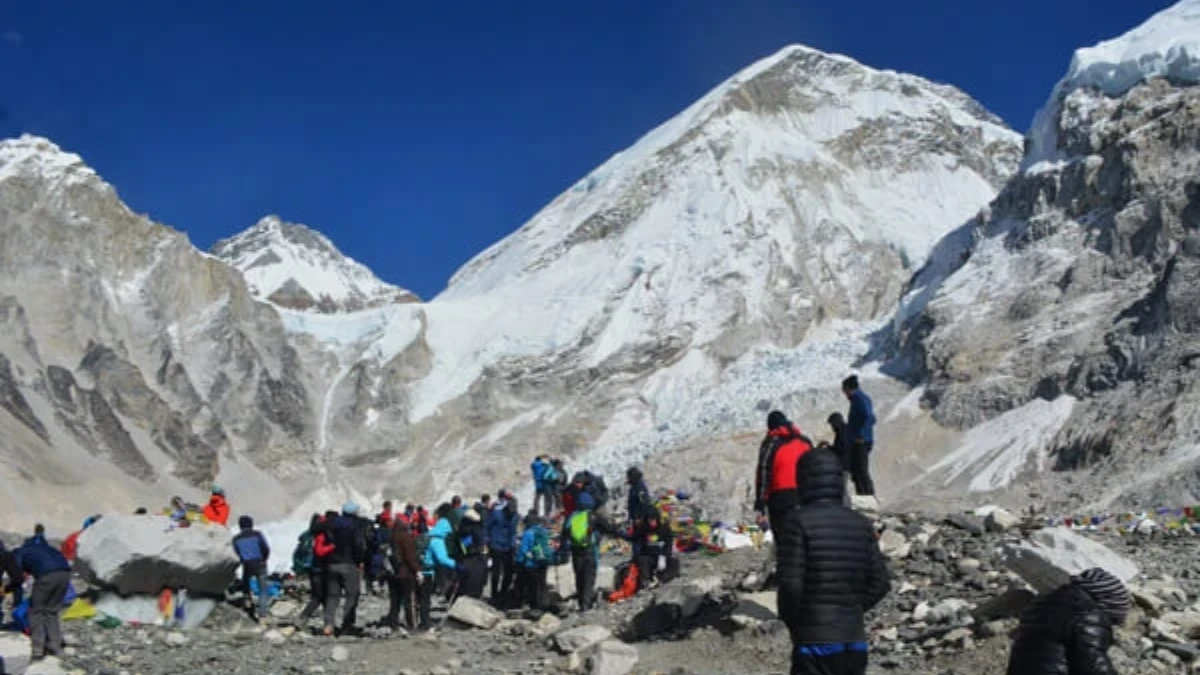
The climb to Thukla Pass (4,830 metres), where the memorials stand, is the steepest sustained climb of the day. The trail switches back and forth across a rocky hillside, gaining three hundred metres in about ninety minutes. The altitude makes the climb feel like climbing a staircase in a building with half the air removed. Your pace drops to twenty steps, then rest. Fifteen steps, then rest. Ten steps, then rest. This is normal. This is what 4,800 metres feels like. Your guide walks beside you at exactly your pace, neither pushing nor patronising, monitoring your breathing and your balance with the specific attention that altitude demands.
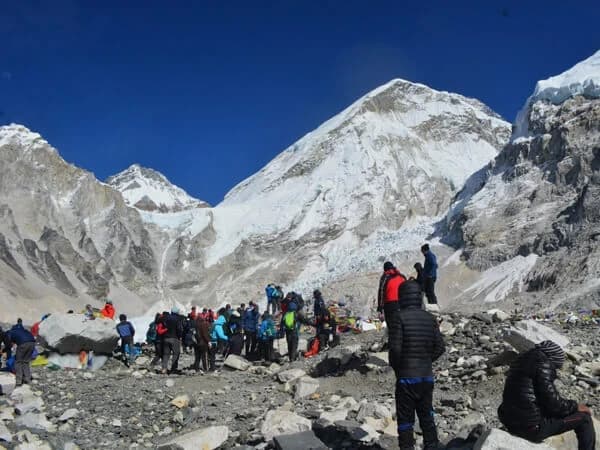
The memorials at Thukla are a mandatory stop, not for logistics but for respect. The cairns cover a broad, flat area at the top of the climb, facing the Khumbu Glacier and the mountains beyond. Most trekkers spend ten to twenty minutes here, reading the plaques, looking at the photographs, and processing the fact that the mountain they are walking toward has taken lives as well as given summits. Some guides share stories, who the people were, how they died, what the mountain was doing on the day it took them. These stories are not meant to frighten. They are meant to contextualise. Everest is not a tourist attraction with safety nets. It is a mountain. And the memorials at Thukla are the mountain's honest disclosure.
Where Can You Stay at Lobuche?
Lobuche has four or five teahouses, the exact number varies as new ones open and old ones close. They are the most basic accommodation on the EBC trail below Gorak Shep: small rooms, thin mattresses, stone walls, tin roofs, and temperatures that drop to minus ten to minus fifteen inside the building at night. There is no insulation. The single-glazed windows frost over by midnight. The bathroom, shared, often outside, is a journey that requires boots, a headlamp, and the specific determination that altitude, cold, and a full bladder produce at three in the morning.
The common room is the social centre, a single room with a stove (burning dried yak dung, which produces a distinctive, not entirely unpleasant smell), wooden benches, and a crowd of trekkers huddled in down jackets drinking tea. The stove is lit in the late afternoon and burns until ten or eleven at night. The temperature difference between the stove side and the wall side of the common room is dramatic, five degrees at the stove, minus five at the wall. Seating position matters. Arrive early.
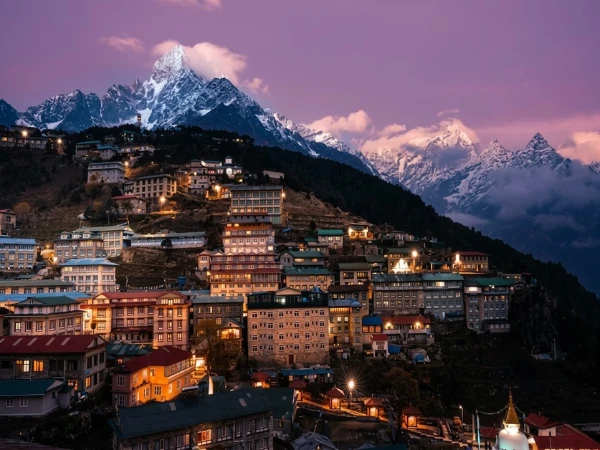
The food is dal bhat and noodle soup. The menu is shorter than at lower teahouses, the logistics of supplying a kitchen at 4,940 metres limit what is possible. Every ingredient arrives on someone's back. The porter who carried your rice walked the same trail you walked, at the same altitude, carrying thirty kilograms. The price of your dal bhat, six hundred to eight hundred rupees, reflects not just the food but the extraordinary physical labour required to bring it here.
Charging devices costs five hundred rupees per device. Wi-Fi, if it exists, is unreliable. Hot showers do not exist. Hot water for washing is available at some teahouses for five hundred rupees, a small basin of lukewarm water that you use standing in a cold bathroom, trying to wash the essential parts before the water and your body temperature both drop below functional.
How High Is Lobuche and How Does the Altitude Feel?
At 4,940 metres, you are in the altitude zone where the human body begins to protest in earnest. The atmospheric pressure is roughly fifty-five percent of sea level. Your blood oxygen saturation, measured by the pulse oximeter your guide clips to your finger every morning and evening, is typically 78-85 percent, down from 95-100 at sea level. Your resting heart rate is elevated by twenty to thirty beats per minute. Your breathing rate is increased. Your appetite is suppressed. And your sleep, which has been getting worse since Dingboche, reaches its nadir at Lobuche.
The sleep at Lobuche deserves its own paragraph because every EBC trekker remembers it. Periodic breathing, the altitude-induced pattern where your body alternates between deep breaths and no breaths at all, wakes you repeatedly through the night. You fall asleep. Your breathing slows. Pauses. Stops. Your brain, registering the oxygen drop, jolts you awake with a gasp. You fall asleep again. The cycle repeats. All night. Every night. The trekker in the next room is experiencing the same thing. The trekker across the hall is experiencing the same thing. The sound of gasping, coughing, and restless movement fills the teahouse like a hospital ward. Nobody sleeps well at Lobuche. Nobody has ever slept well at Lobuche. And the morning, when the guide knocks at five-thirty and you emerge from a sleeping bag that was the only warm thing in the universe into air that is minus ten and a headache that paracetamol does not fully address, is the morning that tests your commitment to the summit.
What Are the Evenings Like at Lobuche?
Despite the cold, the altitude, and the sleep deprivation, the evening at Lobuche has a particular quality that lower stops do not. The trekkers gathered in the common room at Lobuche are two days from Everest Base Camp. They have walked for seven days. They have acclimatised at Namche and Dingboche. They have passed the memorials at Thukla and absorbed what they mean. And they are, at this point, deeply committed, emotionally, physically, and financially, to reaching the destination that has pulled them across the world and up through nine thousand metres of altitude.
The conversation at Lobuche is different from lower stops. There is less small talk. Less comparison of gear and itineraries. More quiet assessment of personal condition, how is the headache, how is the breathing, how much water did you drink today. The guide's evening briefing is listened to with the concentration of soldiers being briefed before an operation, which, in a sense, is what is happening. Tomorrow is Gorak Shep. The day after is Base Camp and Kala Patthar. The plan is simple. The execution, at this altitude, is anything but.
The sunset at Lobuche, if you are willing to step outside the warm common room into the minus-five evening air, is worth the cold. Nuptse's massive wall catches the last light directly above. The Khumbu Glacier, spread below the teahouse like a frozen river of rubble, turns from grey to gold. And the sky, clear, cold, so dark that the first stars appear while the western horizon is still orange, holds the specific emptiness of altitude, where the atmosphere is thin enough to see the blackness of space behind the blue.
What Comes After Lobuche on the EBC Trek?
You leave Lobuche at seven in the morning. The walk to Gorak Shep takes three to four hours across glacier moraine that is the same grey rubble as yesterday but somehow harder, because the altitude has added a hundred metres and the sleep has subtracted two hours and the headache is the specific, pressing, behind-the-eyes headache of 5,000 metres that paracetamol softens but does not remove.
At Gorak Shep, you leave your bags and walk to Everest Base Camp. Or you walk to Kala Patthar for sunrise the next morning. Or both, on consecutive days. And the experience, standing at 5,364 metres on the Khumbu Glacier or 5,545 metres on the summit of Kala Patthar, looking at the highest mountain on earth, is the experience that justified every cold night, every altitude headache, every gasping awakening at Lobuche.
Lobuche is not the destination. It is the price. The price of admission to the highest, coldest, most magnificent section of the EBC trail. And the price, paid in discomfort and determination and the willingness to endure one very bad night's sleep at 4,940 metres, is a price that every trekker who stands at Kala Patthar at sunrise agrees was worth paying.
Lobuche is the last major stop before Gorak Shep and Everest Base Camp on the EBC Trek. Trekkers on the Everest Three Passes Trek pass through Lobuche twice, once before base camp and once after crossing Kongma La.
Lobuche is the last village before Gorak Shep and Everest Base Camp. The altitude is 4,940 metres, the air is thin, and sleep is a negotiation your body usually loses. But the morning view of Nuptse from the lodge window, filling the entire frame with ice and rock and sunrise, is the kind of thing that makes the headache feel like a small price to pay.
Lobuche is night ten on our Everest Base Camp Trek.
The best time to visit Lobuche
At 4,940 metres (16,207 feet), the season makes a real difference at Lobuche. Spring (March to May) and autumn (late September to November) are the two windows trekkers aim for, with the clearest skies and every lodge open; days hover around freezing and nights fall well below minus ten. Winter is bitterly cold with only three or four lodges open, while the summer monsoon leaves the lower forests wet, though Lobuche sits high enough to escape the worst of the rain. For mountain views, late October and early May are about as good as it gets.
What you can see from Lobuche
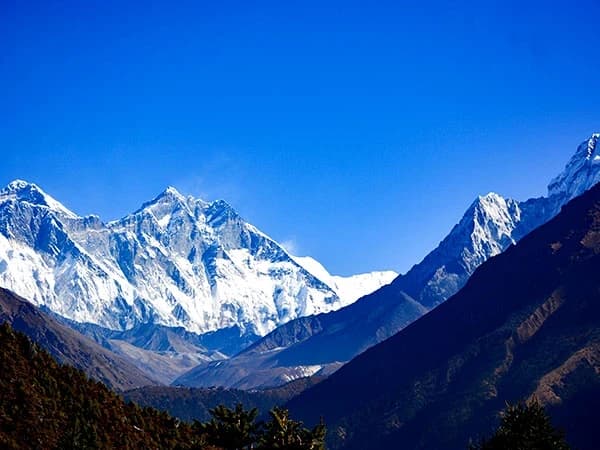
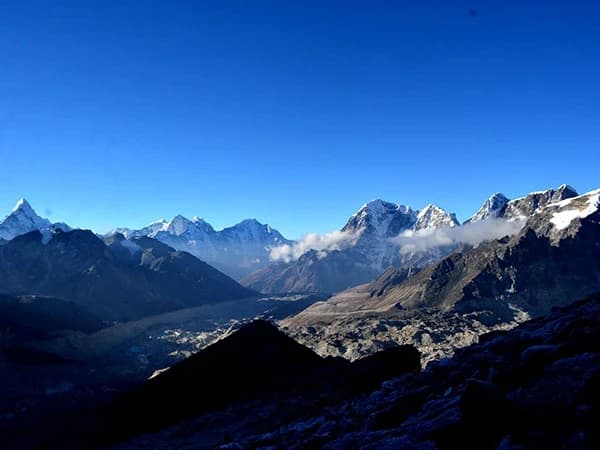
For such a small place, Lobuche is ringed by giants. Pumori (7,161 metres), often called Everest's daughter, rises almost straight ahead, while the vast south face of Nuptse (7,861 metres) and the tip of Lhotse fill the view towards Base Camp. The twin Lobuche East and West peaks that give the village its name climb steeply behind the lodges, and the sharp summits of Cholatse and Tawoche stand out back down the valley, with Ama Dablam appearing from the ridge just above the village. Dawn and dusk are the best, when the light hits the snow.
Which lodges are in Lobuche, and can you book ahead?
The lodges are worth knowing by name. The better-known ones include Mother Earth House, the New EBC Guest House, Oxygen Altitude Home, the Himalayan Eco Lodge and the National Park Hotel, with the 8000 Inn the most comfortable in the village and Alpine Home among the few rooms with an attached bathroom. Beds are genuinely limited this high and fill quickly in peak season, so we book and confirm your Lobuche accommodation in advance as part of your package, which means you are never left looking for a room at 4,940 metres after a long day on the trail.
The Italian Pyramid, and staying there
About fifteen minutes' walk north of the village, set in a side valley at 5,050 metres, stands one of the most unusual sights on the trek: a glass and steel laboratory shaped like an Egyptian pyramid. Built in 1990 by an Italian and Nepali scientific project (Ev-K2-CNR, with the Nepal Academy of Science and Technology), it was once one of the highest research stations in the world, studying weather, altitude and the glaciers. The laboratory has stood largely dormant since Italian funding was cut in 2014, though the building is intact and there are efforts to bring it back into use. There is also a simple Nepali-style lodge at the base of the Pyramid that takes guests overnight, a quiet alternative to the village lodges. If you would rather spend a night there than in Lobuche itself, we can build it into your itinerary.
Staying connected at Lobuche
Mobile signal is patchy this high. Most trekkers pick up an Everest Link Wi-Fi card lower down at Namche or Dingboche, but even that can be slow or drop out entirely at Lobuche, so it is worth downloading offline maps before you climb and letting people at home know you may be out of touch for a day or two.
WhatsApp:+977 9810351300
Email:[email protected]
Written by Shreejan Simkhada, CEO of The Everest Holiday and third-generation Himalayan guide. TAAN Member #1586.
Not every visitor wants Lobuche-level cold and altitude; for the easier-but-still-beautiful options see our Nepal day hikes for non-trekkers guide.
Lobuche is days 9-10 on EBC. Our Everest Base Camp Trek (12 Days) is private (your group only, no strangers), 2027 dates open, From USD $1399. WhatsApp us for tailored 2027 dates and current departures.


 Chat with Shreejan