

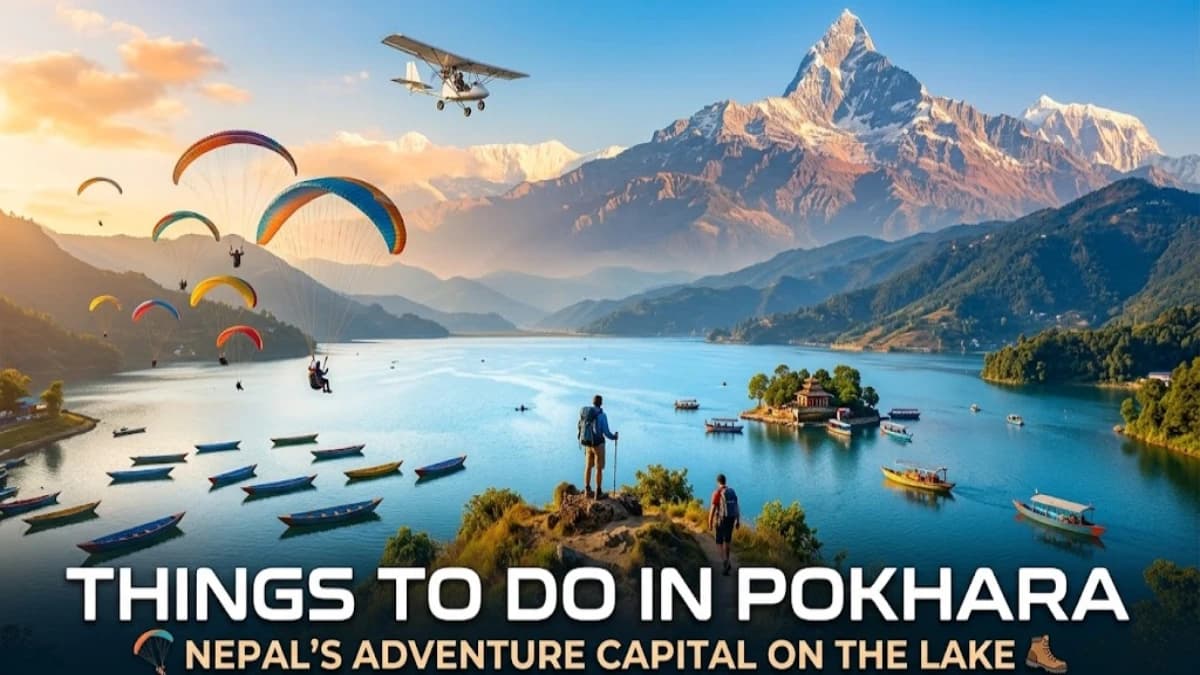
Short answer: Pokhara is Nepal's lake city and the gateway to the Annapurna treks, about 200 km west of Kathmandu. I recommend two days, one before your trek and one after: Sarangkot sunrise, a boat on Phewa Lake, the World Peace Pagoda, and paragliding if you want it. It is calmer and greener than Kathmandu. See it on our Kathmandu and Pokhara tour.
Pokhara exists in two versions. The first is the one in the guidebooks: a lakeside tourist strip with restaurants serving banana pancakes, shops renting paragliders, and bars playing Bob Marley until midnight. Pleasant enough. Forgettable enough.
The second version reveals itself when you leave the lakeside strip and discover the Pokhara that trekkers and locals know: a city cradled in a valley between the Annapurna range and a lake that reflects them, where the world's deepest gorge cuts between two eight-thousand-metre peaks, and the mornings begin with a sunrise that turns Machhapuchhre's sacred Fishtail summit from steel grey to pink to incandescent gold.
Pokhara is the gateway to the Annapurna region. Most trekkers pass through on their way to or from the mountains. But the city itself, when given more than a single night of transit, is one of the most compelling places in Nepal.
How many days do you need in Pokhara?
Two days is the number I recommend: one before your trek and one after. That is enough for the lake, the Sarangkot sunrise and a slow afternoon. Add a third day if you want to paraglide, visit Begnas Lake or take the International Mountain Museum at a relaxed pace. If you are only passing through to start a trek, one night is the minimum, and our Fewa Lake guide shows what you can fit into a single morning.
When is the best time to visit Pokhara?
October to November and March to April give the clearest views of the Annapurna range, and they are the months I would pick. December to February is cold but usually dry and good for the lake and the town, though the higher tea houses on nearby treks can be very cold. June to September is the monsoon: the valley is green and Davis Falls is at its most dramatic, but the mountains are often hidden behind cloud. Our best time to visit Nepal guide goes month by month.
How do you get to Pokhara from Kathmandu?
You can fly, which takes about 25 minutes, or take the tourist bus, which takes about 7 hours. The flight saves a day and gives you views of the Annapurna range from the window; the bus is slower but shows you the river valleys and terraced hillsides. If you are coming back from a trek with tired legs, the flight is the easier choice. Our Kathmandu to Pokhara transport guide compares the options, and our Sarangkot sunrise guide covers the best viewpoint once you arrive.
What Should You Do in Pokhara Before Your Trek?
What Is Fewa Lake Like at Dawn?
Rent a rowboat before the motor boats start. Six in the morning. The lake is glass. The Annapurna range reflects in the water with such precision that for a moment you cannot tell which mountains are real and which are reflection. The small island temple, Tal Barahi, sits in the centre of the lake, accessible only by boat, with bells that ring across the water when morning devotees arrive.
This is not a tourist activity. It is a meditation disguised as a boat ride.
Is the Sarangkot Sunrise Worth Getting Up For?
A thirty-minute drive from Lakeside to a hilltop at 1,592 metres. The viewing platform faces the full breadth of the Annapurna range, from Dhaulagiri in the west to Manaslu in the east, with Machhapuchhre directly ahead. The sunrise here is the Pokhara version of Poon Hill, less altitude, equally spectacular, and accessible without days of trekking.
Go early. The first light hits Machhapuchhre around five thirty in spring and autumn. The tourist buses arrive at six. The window of quiet perfection between the two is narrow and precious.
Paragliding
Pokhara is one of the best paragliding locations on earth, not because the thermals are exceptional (they are good, not extraordinary) but because the scenery is unmatched. You launch from Sarangkot at 1,500 metres and fly for twenty to thirty minutes above the valley with Fewa Lake below and the Annapurna range ahead. The pilots are experienced and the safety record is strong.
Tandem flights cost eighty to one hundred and twenty dollars. No experience required. You sit in a harness, the pilot runs, and suddenly you are airborne with mountains in every direction and the strange, disorienting pleasure of seeing Pokhara from a perspective that even the trekkers on the ridgeline above cannot access.
The International Mountain Museum
An underrated attraction south of Lakeside. The museum covers the history of Himalayan mountaineering from the first surveys to the modern era. Models of every eight-thousand-metre peak. Gear used by legendary expeditions. Photographs of the mountains from angles that trekkers cannot reach. If you are about to trek in the Annapurna region, an hour here gives you context that makes the mountains ahead more meaningful. Related: Pokhara Zipline Guide: Is It Worth the Adrenaline Rush?
After Your Trek
You return from the mountains with tired legs, a sunburnt nose, and an appetite that dal bhat alone cannot satisfy. Pokhara is the perfect recovery city.
Lakeside Restaurants
The Lakeside strip has restaurants serving every cuisine imaginable, Nepali, Tibetan, Indian, Italian, Mexican, Japanese, Korean. After days of teahouse food, the variety feels luxurious. The quality varies from excellent to forgettable, but the lakeside setting, eating pizza with Machhapuchhre reflected in the water, elevates even average food into a memorable meal.
For Nepali food done properly, leave the tourist strip. Pokhara Thakali Kitchen serves the regional Thakali thali that the Annapurna Circuit's Marpha village is famous for. The Newari restaurants in the old town, Pokhara Bazaar, away from Lakeside, serve local dishes that the tourist menus never include.
Davis Falls and Gupteshwor Cave
Davis Falls is a waterfall that drops into a narrow gorge and disappears underground. In monsoon, the volume is extraordinary, a river simply vanishing into the earth. Below the falls, Gupteshwor Cave follows the underground river for several hundred metres past stalactites, stalagmites, and a shrine to Shiva that monks maintain in the dark.
Together they take about an hour and cost a few hundred rupees. Not world-changing. But if you have a free afternoon and want to see something unexpected, a river that drops into a hole in the ground and reappears inside a cave half a kilometre away is worth the detour.
Begnas Lake
Thirty minutes east of Lakeside. A quieter, less developed lake with no motor boats, no tourist strip, and a fraction of Fewa's visitors. Rent a rowboat. Have lunch at a lakeside restaurant. Watch the fishermen. Begnas is what Fewa Lake looked like thirty years ago, peaceful, rural, genuinely Nepali in a way that Lakeside is not.
Cycling the Valley
Rent a bicycle from Lakeside and ride south along the Seti River gorge, a surreal crack in the earth that runs through the city, sometimes only a few metres wide but hundreds of metres deep. The gorge is visible from several bridges and platforms. Looking down into the chasm where the river roars invisibly far below is one of Pokhara's strangest and most compelling sights.
Continue to the World Peace Pagoda, a white stupa built by Japanese monks on a hilltop south of the lake. The ride is hilly but manageable. The views from the pagoda, Fewa Lake, the Annapurna range, the city spread between them, are exceptional.
Pokhara Beyond Tourism
The old bazaar, Pokhara's original market area, north of Lakeside, is where the city lives its non-tourist life. Spice shops. Fabric stores. Tea stalls where men argue about politics over clay cups. The architecture is Newari, brick and wood, carved windows, internal courtyards that hide from the street. Walking through the bazaar for an hour gives you a Pokhara that the Lakeside strip cannot: a real Nepali city going about its business in the shadow of the world's most dramatic mountain range.
Pokhara deserves two days. One before your trek. One after. The mountains will define your Nepal trip. But the mornings on the lake, the sunsets from Sarangkot, the flight above the valley, and the quiet of Begnas will shape how you remember them.
Base yourself in Pokhara for our Annapurna Base Camp Trek, Poon Hill Trek, or Kathmandu and Pokhara Tour.
Pokhara is the town where trekkers recover, paragliders launch, and the lake reflects Machhapuchhre every morning. If Kathmandu is Nepal's brain, Pokhara is its heart. Spend at least two days here: one before your trek to acclimatise, one after to celebrate. The lakeside restaurants, the boat rides, and the sunset from the Peace Pagoda are all worth your time.
Pokhara is included in most of our Annapurna region packages. Ask us about extending your stay.
WhatsApp:+977 9810351300
Email:[email protected]
Written by Shreejan Simkhada, CEO of The Everest Holiday and third-generation Himalayan guide. TAAN Member #1586.
Pokhara highlights: days 4 and 5 on our Kathmandu and Pokhara tour. Our Kathmandu & Pokhara Tour (7 Days) is private (your group only, no strangers), 2027 dates open, From USD $749. WhatsApp us for tailored 2027 dates and current departures.

 Chat with Shreejan