


Written by Shreejan Simkhada, CEO of The Everest Holiday and third-generation Himalayan guide. TAAN Member #1586.
Machhermo is where the Gokyo valley makes you slow down. It sits at 4,470 metres on the way up the Dudh Koshi towards the lakes, and almost every trekker spends a night here whether they planned to or not, because this is the altitude where the body starts to complain and the smart move is to stop and let it catch up. It is also home to the strangest story on the whole trail. If your trek goes to Gokyo, you are sleeping in Machhermo.
Machhermo at a glance
| Altitude | 4,470 m (14,665 ft), in the Gokyo valley of the Khumbu |
| Region | Sagarmatha National Park (a UNESCO World Heritage Site) |
| On the trail | The Gokyo Lakes route, one day below Gokyo and above Dole |
| Why you stop | The key acclimatisation night before Gokyo |
| The views | Kangtega, Thamserku and the first sight of Cho Oyu (8,188 m), the world's sixth-highest mountain |
| Facilities | A handful of seasonal lodges, no shops and no doctor |
| Trek it on | Gokyo Valley Lakes Trek, EBC with Gokyo and Cho La |
Where is Machhermo and how do you reach it?
Machhermo lies in the Gokyo valley, the quieter western branch of the Khumbu that carries roughly a fifth of the traffic of the main Everest Base Camp trail. Coming up from Namche Bazaar, the route climbs through Dole and Luza to reach Machhermo in two days, following the Dudh Koshi as the valley opens out and the tree line falls away behind you. From Machhermo it is a half-day on to Gokyo and its lakes. There is no road and no flight; you walk in, gaining height slowly, which is exactly the point. Related: Dole: The Gokyo Valley's First Night, Where the Trees Stop.
Why is Machhermo the key acclimatisation stop?
By Machhermo you are at 4,470 metres, and the jump from here to Gokyo at 4,790 metres and then to Gokyo Ri at 5,357 metres is where altitude sickness catches people out if they rush. Spending a proper night at Machhermo, ideally with an afternoon walk up the ridge behind the village and back down to sleep, is what makes the rest of the Gokyo trek safe and enjoyable. I build the Gokyo itineraries around a real stop here rather than pushing straight through, because the trekkers who take Machhermo seriously are the ones who stand on Gokyo Ri feeling strong instead of sick.
Medical help in the Gokyo valley
For years Machhermo had a volunteer rescue post, run by the International Porter Protection Group with doctors in the trekking seasons. It closed after the 2019 season. The Himalayan Rescue Association does not run an aid post here; its nearest one is at Pheriche, in the next valley over the Cho La. So plan as if there is no doctor in the Gokyo valley. That is one more reason to take the acclimatisation night here seriously, to tell your guide about a headache early rather than late, and to carry travel insurance that covers helicopter evacuation. If symptoms get worse, the treatment is to go down, and from Machhermo that means Dole or lower.
The Machhermo yeti story
Machhermo has a genuine place in Himalayan folklore. In 1974 a young Sherpa woman herding yaks near the village reported being attacked by a creature she could not identify, which also killed several of her animals. The account was taken seriously enough to be recorded at the time, and whatever you make of it, it is the most famous yeti incident in Nepal and it happened right here. Ask your guide to point out the spot. It is a good story to hear over dal bhat at 4,470 metres with the wind coming down off Cho Oyu.
What can you see from Machhermo?
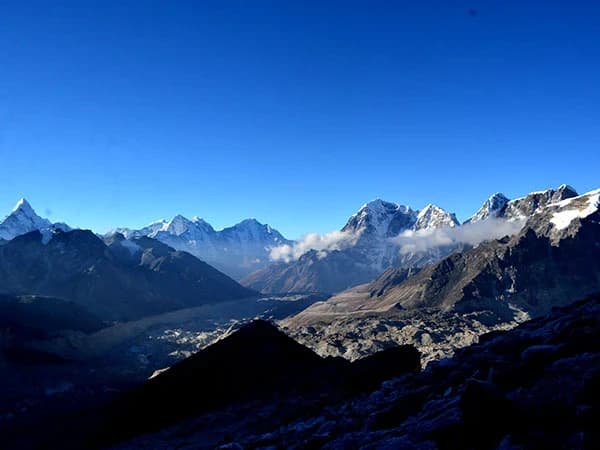
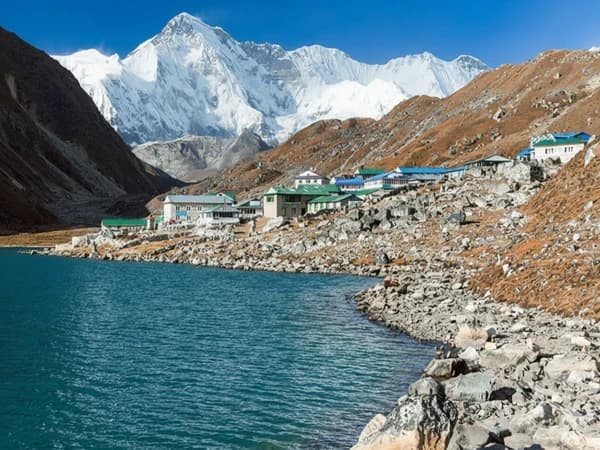
The valley here is wide and the peaks are close. Kangtega and Thamserku rise sharply to the south, the way you came, and ahead to the north the great white bulk of Cho Oyu, the sixth-highest mountain in the world at 8,188 metres, begins to fill the head of the valley. Machhermo Ri, the ridge directly above the village, is the acclimatisation walk that gives the widest view and the best use of a spare afternoon.
What facilities does Machhermo have?
Machhermo is a small seasonal settlement of teahouse lodges that open for the two trekking seasons. Expect a simple room, a warm communal dining hall, the standard trekking menu built around dal bhat. Phone signal is patchy, hot showers and charging cost extra and get pricier the higher you go. Carry up what you need from Namche; this is not a resupply point.
When is the best time to trek to Machhermo?
The Gokyo valley follows the same seasons as the rest of the Khumbu. October and November give the clearest, most stable weather and the sharpest views of Cho Oyu. Late March to May is the warmer spring season, also excellent. Winter is clear but bitterly cold and most lodges close; the monsoon hides the peaks. Whenever you come, do not skip the acclimatisation night here to save a day.
Common questions about Machhermo
How high is Machhermo? The village sits at 4,470 metres. The next stop, Gokyo, is at 4,790 metres, and Gokyo Ri above it reaches 5,357 metres.
Is there a doctor in Machhermo? No. The volunteer rescue post that used to run here closed after the 2019 season, and the nearest Himalayan Rescue Association aid post is at Pheriche, on the other side of the Cho La. Plan as if there is no doctor in the Gokyo valley, and make sure your insurance covers helicopter evacuation.
Do I need a permit and guide for the Gokyo valley? Yes. You need the Sagarmatha National Park permit, the Khumbu Pasang Lhamu Rural Municipality permit and a TIMS card, and a licensed guide is required on the route. We arrange all of it.
Is Gokyo less crowded than Everest Base Camp? Considerably. The Gokyo valley carries roughly a fifth of the traffic of the main Base Camp corridor, which is a large part of its appeal.
Machhermo is the gateway to the Gokyo lakes. We run it on the Gokyo Valley Lakes Trek and the Everest Base Camp with Gokyo Lakes and Cho La Pass, private, with a proper acclimatisation night built in, 2027 dates open. WhatsApp us for current departures.
Machhermo sits within Sagarmatha National Park, managed by Nepal's Department of National Parks and Wildlife Conservation.
Shreejan Simkhada is the CEO and co-founder of The Everest Holiday, a family-run trekking company in Kathmandu, and a third-generation Himalayan guide. TAAN Member #1586. Every booking helps fund our Nagarjun Learning Center.


 Chat with Shreejan