
Month-specific guide to the Langtang Valley trek in October. Weather, crowd levels, Kyanjin Gompa conditions, Tserko Ri summit, and why Langtang is Nepal best-kept secret.
Govt Regd. No.: 147653/072/073
Travel Agency Licence: 2838/072
Langtang Trek in October: Quiet Trails and Big Mountains Close to Kathmandu

Last updated 2 October 2026. This post was written for a normal October. This year is not normal, so the first thing you need is the road position, and I have put it before everything else.
Can you trek Langtang in October 2026?
Not at the moment, and I will not sell it until the road is open. As at 1 October the Rasuwa and Trishuli road had been closed since the flood of 26 August and still did not reach Syabrubesi, where the Langtang trek starts. This is what has been reported, with dates:
- The Kathmandu Post (1 October) said the Bhotekoshi flood left Rasuwa and Nuwakot with no direct road link. A team was heading to Syaphrubesi to install two Bailey bridges, one of 73 m over the Phalaku river and one of 76 m over the Bhotekoshi, "after which Syaphrubesi bazar will regain road connectivity".
- Onlinekhabar (1 October) reported that a temporary track had opened on the Galchhi to Betrawati road, with a Bailey bridge targeted within about a week. The report does not say the track reaches Syabrubesi, and it does not say which vehicles can use it.
- Onlinekhabar (2 October) reported that Bailey bridge work had begun at Betrawati, with the foundations on both sides complete. It gave no completion date.
- Onlinekhabar (1 October) also reported displaced Syabrubesi residents, which tells you the village itself was badly hit.
A bridge near Betrawati is one link in a long chain. Between the capital and the trailhead there are also the Rasuwa side of the road, the town of Syabrubesi and the lodges you would sleep in. I have no reopening date for any of them. Our full position is on the Langtang status page, and I update that page as news comes in.
Our policy is simple. We confirm the road 48 hours before departure. If it is shut, we find you an alternative route or a different starting point and we tell you before you travel. For Langtang that realistically means one of two things: you reschedule to a date when the road is open, or you switch to a trek that starts from Pokhara. If you reschedule, it is free with at least 72 hours' notice, to any date within one year. The rest of this post tells you what October on the Langtang trail is like once you can get there, because that is what you were looking for.
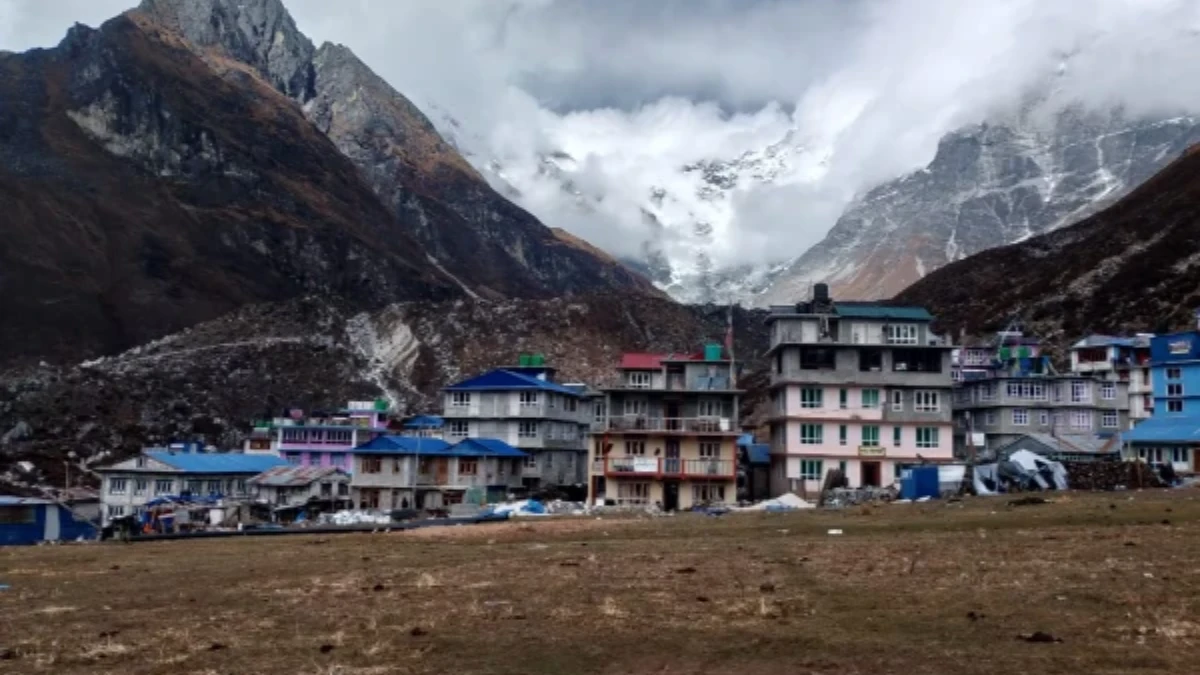
Why is October the favourite month for Langtang?
The monsoon has finished, the air is washed clear and the views of the valley's big peaks are at their sharpest. Langtang is also quieter than Everest and Annapurna in the same month. The Langtang Valley trek is the third most popular trek in Nepal after the Annapurna Circuit and Everest Base Camp, so it has plenty of trekkers in a normal year, but on the trail you will usually meet fewer groups than on those two. This is my experience from guiding the route, not a count.
The trail also changes character as it climbs. It leaves subtropical forest behind, passes the old Tamang villages and ends in glacial moraine at Kyanjin Gompa. Swiss cheese-making was introduced in Langtang in the 1950s and production continues in the valley today.
What is the weather in October?
I have no weather-station reading for the Langtang trail itself. The nearest station with published data is Dhunche, at 1,982 m, which is lower than Langtang village and a different valley, so read it as a guide to the lower section only. The figures are monthly averages for Dhunche from the Australian National University and JICA.
| Dhunche, 1,982 m | October | November | December |
|---|---|---|---|
| Average high | 21.7 °C | 17.3 °C | 14.4 °C |
| Average low | 10.5 °C | 5.8 °C | 2.9 °C |
| Rainfall | 94.4 mm | 26.1 mm | 25.7 mm |
The October rainfall is the point to notice. It is much higher than November, which is why the first week of October can still bring rain at the lower altitudes. Higher up, at Langtang village and Kyanjin Gompa, there are no station figures, so I won't give you a number. The nearest high-altitude reading is Manang Airport at 3,401 m in the Annapurna region (Department of Hydrology and Meteorology, 1991 to 2020): an October average of 14.6 °C by day and 0.9 °C at night, falling to 11.6 / -4.4 °C in November. Manang is a different and drier valley, so it only tells you the order of magnitude, but it is why we pack for frost at Kyanjin.
What does our 8-day Langtang itinerary look like?
This is the plan from our live itinerary. Day 1 is a drive, and the trek begins on day 2. The distances and times are as printed on the itinerary and are approximate.
| Day | Route | Sleep | Distance and time |
|---|---|---|---|
| 1 | Drive Kathmandu to Syabrubesi | About 1,500 m | 122 km, 7 to 9 hours |
| 2 | Syabrubesi to Lama Hotel | 2,470 m | 11.3 km, about 6 hours |
| 3 | Lama Hotel to Langtang village | 3,430 m | 14.8 km, about 6 hours |
| 4 | Langtang village to Kyanjin Gompa | 3,870 m | 6.8 km, about 3 hours |
| 5 | Rest day and exploring at Kyanjin | 3,870 m | Short walks |
| 6 | Kyanjin Gompa to Lama Hotel | 2,470 m | 21 km, 7 to 8 hours |
| 7 | Lama Hotel to Syabrubesi | About 1,500 m | Walk down |
| 8 | Drive to Kathmandu | 7 to 9 hours |
The Syabrubesi roadhead is 113 km from Kathmandu and the drive 6 to 8 hours by one published account, a little different from our itinerary figures because of how each is measured. Whichever you use, the first day is a long day on the road, and you start walking the next morning. Our older version of this post said you could start walking the same afternoon. I have removed that, because it does not match our own itinerary.
The rest day at Kyanjin is where you choose between the short climb of Kyanjin Ri or the longer day on Tserko Ri. Kyanjin Ri and Tsergo Ri are easy-to-climb peaks of around 5,000 m, so allow for altitude on either. I have a full post on Tserko Ri and one on Langtang distances.
Is Langtang safe after the 2015 earthquake and the 2026 flood?
The two events are different, and I would rather not blur them. Langtang village was destroyed in the 2015 earthquake and rebuilt, and the valley's lodges are largely new. That story is in Langtang 2026: rebuilt, with an honest update. The August 2026 flood is a separate matter. It came down the Bhotekoshi valley and hit the road and Syabrubesi, not the Langtang Khola trail above it (our own post of 29 September). So the open questions are the road, the town and the bridges, not the trail. I said "fully rebuilt and safe" in the older version of this post, and that was true of the trail before August. It is not a statement I can make about the road today.
Can you extend to Gosaikunda in October?
In a normal year, yes, as a longer trek. Gosaikunda lake is at 4,380 m and the Laurebina La pass at 4,610 m, and the lake stays frozen for about six months, from October to June. That means you would see it with ice forming from the first days of the season, and the pass can hold snow earlier than the valley does. The pass depends on the weather in the week you go. We run this route as our Langtang Gosainkunda trek (13 days), and it depends on the same road.
What should you pack?
Langtang is lower than Everest, but the nights at Kyanjin are still cold. Bring a down jacket, thermal base layers, a fleece, a waterproof shell, a warm hat and gloves, and a warm sleeping bag or liner. For the lower forest section in early October, lighter layers and a sun hat are enough during the day. We provide a sleeping bag and a down jacket on every tier, and a duffel bag on Standard and Luxury. These items are in our package list, so check the page for your tier.
What does it cost, and how are porters handled?
The 8-day Langtang trek is from US$365 Budget, US$650 Standard and US$1,000 Luxury per person for one traveller, and less per person for larger groups. On Budget you carry your own bag and meals are not included. On Standard you have all meals and one porter for every two trekkers, so a solo Standard trekker has no porter and the guide carries up to 10 kg. On Luxury you have a dedicated porter and all meals with fruit and nuts. Kathmandu hotels are not included on any trek. A 10 per cent deposit holds your dates and you pay the balance in Kathmandu. A card payment of the balance carries a 3.5 per cent charge, and we do not take Nepali rupees from foreign guests. The deposit is non-refundable. If we cannot run your trip, we refund what you paid less taxes, bank and card charges and money already spent on permits or flights. Insurance must be bought at home.
For permits, the Langtang National Park fee is NPR 3,000 plus 13 per cent VAT and the TIMS card is NPR 2,000. We arrange both for every trekker. The permits guide carries the current figures.
Who should wait?
Anyone with fixed dates this month and no flexibility, because the road is not open and I cannot give you a day. Anyone who would not enjoy a rescheduled start. If you want to trek this October, the open options start from Pokhara or Kathmandu, and I have set them out in Trekking Nepal in November 2026 and Nepal treks open after the Rasuwa flood. For the cold season after, see Langtang in November and December. If you want the place-by-place stays, see best teahouses on the Langtang trek.
Message me with your dates on WhatsApp, +977 9810351300, or email [email protected], and I will give you the road position that day.
Sources: Department of Immigration and Nepal Tourism Board (permit fees); Department of Hydrology and Meteorology for Manang Airport figures (1991 to 2020); Australian National University and JICA for Dhunche. Road position: Kathmandu Post 1 October 2026, Onlinekhabar 1 and 2 October 2026.
About The Everest Holiday
We are a family company in Kathmandu, three generations of Himalayan guides, registered in 2016 and a member of the Trekking Agencies' Association of Nepal, number 1586. When you book with us you deal with the family, not a call centre.
Every booking helps fund our Nagarjun Learning Center. We fully run the centre at Saldum, where 70 children learn with a teacher I pay for personally.
Written by Shreejan Simkhada, CEO of The Everest Holiday and third-generation Himalayan guide. TAAN Member #1586.
Langtang is not open for starts at the moment. Our Langtang Trek (8 Days) is private (your group only, no strangers), from USD $365. WhatsApp us for dates and the current road position.
Planning a trip to Nepal?
Drop us your details and tell us what you have in mind. We will put together a personalised plan and get back to you.
Not sure which Nepal trek is right for you?
Take our free 2-minute quiz and get personalised recommendations based on your fitness, experience, and travel style.
Find Your Perfect Trek →Need Help? Call Us+977 9810351300orChat with us on WhatsApp
Latest Travel Blogs
Trekking in Nepal in September 2027: Weather, Best Treks and Departures
Plan a September 2027 trek in Nepal: monsoon-tail weather, why Upper Mustang works, which treks to avoid and our departures on 6, 13, 20 and 27 September.
Read More
Trekking in Nepal in March 2027: Weather, Best Treks and Departures
Plan a March 2027 trek in Nepal: weather figures, the treks that suit the month, crowds, festivals and our departures on 8, 15, 22 and 29 March.
Read More
Trekking in Nepal in April 2027: Weather, Best Treks and Departures
Plan an April 2027 trek in Nepal: weather figures, the treks that suit the month, crowds, the Manthali flights and our departures on 5, 12, 19 and 26 April.
Read More Chat with Shreejan