Why autumn is the best time for Everest Base Camp. October vs November, weather, crowds, temperatures, and what to expect. By a guide who treks EBC every autumn.
Govt Regd. No.: 147653/072/073
Travel Agency Licence: 2838/072
Everest Base Camp Trek in Autumn: Why October and November Are the Best Months

Last updated 2 October 2026. This page replaces my separate October guide, so everything about autumn on the Everest trail is now in one place. The temperature and rain tables are published station averages, not forecasts, and I name the source of each. Above Dingboche there is no station data. Crowd and flight comments come from what our guides see, and I label them that way.
The short answer: October and November are the two best months for the Everest Base Camp trek, but they are different treks. October is the warmest and the busiest, with the most reliable lodges and the highest chance of a bed. November is colder, clearer and quieter, and the second half of it is properly cold at night. Early October can still carry rain (Lukla averages 102.9 mm of rain in October against 6.2 mm in November), so the driest, steadiest stretch of the year is roughly mid-October to mid-November. If I had to pick one window for a first-timer, that is it.
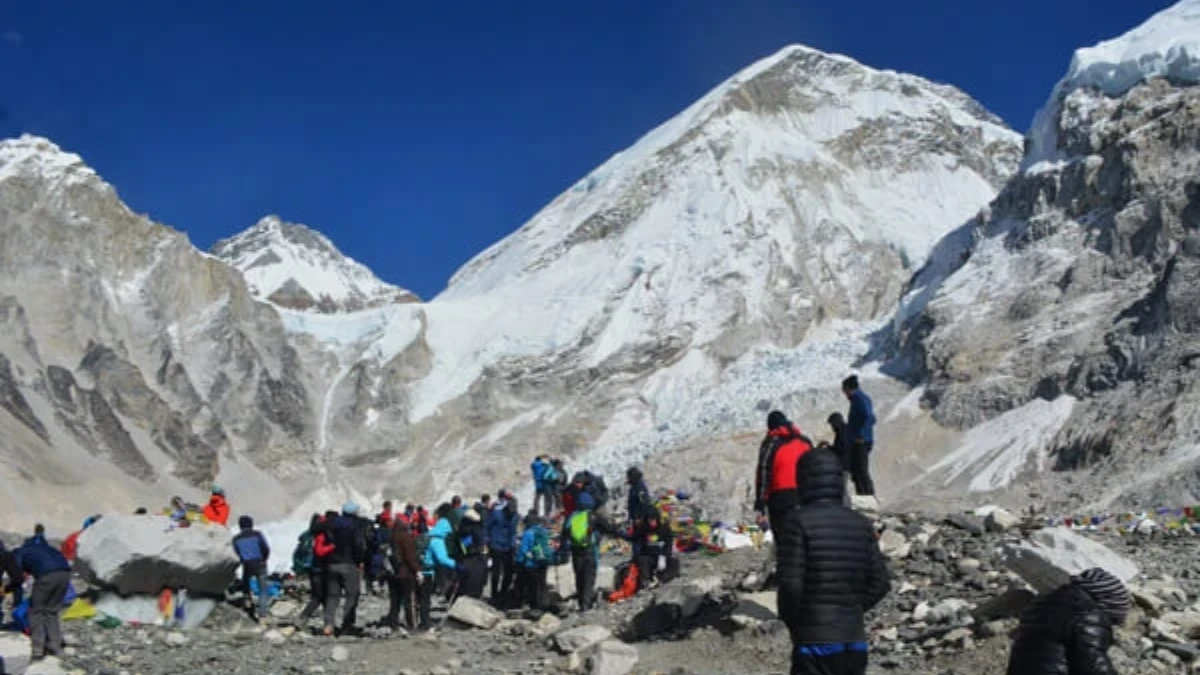
Our guides walk the Everest trail in every season. Autumn is my favourite, but it is not perfect: it is crowded, the nights get cold quickly after mid-November, and flights to Lukla are never guaranteed. Below is the honest version, with numbers where they exist. If you are still choosing between seasons, my best time to trek to Everest Base Camp guide is the decision page, and my month-by-month weather guide covers all twelve months. If you already know you are going in autumn and want the trek itself, it is our Everest Base Camp trek, 12 days, from US$1,399 Budget, US$2,785 Standard and US$4,999 Luxury.
Why is autumn the best season for Everest Base Camp?
Three practical reasons. First, the monsoon has finished. Nepal's wet season runs roughly June to mid-September, and Lukla's weather record shows it: June to September brings about 84 per cent of the year's rain there. After that the air is dry. Second, visibility. Four months of rain clean the air, so October mornings are the sharpest of the year, and the pre-monsoon haze that softens spring afternoons has not built up yet. Third, the infrastructure is fully switched on: lodges are open and staffed, and the trail is in its best condition after the rains.
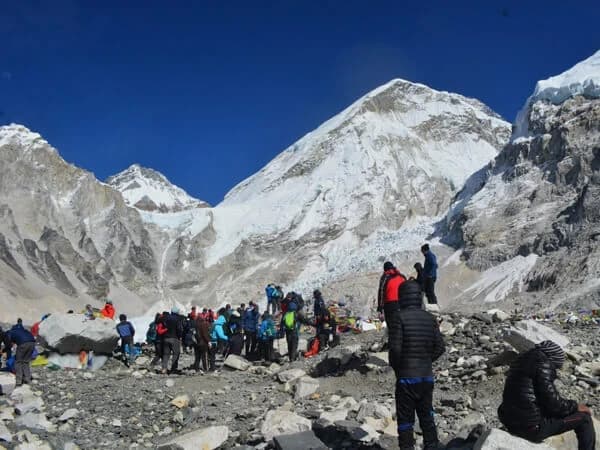
This does not mean every day is clear. Snow at Gorak Shep in October is possible. It means the odds of several clear days in a row are better than in any other season. At Gorak Shep, the last village before Base Camp, March to April and October to November are the best seasons, and in December to February most accommodation there is closed.
What are the temperatures on the Everest trail in October and November?
There is no weather station at Base Camp with a long record, so I use the four stations along the route that have one: Lukla (2,786 m), Namche Bazaar (3,450 m), Tengboche (3,857 m) and Dingboche (4,410 m, modelled data, not an instrument record). Each cell is the average daily high, then the average daily low, in degrees Celsius, with monthly rain in millimetres.
| Station | October high / low | October rain | November high / low | November rain |
|---|---|---|---|---|
| Lukla 2,786 m | 16.8 / 7.4 | 102.9 mm | 13.8 / 2.4 | 6.2 mm |
| Namche 3,450 m | 12.5 / 1.2 | 57 mm | 9.1 / -3.8 | 11 mm |
| Tengboche 3,857 m | 12.0 / -1.7 | 72.1 mm | 8.1 / -6.9 | 3.0 mm |
| Dingboche 4,410 m (modelled) | 8.9 / -5.3 | 31 mm | 5.3 / -11.0 | 2 mm |
Sources: Lukla, Nepal Department of Hydrology and Meteorology 1991 to 2020 normals. Namche, FAO FAOCLIM. Tengboche, FAO and the Australian National University record. Dingboche, (a computer model, so a guide, not a measurement).
What the numbers say in plain words: the average night at Dingboche drops from -5.3 degrees in October to -11.0 in November, almost six degrees in one month. At Namche the average low goes from above zero to below it, and Lukla's average low falls from 7.4 to 2.4 degrees.
Above Dingboche I have no station to quote. A rough guide: the standard atmosphere cools by about 6.5 degrees for every 1,000 m of height (ICAO standard atmosphere). Gorak Shep is about 750 m above Dingboche, so subtract roughly 5 degrees from Dingboche's modelled lows. That puts an average October night near -10 and an average November night near -16 degrees. This is calculated from a standard formula, not a measurement, and a clear night in a valley can be colder than the formula suggests. It is why I tell everyone to pack for the cold end.
October or November: which is better?
They are different treks, so here is the honest split.
October. Warmer, longer days, and the lower valleys are still green. The sky is a deep blue that looks edited but is not. The catch is that everyone knows it. Lodges above Namche fill by early afternoon, and if you arrive at Dingboche at 3 pm you may be offered the last room or overflow accommodation. There is also competition for beds at Gorak Shep in the autumn season. The first half of October can bring afternoon showers, which the Lukla rainfall figure above reflects. One more October risk is worth saying plainly: in my experience, in two of the last few autumns the tail of a Bay of Bengal cyclone clipped Nepal in the last week of October, with a few days of heavy snow and cloud high up and Lukla flights grounded. It is not every year. It is the reason I tell people to leave a spare day at the end.
November. Colder, quieter and more dramatic. The first half is my favourite stretch of the whole year: the October crowds have gone, the weather is still clear, and the cold is real but manageable. The second half is different. Our guides say nights at Gorak Shep are minus ten or colder, some lodges above Lobuche start closing for winter, and the days are short. The views, though, can be the best of the year: crystal air, fresh snow on the peaks and Kala Patthar almost to yourself at sunrise.
Daylight is the quiet difference between them. These are published sunrise and sunset times for Kathmandu in 2026; the Everest valleys have the same day length but lose the low sun earlier behind the ridges, so real walking light is shorter.
| Date (2026) | Sunrise | Sunset | Day length |
|---|---|---|---|
| 1 October | 5:55 | 17:51 | 11 h 56 min |
| 15 October | 6:02 | 17:36 | 11 h 34 min |
| 1 November | 6:13 | 17:21 | 11 h 08 min |
| 15 November | 6:23 | 17:13 | 10 h 50 min |
| 30 November | 6:34 | 17:09 | 10 h 35 min |
So you lose about an hour and twenty minutes of daylight between the start of October and the end of November. That matters on the long days (Dingboche to Lobuche, and the Base Camp day), and it is why we start early.
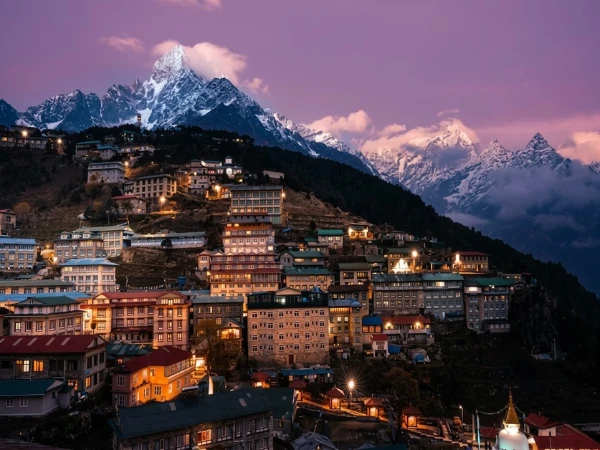
What does a typical autumn day look like on the trail?
The pattern is predictable even when the temperatures are not. This is guide experience, not station data.
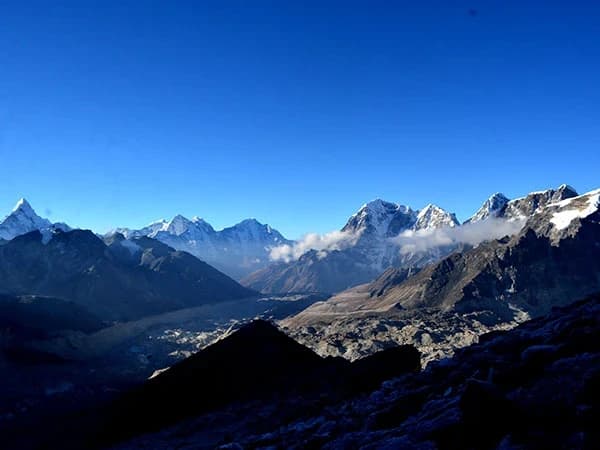
- Early morning (about 5:30 to 9 am). Cold and clear. This is when Everest, Lhotse and Ama Dablam are at their sharpest. Start walking early to use it.
- Mid-morning to early afternoon. Warming. The most comfortable walking window, and you shed layers steadily.
- Afternoon. Cloud builds from the south, and the big views often disappear by 2 pm. Light showers or snow above 4,000 m are possible in October and less likely in November. Arriving at a lodge in the afternoon means you have already missed the best light.
- Evening and night. The cloud often clears again as it cools, and the stars at altitude are extraordinary. The coldest hour is usually just before dawn.
How busy is the trail in October and November?
I can only be partly precise here. Approximately 40,000 people trek to Everest Base Camp from Lukla each year, and beds are competed for in autumn. There is no published daily count for the park entrance at Monjo that we know of, so I don't quote one. My own experience, and what our guides report, is this: October, especially the weeks around 10 to 30 October, is the busiest. You will pass or be passed by groups regularly between Lukla and Namche, the suspension bridges and Namche's narrow streets are the bottlenecks, and above Dingboche the numbers thin. Early November is clearly quieter, and by late November you can walk for an hour without seeing another group. Even in October it is nothing like a queue on a continuous line; you are just aware of other trekkers all day.
Two festivals shift the picture. The Nepal government holiday notice lists Dashain as 17 to 23 October 2026 and Tihar as 8 to 12 November 2026 (Nepali calendar, read 2 October). During those days many Nepalis travel, domestic flights are heavily booked, some Kathmandu shops close for several days, government offices are shut so last-minute paperwork can slip, and small lodges on the trail may close while staff go home. Larger lodges stay open. I plan our departures around the dates. If you are in Kathmandu for Tihar, the lamps and marigold garlands are worth the change of schedule.
How do I beat the October crowds?
- Leave early. Setting off at 6:30 to 7:00 am puts you ahead of most groups on the narrow sections and gets you to the next lodge before the afternoon rush for rooms.
- Take a second Kala Patthar morning if the first one clouds over. Your guide will tell you if a spare morning at Gorak Shep makes sense.
- Choose another route. The Everest Base Camp with Gokyo Lakes via Cho La Pass trek follows the same approach to Namche and then branches west to the Gokyo valley, which carries a fraction of the main-trail traffic, and still reaches Base Camp.
- Shift your dates. Mid-October to early November, or the first half of November, give most of the autumn clarity with fewer people.
- Book lodges in advance. We book teahouses ahead on our fixed departures. Independent trekkers cannot always do this, and I would not rely on finding a room above Namche on an October afternoon.
Are Lukla flights reliable in October and November?
Better than in spring or monsoon, never guaranteed. The Tenzing-Hillary Airport at Lukla has a short runway, mountain walls on three sides and no go-around once a pilot commits, and pilots must see the runway, so flights depend on cloud. In the monsoon, poor visibility closes the airport about half the time, which is why I do not run Everest treks then. There is no published cancellation rate for autumn, so I won't give one. Our guides' view is that autumn disruptions are mostly short morning delays when cloud or fog sits over Lukla, occasionally a whole day, and rarely worse than a one or two day backlog.
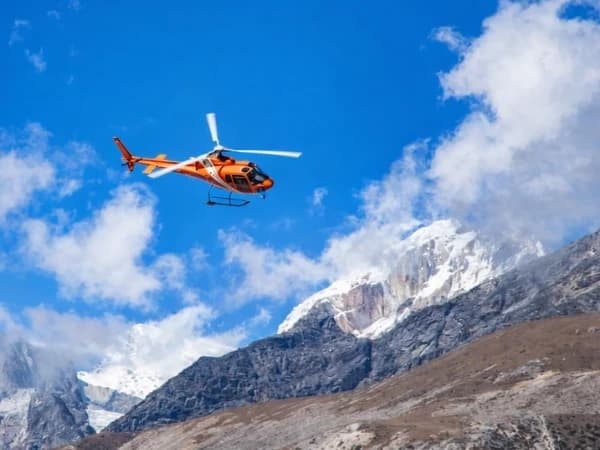
Two practical points. First, in the busy autumn weeks the fixed-wing Lukla flights normally leave from Ramechhap rather than Kathmandu, a four to five hour drive with a pickup between midnight and 2 am. My flight guide sets out the usual windows (roughly 25 September to 30 November) and why. The airport can change at short notice, so ask me about your week. Helicopters fly Kathmandu to Lukla direct, which is part of the Luxury tier. Second, build a spare day or two at the end of the trip so a weather hold becomes a rest day and not a missed flight home. If you want to avoid the Lukla question entirely, our Everest Base Camp by road trip reaches the trail by road, and our 10-day Everest Base Camp trek with return by helicopter shortens the descent, though not the flight into Lukla.
What should I pack for the Everest trek in autumn?
My full Everest Base Camp packing list applies. The autumn specifics:
- Sleeping bag and down jacket. We provide both free on every tier. Ask us the temperature rating when you book. Our November advice is a bag rated to -15 degrees for nights above 4,000 m, and teahouse rooms are freezing at night.
- Sunglasses and sunscreen. Ultraviolet radiation rises with altitude and snow reflects it. The World Health Organization notes UV is higher at altitude, and cloud does not remove it. Use a high-factor sunscreen and wear sunglasses with proper UV protection from 4,000 m.
- Trekking poles. Useful on the long descents and on frosty morning trail.
- Light rain gear. Mostly for early October. In November rain is rare, as Lukla's 6.2 mm average shows.
- A buff or bandana. Dry autumn trails are dusty between Lukla and Namche, with mule trains.
- Warm hat, liner gloves and insulated gloves, thermal layers, spare camera battery. Cold drains batteries quickly. Keep the spare against your body. For layering detail see what to wear trekking in Nepal.
How hard is the trek in autumn?
The difficulty is altitude, not season. The acclimatisation plan is the same in October and November: rest days at Namche and Dingboche, a gradual ascent and sleeping lower than you climb. November is a little harder only because of the cold and the shorter days, and the trail itself is dry and firm. Snow above 5,000 m is possible. Our guides carry microspikes in case, and in most seasons they stay in the bag. Read my altitude sickness guide before you go. We provide an oximeter for our groups.
What does the trek cost in autumn, and what do the tiers include?
Our price does not change with the month. The 12-day Everest Base Camp trek is US$1,399 on Budget, US$2,785 on Standard and US$4,999 on Luxury for one traveller, and groups pay less each. The tier sets what is included:
| Tier | Porters | Meals | Lukla travel |
|---|---|---|---|
| Budget | None, you carry your own bag | Not included | Fixed-wing flight |
| Standard | One porter for every two trekkers (a solo Standard trekker has no porter; the guide carries a share) | All meals | Fixed-wing flight |
| Luxury | Your own porter | All meals, with fruit and nuts | Helicopter, round trip |
Kathmandu hotels are not included in any trek tier, so we quote them separately. Permits are arranged for you. The Sagarmatha National Park fee is NPR 3,000, the Khumbu local fee is NPR 3,000 and TIMS is NPR 2,000, about NPR 8,000 in all. I arrange TIMS for every trekker. A 10 per cent deposit holds your dates and you pay the balance in Kathmandu. You can reschedule for free, with at least 72 hours' notice, to any date within one year. The deposit itself is not refunded if you cancel.
A word on timing. For autumn 2026 the one fixed departure I have listed is 11 October (open as at 2 October). Every other date is a private departure at the same price, so contact me for dates. Our 2026 prices hold for 2027. For autumn I suggest booking two to three months ahead, because flights and Kathmandu hotels fill first. That is my advice from experience, not a rule.
Is the Everest region open right now?
As at 29 September 2026, the date of my latest status update, the Everest region was open and unaffected by the late-August Rasuwa flood and the late-September rain, which hit other river systems. This can change. I keep the live position on my late-September floods travel update, and I recheck before every departure.
Should I trek Everest Base Camp in autumn?
Yes, if you want the best mountain views, stable weather and a fully working trail, and you do not mind sharing it. For most first-timers autumn is the right choice. My plain recommendation is mid-October to early November for the best balance, early October if you want the warmest and greenest trek, and mid to late November only if you have good cold-weather kit, have trekked before and value solitude. Skip autumn if crowds ruin a walk for you; spring has fewer people, though more afternoon haze. Skip late November if cold nights worry you, and skip any month if your schedule leaves no spare day at the end.
Tell me your dates on WhatsApp, +977 9810351300, or email [email protected], and I will tell you what that week usually does.
Sources: Nepal Department of Hydrology and Meteorology (Lukla, 1991 to 2020), FAO (Namche Bazaar and Tengboche), the Australian National University (Tengboche), the World Health Organization (UV), the ICAO standard atmosphere (lapse rate) and the Nepal government holiday notice for Dashain and Tihar dates. Dingboche figures are modelled. Temperature figures for Gorak Shep are our own estimate and are marked as such above.
About The Everest Holiday
We are a family company in Kathmandu, three generations of Himalayan guides, registered in 2016 and a member of the Trekking Agencies' Association of Nepal, number 1586. When you book with us you deal with the family, not a call centre.
Every booking helps fund our Nagarjun Learning Center. We fully run the centre at Saldum, where 70 children learn with a teacher I pay for personally.
Written by Shreejan Simkhada, CEO of The Everest Holiday and third-generation Himalayan guide. TAAN Member #1586.
Autumn is peak season. Book early. Our Everest Base Camp Trek (12 Days) is private (your group only, no strangers), from USD $1399. WhatsApp us for dates and current departures.
Planning a trip to Nepal?
Drop us your details and tell us what you have in mind. We will put together a personalised plan and get back to you.
Not sure which Nepal trek is right for you?
Take our free 2-minute quiz and get personalised recommendations based on your fitness, experience, and travel style.
Find Your Perfect Trek →Need Help? Call Us+977 9810351300orChat with us on WhatsApp
Related Trek Packages
 US$1,399
15 DaysMax 20
(6 reviews)
Everest Base Camp Trek By Road Trip - 15 Days Itinerary and Cost
Starts From
ExploreUS$1,399
Everest Base Camp with Gokyo Lakes Trek via Chola Pass - 15 Days
Starts From
ExploreUS$1,699
Latest Travel Blogs
Christmas and New Year Treks from Pokhara 2026/27: 3 to 5 Days
<p>Short treks from Pokhara for Christmas and New Year 2026/27: Panchase 3 days, Poon Hill 4 days and Mardi Himal 5 days. Weather, snow, what is open, and prices by group size.</p>
Read More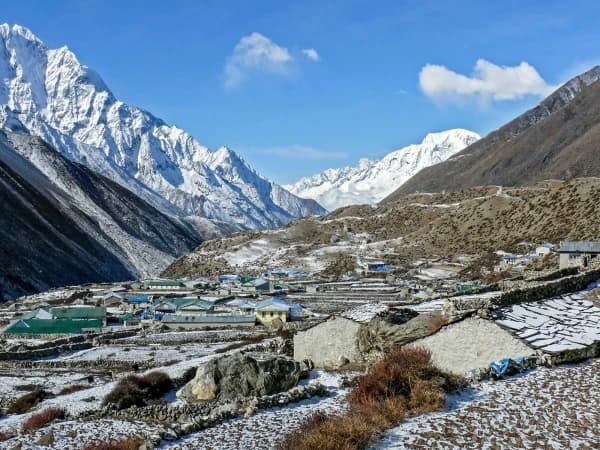
Thamdanda and Surke: The Road Head for Everest Base Camp by Road
Thamdanda is the road head where our Everest Base Camp trek by road starts and ends on foot. How to get there from Phaplu and what the first walk to Paiya is like.
Read MorePoon Hill Trek Permits 2027: ACAP, TIMS, Cost and What You Need
Poon Hill needs two permits: ACAP at NPR 3,000 and a TIMS card at NPR 2,000. Who arranges them, where they are checked, SAARC rates and the 2027 trek prices.
Read More Chat with Shreejan