While the rest of Nepal drowns in rain, Upper Mustang stays dry. Here's why July-August is actually the best time to trek the Forbidden Kingdom.
Govt Regd. No.: 147653/072/073
Travel Agency Licence: 2838/072
Upper Mustang in Monsoon: Nepal's Best Rain Shadow Trek
Short answer: Upper Mustang is the one major trek in Nepal that works well in the monsoon. It sits in a rain shadow behind the Annapurna and Dhaulagiri ranges, so it gets a small fraction of the rain that falls on the rest of the country. The restricted-area permit is USD 50 per person per day, and a licensed guide is compulsory. The weak points are the Jomsom flight and the road below it. Walk it on our Upper Mustang trek.
Update, 14 October 2026: As of 14 October 2026 the Besisahar–Chame road and the Beni–Jomsom road are repaired and open to vehicles again. We still check road and trail conditions 48 hours before every departure. If a road is not open on the day, we move your dates free.
Upper Mustang in Monsoon: Nepal's Best Rain Shadow Trek
Every June, the same question lands in my inbox. "I can only take leave in July. Is it even worth trekking in Nepal during monsoon?"
My name is Shreejan, and I've been running treks in Nepal for a decade. The honest answer is that most of Nepal in July is a washout. The Everest Base Camp trail is shrouded in cloud. The Annapurna Circuit turns to mud. Leeches own the lower forests, and landslides close roads without warning. If you're planning a classic Himalayan trek for July or August, I'll tell you straight: don't.
But there's one place where that advice flips completely. Upper Mustang sits behind the tallest mountain wall on Earth, in a rain shadow so effective that while the rest of Nepal receives two thousand millimetres of monsoon rain, Mustang gets less than two hundred. While trekkers elsewhere are hiding in teahouses waiting for the downpour to stop, trekkers in Mustang are walking through warm sunshine under clear blue skies, dust kicking up from a trail that hasn't seen rain in weeks.
This isn't a consolation prize. Upper Mustang in monsoon is the trek at its absolute best. And if July or August is your only window, it's one of the finest treks on the planet.
Why is Upper Mustang dry during the monsoon?
The science is straightforward. The Indian monsoon pushes moisture-laden air northward across the subcontinent from June to September. When that air hits the Himalayan barrier, it's forced upward. As it rises, it cools. As it cools, it dumps its moisture as rain on the southern slopes. By the time the air crosses over the Annapurna and Dhaulagiri ranges, it's wrung dry. What reaches Upper Mustang is warm, dry wind with almost no moisture left to give.
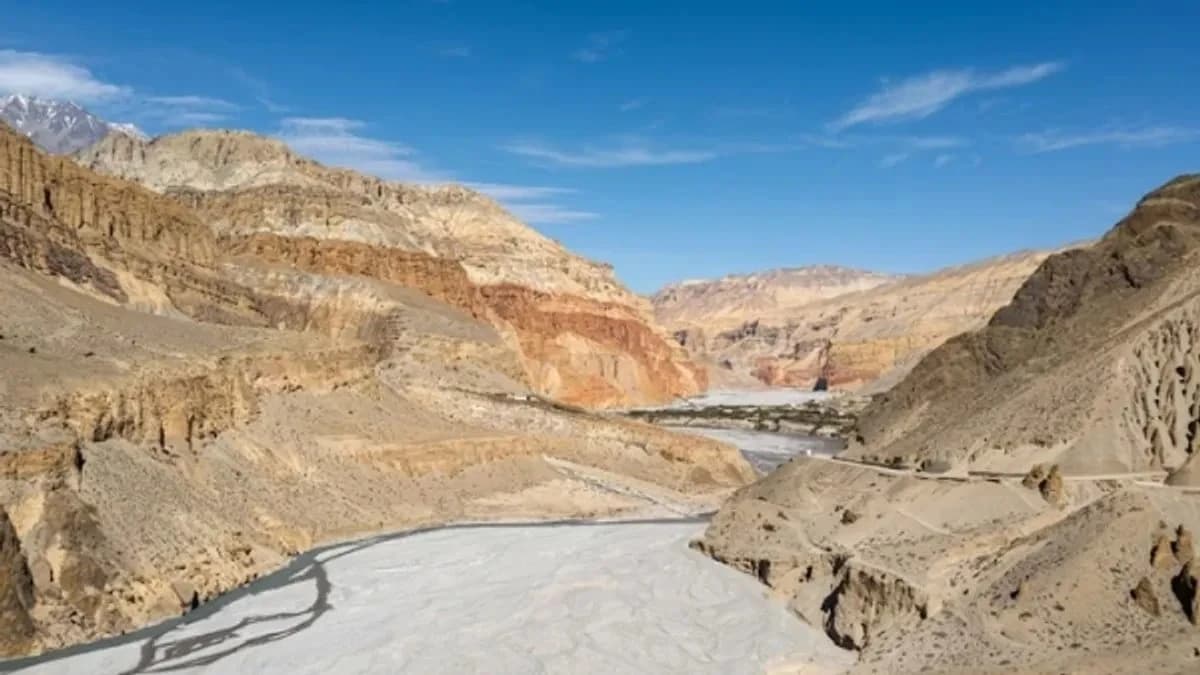
The result is a pocket of high-altitude desert that experiences its warmest, driest weather precisely when the rest of Nepal is at its wettest. The Kali Gandaki gorge acts as a funnel, channelling the dry air northward into the ancient kingdom of Lo. The barley fields turn green from glacial meltwater irrigation, the sky stays cloudless for days on end, and the temperature at Lo Manthang (3,840 metres) sits comfortably between 15 and 25 degrees Celsius during the day.
This is not a marginal effect. It's the difference between a trek that's genuinely enjoyable and one that's genuinely miserable. In July, the Langtang Valley receives heavy rain daily. The Manaslu Circuit is leech-infested and dangerous. Upper Mustang is dry, warm, and clear.
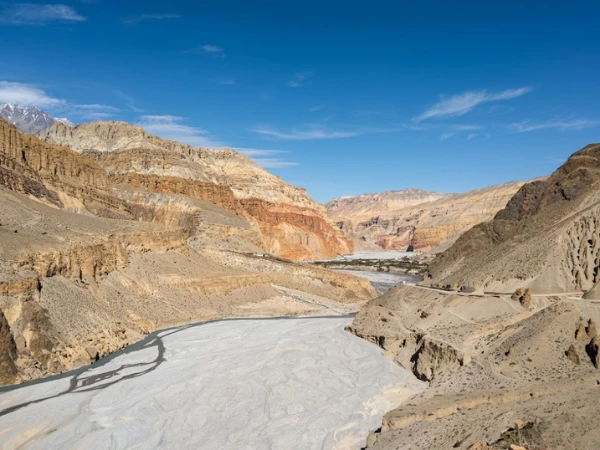
What is Upper Mustang like during the monsoon season?
Mornings break cloudless. The air is still, the light sharp, and the red cliffs of the Kali Gandaki gorge glow in the early sun. By mid-morning, the wind picks up. This is the famous Mustang wind, and it blows every day regardless of season. It funnels through the gorge from the south, carrying dust and grit but not rain. Walking in the morning and resting during the windiest afternoon hours is the standard rhythm.
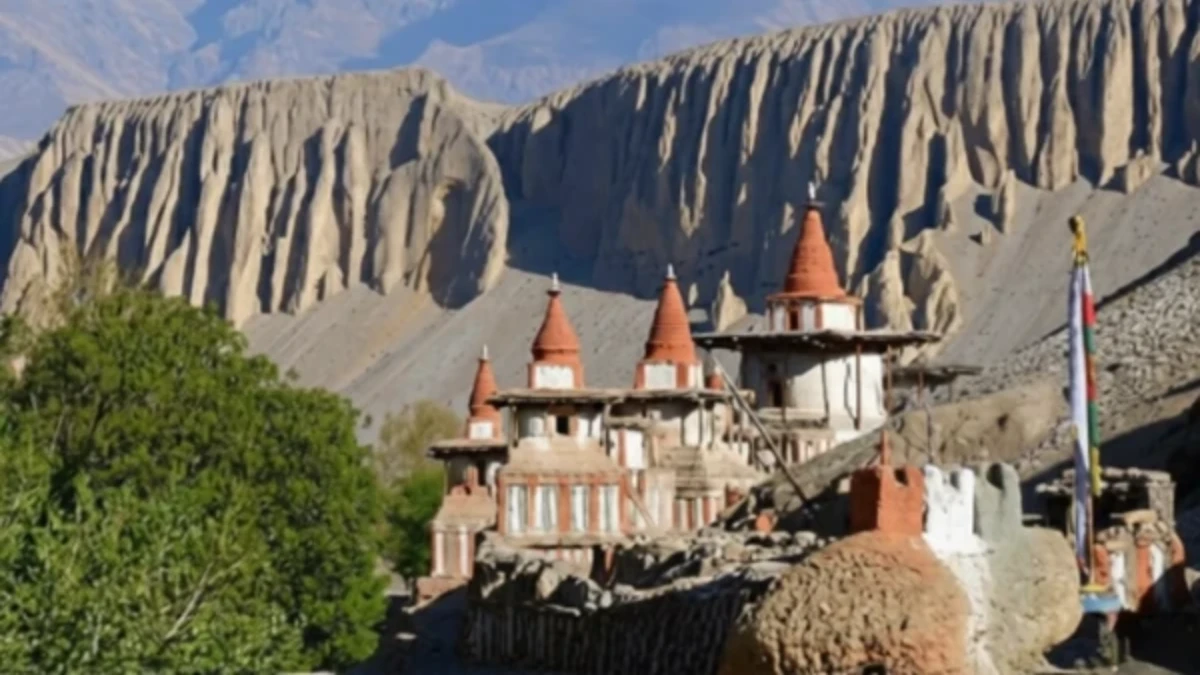
The landscape is Mars-like. Red and ochre cliffs, eroded into fantastical shapes by millennia of wind. Dry riverbeds. Cave systems carved into cliffsides that once housed entire communities. Prayer flags snapping from every rooftop in villages that look unchanged from the fifteenth century. And above it all, the sky. A deep, saturated blue that photographers chase and struggle to believe is real.
Occasionally, a stray monsoon cloud drifts over the Annapurna-Dhaulagiri barrier and delivers a brief shower. This happens perhaps once a week in July or August, lasts an hour at most, and is more welcome than disruptive. The rest of the time, the weather is as reliable as it gets anywhere in the Himalayas.
The Permit Question: Is USD 50 a Day Worth It?
Let's address this directly, because the restricted area permit is the single biggest objection people raise about Upper Mustang. The permit costs fifty US dollars per person per day, and you pay only for the days you are actually inside the restricted zone. Until December 2025 it was a flat five hundred dollars for ten days whether you stayed ten days or three, and that rule has been abolished. It's paid through your trekking agency and goes directly to the Nepali government. There's no way around it, no discount for longer stays, and no negotiation.
Is it worth it? I think so, and here's why.
The permit limits visitor numbers. Upper Mustang receives roughly three to four thousand trekkers per year. The Everest Base Camp trail sees fifty thousand. The permit cost is the reason Mustang's monasteries are intact, its caves unpillaged, and its culture alive rather than preserved in amber for tourist consumption. You are paying not just for access but for the preservation of what you're accessing.
The total trek cost with the permit included still compares favourably with treks to Bhutan, where daily fees run two hundred US dollars or more. And unlike Bhutan, Mustang's permit covers the entire restricted area rather than limiting you to government-approved hotels and guides.
That said, the permit does make Mustang significantly more expensive than alternatives like the Ghorepani Poon Hill trek or the Mardi Himal trek. If budget is tight and monsoon is your only option, those treks aren't viable in July anyway. But if you're choosing between Mustang and a non-monsoon trek at a different time of year, the cost difference is real and worth factoring into your decision.
What are the downsides of trekking Upper Mustang in monsoon?
I'd be doing you a disservice if I painted Mustang in monsoon as perfect. It's not. Here's what to expect.
Dust. The dry conditions mean dust. The Mustang wind picks it up and deposits it everywhere: your hair, your camera, your food, the inside of your sleeping bag. A buff or bandana for your face is not optional. Sunglasses are essential. And accept that by day three, everything you own will have a fine coating of red-brown grit.
Wind. The afternoon wind in the Kali Gandaki gorge can be strong enough to make walking unpleasant and photography difficult. Some days it gusts hard enough that you'll lean into it at a noticeable angle. Early morning starts help, but you cannot avoid the wind entirely. It's the price of the rain shadow.
Basic accommodation. Lo Manthang has a handful of decent lodges. The smaller settlements along the trail offer simple rooms with thin mattresses, shared bathrooms, and limited hot water. This is not the Annapurna Circuit's well-developed teahouse network. Mustang's remoteness means fewer options, simpler facilities, and food that's hearty but not varied. Expect dal bhat, thukpa, and momos. Expect them to be good. Don't expect a menu with twenty options.
Remoteness. Upper Mustang is genuinely remote. Medical facilities are minimal. Helicopter evacuation is possible but depends on weather and timing. The nearest proper hospital is in Pokhara, hours away by road from Jomsom. Travel insurance with helicopter evacuation cover is not a suggestion here. It's a necessity.
What You'll See That Nobody Else Does
The walled city of Lo Manthang. A medieval capital still inhabited by roughly a thousand people, with a former royal palace, four monasteries containing fifteenth-century Buddhist paintings, and alleys narrow enough to touch both walls simultaneously. The king of Mustang no longer holds political power, but he remains a revered cultural figure.
The caves of Chosar. Thousands of cave dwellings carved into cliffsides near the Tibetan border, some containing wall paintings that predate anything in Kathmandu by centuries. The art was unknown to the outside world until researchers accessed Mustang in the late nineties.
Dhakmar's red cliffs. A wall of crimson rock that rises above the village like a geological cathedral. Legend says the colour comes from the blood of a demon slain by Guru Rinpoche. Geology says it's iron oxide. Both explanations feel equally plausible when you're standing beneath it.
The Tiji Festival. If you time your trek for late May, you'll witness three days of masked dances performed by monks in Lo Manthang's monastery courtyard. Even outside festival time, the monasteries are active and welcoming. Monks debate, pray, and go about their routines. You're watching a living tradition, not a museum exhibit.
How do you get to Upper Mustang during the monsoon?
The standard approach is to fly from Pokhara to Jomsom and trek north from Kagbeni into the restricted area. During monsoon, Jomsom flights can be disrupted by wind and cloud, though less frequently than flights to Lukla. Build a buffer day in Pokhara for flight delays.
An alternative is to drive from Pokhara to Jomsom via the Beni-Jomsom road. The road is rough, the journey takes ten to twelve hours, and during monsoon the lower sections are prone to landslides and delays. It's slower but more reliable than relying on flights. Some trekkers drive up and fly back, or vice versa.
A third option is the Upper Mustang motorbike tour, which covers the same territory on wheels rather than feet. For those who want the landscape and culture without the fifteen-day walking commitment, it's worth considering. There's also the Lower Mustang motorbike tour for a shorter taste of the region, and the Mustang mountain bike tour for those who want the physical challenge without a motor.
What treks can you combine with Upper Mustang?
If you've got three weeks or more, Mustang pairs well with the lower Annapurna region. After returning from Lo Manthang to Jomsom, you could add a few days exploring the Annapurna Base Camp trail in September when the monsoon weakens. Or pair it with a cultural tour. The Kathmandu-Pokhara-Chitwan-Lumbini tour covers Nepal's lowland highlights and works well as a pre-trek or post-trek extension.
For the ambitious, a late-monsoon Mustang trek finishing in early September transitions neatly into the Annapurna Circuit with Tilicho Lake as autumn conditions take hold. You'd cover Nepal's best monsoon trek and its best autumn trek in a single trip.
Who is the Upper Mustang monsoon trek best for?
Summer-only travellers. Teachers, academics, anyone whose leave falls between June and September. You don't need to resign yourself to skipping Nepal. You need to choose the right destination within Nepal.
Culture seekers. If monasteries, cave art, and medieval walled cities excite you more than glaciers and summit views, Mustang delivers cultural depth that rivals anywhere in the Himalayas.
Experienced trekkers wanting something different. If you've already done Everest Base Camp and the Annapurna Circuit, Mustang is the logical next step. It's a fundamentally different landscape, a fundamentally different culture, and a fundamentally different kind of walking.
Anyone willing to trade comfort for authenticity. Mustang won't pamper you. The lodges are basic. The dust is constant. The wind is relentless. But the trade-off is something that most trekkers in Nepal never get: a landscape and a culture that exist on their own terms, largely untouched by the tourism that has reshaped the Everest and Annapurna regions.
Frequently Asked Questions
Does it really not rain in Upper Mustang during monsoon?
It rains very little. Upper Mustang receives less than two hundred millimetres of annual rainfall, and even during peak monsoon in July and August, you might see one or two brief showers per week. The rain shadow behind the Annapurna and Dhaulagiri ranges is remarkably effective. You'll carry a waterproof jacket for those occasional showers, but you won't need it most days.
Can I trek Upper Mustang solo?
Not independently. Nepal requires all trekkers to hire a licensed guide, and the Upper Mustang restricted area specifically requires trekkers to travel through a registered agency. You can go as a solo trekker with a guide, but you'll pay the full permit cost yourself rather than splitting it. A minimum of two trekkers used to be required, but the current regulation allows solo trekkers with an agency and guide. The permit is fifty dollars per person per day, charged only for the days you are actually inside the restricted zone, and it is the same rate whatever the size of your group. The old flat five hundred dollars for ten days was abolished in December 2025.
How fit do I need to be for this trek?
Moderately fit. The maximum altitude is 3,840 metres at Lo Manthang, which is significantly lower than Everest Base Camp (5,364 metres) or Thorong La (5,416 metres). The daily walking distances are moderate, typically five to seven hours. The terrain is undulating rather than steep. If you can comfortably walk six hours on hilly ground carrying a day pack, you're fit enough. The heat and dust in summer are more demanding than the altitude.
What should I pack specifically for monsoon Mustang?
Sun protection is your priority, not rain gear. A wide-brimmed hat, SPF 50 sunscreen, quality sunglasses, and a buff or bandana for dust are more important than waterproof trousers. Bring a light waterproof jacket for the occasional shower. Lip balm with SPF. Moisturiser for skin that the dry air and wind will crack. A head torch for basic lodges. And a good camera lens cleaning kit, because the dust gets into everything.
Is Upper Mustang worth the permit cost over cheaper treks?
That depends on what you're after. If you want the cheapest possible Nepal trek, Mustang isn't it. If you want something genuinely unlike anything else in the Himalayas, with a landscape that looks like another planet and a culture that's survived nearly unchanged for centuries, then yes. The permit also means fewer trekkers, which preserves the experience. I've had clients who hesitated about the cost and came back saying it was the best money they'd spent on any trip, anywhere. I've also had clients who preferred the grandeur of Everest and the social atmosphere of the Annapurna Circuit. Neither group was wrong.
Plan Your Monsoon Mustang Trek
If July or August is your window and you've been told Nepal isn't worth visiting in monsoon, you've been told wrong. Upper Mustang is worth visiting precisely because it's monsoon. The dry trails, the warm days, the empty lodges, and the Forbidden Kingdom waiting at the end of the walk. It doesn't get better than that.
We organise Upper Mustang treks year-round but especially during monsoon season, when the conditions are at their finest. Every trek is led by a licensed guide who knows the region, the culture, and the logistics of getting to Lo Manthang and back without drama.
WhatsApp / Call:+977 9810351300
Email:[email protected]
Website:www.theeverestholiday.com
Written by Shreejan Simkhada, founder of The Everest Holiday (TAAN Licence #1586) and a third-generation Himalayan guide. Shreejan has been organising treks across Nepal since 2016, and Upper Mustang remains one of his favourite recommendations for anyone who thinks Nepal shuts down in monsoon. It doesn't. You just need to know where to go.
Upper Mustang in monsoon is one of the few trails open in July-August. Our Upper Mustang Trek (10 Days) is private (your group only, no strangers), 2027 dates open, From USD $1290. WhatsApp us for tailored 2027 dates and current departures.
Planning a trip to Nepal?
Drop us your details and tell us what you have in mind. We will put together a personalised plan and get back to you.
Not sure which Nepal trek is right for you?
Take our free 2-minute quiz and get personalised recommendations based on your fitness, experience, and travel style.
Find Your Perfect Trek →Need Help? Call Us+977 9810351300orChat with us on WhatsApp
Latest Travel Blogs
Christmas and New Year Treks from Pokhara 2026/27: 3 to 5 Days
<p>Short treks from Pokhara for Christmas and New Year 2026/27: Panchase 3 days, Poon Hill 4 days and Mardi Himal 5 days. Weather, snow, what is open, and prices by group size.</p>
Read More
Thamdanda and Surke: The Road Head for Everest Base Camp by Road
Thamdanda is the road head where our Everest Base Camp trek by road starts and ends on foot. How to get there from Phaplu and what the first walk to Paiya is like.
Read MorePoon Hill Trek Permits 2027: ACAP, TIMS, Cost and What You Need
Poon Hill needs two permits: ACAP at NPR 3,000 and a TIMS card at NPR 2,000. Who arranges them, where they are checked, SAARC rates and the 2027 trek prices.
Read More Chat with Shreejan