

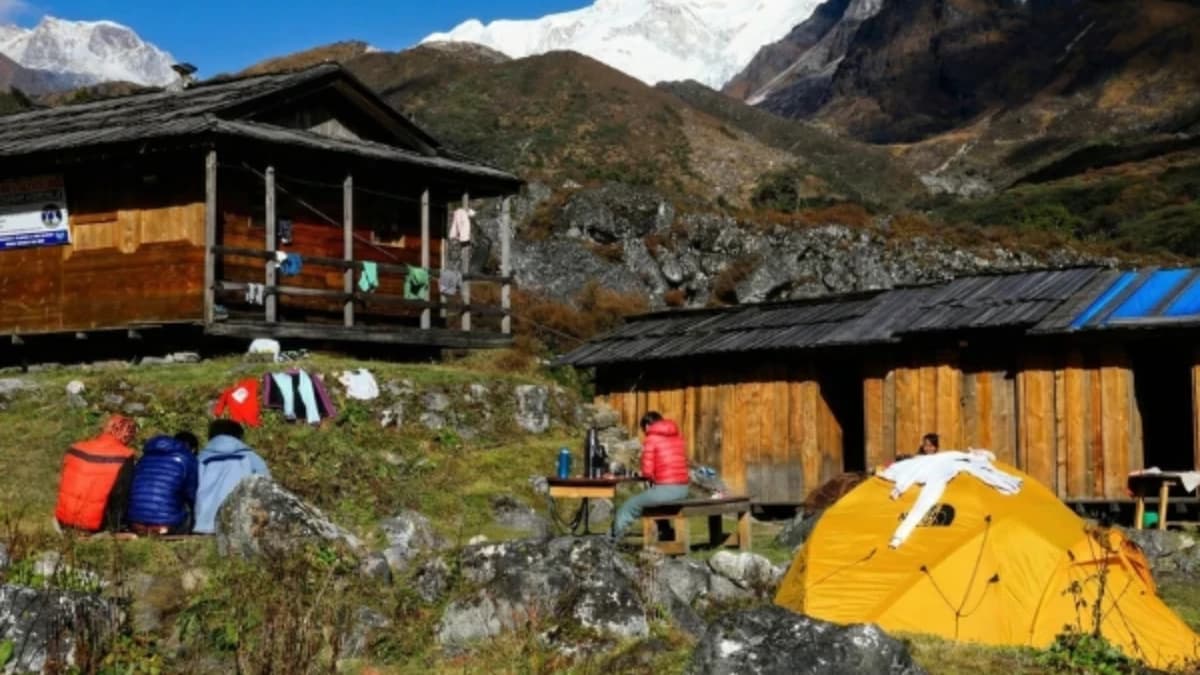
Short answer: Tseram, also written Cheram (3,870 m), is a small seasonal stop in the Simbua Khola valley on the south side of the Kanchenjunga trek, with rhododendron forest around it and a view of Kanchenjunga's south face. It is the stop before the south base camp. It is on our 19-day Kanchenjunga Base Camp trek.
Tseram: The Rhododendron Gateway to Kanchenjunga's South Face
The forest closes in around you for hours, a tunnel of gnarled trunks and moss so thick it muffles your footsteps. Then, without warning, the trees part. A rough clearing appears at 3,870 metres, a handful of stone shelters tucked against the hillside, and above them, filling the entire northern sky, the south face of Kanchenjunga. You've arrived in Tseram.
Also written as Cheram or marked on older maps as Torontan, this small seasonal settlement in the Simbua Khola valley is one of the most quietly spectacular camps on any trek in Nepal. It doesn't have the fame of Everest Base Camp or the foot traffic of Annapurna. What it has is something rarer: a feeling of genuine remoteness, a forest that turns crimson and white every spring, and a front-row seat to the world's third-highest mountain that you'll share with almost nobody.
For trekkers on the Kanchenjunga South Base Camp route, or those completing the full Kanchenjunga Circuit, Tseram is both a resting point and a launching pad. From here, the day hike to Oktang and the Kanchenjunga south base camp viewpoint at 4,620 metres is one of the most rewarding walks in the eastern Himalaya. This is where the trek reaches its emotional peak, even if it isn't the highest point on the map.
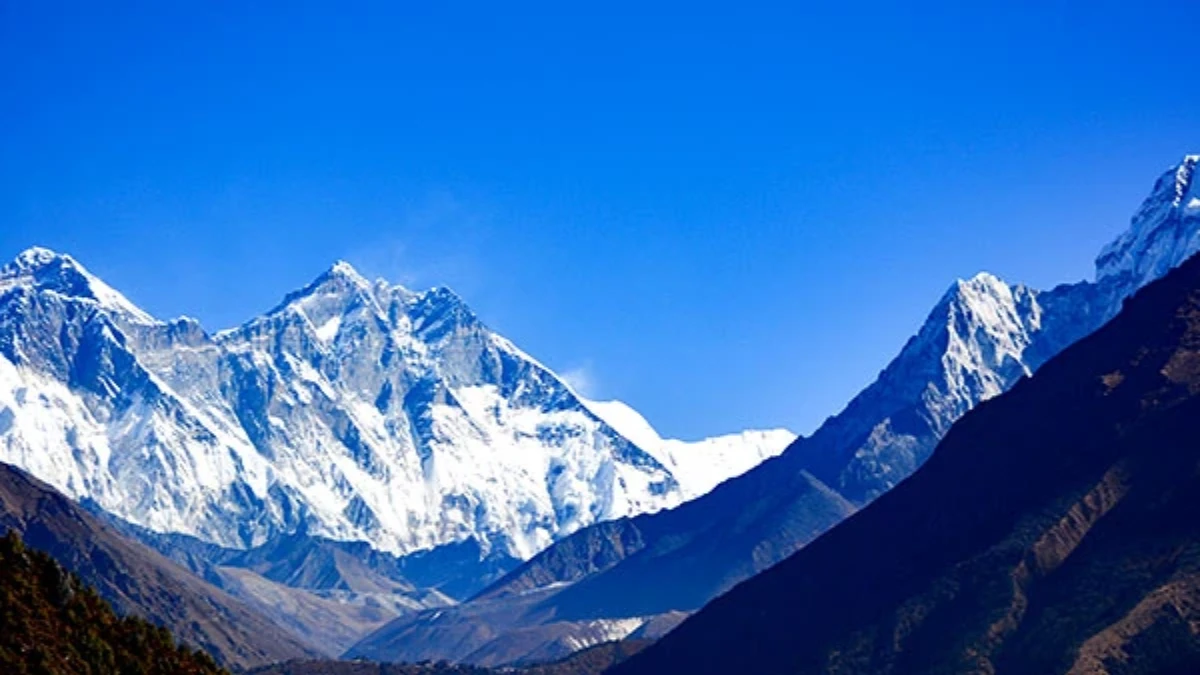
How do you get to Tseram on the Kanchenjunga trek?
Most trekkers reach Tseram from Ramche (3,620m), a straightforward walk of four to five hours that follows the Simbua Khola upstream through increasingly dense forest. The trail gains roughly 250 metres of elevation, which sounds modest on paper. In practice, the path is uneven and rooty, weaving between boulders and across small stream crossings that can be tricky after rain.
The valley narrows as you climb. Bamboo and birch give way to rhododendron, not the decorative garden variety, but ancient trees with trunks as thick as your torso, their branches draped in pale-green lichen that catches the light like cobwebs. In autumn, the forest is dark and atmospheric. In spring, it's something else entirely, but we'll come to that.
Those arriving from the north, from Ghunsa via the Sele La Pass, will approach Tseram from above, descending steeply through high alpine terrain before dropping into the valley. This crossing is one of the toughest sections of the full Kanchenjunga Circuit and deserves its own discussion further on.
There's no dramatic arrival moment. The trail simply opens into a clearing where a few basic lodges and camping platforms sit among the trees. Prayer flags flutter between branches. A stream runs nearby. It's modest, quiet, and entirely without pretension, which is precisely what makes it feel like a proper mountain camp rather than a tourist stop.
The Oktang Day Hike: Kanchenjunga's South Face Revealed
Tseram exists, in trekking terms, for one primary reason: it's the base for the day hike to Oktang, the viewpoint that gives you the south base camp panorama of Kanchenjunga.
The walk begins early, most groups leave between six and seven in the morning to catch the best light and avoid afternoon cloud. From Tseram at 3,870 metres, you'll climb steadily to Oktang at approximately 4,620 metres, a gain of 750 metres over roughly three to four hours.
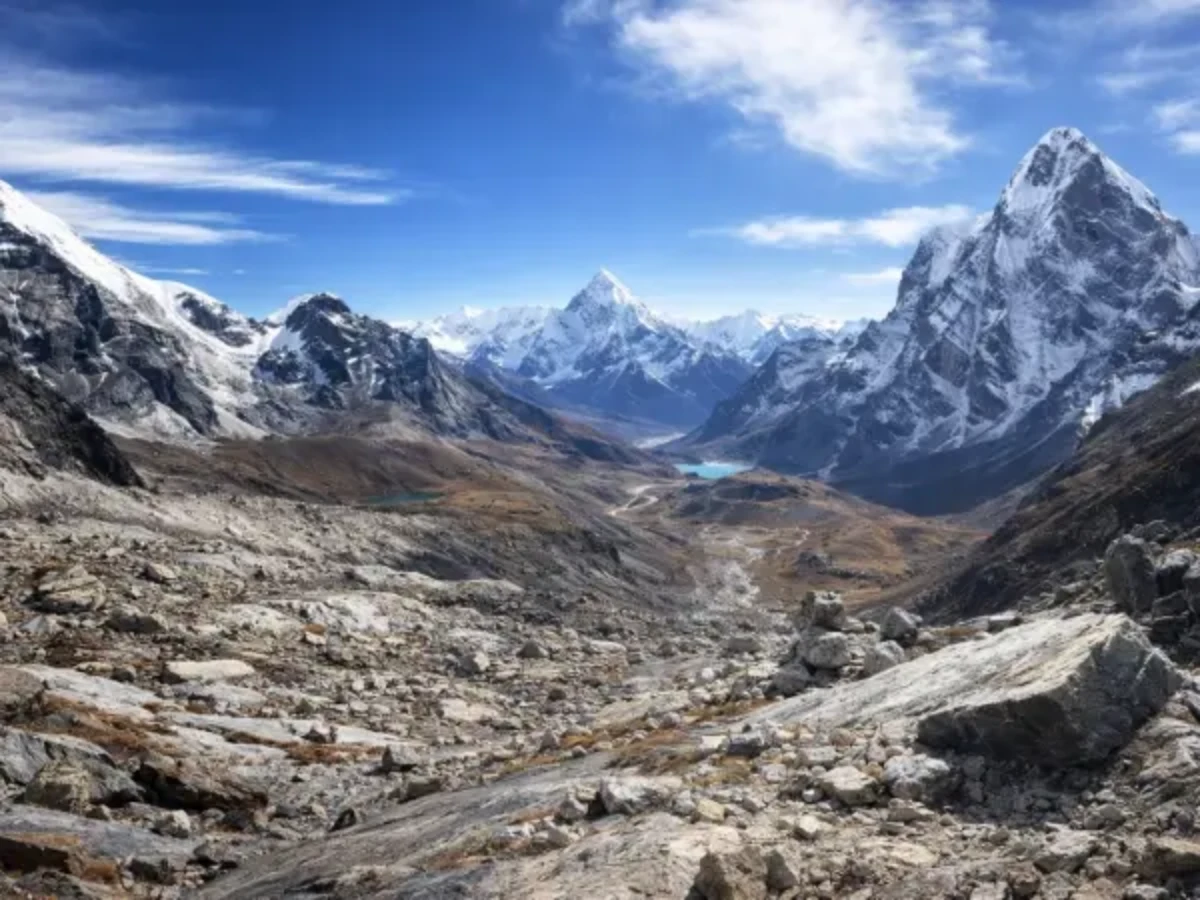
The trail leaves the forest quickly. Within thirty minutes you're above the treeline, walking through scrubby alpine meadow scattered with dwarf rhododendron and juniper. The Simbua Khola valley opens up dramatically. To the west, Rathong (6,679m) and Koktangri (6,147m) frame the skyline. To the north, the terrain steepens into moraine and glacial rubble.
And then Kanchenjunga appears properly, not a distant peak glimpsed through cloud, but an enormous wall of ice and rock that fills your field of vision. The south face of Kanchenjunga (8,586m) from Oktang is one of the great mountain views in the world. It's a sheer, striated face of grey rock banded with ice, dropping thousands of metres from the summit ridge to the glacier below. Hanging glaciers cling to impossible angles. Avalanches rumble in the distance with a sound like slow thunder.
The viewpoint at Oktang is marked with prayer flags and a few cairns. There's often a chorten nearby, and you may see offerings left by local herders. This is sacred ground, the Kanchenjunga Conservation Area is deeply significant to the Limbu people, and the mountain itself is considered a protector deity. Trekkers are asked not to take the final summit of Kanchenjunga for this reason, a tradition that mountaineering expeditions have generally honoured.
Spend at least an hour at the viewpoint if the weather holds. The light changes constantly on the south face, morning sun catches the ice seracs in gold, while shadows move across the rock bands like slow curtains. It's a place where you'll take fifty photographs and still feel none of them captures what you're seeing.
The return to Tseram takes two to three hours. Most trekkers are back by early afternoon, with the rest of the day free to rest, dry out kit, and sit with a cup of tea watching the clouds roll through the valley.
How high is Tseram and how do you acclimatise?
At 3,870 metres, Tseram sits at an altitude where acclimatisation matters but isn't yet critical for most well-paced trekkers. By the time you reach Tseram on the standard south base camp route, you'll have spent several days ascending gradually from Taplejung (1,820m) through Chirwa, Sekathum, Amjilosa, and Ramche, a progression that gives your body time to adjust.
The Oktang day hike to 4,620 metres is where you need to pay attention. You're climbing 750 metres and spending time above 4,000 metres for perhaps the first time on this trek. The golden rule applies: walk slowly, drink plenty of water, and watch for headache, nausea, or unusual fatigue. Our guides carry a pulse oximeter and will check oxygen saturation levels before and after the hike.
If you're arriving from the north via Sele La (4,290m), you'll already have acclimatised to higher elevations in the Ghunsa valley and at Kanchenjunga North Base Camp (5,143m). The descent to Tseram from Sele La actually provides a welcome drop in altitude and a chance for your body to recover.
One night in Tseram is standard on most itineraries, arriving in the afternoon, doing the Oktang hike the next morning, then continuing south to Ramche or beyond. Some trekkers choose to spend two nights here, using the extra day for a more relaxed Oktang hike or to explore the surrounding forest. If you've got the time, the second night is worth it. The forest around Tseram rewards slow exploration.
Is spring or autumn better for trekking to Tseram?
Tseram's rhododendron forest is, without exaggeration, one of the finest in the Nepal Himalaya. The trees here are old, some are estimated at several hundred years, and they grow in dense, tangled stands that create a canopy so thick it blocks out the sky in places.
Spring (March to May)
If you could only visit Tseram once, come in spring. From late March through May, the rhododendrons bloom in waves. The lower elevations around 3,000 metres erupt first in deep crimson and magenta. As the season progresses, the blooms climb higher, pink, white, and pale yellow varieties take over around Tseram's altitude. By April, the forest is a cathedral of colour, with petals carpeting the trail and flowers framing every view of the peaks above.
The effect is surreal. You're walking through a forest that looks like it belongs in a fairy tale, and then you step into a clearing and there's an 8,000-metre peak in front of you. It's the contrast that makes it extraordinary, the softness of the flowers against the brutality of the ice.
Spring also brings migrating birds. The forest around Tseram is home to blood pheasants, satyr tragopans, and several species of laughingthrush. Birdwatchers will want binoculars and patience.
Autumn (September to November)
Autumn is the classic trekking season, and for good reason. The air is cleaner after the monsoon, visibility is at its best, and the mountain views from Oktang are typically sharper and more persistent than in spring. The rhododendrons aren't flowering, but the forest has a dark, atmospheric beauty, moss-covered trunks, shafts of golden light through the canopy, the smell of damp earth and decaying leaves.
Temperatures are colder than spring, particularly at night. Expect lows of minus five to minus ten Celsius at Tseram in late October and November. The Oktang hike in autumn means starting in near-freezing conditions and warming up as the sun hits the valley.
Both seasons have their magic. Spring is for colour and life. Autumn is for clarity and stillness. Related: Tortong Village: Forest Gateway to Kanchenjunga South Base Camp.
How does Sele La Pass connect the Kanchenjunga routes?
For trekkers doing the full Kanchenjunga Circuit, connecting the north base camp at Pangpema with the south base camp approach via Tseram, the Sele La Pass (4,290m) is the critical link.
The crossing typically takes a full day from Ghunsa or the intermediate camp at Sele Le. The trail climbs through increasingly barren terrain to the pass itself, which is often windy and cold even in good weather. From the top, you get views in both directions, the Ghunsa valley and Jannu to the north, the Simbua Khola and the forested slopes around Tseram to the south.
The descent from Sele La to Tseram is steep and can be slippery, particularly in the sections where the trail passes through loose scree before entering the forest. This section takes three to four hours and drops roughly 400 metres. It's technically straightforward but tiring on the knees, and the trail isn't always well-marked, a good guide is essential here.
The Sele La crossing is what elevates the Kanchenjunga trek from a there-and-back route into a genuine circuit. You see two completely different sides of the mountain, pass through contrasting valleys, and experience the transition from the drier, more open terrain of the north to the lush, forested south. It's one of the finest multi-day traverses in Nepal, and Tseram is where you feel the character of the trek change completely.
What wildlife lives in the Simbua Khola valley?
The Kanchenjunga Conservation Area is one of Nepal's most biodiverse protected zones, and the forests around Tseram are particularly rich. The dense rhododendron canopy provides habitat for species that have been squeezed out of more heavily trekked areas.
Red pandas live in the bamboo and rhododendron forests between 2,500 and 4,000 metres. Sightings are rare, they're shy, nocturnal, and well-camouflaged, but their presence is confirmed by researchers working in the area. You're more likely to see signs (droppings, scratch marks on trees) than the animals themselves, but early mornings and late afternoons in quiet forest sections offer the best chance.
Himalayan black bears also range through these forests, though encounters with trekkers are extremely uncommon. Musk deer, Himalayan tahr, and barking deer are more regularly spotted, particularly in the transition zone between forest and alpine meadow above Tseram.
Birdlife is outstanding. The area is home to several pheasant species, including the Impeyan pheasant (Nepal's national bird, also called the danphe), blood pheasants, and the spectacular satyr tragopan with its electric-blue face and crimson plumage. Raptors, lammergeiers, golden eagles, and Himalayan griffon vultures, ride the thermals above the valley.
The conservation area is managed with community involvement, and local Limbu and Sherpa communities play an active role in protecting wildlife. You'll notice the absence of hunting and the relative boldness of some bird species compared to areas outside the protected zone.
Where Can You Stay at Tseram?
Let's be honest: Tseram is basic. This is not Namche Bazaar or Manang. There are a few small teahouses offering simple rooms with thin mattresses and heavy blankets. Some have been upgraded in recent years with plywood partitions and basic dining areas. Others remain essentially stone shelters with beds.
Camping is common here, and many groups on the Kanchenjunga trek carry tents as standard. If you're on a camping trek, Tseram has several flat platforms near the lodges that are well-used and reasonably sheltered by the surrounding forest.
Food is simple but filling, dal bhat, noodle soup, potatoes, chapati, and tea. Don't expect menus with twenty options. Some lodges can prepare basic Western dishes (pancakes, fried rice), but the standard Nepali fare is your best bet for both flavour and reliability. Bring your own snacks for the Oktang hike, chocolate, nuts, dried fruit, and energy bars are worth their weight at 4,600 metres.
There's no mobile signal at Tseram on most networks. No Wi-Fi. No charging facilities in most lodges, though some may offer solar charging for a fee. Bring a power bank and accept that you'll be offline for a day or two. For many trekkers, this forced disconnection becomes one of the highlights of the trip.
Water is available from the nearby stream, but should be purified. Bring purification tablets or a filter. Boiled water is available from the lodges, though it's expensive by Nepali standards, a common reality in remote areas where fuel is carried in on porters' backs.
What Should You Know Before Trekking to Tseram?
What to Carry
A good down jacket is essential, evenings at 3,870 metres are cold year-round, and the Oktang hike starts in near-freezing temperatures even in spring. Layering is key: a base layer, insulating mid-layer, and windproof outer shell will cover most conditions. Gaiters are useful for the muddy forest sections, particularly in spring when snowmelt and rain make the trail slippery.
Trekking poles make a significant difference on the descent from Oktang and on the Sele La crossing. If you don't normally use them, this is a trek where they earn their place in your pack.
Permits Required
The Kanchenjunga Conservation Area requires a special restricted area permit, which must be arranged through a registered trekking agency. You cannot trek independently in this region and a licensed guide is mandatory. The rule requiring groups of at least two trekkers was removed on 22 March 2026, so a solo trekker with a guide and a registered agency is now allowed. Your agency handles the permit paperwork, but budget for the fees: the restricted area permit costs USD 20 per person per week for the first four weeks.
You'll also need a TIMS card (Trekkers' Information Management System) and the Kanchenjunga Conservation Area entry permit.
Fitness and Preparation
The trek to Tseram is not technically difficult, but it is long and physically demanding. By the time you reach Tseram, you'll have been walking for five to seven days from the trailhead, gaining elevation gradually but covering significant distances daily. Cardiovascular fitness matters more than gym strength, focus on walking, running, cycling, or stair climbing in the months before your trek. If you can comfortably walk six to eight hours over hilly terrain with a light daypack, you'll manage well.
Best Time to Visit
April is the sweet spot for spring, rhododendrons in full bloom, reasonable temperatures, and generally stable weather before the pre-monsoon storms of May. For autumn, mid-October to mid-November offers the clearest skies and best mountain views, though nights are significantly colder.
Is the trek to Tseram worth it?
There are places on a trek that serve as waypoints, you pass through them, sleep, and move on. Tseram could easily be one of those places if you're rushing. It's small, it's basic, and it doesn't announce itself with dramatic fanfare.
But if you slow down, if you sit in the forest for an hour and listen, if you watch the light change on Kanchenjunga's south face from the clearing above camp, if you walk the Oktang trail at your own pace and spend time at the viewpoint rather than snapping a photo and turning back, Tseram becomes one of the most memorable stops on any trek in Nepal.
It's the combination that makes it special. The ancient forest. The altitude. The silence. The mountain. Very few places in the Himalaya give you all of these at once, and fewer still without the crowds.
The Kanchenjunga region receives a fraction of the trekkers that visit Everest or Annapurna, roughly 2,000 to 3,000 per year compared to tens of thousands. This won't last forever. As Nepal's trekking infrastructure expands and awareness grows, the eastern Himalaya will see more visitors. Right now, Tseram remains a place where you can sit outside your lodge in the evening, watch the stars appear above the forest canopy, and feel genuinely alone with the mountains.
That feeling, of being somewhere wild and beautiful and unhurried, is increasingly hard to find. Tseram still has it.
Should you book the Kanchenjunga Tseram trek with a local company?
The Kanchenjunga trek is one of Nepal's great wilderness journeys, and it's one we know well. Our guides have walked this route many times, know the teahouse owners by name, and understand the weather patterns, trail conditions, and acclimatisation demands that make the difference between a good trek and an exceptional one.
We run the Kanchenjunga South Base Camp trek and the full Kanchenjunga Circuit with small groups, experienced licensed guides, and all permits arranged. We handle the logistics, restricted area permits, TIMS cards, transport to and from the trailhead, so you can focus on the walking.
A portion of every booking supports the Nagarjun Learning Center, providing free education and hot meals to 70 children in rural Dhading district. The centre is verified and listed on the UN Partner Portal.
If you'd like to talk about trekking Kanchenjunga, reach out to Shreejan on WhatsApp at +977 9810351300 or email [email protected]. We'll put together an itinerary that gives Tseram, and the rest of this remarkable route, the time it deserves.
Tseram is the camp before Kanchenjunga South Base Camp on the Kanchenjunga Base Camp Trek.
Tseram is the alpine stop on Kanchenjunga south. Our Kanchenjunga Base Camp Trek (19 Days) is private (your group only, no strangers), 2027 dates open, From USD $1655. WhatsApp us for tailored 2027 dates and current departures.
Continue planning your trek
This is one stop on the Kanchenjunga Base Camp trail. For the full route, read our Kanchenjunga gateway guide. When you are ready for dates and prices, see the Kanchenjunga Base Camp Trek (19 days) or WhatsApp us directly. We reply personally.

 Chat with Shreejan