

Short answer: Thangka are Tibetan Buddhist scroll paintings made with mineral pigments and gold on treated cotton, and a single painting can take two to four months. Bhaktapur, in the Kathmandu Valley, is one of the best places to watch painters at work in small workshops around the old squares. Visit Bhaktapur on our Kathmandu and Pokhara tour.
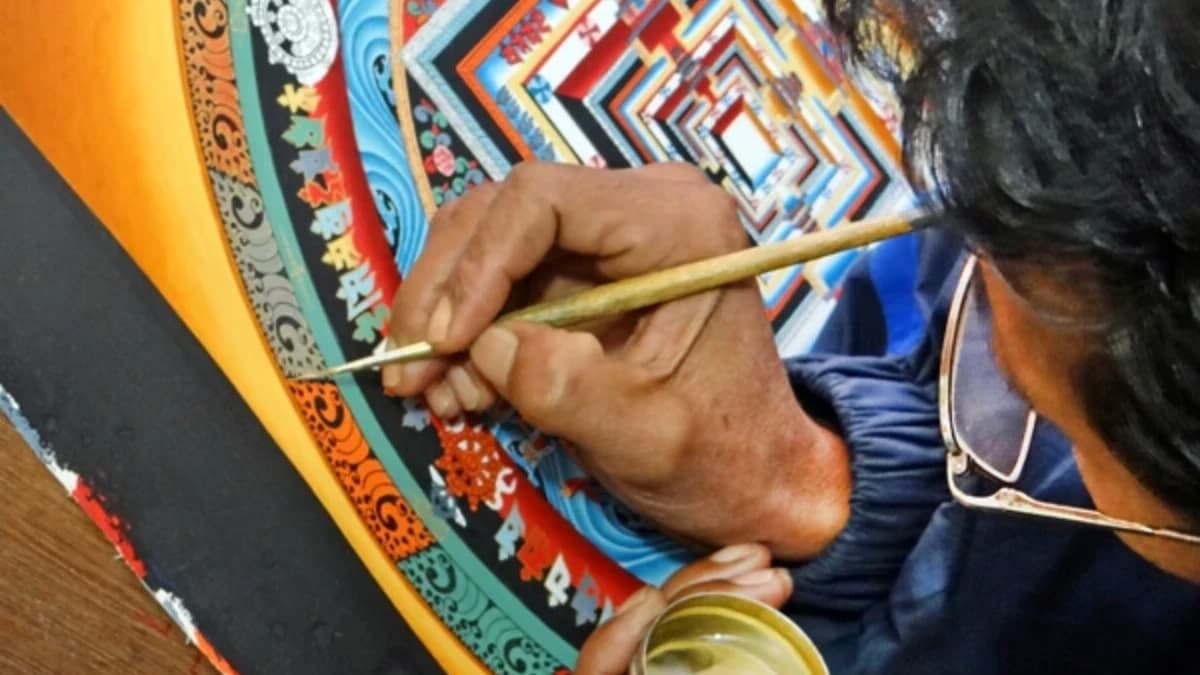
In a narrow room above a courtyard in Bhaktapur, a man is painting a face that has been painted a million times before and that he will paint differently from every one of them. The face belongs to the Buddha, or to Tara, or to Avalokiteshvara, or to one of the thousand emanations of enlightenment that Tibetan Buddhism has imagined into existence and that thangka painters have translated into pigment and gold for over a thousand years. The brush in his hand is made from cat hair. The canvas is cotton, stretched and treated with a mixture of chalk and animal glue. The paint is mineral (ground stone, not chemical dye), and the colours will not fade in a hundred years.
He has been painting this face for three weeks. The entire thangka will take two to four months. When it is finished, it will be a scroll painting roughly sixty centimetres by ninety: portable, rollable, designed to be carried from monastery to monastery by monks who needed their deities to travel with them. The thangka is not art in the Western sense. It is a meditation tool. A teaching aid. A window between the visible world and the one that Buddhist practise insists lies behind it. And the painter is not an artist in the Western sense. He is a practitioner, someone whose brush strokes are themselves a form of meditation, guided by iconographic rules that predate the Renaissance by centuries.
Bhaktapur is the centre of this tradition in Nepal. Not the only centre, Kathmandu's Boudhanath and Patan also have thangka workshops, but the most concentrated and the most accessible. Within the medieval city's brick-walled streets, a dozen workshops produce thangka paintings ranging from student exercises to museum-quality masterworks, and nearly all of them welcome visitors who want to watch the process, ask questions, and understand what makes this art form one of the oldest continuous painting traditions in the world.
What is a thangka painting in Tibetan Buddhism?
A thangka (pronounced TAHN-ka, the "h" is silent) is a Tibetan Buddhist painting on cotton or silk, typically depicting a deity, mandala, or scene from Buddhist teaching. The word comes from the Tibetan "thang" (flat) and "ka" (painting), literally, a flat painting, as opposed to sculpture or architecture.
Thangkas originated in Tibet and Nepal between the seventh and twelfth centuries, evolving from Indian scroll painting traditions that travelled north with Buddhism. They served a practical purpose: in a culture where monasteries were often temporary camps for nomadic monks, thangkas provided portable sacred images that could be rolled up, carried on horseback, and unrolled in any tent or room to create an instant shrine.
The painting follows strict iconographic rules codified in Buddhist texts. The proportions of the Buddha's face, the distance between the eyes, the length of the nose, the curve of the lips, are mathematically prescribed. The colours carry symbolic meaning: blue for wisdom, white for purity, red for compassion, green for activity, yellow for wealth and earth. The border patterns, the throne designs, the arrangement of subsidiary figures, all follow conventions that a trained viewer can read like a text.
This does not mean thangkas are identical. Within the iconographic framework, individual painters bring their own sensitivity to line, their own feeling for colour, and their own interpretation of expression. A master painter's Tara has a quality of presence that a student's does not, not because the proportions are different (they cannot be) but because the brushwork carries decades of practise and the meditation that accompanies it.
How is a thangka painting made step by step?
Watching a thangka being painted is watching patience made visible. The process has not changed significantly in centuries, and the materials, with a few modern exceptions, are the same ones used in medieval Tibetan monasteries.
Canvas preparation. Cotton cloth is stretched on a wooden frame and treated with a mixture of chalk (calcium carbonate) and animal-hide glue, creating a smooth, slightly absorbent surface. The canvas is burnished with a smooth stone until the texture is uniform. This preparation takes one to two days.
Drawing. The composition is sketched in pencil, following the iconographic proportions from memory or reference texts. A master painter draws freehand. Students may use gridlines or pounce patterns (perforated templates through which charcoal dust is pressed). The drawing establishes every element, the central figure, the throne, the surrounding deities, the landscape, the border, before any paint is applied.
Background painting. The background colours are laid in first, sky blues, landscape greens, throne golds. The paint is mineral-based: lapis lazuli for blue, malachite for green, cinnabar for red, orpiment for yellow. These minerals are ground to fine powder using a mortar and pestle, then mixed with animal-hide glue as a binder. The mineral pigments are expensive, genuine lapis lazuli can cost more than gold by weight, and many workshops now use synthetic alternatives for backgrounds while reserving mineral pigments for faces and important details.
Detail painting. The faces, hands, robes, and ornaments are painted with progressively finer brushes. The brushes are handmade, traditionally from cat hair, which holds a fine point, and the finest lines (eyebrows, eyelashes, the edges of lips) require a brush that is essentially a single hair. This stage takes the longest and demands the most concentration. Many painters meditate before beginning a face, and some recite mantras throughout the painting process.
Gold application. Gold paint, real gold, ground to powder and mixed with glue, is applied to crowns, jewellery, halos, and decorative elements. The gold is burnished with an agate stone after drying, creating the luminous sheen that distinguishes quality thangkas from painted reproductions. The gold application is often the final stage and transforms the painting from beautiful to radiant.
Eye opening. The last element painted is the eyes of the central deity. This is considered the moment when the painting becomes sacred, when the image transitions from art to embodiment. Some painters perform a small ceremony. Some simply pause, breathe, and paint. The eyes are the most technically demanding element and the most spiritually significant. A thangka with poorly painted eyes is a thangka that does not function as a meditation tool, regardless of how beautiful the rest may be.
Where can you see thangka painting workshops in Bhaktapur?
Bhaktapur's thangka workshops are concentrated in the old city, particularly near Taumadhi Square and Dattatraya Square. Most workshops are family operations, the skill is passed from parent to child, and the workspace is often a room in the family home, lit by natural light from a window or skylight.
Visiting a workshop is informal. You walk in, greet the painters, and watch. Some workshops have a small gallery or shop at the front where finished thangkas are displayed for sale. The painters work in the back room and are generally happy to have visitors, they may explain what they are painting, demonstrate a technique, or show you the progression from sketch to finished work.
Several workshops offer short courses for visitors, half-day or full-day sessions where you learn the basics of thangka drawing or painting under the guidance of a practising painter. These courses do not produce a finished thangka (that takes months) but they give you a physical understanding of the process, the weight of the brush, the texture of the mineral paint, the concentration required to draw a straight line with a trembling hand, that watching alone cannot provide.
The Bhaktapur entry ticket (approximately fifteen hundred Nepali rupees, around twelve US dollars) covers access to the entire old city, including the workshops. Individual workshop visits are free. If you take a course, expect to pay fifteen hundred to three thousand rupees for a half-day session. If you buy a thangka, prices range from three thousand rupees (fifty dollars) for a small student work to hundreds of thousands of rupees for a master-quality piece painted with genuine mineral pigments and real gold.
How do you tell if a thangka painting is authentic?
The thangka market includes everything from mass-produced prints on treated canvas to genuine hand-painted masterworks. Knowing the difference prevents both overpaying and under-appreciating.
Printed vs painted. The most basic distinction. Printed thangkas are machine-reproduced images on treated canvas, sometimes with hand-painted details added on top. They cost five to twenty dollars and are decorative objects, not art. Genuine hand-painted thangkas are entirely created by hand. Hold the piece at an angle to the light, printed images have a uniform dot pattern; painted images show visible brushstrokes and slight variations in colour density.
Student vs master. Student work shows hesitation in line quality, lines that wobble slightly, colour that bleeds at edges, faces that lack expression. Master work shows confidence, clean lines, precise colour boundaries, and faces that have the quality Tibetans call "life", an expression that seems to change depending on your mood and angle of viewing.
Synthetic vs mineral pigments. Mineral pigments have a depth and luminosity that synthetic paints do not replicate. The blue of genuine lapis lazuli glows from within. The green of malachite has a warmth that chemical green lacks. Ask the painter what pigments were used. Mineral-pigment thangkas are significantly more expensive because the materials cost more and the painting technique differs.
Gold. Real gold (24-karat, ground to powder) creates a warm, rich sheen that does not tarnish. Gold paint (synthetic) creates a bright, slightly harsh reflectivity that may darken over time. Rub a gold area very gently with your finger, real gold feels smoother and warmer than synthetic.
Can you visit thangka workshops while trekking in Nepal?
For trekkers visiting Nepal, Bhaktapur's thangka workshops offer a cultural dimension that the mountains do not. The trek delivers landscape, physical achievement, and altitude. Bhaktapur delivers art, history, and the specific pleasure of watching human hands create something that has been created for a thousand years and that will outlast the person creating it.
A day in Bhaktapur, visiting the workshops, watching the painters, eating juju dhau (the famous king curd) in Taumadhi Square, fits perfectly before or after a trek. The slow pace of the medieval city, the warmth of the Terai-adjacent climate, and the intimacy of watching a painter work in a room that his grandfather worked in are the antidote to the scale and exertion of the mountains.
And if you buy a thangka, a genuine, hand-painted one from a workshop you visited, created by a painter whose face you remember, you carry home something that no photograph provides: a physical object made by human hands in a tradition that connects the room where you stood to the monasteries of medieval Tibet, to the scroll paintings of ancient India, and to the specific, unbroken chain of teacher and student that has passed this knowledge forward for longer than most nations have existed.
The brush strokes are a meditation. The pigments are ground stone. The gold is real. And the face that the painter spent three weeks creating will look back at you from your wall for a hundred years, unchanged, patient, and, if the painter was good, alive with the quality that makes sacred art sacred: not perfection, but presence.
Visit Bhaktapur on our Kathmandu-Pokhara-Chitwan Tour, which includes a Bhaktapur day visit, or the Dhulikhel-Namobuddha Day Hike which passes through the Kathmandu Valley rim.
Thangka painting is one of those Nepali art forms that looks simple from across the room and impossibly complex from two feet away. The gold leaf, the mineral pigments, the brushstrokes thinner than a hair: a single thangka takes months to complete. Bhaktapur has been producing them for centuries, and watching a master painter work in silence is one of the most unexpectedly moving experiences in the Kathmandu Valley.
We include Bhaktapur in our Kathmandu cultural tours. A thangka workshop visit is something we highly recommend.
WhatsApp:+977 9810351300
Email:[email protected]
Written by Shreejan Simkhada, CEO of The Everest Holiday and third-generation Himalayan guide. TAAN Member #1586.
Bhaktapur thangka art is on our Kathmandu-Pokhara cultural day. Our Kathmandu & Pokhara Tour (7 Days) is private (your group only, no strangers), 2027 dates open, From USD $749. WhatsApp us for tailored 2027 dates and current departures.
 Chat with Shreejan