

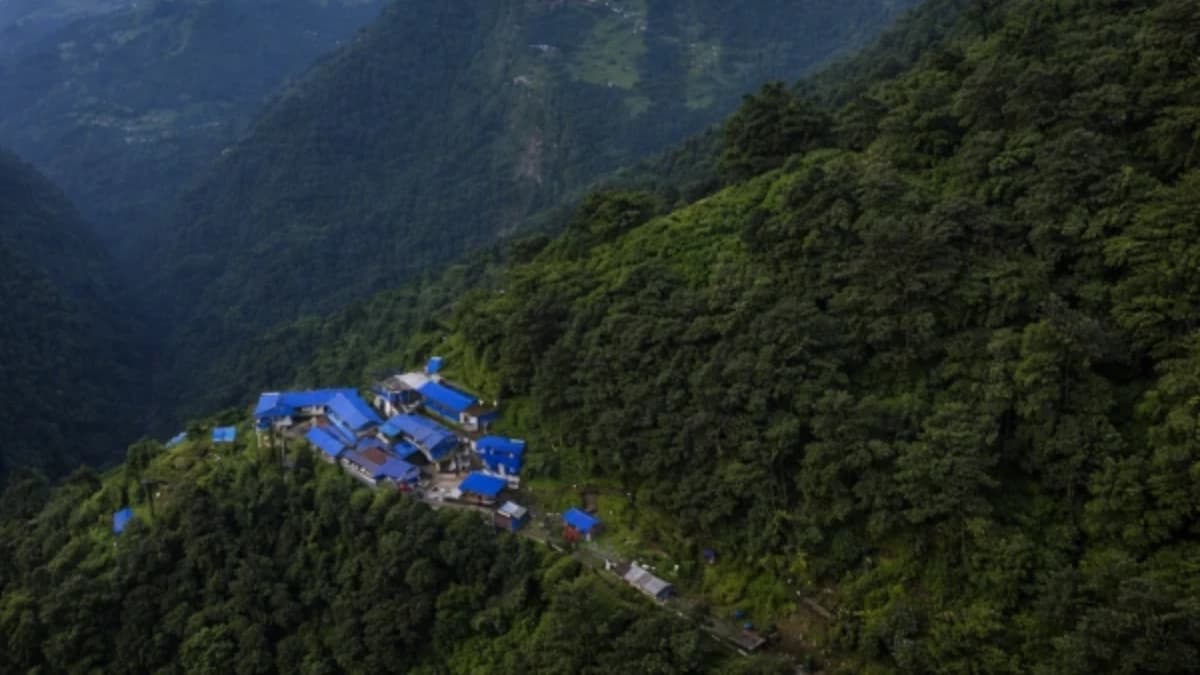
Short answer: Sinuwa (2,360 m) is a small village between Chhomrong and the bamboo forest on the Annapurna Base Camp trail, reached by going down Chhomrong's stone steps and climbing again. It has views back to Annapurna South and some of the best rhododendron forest on the route. It is on our Annapurna Base Camp trek.
Sinuwa, The Quiet Village Between the Stairs and the Forest
If Chhomrong is where the Annapurna Base Camp trek gets serious, Sinuwa is where it gets beautiful. This small settlement sits at 2,360 metres on the steep hillside between Chhomrong and the dense bamboo forests below, and it's one of those places that most trekkers pass through without really stopping to look around. That's a shame, because Sinuwa has a character all its own, and some of the best rhododendron forests on the entire trail.
You'll reach Sinuwa after descending from Chhomrong on one of the most famous (and most cursed-at) staircases in Nepal. Then you'll climb again, because that's what this section of the trek does, it goes down, then it goes up, then it goes down again, and your knees have strong opinions about all of it. But Sinuwa, perched on its ridge with views back toward the Annapurna South face, is worth every step.
Where Sinuwa Sits on the ABC Trek
Sinuwa sits between two much better-known stops on the Annapurna Base Camp route. Behind you (uphill) is Chhomrong, the last large village before the sanctuary, with its stone houses, shops, and hot showers. Ahead of you (downhill) is Bamboo, a tiny settlement in the river valley where the trail enters dense forest and the mountains disappear from view.
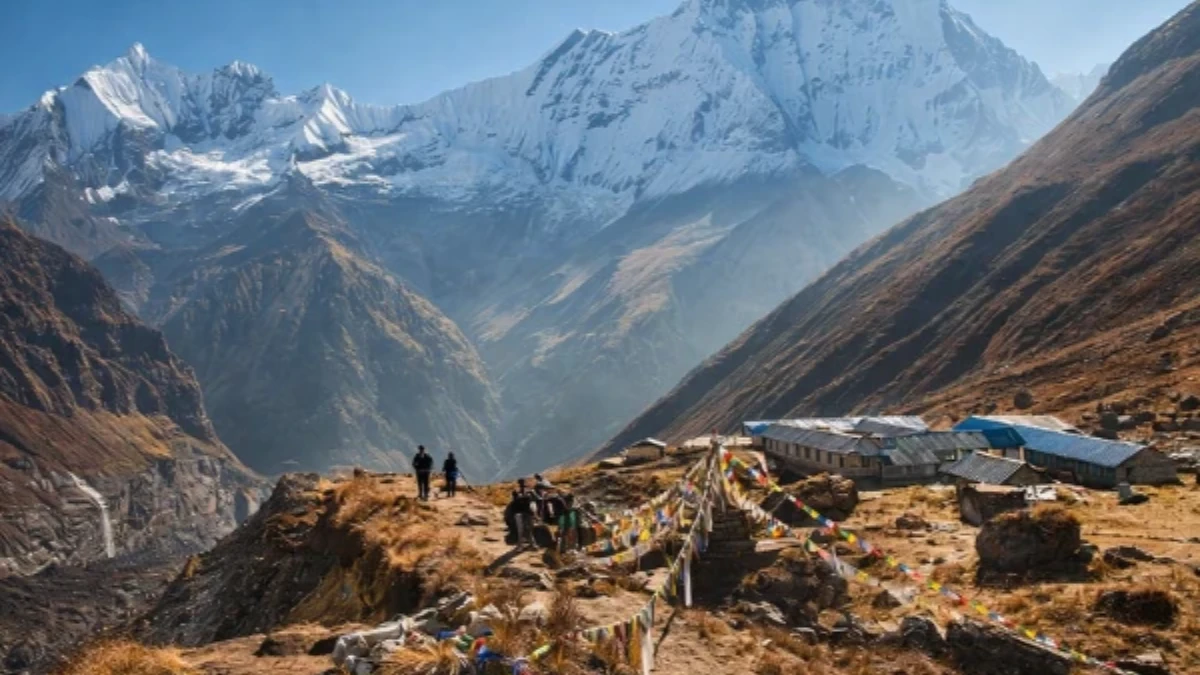
Most trekkers pass through Sinuwa on Day 3 or Day 4 of the standard ABC itinerary, depending on their pace and starting point. If you've started from Ghandruk and overnighted in Chhomrong, Sinuwa is roughly an hour and a half below. If you're pushing through to Bamboo or even Dovan, Sinuwa is your mid-morning rest stop, a place to catch your breath, drink some tea, and let your legs recover from the stone steps.
Some trekkers choose to overnight here instead of pushing on to Bamboo. It's a good choice if you're feeling the altitude change or if you simply want a quieter evening. Sinuwa's lodges are smaller and less crowded than Chhomrong's, and there's a peacefulness here that the busier stops don't have.
The Stone Steps, Let's Be Honest
We won't pretend the approach to Sinuwa is gentle. Coming from Chhomrong, you descend roughly 600 metres on steep stone staircases that wind down through terraced farmland before crossing the Chhomrong Khola on a small bridge. Then you climb back up, steeply, to reach Sinuwa on the opposite ridge.
These stone steps are hand-cut into the hillside and have been used by local people for generations. They're solid and well-maintained, but they're relentless. Your thighs will burn on the way up. Your knees will complain on the way down. Trekking poles help enormously here, we always recommend them for this section.
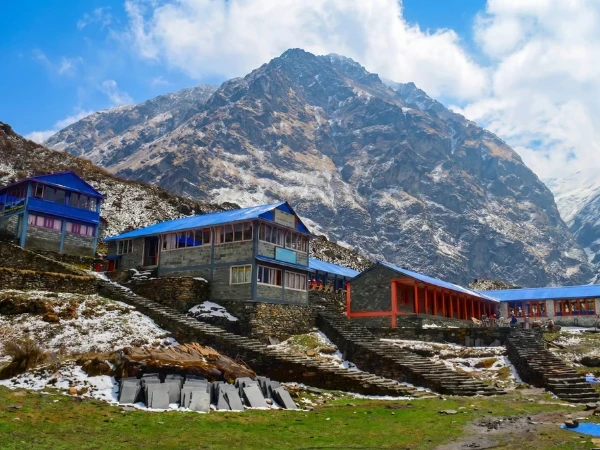
The good news? The steps are beautiful. They wind through cultivated fields where local families grow millet, maize, and potatoes. In spring, the hillsides are green and alive with wildflowers. In autumn, the harvest is in and the terraces glow golden in the afternoon light. You'll pass local farmers carrying baskets of produce on their backs, children heading to school, and the occasional mule train loaded with supplies for the lodges above.
Take your time on the steps. Stop often. Look behind you, the views of the Annapurna South face and Hiunchuli from the staircase are some of the best on the entire trek. Many trekkers are so focused on their feet that they forget to look up. Don't make that mistake.
The Rhododendron Forest
This is Sinuwa's real treasure. The village sits right at the edge of one of the most spectacular rhododendron forests in the Annapurna region. From Sinuwa downward toward Bamboo, the trail plunges into dense woodland where rhododendron trees, some of them ancient, with twisted trunks thicker than a person, form a canopy overhead.
If you're trekking in spring (March to May), this section of trail is extraordinary. The rhododendrons bloom in waves of red, pink, and white, turning the forest into something from a fairy tale. The flowers are so thick in good years that petals carpet the path and the air smells sweet. Even our guides, who've walked this trail hundreds of times, still stop to admire it in spring.
In autumn, the forest is quieter but no less beautiful. The leaves are deep green, the light filters through the canopy in shafts, and the trail has a cool, shaded quality that's welcome after the exposed hillsides above. You'll hear birdsong everywhere, the Annapurna sanctuary forests are home to dozens of species, including the Himalayan monal (Nepal's national bird, known locally as the danphe) with its iridescent plumage.
Between Sinuwa and Bamboo, keep your eyes open for langur monkeys in the canopy. They're shy but not uncommon, and watching them leap between the rhododendron branches is one of those unexpected moments that makes a trek memorable.
Lodges and Accommodation
Sinuwa has a handful of small lodges, typically three to five, depending on the season. These are simple teahouse-style guesthouses run by local families. Don't expect luxury. Expect warmth.
Rooms are basic: twin beds with foam mattresses, a pillow, and heavy blankets. Most rooms don't have attached bathrooms, you'll use shared facilities. Hot showers are sometimes available (solar-heated or gas), but at this altitude and in this location, a bucket of hot water is more reliable. It does the job perfectly well.
The dining rooms are the heart of these lodges, small communal spaces with bench seating, a central stove that burns in the evenings, and menus chalked on a board or printed on laminated cards. You'll eat with other trekkers and swap stories about the steps, the views, and the state of your knees.
If you're overnighting in Sinuwa, the evenings are wonderfully quiet. There's no mobile signal in some spots (though it's improving year on year), no traffic noise, and very little artificial light. Just the sound of the forest, the occasional bark of a village dog, and the crackle of the fire in the common room.
Food, Dal Bhat and More
The dal bhat in Sinuwa is excellent. That might sound like a small thing, but when you've been climbing stone steps for three hours, a heaped plate of rice, lentil soup, curried vegetables, and pickle is one of life's genuine pleasures.
Every lodge serves dal bhat as the staple, and you'll get free refills. It's the best value meal on the trail and it's what our guides eat every single day. There's a reason for that. Dal bhat gives you sustained energy without sitting heavy in your stomach. The saying on the trail is "dal bhat power, 24 hour", and it's not wrong.
Beyond dal bhat, you'll find the usual teahouse menu: fried rice, noodle soup (thukpa), momos (Nepali dumplings), chapati, porridge, pancakes, and various egg dishes. The ingredients are carried up from the valley below on the backs of porters and mules, so prices are a little higher than in Chhomrong and rise further as you go up. A meal in Sinuwa typically costs NPR 600-900 (roughly USD $4-7).
Tea and coffee are available everywhere. Nepali milk tea (chiya) is the classic, sweet, milky, warming, and cheap. It's the fuel that keeps trekkers and guides moving. A thermos of hot water for the trail is also worth buying here, especially if you're heading into the cooler forests below.
Altitude and Health
At 2,360 metres, Sinuwa is well below the altitude where most trekkers experience serious problems. Acute mountain sickness (AMS) typically begins above 2,500 metres and becomes a real concern above 3,500 metres. You're safe here in terms of altitude.
That said, you might feel more tired than you'd expect. The combination of altitude (even moderate altitude reduces your oxygen intake), the steep stone steps, and several days of continuous walking can leave you genuinely fatigued by the time you reach Sinuwa. This is normal. Drink plenty of water, eat well, and don't rush.
If you're feeling any headache, nausea, or unusual breathlessness, mention it to your guide. It's almost certainly just tiredness at this altitude, but our guides check in with every trekker daily and it's always better to flag something early. We carry a pulse oximeter on every trek and can check your oxygen saturation in seconds.
Practical Tips for Sinuwa
- Trekking poles are essential for the stone steps between Chhomrong and Sinuwa. They save your knees on the descent and give you stability on the climb back up.
- Start early from Chhomrong. The morning light on the stone steps is beautiful, the air is cool, and you'll avoid the midday heat on the exposed sections.
- Carry enough water. There are tea stops along the way, but it's good practise to have at least a litre in your bottle.
- If you're trekking in spring, have your camera ready before you reach the forest below Sinuwa. The rhododendrons won't wait for you to dig it out of your pack.
- Consider overnighting here if the lodges in Bamboo are full (common in peak season) or if you'd prefer a shorter walking day. The sunset views from Sinuwa's ridge are worth staying for.
- Charge your devices in Chhomrong. Charging facilities in Sinuwa are limited and some lodges charge a small fee for electricity.
Why Sinuwa Stays With You
Most trekkers remember Sinuwa for the steps, that brutal, beautiful staircase that tests your resolve and rewards your effort. But if you slow down and pay attention, you'll find that Sinuwa is more than a waypoint. It's the threshold between the inhabited world of Chhomrong and the wild forest of the Annapurna sanctuary. Behind you, terraced fields and village life. Ahead of you, ancient forest, glacial rivers, and the high mountains.
It's a place of transition, and like all good transitions, it deserves a moment of stillness before you move on.
Sinuwa is a stop on the Annapurna Base Camp Trek, between Chomrong and Bamboo in the deep forest section of the Annapurna Sanctuary.
Sinuwa is the last place where the forest feels like a forest. After here, the rhododendron thins out, the bamboo takes over, and then you are in the open sanctuary with nothing between you and Machhapuchhre. I always tell our trekkers to look back from Sinuwa, because the valley you came through looks completely different from above.
Sinuwa is on day two of our Annapurna Base Camp Trek. We time the walk so you arrive with daylight to spare.
WhatsApp:+977 9810351300
Email:[email protected]
Written by Shreejan Simkhada, CEO of The Everest Holiday and third-generation Himalayan guide. TAAN Member #1586.
Sinuwa is the day-4 stop on ABC. Our Annapurna Base Camp Trek (9 Days) is private (your group only, no strangers), 2027 dates open, From USD $725. WhatsApp us for tailored 2027 dates and current departures.

 Chat with Shreejan