

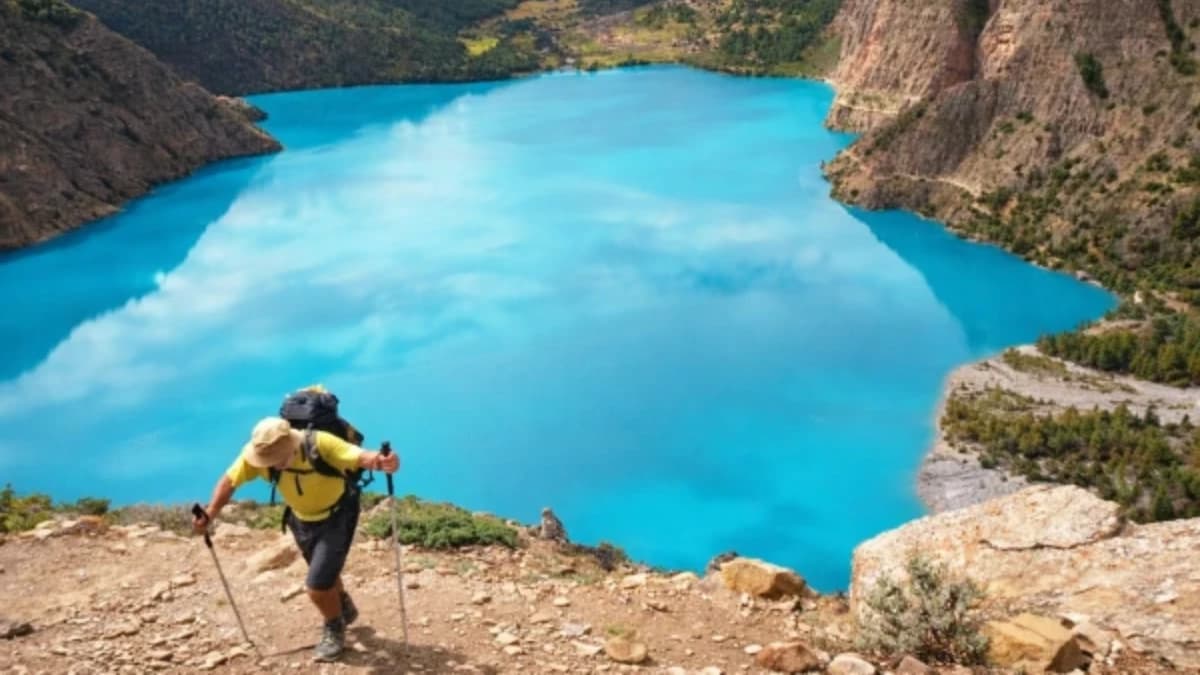
Short answer: Shey Phoksundo Lake sits at 3,611 m in Shey Phoksundo National Park, Dolpo, and is up to 145 m deep (2004 survey). Its turquoise colour comes from fine glacial flour in the water. You fly Kathmandu to Nepalgunj to Juphal, then walk about two days to the lake, with the Lower Dolpo restricted-area permit, the park fee, TIMS and a licensed guide.
The colour is wrong. That is the first thought. Standing at the rim of the lake, looking down at water that is not blue, not green, not teal, but a specific, vivid, almost electric turquoise that does not exist in any other body of water you have seen, the brain insists that something is wrong. Water is not this colour. Lakes are not this clear. The bottom, visible five metres down through water so transparent it looks like tinted glass, should not be visible at all in a lake that is, according to the measurements, 145 metres deep. And yet here it is. Phoksundo Lake. One of the deepest lakes in Nepal. The most beautiful lake in the Himalaya. A turquoise impossibility sitting at 3,611 metres in a landscape of desert canyons and Buddhist monasteries in the most remote trekking region in the country. We walk to the lake on our 15-day Lower Dolpo Circuit trek.
Peter Matthiessen wrote about this lake in "The Snow Leopard" (1978), the book that introduced Dolpo to the world and that remains, nearly fifty years later, the definitive account of what it feels like to walk through a landscape so remote and so beautiful that it alters the consciousness of the walker. Matthiessen came looking for snow leopards and found something else, a quality of presence, of attention, of being-in-the-world that the lake and its surrounding mountains forced upon him by the simple act of being more beautiful than anything he had words for.
The lake has not changed since Matthiessen saw it. The colour is the same. The depth is the same. The silence, broken only by wind, birdsong, and the occasional crack of a rock falling from the cliffs above, is the same. What has changed is access. Shey Phoksundo National Park, which protects the lake and the surrounding Dolpo region, is now open to trekkers. The walk from Juphal airstrip to the lake takes about two days, with a night at Shyanta. And the thrill of standing where Matthiessen stood, looking at the water that inspired one of the finest pieces of nature writing in the English language, is available to anyone willing to walk there.
Shey Phoksundo Lake quick facts
| Detail | What to know |
|---|---|
| Altitude | 3,611 m (11,847 ft), in Shey Phoksundo National Park, Dolpo. |
| Depth | Up to 145 m in the 2004 survey. The lake is about 5 km long and 800 m wide. |
| Waterfall | About 167 m, in several cascades, at the southern end. |
| Getting there | Fly Kathmandu to Nepalgunj, then to Jhupal (Juphal), then walk about 2 days to the lake. Flights depend on the weather. |
| Permits | Lower Dolpo restricted area permit USD 20 per person for the first week, then USD 5 per day. Shey Phoksundo National Park entry NPR 3,000. TIMS card required. |
| Guide | Restricted areas are trekked through a registered agency with a licensed guide. |
| Best months | October and November, and March to May. |
| Trail status | Dolpo status is from our 29 September update. See the note below. |
The lake is the highlight of our Lower Dolpo Circuit Trek, 15 Days: flights from Kathmandu via Nepalgunj to Jhupal, a rest day at Phoksundo Lake, a licensed guide and all permits arranged. It starts from USD 3,470 per person on the Budget option for 2 to 4 travellers, with a minimum of two. Pay in USD or EUR. Rescheduling is free on 72 hours notice. The 10% deposit itself is not refunded if you cancel.
Dolpo access note
In our 29 September 2026 flood update we found no trail-closure reports for Dolpo. We treated it as an open question rather than an all-clear, because the late-September rain put Dolpa among the districts with road subsidence and flash-flood risk. Flights to Jhupal also depend on the weather. We check access for your exact dates before you commit.
How deep is Shey Phoksundo Lake and why is it turquoise?
Phoksundo Lake occupies a glacially carved basin in the Suligad valley, dammed at its southern end by a natural moraine that creates the lake and the waterfall that spills over it. The lake is approximately five kilometres long and eight hundred metres wide, with a maximum depth of 145 metres in the 2004 survey. That makes it one of the deepest lakes in Nepal, though not the deepest: Rara Lake measured 167 metres in the same survey, and our comparison of the two lakes sets the figures side by side.
The colour comes from suspended particles of glacial flour, rock ground to powder by the glaciers above the lake and carried into the water by meltwater streams. The particles are too fine to settle and too dense to dissolve, and they scatter light in the specific wavelength range that produces turquoise. The colour changes with the light, pale and ethereal at dawn, deep and saturated at midday, silver and steel at dusk. Photographers who visit Phoksundo say the lake is unphotographable, not because the colour is difficult to capture but because the colour changes so constantly that no single image represents the lake accurately.
The water is cold, year-round temperature of approximately five to eight degrees Celsius at the surface. Swimming is possible but brief. The clarity is extraordinary, objects on the bottom are visible at depths of five metres or more. The lake has no outflow at the surface, the water exits through the moraine dam as underground seepage that emerges as the waterfall on the southern side.
There are no fish in Phoksundo Lake. The local Bon and Buddhist communities consider the lake sacred, and a prohibition on fishing, enforced by religious tradition rather than law, has kept the lake fish-free for centuries. The absence of fish contributes to the water's clarity, no biological activity disturbs the suspended glacial flour.
How Do You Get to Shey Phoksundo Lake?
Phoksundo Lake is in Shey Phoksundo National Park, in the Dolpo region of western Nepal. The approach involves a flight to Juphal airstrip (about 2,500 metres) followed by a two-day trek through the Suligad and Phoksundo valleys.
Flights to Juphal: From Nepalgunj (accessible by daily flights from Kathmandu). Juphal flights operate two to four times per week, weather-dependent. The flight takes twenty-five minutes and crosses the Himalayan foothills with views of Dhaulagiri and the western ranges. Flight cancellations are common, build buffer days into your itinerary.
The trek: From Juphal, the trail descends to the Bheri River, follows it upstream, and enters the Phoksundo valley through increasingly dramatic canyon terrain. The walking is moderate, no extreme altitude (the lake is at 3,611 metres), no high passes, no technical sections. The challenge is the remoteness, teahouse availability is limited on some sections, and the trail infrastructure is less developed than the Annapurna or Everest regions.
Permits: Shey Phoksundo National Park entry permit (NPR 3,000 per person). Lower Dolpo, which includes Phoksundo Lake, needs a restricted area permit at USD 20 per person per week (USD 5 per day after the first week). A TIMS card (NPR 2,000) is also required, and we arrange it with your permits. For Upper Dolpo (beyond the lake, toward Shey Gompa and the Crystal Mountain), the restricted area permit is USD 500 per person for the first ten days, then USD 50 per day.
How high is the Phoksundo waterfall?
The Phoksundo waterfall, at the southern end of the lake where the water exits through the moraine dam, drops approximately one hundred and sixty-seven metres in multiple cascades. It is one of the tallest waterfalls in Nepal and is visible from the trail approaching the lake from the south. The waterfall is at its most powerful during and after monsoon (July-October), when meltwater and rain feed the lake to its highest level. In the dry season (November-April), the flow reduces but the waterfall remains impressive.
The trail to the lake passes the base of the waterfall, and the mist, the sound, and the rainbow that forms in the spray on sunny afternoons are the first signs that the lake is close. The final approach, climbing from the waterfall to the lake rim, takes thirty to forty-five minutes and delivers the full reveal: the lake appearing suddenly, filling the valley ahead with a colour that the waterfall below did not prepare you for.
What is Ringmo village at Shey Phoksundo Lake?
Ringmo sits at the southern end of Phoksundo Lake, a small settlement of approximately fifty houses that is the only permanent habitation on the lake shore. The village is the cultural and logistical base for treks to the lake and beyond. Several teahouses and lodges provide accommodation. The food is simple, dal bhat, tsampa, Tibetan bread, and the ingredients are local, grown in the terraced fields below the village or carried in from the trail below.
The people of Ringmo are Bon practitioners, followers of the pre-Buddhist Tibetan religion that predates the arrival of Buddhism by centuries. Bon and Buddhism have coexisted in Dolpo for over a thousand years, and the religious architecture of Ringmo, chortens, prayer flags, mani walls, reflects both traditions. The local gompa (monastery) practices Bon rituals that are distinct from the Buddhist ceremonies at Khumbu or Annapurna monasteries, and the difference, subtle but significant, adds a cultural dimension to the lake visit that purely natural attractions cannot provide.
Can you trek all the way around Shey Phoksundo Lake?
A trail circumnavigates Phoksundo Lake, a full day's walk (six to eight hours) that follows the eastern shore through forest and rock, crosses the northern inlet streams, and returns along the western shore. The circuit provides changing perspectives on the lake, from above, from shore level, from the northern end where the glacial streams enter, and each perspective reveals a different aspect of the colour, the clarity, and the scale.
The eastern shore trail is narrower and more exposed than the approach trail, passing through sections carved into cliff faces above the water. The views from these sections, looking down into turquoise water from fifty metres above, with the canyon walls rising on both sides, are among the most dramatic in the Dolpo region.
The northern end of the lake is the wildest section, glacial moraines, ice-cold streams, and the beginnings of the trail to Upper Dolpo and the Crystal Mountain (Shey Gompa). For trekkers continuing to Upper Dolpo, this is the transition point from the accessible Lower Dolpo to the restricted, remote, and expensive Upper Dolpo, a different tier of trekking that requires the five-hundred-dollar restricted area permit and a willingness to spend two to three weeks in one of the most isolated trekking regions on earth.
Phoksundo on the Lower Dolpo Circuit in numbers
Key stages of our 15-day itinerary, with altitudes from the itinerary.
| Day | Stage | Distance and time |
|---|---|---|
| Day 2 | Fly Nepalgunj to Jhupal (about 2,500 m), then walk to Dunai (about 2,100 m) | 7 km, about 3 hours |
| Day 7 | Rest day at Dho Tarap (4,090 m) | Acclimatisation |
| Day 8 | Dho Tarap to Numa La Base Camp (4,440 m) | 10 km, 5 to 6 hours |
| Day 12 | Rest day at Phoksundo Lake | Acclimatisation |
| Day 13 | Phoksundo Lake to Shyanta (2,520 m) | 16 km, 6 to 7 hours |
| Day 14 | Shyanta to Jhupal | 7 km, 3 to 4 hours |
When Is the Best Time to Visit Shey Phoksundo?
October-November: The best months. Clear skies, stable weather, the lake at its most vivid turquoise (the glacial flour concentration is highest after monsoon melt). Cold at night (minus five to minus ten) but comfortable during the day (ten to fifteen degrees).
March-May: Spring brings warmer temperatures and rhododendron blooms at lower altitudes. The lake colour may be slightly less vivid (lower glacial flour concentration before summer melt begins). Good trekking conditions.
June-September: Monsoon. Dolpo receives less rain than eastern Nepal (partial rain shadow), but the trails are wet, leeches are present at lower altitudes, and flight cancellations to Juphal increase dramatically. Not recommended for most trekkers.
What is the national park around the lake like?
The lake sits inside Shey Phoksundo National Park, the largest national park in Nepal at 3,555 square kilometres, set up in 1984. There are no roads in Dolpo, so everything arrives on foot or on an animal after you fly to Juphal. The park lies in the rain shadow of the Dhaulagiri range, so it is dry and brown and closer to Ladakh or the Tibetan Plateau than to the green valleys of the Khumbu. The height runs from about 2,000 m in the southern valleys to 6,883 m at Kanjiroba. Blue sheep are the usual sight on the rocky slopes. Snow leopards live in the park, but you should not expect to see one.
How can you tell Bon from Buddhism on the trail?
Dolpo is one of the last strongholds of Bon, the religion of Tibet that came before Buddhism. The temples look much like Buddhist gompas, with prayer flags, chortens and wall paintings, but the deities and rituals differ. The easiest difference to see is the direction: Bon followers walk anticlockwise around a sacred site, Buddhists clockwise. Walk the way your guide tells you, take your shoes off, speak quietly and leave a small donation.
What is the difference between Lower and Upper Dolpo?
Lower Dolpo includes the lake and the valleys around it. It takes seven to ten days as a return trek, with simple teahouse lodging. Upper Dolpo starts beyond the lake and takes about three to four weeks. You camp and carry all your food, and it needs a separate restricted-area permit, USD 500 for the first 10 days and USD 50 for each day after that, arranged by us. Nobody should enter either area without a licensed guide from a registered agency.
Is Shey Phoksundo Lake worth visiting?
Nepal has many lakes. Gosaikunda. Tilicho. Rara. The Gokyo Lakes. Each is beautiful. Each has its devotees. Phoksundo is different from all of them, not because it is higher (it is not) or larger (it is not) or more famous (it is not). Phoksundo is different because of the colour and because of the journey.
The colour is the colour of nothing else. Not ocean turquoise. Not swimming pool blue. Not the teal of glacial rivers. A colour that exists only here, only at this altitude, only in this valley, only where these specific glaciers feed this specific basin with this specific particle size of ground rock. The colour is Phoksundo's signature, and no photograph, no description, no traveller's breathless account prepares you for the moment you see it.
The journey is the journey to the most remote major trekking destination in Nepal. Not the hardest, the altitude is moderate, the trail is not technical. But the most remote, the farthest from roads, the farthest from airports, the farthest from the infrastructure that the popular routes provide. The journey to Phoksundo is a journey away, from crowds, from convenience, from the familiar, and toward a lake that rewards the distance with a beauty that distance has preserved.
Matthiessen saw the snow leopard. Or he did not, the book is ambiguous. But he saw the lake. And the lake changed him. Not because it was beautiful, though it was. But because it was there. Present. Vivid. Real. A turquoise fact in a grey landscape, holding its colour against the rock and the sky and the centuries, waiting for anyone willing to walk far enough to find it.
Phoksundo Lake is the highlight of the Lower Dolpo Circuit Trek. The 15-day route circles the lake and explores the ancient Bon culture of Dolpo.
Phoksundo Lake is one of the deepest lakes in Nepal and possibly the most beautiful body of water in the Himalaya. The colour (turquoise fading to deep blue fading to black) comes from fine glacial flour suspended in the water. There are no fish, and the water is so clear that the bottom is visible at five metres or more. Getting there takes days of walking through Dolpo, and that remoteness is what keeps it pristine.
We offer treks to Phoksundo Lake and the Dolpo region. Restricted area permits required.
WhatsApp:+977 9810351300
Email:[email protected]
Written by Shreejan Simkhada, CEO of The Everest Holiday and third-generation Himalayan guide. TAAN Member #1586.
Shey Phoksundo Lake is the centrepiece of Lower Dolpo. Our Lower Dolpo Circuit Trek (15 Days) is private (your group only, no strangers), 2027 dates open, From USD $3470. WhatsApp us for tailored 2027 dates and current departures.


 Chat with Shreejan