

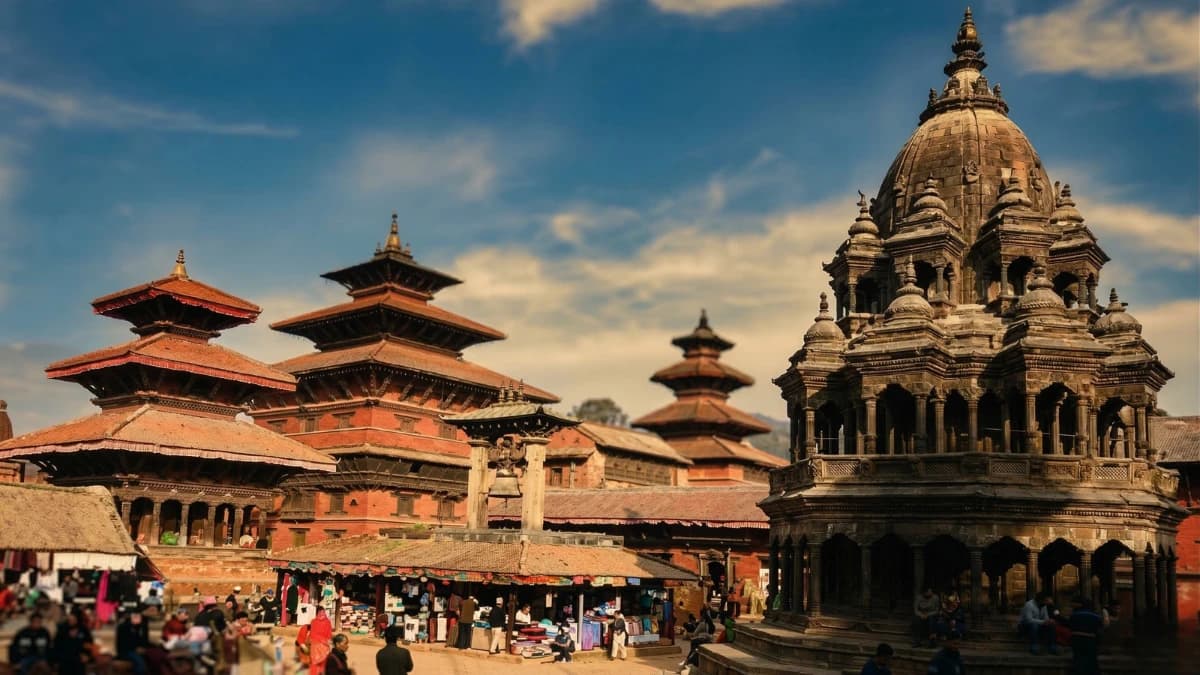
Patan, also called Lalitpur, is a Newar city about 5 km south-east of Kathmandu, and its Durbar Square is one of the seven monument zones of the Kathmandu Valley World Heritage Site. The Nepal Tourism Board lists the entry fee for foreign visitors at NPR 1,000, and that ticket includes the Patan Museum. Give it a half day if you only want the square and the museum, or a full day if you want the Golden Temple, Mahabouddha, Kumbheshwar and the craft lanes as well. This page is my practical plan for both, and it sends you to the separate posts for the other valley sites so I do not repeat them here.
Written by Shreejan Simkhada, CEO of The Everest Holiday. We are three generations of family guides, and I am a TAAN member (#1586). Last updated 4 October 2026. Fees are from the Nepal Tourism Board heritage-fee table, and history is from the Nepal Tourism Board and UNESCO listing summaries. Where I give a time that is not from a published source, it is marked as our estimate.
What is Patan and why visit it?
Patan is the old Newar royal city on the southern side of the Bagmati river, which separates it from Kathmandu. The local name is Yala, the 2021 census recorded 299,283 inhabitants, and the city is a long-standing centre of metalwork, wood carving and stone sculpture. The Nepal Tourism Board calls it the city of artisans and says its craftsmen still use the repoussé and lost-wax techniques. Tradition credits a king called Varadeva with founding the city in 290 CE, but that date comes from local tradition and I would treat it as legend.
The reason to go is the density. In one square you have palace courtyards, temples in stone and brick, a museum in a restored palace wing, and working craft streets within a few minutes of the square. I would not call it a 30-minute stop. If you rush it, you walk past the best part, which is the museum.
How much does Patan Durbar Square cost, and what are the opening hours?
This is the figure from the Nepal Tourism Board heritage-fee table. The Board says its information comes from the departments concerned, so check the ticket window on the day.
| Visitor | Patan Durbar Square including Patan Museum |
|---|---|
| Foreign visitors | NPR 1,000 |
| SAARC (BIMSTEC) visitors | NPR 500 |
| Chinese visitors | NPR 500 |
| Students (letter from school / student card / others) | NPR 10 / NPR 15 / NPR 30 |
| Nepali citizens | The Board says the fee applies only to the Patan Museum |
Opening hours: the Nepal Tourism Board gives none for Patan, and the Patan Museum website has no hours or fee page yet ("Coming soon"). Check at the gate. Please ask when you buy it whether the ticket is valid for more than one day.
For comparison, the Board lists Kathmandu Durbar Square at NPR 1,000 including the Tribhuvan Museum and Bhaktapur Durbar Square at US$18 or NPR 1,800. If money or time is tight and you must choose one of the three squares, our posts on Kathmandu Durbar Square and Bhaktapur will help you decide, and the Kathmandu Valley UNESCO sites guide compares all seven zones side by side.
What should I see inside the square?
The palace is built around courtyards. Mul Chowk is the largest central courtyard, Sundari Chowk holds a sunken tank called Tusha Hiti, and Keshav Narayan Chowk is where the Patan Museum is. Sundari Chowk was added to the museum in 2017, and the Nepal Tourism Board says it has woodcarvings and stone and metal sculptures.
The temples worth your time:
- Krishna Mandir. A stone Shikhara-style temple with 21 gilded spires, according to the Nepal Tourism Board. The date is disputed: the Nepal Tourism Board says 1637, other sources say 1667 and name King Siddhi Narsingh Malla as the builder, so I simply say 17th century. It was damaged in the April 2015 earthquake and restored in 2018.
- Bhimsen Temple. It dates to 1680. It is not open to tourists, so view it from outside.
- Vishwanath Temple. It dates to 1627.
- Taleju Bhawani. It was first built in 1640 and rebuilt in 1667 after a fire.
The square was heavily damaged in the April 2015 earthquake and the Hari Shankar Temple collapsed. Restoration work means you may see scaffolding or closed corners on the day. That is normal, and I would not change your plan for it.
Is the Patan Museum worth the time?
Yes, and it is the reason I would not do Patan in 30 minutes. The museum was inaugurated in 1997 by King Birendra, restored by the Austrian architect Götz Hagmüller, and curated by Mary Shepherd Slusser. It lists over 1,100 artefacts, about 200 of them on permanent display, mainly cast bronzes and gilt copper repoussé. The museum's own website says the Austrian government joined the Nepal Government in a UNESCO campaign to preserve the square, with the project starting in 1982 with the repair of Keshav Narayan Chowk.
What else is worth visiting in Patan?
| Place | What the sources say | Entry |
|---|---|---|
| Golden Temple (Hiranya Varna Mahabihar, Kwa Baha) | Dating from the 12th century, known for wood carving and repoussé (Nepal Tourism Board). The chief priest is a boy under twelve serving a one-month term, helped by an older boy or young man. | Not confirmed. Check at the gate |
| Mahabouddha Temple | The Board calls it a 14th-century terracotta monument with thousands of Buddha images. Some sources date it to 1585, and it was rebuilt after the 1934 earthquake. The date is disputed, so there is no single agreed one. | Not confirmed. Check at the gate |
| Kumbheshwar Temple | Built in 1392 (Board); the only five-storey pagoda in Patan (Board). It is one of two free-standing five-storey temples in the valley, the other being Nyatapola in Bhaktapur. | Not confirmed. Check at the gate |
Kumbheshwar has a trekking link. Its spring is believed to come from Gosainkunda, and a dip at Kumbheshwar on Janai Purnima is held to be equal to a dip at Gosainkunda itself. Janai Purnima falls on the full-moon day of the month of Shrawan. If you are planning the Langtang Gosainkunda trek, it is a nice way to see the lake's place in local belief before you go.
Please ask at the door about entry fees and photography rules for these three sites, and dress respectfully.
How long do I need? Half day or full day?
These times are our estimates from guiding groups here, not published figures. Add time if you want to sit and watch rather than tick sites off.
| Plan | What fits | Our estimate | Best for |
|---|---|---|---|
| Half day | Durbar Square and the Patan Museum, then a short walk to the Golden Temple | 3 to 4 hours | The day you arrive, or a trek briefing day |
| Full day | The half-day plan, then Mahabouddha, Kumbheshwar and a slow walk through the craft lanes with lunch | 5 to 7 hours | A spare day before or after a trek |
| Combined with Boudhanath | Boudhanath in the morning, Patan in the afternoon (see our Boudhanath guide) | Most of a day | Two sites with little time |
My own advice: start with the museum while you are fresh, because it is the part people skip when they are tired, and leave the craft lanes for the end of the day when the pace can slow down.
How do I get to Patan from Thamel?
The Nepal Tourism Board says Patan lies about 5 km south-east of Kathmandu. Traffic decides the journey time, not the distance, so don't plan on exact minutes. I have no sourced taxi fare either, so I give none. Agree the fare with a taxi driver before you get in, or ask your hotel to arrange the car. If you are coming with us, the transfer is arranged for you.
Walking from Thamel is possible but long, and you cross the Bagmati. I would take a vehicle there and walk back through the lanes if you still have energy.
When is the best time to visit, and what about festivals?
The figures below are Kathmandu's 1991 to 2020 normals at Tribhuvan International Airport. Patan sits next to it in the same valley, but this is Kathmandu's figure, not a Patan reading.
| Month | Average daily high | Average daily low |
|---|---|---|
| January | 19.2 °C | 2.8 °C |
| April | 28.6 °C | 12.3 °C |
| July | 28.7 °C | 20.3 °C |
| October | 27.2 °C | 13.9 °C |
About 65% of the annual rain falls in the monsoon months of June to September, and the annual total is 1,502 mm. So walking the square is easiest outside those months, though the museum is a good wet-day fallback.
The Rato Machhindranath festival is the big event for Patan. It is held in April to May, runs for about a month, and moves a chariot of roughly 65 feet through the streets of Patan, ending at Jawalakhel. The exact dates follow the lunar calendar, so see our festivals post and the 2027 festival calendar and confirm locally. Festival days bring crowds and sometimes road closures, so allow extra travel time. Offices and some sites can close around the major national festivals, so check our Dashain and Tihar posts if your dates are close.
What should I eat in Patan?
Patan is a good place for Newar food. Bara is a fried lentil cake, chatamari a rice-flour crepe, yomari a steamed dumpling made from chaku and flour, and samay baji a set of beaten rice with roasted meat, vegetables, cowpea, soybean and ginger. Aila is a Newar spirit. Our Nepali food guide covers the wider menu. I'm not naming restaurants here.
How does Patan fit with a trek briefing day?
In our experience many trekkers arrive in Kathmandu a day or two before they fly to the mountains, and Patan fits well into that gap. My suggestion is to keep the briefing, gear check and any paperwork in the other half of the day.
- Morning Patan, afternoon briefing. The half-day plan above works well. Ask your trek leader what time the briefing is and plan the return to Thamel around it.
- Do not stretch the day. A full-day Patan walk the day before an early start is tiring. Keep the long version for a spare day.
- Permits take time. Permits need at least 48 hours in government working days, so send your passport details well before you land. A licensed guide and agency-issued TIMS card are required on most trekking routes under the Nepal Tourism Board rule from 31 March 2023; the rule covers the Everest (Khumbu) region too, and we always trek with a licensed guide.
- Insurance. Buy it at home before you travel, not in Nepal.
- Where to stay. Our Kathmandu hotel guide and first-time Kathmandu post cover the practical side. Kathmandu hotels are not included in any of our trek tiers, so we quote them separately.
If you want a gentler first day, our post on day hikes near Kathmandu lists walks that suit the same slot.
How can The Everest Holiday help?
Patan and the other six valley zones are part of our tours, and we can add Patan to any trek itinerary as a rest-day or arrival-day plan.
- Our one-day UNESCO World Heritage Site tour includes Patan Durbar Square in its itinerary. On the Budget tier the price covers a private vehicle and an English-speaking guide, and you pay entrance fees yourself. The Standard tier adds lunch, all heritage entrance fees and government taxes.
- On day 2 of our 7-day Kathmandu and Pokhara tour, the afternoon visit is Patan Durbar Square. It starts from USD 749 per person on the Budget tier, USD 999 Standard and USD 1,799 Luxury for a group of one to four, read from our booking system on 4 October 2026.
- The 8-day Kathmandu, Pokhara and Chitwan tour mentions a visit to Patan Durbar Square on the final morning if your flight is later in the day.
If you need to change your dates, we offer free rescheduling with at least 72 hours' notice, to any date within one year. The 10% deposit itself is not refunded if you cancel. For a plan built around your own dates, message me on WhatsApp at +977 9810351300 or email [email protected]. Prices are in US dollars, paid in cash or by card, and a card payment of the balance carries a 3.5% charge.
Related reading: Pashupatinath, Swayambhunath and Changu Narayan.

 Chat with Shreejan