

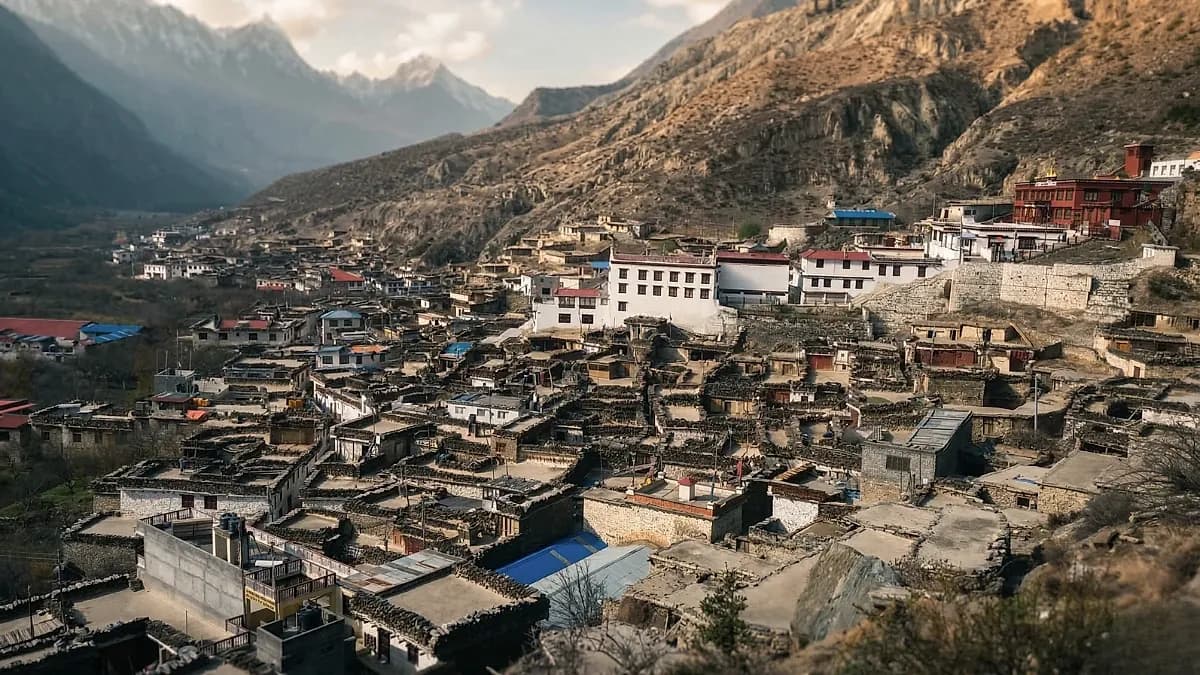
Written by Shreejan Simkhada, CEO of The Everest Holiday and third-generation Himalayan guide. TAAN Member #1586.
If someone told you there's a village in the middle of the Himalayan rain shadow where cobblestone streets run between whitewashed stone houses, where apple orchards stretch out in every direction, and where you can sit down to a plate of dal bhat so good it makes you forget you've been walking for a week, you'd probably think they were exaggerating. They're not. That's Marpha.
Marpha at a glance
Short answer: Marpha is a Thakali village at about 2,670 m in the Kali Gandaki valley, known as the apple capital of Nepal. It is about 1.5 to 2 hours on foot south of Jomsom, and a lunch or rest stop for most people on the Annapurna Circuit. Altitude is not a concern here. The valley wind builds from late morning, so walk early. On our 12-day Annapurna Circuit trek, you drive through Marpha on day 11, on the way from Muktinath to Pokhara.
| Altitude | About 2,670 m, in the Kali Gandaki valley of Lower Mustang |
| Region | Annapurna Conservation Area (ACAP), in the Himalayan rain shadow |
| People | A Thakali village of whitewashed stone houses and flagstone streets |
| Known for | The apple capital of Nepal: orchards, apple brandy and dried fruit |
| On the trail | A rest-day favourite on the Annapurna Circuit and the road to Upper Mustang |
| From Jomsom | About 1.5 to 2 hours on foot; Marpha to Tukuche is about 1 to 1.5 hours |
| Best months | October to November for clear skies and apple season; March to May for warm days |
| Visit it on | Muktinath Tour by Flight, 5 Days (day 3), Annapurna Circuit Trek (the day 11 drive from Muktinath passes through), Upper Mustang Trek (the road north starts at Jomsom) |
Marpha lies within the Annapurna Conservation Area, managed by Nepal’s National Trust for Nature Conservation.
Sitting at 2,670 metres on the western bank of the Kali Gandaki River, Marpha is one of the most beautiful stops on the Annapurna Circuit. It's also a key waypoint for anyone heading into Upper Mustang or completing the classic Jomsom-to-Muktinath route. But honestly, even if it weren't on the way to anywhere, Marpha would be worth the trip on its own.
I've walked through this village more times than I can count, and every single time I end up staying longer than planned. There's something about Marpha that slows you down, in the best possible way.
Why Is Marpha Called the Apple Capital of Nepal?
Nepal isn't the first country people think of when they think of apples, but Marpha has been growing them for decades. The Horticulture Research Centre here, one of the oldest in the country, introduced apple farming to the Kali Gandaki valley decades ago, and the results speak for themselves. The climate is perfect: dry air, strong sun, cool nights, and well-drained soil on the valley slopes.
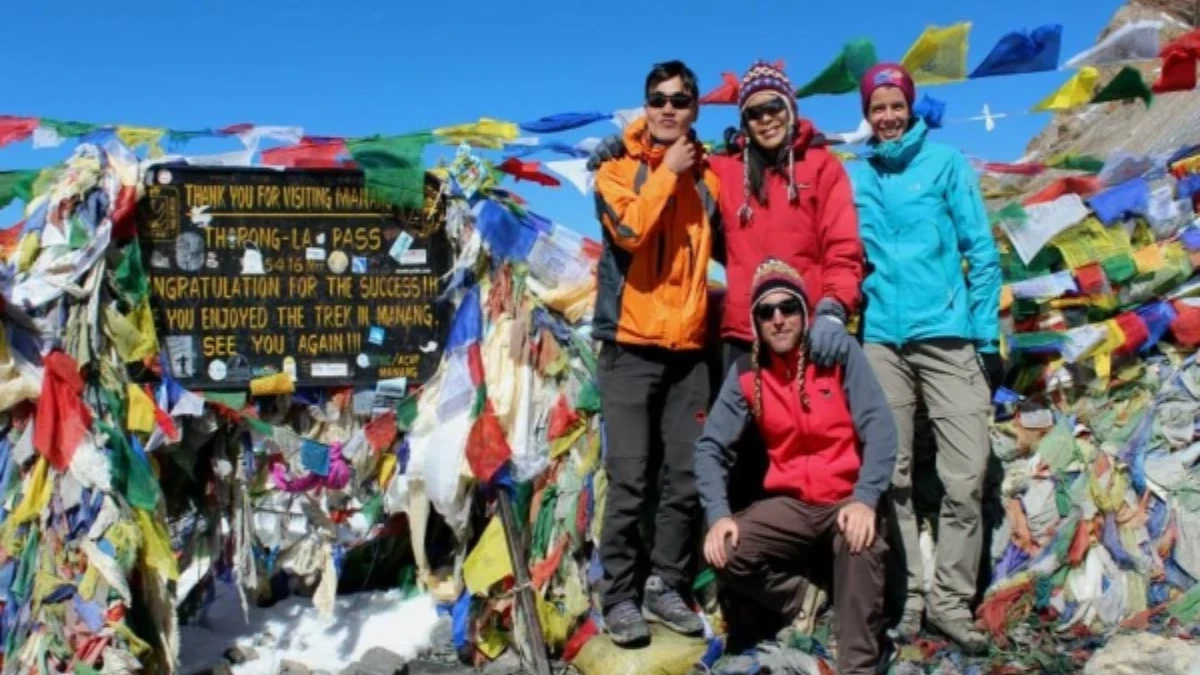
Walk through Marpha between September and November and you'll see apples everywhere. Stacked in baskets outside guesthouses, drying on rooftops, pressed into juice, baked into pies, and, most famously, distilled into apple brandy. The locals call it raksi, but Marpha's version is something else entirely. It's smooth, strong, and served in small glasses that somehow keep refilling themselves. If you've just come down from Thorong La or you're on your way up, a glass of Marpha apple brandy feels like the Himalayas giving you a pat on the back.
You'll find apple products in nearly every shop: dried apple rings, apple cider, apple jam, apple wine, and bottles of brandy wrapped in newspaper for the journey home. Some trekkers carry a bottle all the way back to Kathmandu. It's worth the weight.
What Is Marpha Village Like?
Marpha doesn't look like most Nepali villages. The architecture here is distinctly Thakali, flat-roofed stone buildings with whitewashed walls, narrow alleyways with drainage channels running down the centre, and heavy wooden doors that have been here for generations. The main street is a single cobblestone path, sheltered from the Kali Gandaki wind that whips through the valley every afternoon.
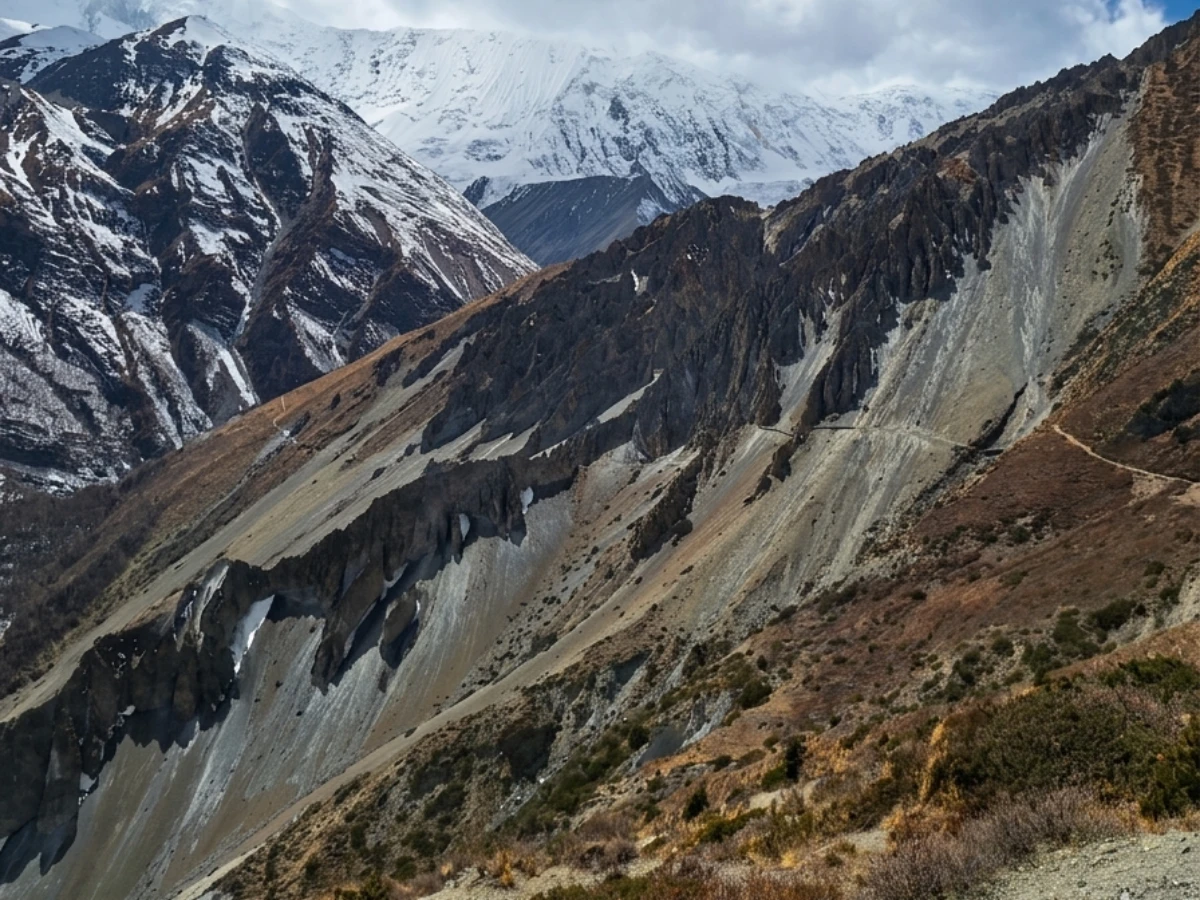
That wind, by the way, is no joke. The Kali Gandaki gorge funnels air from the lowlands straight up through the valley, and by midday it can feel like someone's opened a giant hairdryer pointed right at your face. Marpha's clever layout, with its enclosed streets and stone walls, was designed centuries ago to deal with exactly this. Walk through the village at two in the afternoon and you'll barely notice the gale howling outside.
The village is compact enough to explore in an hour or two, but give yourself more time. Wander through the back lanes above the main street and you'll find the monastery, the apple orchards stretching up the hillside, and viewpoints looking across the valley to the Nilgiri peaks. On a clear morning, the light on the white buildings against the brown hills and blue sky is genuinely striking.
What Is Thakali Food and Why Is It Special?
If there's one thing Marpha is famous for beyond apples, it's the food. The Thakali people of this region have a culinary tradition that's considered one of the finest in the country, and in Marpha you get to experience it at its source.
Thakali dal bhat is a proper meal. You'll get rice, lentil soup, a meat or vegetable curry, pickles (achar), greens, and sometimes a small dish of buckwheat or barley on the side. The flavours are distinct from what you get in Kathmandu, more mustard oil, more timur (Sichuan pepper), more dried meat. It's hearty, warming food made for people who live and work at altitude.
Beyond dal bhat, keep an eye out for:
- Thakali thali set, the full spread with multiple side dishes, often the best value meal on the entire circuit
- Dhido, a dense, dough-like staple made from buckwheat or millet flour, eaten with dal and gundruk (fermented greens)
- Apple pie, nearly every lodge in Marpha bakes their own, and the competition between them is fierce. Some trekkers rate Marpha apple pie as the best food they eat on the entire trek
- Buckwheat pancakes, served with apple honey or jam for breakfast
- Yak cheese, sometimes available, depending on the season
My honest advice: don't skip lunch in Marpha. Even if you're just passing through on the way to Jomsom, stop and eat properly. You won't regret it.
Where Should You Stay in Marpha?
Marpha has a good range of lodges for a village its size. Because it sits on both the Annapurna Circuit and the Jomsom trek route, it gets steady traffic through the main trekking seasons, and the accommodation reflects that.
Most lodges are family-run guesthouses built into the traditional stone buildings. Rooms are simple but clean, expect a bed, blankets, and sometimes an attached bathroom with hot water (solar-heated, so morning showers are warmer than evening ones). A few of the newer places have proper en-suite rooms with better mattresses.
Some well-known options include:
- Hotel Dhaulagiri, one of the older establishments, good food, reliable rooms
- Paradise Guest House, popular with trekkers, known for their apple pie
- New Dhaulagiri Guest House, slightly updated rooms, friendly family
Room rates in Marpha are reasonable. During peak season (October-November and March-April), it's worth arriving by early afternoon to get your pick. The village doesn't get as crowded as Manang or Muktinath, but the best rooms do fill up.
Most lodges operate on the standard trekking model: cheap rooms if you eat at the lodge, slightly higher if you eat elsewhere. Eating at your lodge is usually the right call anyway, as I said, the food here is excellent.
Where Does Marpha Fit on the Annapurna Circuit?
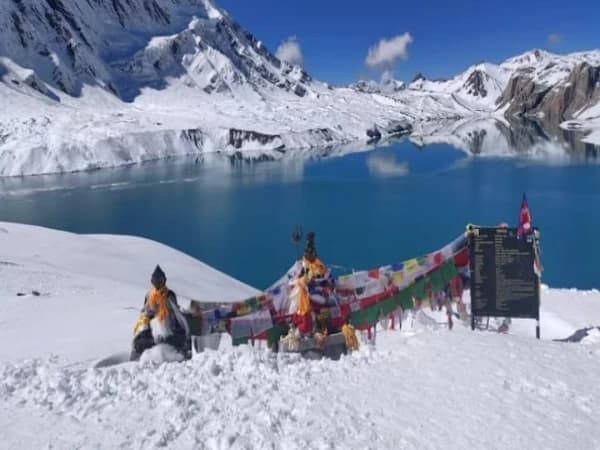
If you're walking the full Annapurna Circuit anticlockwise (the most common direction), you'll reach Marpha after crossing Thorong La Pass and descending through Muktinath, Kagbeni, and Jomsom. By this point you've done the hard part, and Marpha feels like a reward.
Most trekkers arrive from Jomsom, which is only about an hour and a half to two hours' walk north. The trail follows the Kali Gandaki riverbed, flat, wide, and dusty when the wind picks up. It's not the most scenic section of the circuit, but once you turn the corner and see Marpha's white buildings set against the hillside, you'll forget about the dust.
From Marpha, the trail continues south towards Tukuche, Lete, Tatopani (where there are natural hot springs, yes, you should stop), and eventually Birethanti and Nayapul, where most trekkers end the circuit.
A typical itinerary might look like:
- Jomsom to Marpha: 1.5-2 hours
- Marpha to Tukuche: 1-1.5 hours
- Marpha to Lete/Kalopani: 4-5 hours
- Marpha to Tatopani: a long day or comfortable two days
If you've got time, spend a rest day in Marpha. You've earned it after Thorong La, and there's enough to see and eat to fill a day without feeling restless.
Can You Visit Marpha on the Way to Upper Mustang?
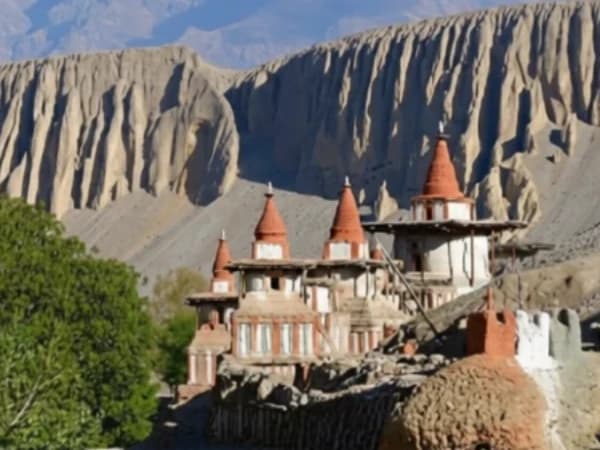
Marpha sits at a crossroads. Head north through Jomsom and Kagbeni and you're on the route into Upper Mustang, the former forbidden kingdom of Lo, with its red-walled monasteries, eroded canyons, and Tibetan culture. Upper Mustang requires a special permit and is a separate trek altogether, but if you're considering it, Marpha is a natural place to rest before or after.
Some trekkers combine the Annapurna Circuit with a shorter foray towards Kagbeni and the edge of the Upper Mustang restricted area. Even without the full permit, walking from Jomsom to Kagbeni and back gives you a taste of that arid, Tibetan-influenced landscape.
What Should You Know Before Visiting Marpha?
- Best time to visit: October-November for clear skies and apple season. March-May for rhododendrons further south and warm days. Winter (December-February) is cold but Marpha stays open, it's a real village, not just a trekking stop
- Altitude: At 2,670m, Marpha is low enough that altitude sickness isn't a concern here. If you're walking the circuit clockwise (south to north), you'll pass through before the serious altitude begins. If anticlockwise, you're on the way down and your body is already acclimatised
- Cash: There's no reliable ATM in Marpha. Bring enough cash from Jomsom or Kathmandu. Most lodges accept Nepali rupees only
- Phone signal: You'll get NTC coverage in Marpha, though it can be patchy. Some lodges have Wi-Fi, slow, but it works for basic messages
- The wind: It hits every afternoon, usually from about 11am onwards. Plan your walking for the morning and be in Marpha by lunchtime if you can. Walking into a headwind in the Kali Gandaki valley is nobody's idea of fun
- Apple brandy caution: It's stronger than it tastes. One glass is lovely. Three glasses at 2,670m and you'll feel it the next morning. Pace yourself
- Photography: The morning light between 6am and 8am is beautiful. The whitewashed walls glow, the orchards are still, and the peaks behind the village catch the first sun. Bring your camera out early
Why Is Marpha Worth a Stop?
I've taken trekkers through dozens of villages on the Annapurna Circuit, and Marpha is the one they talk about afterwards. Not because it's the highest or the most dramatic, it isn't. But because it's one of those rare places where everything comes together: the architecture, the food, the pace of life, the setting.
There's a moment in Marpha that catches most people off guard. You're sitting in a courtyard, the afternoon wind is howling somewhere above the rooftops but you can't feel it, there's a plate of apple pie and a cup of tea in front of you, and Nilgiri South is turning gold in the late sun. It's quiet. It's perfect. And you think: this is why I came to Nepal.
That's Marpha. Don't rush through it.
Marpha is on the descent side of the Annapurna Circuit Trek after Thorong La Pass, known for its apple orchards and brandy. It is also a short walk or drive from Jomsom, where the route to Upper Mustang begins, which our Upper Mustang Trek covers.
Marpha is the apple capital of Nepal and one of the cleanest villages on the Annapurna Circuit. The cobblestone streets, the whitewashed houses, the apple brandy distilleries: it feels more like a Tibetan village in a storybook than a real place on a trekking trail. Buy the apple brandy. It is genuinely good.
On our Annapurna Circuit Trek the day 11 drive from Muktinath to Pokhara passes through Marpha. Our Muktinath Tour by Flight visits it on day 3.
WhatsApp:+977 9810351300
Email:[email protected]
Marpha is on the day 11 drive of our Annapurna Circuit Trek. Our Annapurna Circuit Trek (12 Days) is private (your group only, no strangers), 2027 dates open, From USD $1,175. WhatsApp us for tailored 2027 dates and current departures.

 Chat with Shreejan