

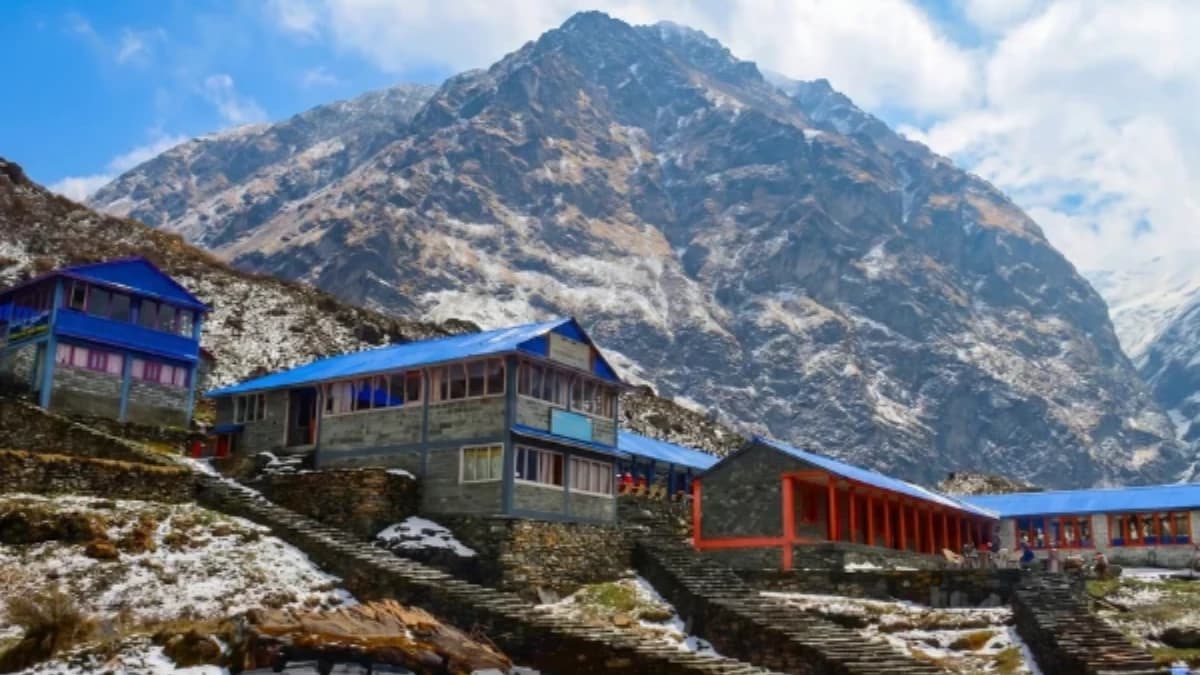
Short answer: Machhapuchhre Base Camp (MBC, about 3,700 m) is the last stop before Annapurna Base Camp (4,130 m), at the entrance to the Annapurna Sanctuary and directly below Machhapuchhre (6,993 m), a sacred peak that is closed to climbing. Most trekkers pass through and reach ABC two to three hours later, but sleeping at MBC is a gentler step for the altitude. It is on our Annapurna Base Camp trek.
The trail levels. The gorge widens. And there it is: Machhapuchhre, the Fish Tail, rising directly above you in a wall of ice and rock so steep, so close, and so impossibly vertical that your neck aches from looking up and your mind refuses to calculate the angle. The mountain is 6,993 metres high. You are standing at 3,700 metres. The three thousand metres between you and the summit are not horizontal distance; they are vertical, compressed into a face that climbers have studied for decades and that the Nepal government has declared permanently off-limits. Machhapuchhre is sacred. It is the throne of Lord Shiva. And it is unclimbed, the only major peak in the Himalaya that humans have agreed to leave alone.
Machhapuchhre Base Camp (MBC, as every trekker abbreviates it) is not the destination of the Annapurna Base Camp trek. It is the penultimate stop, the night before ABC, the place where the Sanctuary begins to reveal itself and where the mountains close in from every direction with a completeness that the lower trail only hinted at. Most trekkers arrive at MBC in the early afternoon, drop their packs, stare at Machhapuchhre for twenty minutes, eat lunch, and continue to ABC two to three hours further up the valley. Some stay the night, and those who do are rewarded with a sunset and sunrise on the Fish Tail that the through-walkers miss entirely.
How Do You Get to Machhapuchhre Base Camp?
MBC sits at the point where the Modi Khola valley transitions from gorge to sanctuary. Below MBC, from Chhomrong through Sinuwa, Bamboo, Dovan, Himalaya, and Deurali, the trail follows the river through a narrow, forested canyon. The valley walls are steep. The vegetation is dense, bamboo, rhododendron, oak. The sound of the river is constant and close. Waterfalls drop from cliffs that disappear into cloud. The trail feels enclosed, intimate, and green.
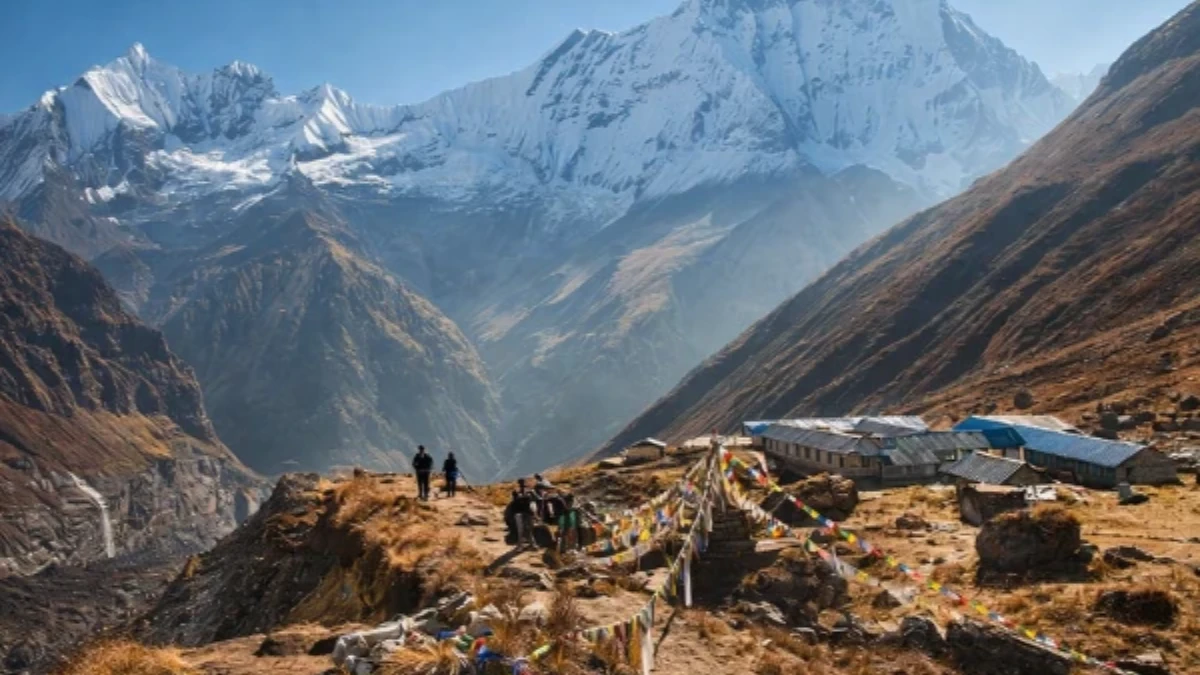
At MBC, the gorge opens. The forest ends. The valley floor widens into a broad, rocky plateau dotted with stone teahouses and prayer flags. And the mountains, which have been hidden behind the gorge walls for two days, suddenly appear in every direction. Machhapuchhre to the east. Annapurna III to the north. Hiunchuli to the west. The transition from enclosed forest to open mountain amphitheatre is one of the most dramatic landscape shifts on any trek in Nepal, a curtain rising on a stage that holds some of the highest peaks in the world.
The walk from Deurali to MBC takes approximately two hours. The trail climbs gradually through the last section of scrub vegetation, crossing several small landslide areas and a section of exposed moraine. The altitude gain is moderate, approximately 400 metres, but the thinning air at 3,700 metres makes the climb feel harder than the altitude gain suggests. By MBC, most trekkers are breathing noticeably harder than at Chhomrong, and the first symptoms of altitude, mild headache, reduced appetite, may appear.
Why Is Machhapuchhre Sacred and Unclimbed?
Machhapuchhre is not the highest mountain visible from MBC. Annapurna I (8,091 metres), visible from ABC two hours further up the valley, is over a thousand metres higher. But Machhapuchhre is the most beautiful. Its shape, a near-perfect pyramid with twin summits that, from certain angles, resemble the forked tail of a fish, is one of the most distinctive silhouettes in the Himalaya. It is the mountain that appears on Nepal Tourism Board posters, on airline advertisements, and on the covers of trekking guides. It is the mountain that most people picture when they think "Nepal."
The mountain is sacred to the Gurung people, who consider it the home of Lord Shiva. In 1957, a British expedition led by Jimmy Roberts climbed to within fifty metres of the summit before turning back, honouring a promise made to the Nepal government that the summit would not be touched. Since then, the mountain has been closed to climbing. No climbing permits are issued. No expeditions are authorised. Machhapuchhre remains, in perpetuity, an unclimbed peak, a decision that is both religious and philosophical, a statement that some mountains are not for humans to stand on.
From MBC, the mountain's south face fills the eastern sky. In the morning, the face catches the first light, turning from grey to gold to white in a sequence that takes ten minutes and that no two mornings repeat identically. In the evening, the sunset paints the face in oranges and pinks that deepen to purple as the light fades. And at night, under a sky dense with stars, the mountain is a dark shape against the Milky Way, a pyramid of shadow so large and so close that it seems to lean over the camp.
Where Can You Stay at Machhapuchhre Base Camp?
MBC has three or four teahouses, small stone buildings with tin roofs, basic rooms, and common areas heated by gas stoves. The teahouses are simpler than those at Chhomrong or Ghandruk, the altitude and the remoteness limit what can be provided. Rooms have two single beds with thin mattresses. Blankets are provided but a sleeping bag is recommended. The bathroom is shared and may be outside. Hot showers are not available.
The menu is standard teahouse fare: dal bhat, noodle soup, fried rice, pancakes, eggs, and tea. The food is carried in from lower villages, every grain of rice, every egg, every tea bag arrives on someone's back along the same trail you walked. The prices reflect this: higher than Chhomrong, lower than ABC. Expect to pay three hundred to four hundred rupees for tea and five hundred to seven hundred for a meal.
The common room at MBC is where trekkers gather in the evening, sitting around the stove, drinking tea, and talking about the mountains. The conversations are different at MBC than at lower stops. At Chhomrong, people talk about where they are from and what they do. At MBC, people talk about what they have seen. The gorge. The waterfalls. The moment the valley opened. Machhapuchhre. The conversations have a quality of shared wonder that the lower elevations, for all their beauty, do not produce. Something about the thin air and the close mountains strips away the social conventions that keep conversations polite and shallow, and the result is the kind of honest, open exchange that trekkers remember long after the altitude headache fades.
Should You Stay at MBC or Push to Annapurna Base Camp?
The standard itinerary pushes through MBC to ABC in a single day, arriving at MBC for lunch and continuing to ABC (4,130 metres) in the afternoon, a further two to three hours of walking. This is the most common approach, and it works. You see MBC. You see Machhapuchhre. You arrive at ABC for sunset. One night at ABC. Sunrise. Then descend.
The alternative, staying overnight at MBC and walking to ABC the next morning, offers advantages that the push-through misses.
Acclimatisation. MBC at 3,700 metres is 430 metres lower than ABC at 4,130 metres. Sleeping at MBC and walking to ABC the next day gives your body an additional night at a lower altitude before pushing to the highest point of the trek. For trekkers who are acclimatising slowly or who felt the altitude strongly at Deurali, the extra night at MBC can make the difference between enjoying ABC and suffering through it.
Sunset on Machhapuchhre. The sunset at MBC is spectacular, arguably more dramatic than the sunset at ABC, because Machhapuchhre is closer and more dominant from MBC than from the higher camp. The mountain catches the last light in a cascade of colour that lasts twenty minutes and that through-walkers, arriving at ABC after the long day, miss entirely.
Morning light. The sunrise at MBC illuminates Machhapuchhre before it illuminates ABC. If you are staying at MBC, you can watch the dawn light hit the Fish Tail from close range, a private show before you walk to ABC for the main event.
The disadvantage of the overnight stop is an extra day on the trail. For trekkers on tight schedules, this day may not be available. For trekkers with time, it is one of the best-spent days on the ABC route.
How High Is Machhapuchhre Base Camp?
At 3,700 metres, MBC is above the altitude threshold (3,000 metres) where acute mountain sickness symptoms commonly begin. Most trekkers feel the altitude to some degree at MBC: mild headache, slight breathlessness on exertion, reduced appetite, and difficulty sleeping.
These symptoms are normal and manageable. Paracetamol for the headache. Three to four litres of water throughout the day. Light walking rather than complete rest (the "climb high, sleep low" principle means a short walk above camp is better for acclimatisation than lying in bed). And attention to your body's signals, if symptoms worsen rather than stabilise, tell your guide.
Your guide checks SpO2 (blood oxygen saturation) at MBC. A reading of 85-90 percent is normal for this altitude. Below 80 percent with symptoms warrants attention. Below 75 percent warrants descent. The guide makes this assessment with experience that no reading alone can provide, the number is one data point alongside visual observation, conversation, and years of watching trekkers adapt and struggle at altitude.
What Makes MBC the Spiritual Gateway to Annapurna?
There is a moment at MBC, usually in the evening, when the stove is lit and the mountains are turning purple and the stars are beginning to appear, when the significance of where you are settles into your awareness. You are inside the Annapurna Sanctuary. You are at the base of a mountain that no human has climbed and that no human will climb. You are surrounded by peaks above six and seven and eight thousand metres that together form a natural amphitheatre of such scale and beauty that the Gurung people declared it sacred and the trekking world, decades later, agreed.
The mountain above you is not yours to conquer. It is not yours to climb. It is not yours to stand on. It is yours only to look at, to see in the morning light, in the evening colour, in the starlit darkness, and to carry the seeing home as the specific, personal, untransferable gift that Machhapuchhre offers to everyone who walks here and to no one who does not.
This is what MBC teaches. Not the altitude physiology. Not the teahouse logistics. But the particular beauty of a mountain that humans have chosen to leave alone, a beauty that is amplified, not diminished, by the restraint. The summit is up there. The trail stops here. And the space between, three thousand metres of ice and rock and air that you will never cross, is not a barrier. It is a boundary. And the boundary, respected, makes the mountain more beautiful than any summit photograph could.
Machhapuchhre Base Camp is the penultimate stop on the Annapurna Base Camp Trek, one day before reaching ABC itself at 4,130 metres.
Machhapuchhre Base Camp is the place where the fishtail mountain fills the entire sky. You cannot climb Machhapuchhre (it is sacred, off-limits to expeditions), but you can stand at its base and look up at one of the most beautiful mountains in the world. The view from MBC at dawn, with the first light hitting the twin peaks, is one of the defining images of Nepal trekking.
MBC is on day six of our Annapurna Base Camp Trek.
WhatsApp:+977 9810351300
Email:[email protected]
Written by Shreejan Simkhada, CEO of The Everest Holiday and third-generation Himalayan guide. TAAN Member #1586.
Machhapuchhre Base Camp is the day before ABC. Our Annapurna Base Camp Trek (9 Days) is private (your group only, no strangers), 2027 dates open, From USD $725. WhatsApp us for tailored 2027 dates and current departures.

 Chat with Shreejan