You have planned everything. The trek is booked. The gear is packed. The flights are confirmed. Kathmandu to Lukla, thirty-five minutes of mountain flying to the gateway of Everest. And then, two days before departure, your trekking company sends a message: your flight has been diverted to Ramechhap. Not Kathmandu. Ramechhap. A place you have never heard of, in a direction you did not expect, with a departure time that begins with the number one and ends with the letters AM.
This is normal. This is not a problem. This is the Civil Aviation Authority of Nepal managing air traffic at one of the world's busiest mountain airstrips, and the diversion — while inconvenient — is a well-established system that works, that is safe, and that adds an unexpected dimension to the start of your trek. But you need to understand what it means, because arriving at Manthali Airport in Ramechhap at two in the morning without knowing what to expect is a different experience from arriving prepared.
Why Flights Get Diverted
Tenzing-Hillary Airport in Lukla has one runway. It is 527 metres long, tilted at twelve degrees, with a mountain wall at one end and a six-hundred-metre cliff at the other. It handles dozens of flights per day during trekking season — small turboprop aircraft carrying eighteen passengers each, landing and departing in windows of clear weather that can open and close within hours.
Kathmandu's Tribhuvan International Airport is Nepal's only international airport. It also has limited domestic capacity. During peak trekking season (October-November and March-April), the volume of Lukla flights competes with international arrivals, domestic routes to Pokhara and other cities, and helicopter operations. The air traffic congestion became unsustainable.
In 2024, the Civil Aviation Authority of Nepal (CAAN) began seasonally diverting Lukla-bound flights from Kathmandu to Manthali Airport in Ramechhap, a small airport approximately 130 kilometres east of Kathmandu. The diversion typically runs during peak season — October through November and March through May — when Lukla flight volume is highest. Outside peak season, flights generally operate from Kathmandu as usual.
The diversion is not random. It is announced in advance, and your trekking company knows about it before you do. When you book a trek during peak season, the possibility of a Ramechhap departure is built into the logistics. Reputable companies manage the entire process, including the ground transfer to Manthali, so that the diversion changes your departure point but not your trekking experience.
The Drive to Ramechhap
This is the part that nobody prepares you for. The drive from Kathmandu to Manthali Airport in Ramechhap takes four to five hours. And it departs at one to two o'clock in the morning.
The reason for the pre-dawn departure is the mountain weather window. Lukla flights must land and depart in clear conditions. The best visibility in the Khumbu is typically between six and ten in the morning, before afternoon clouds build. To catch this window, flights from Manthali depart at first light, around six AM. Which means you need to be at Manthali Airport by five AM. Which means you need to leave Kathmandu at one AM.
Your trekking company arranges the transport, a private vehicle or shared minibus from your Kathmandu hotel to Manthali. You sleep in the vehicle. Or you try to sleep. The road from Kathmandu follows the Arniko Highway east, climbing out of the valley and descending through the middle hills. The road is paved but winding. The driver is experienced and drives at night routinely. The vehicle arrives at Manthali around five AM.
Some trekkers find the night drive exhausting. Others find it atmospheric, the dark hills, the occasional village light, the slow emergence of dawn as you approach the airport. Several trekkers have described it as "an unexpected adventure before the adventure", an experience they did not plan for but that, in retrospect, added texture to the trip.
An alternative that some trekkers choose: drive to Ramechhap the afternoon before and sleep in a local hotel. This avoids the night drive entirely and lets you approach the flight rested. Your trekking company can arrange accommodation in Ramechhap town. The hotels are basic but functional, clean beds, hot water, and an early morning wake-up call.
Manthali Airport
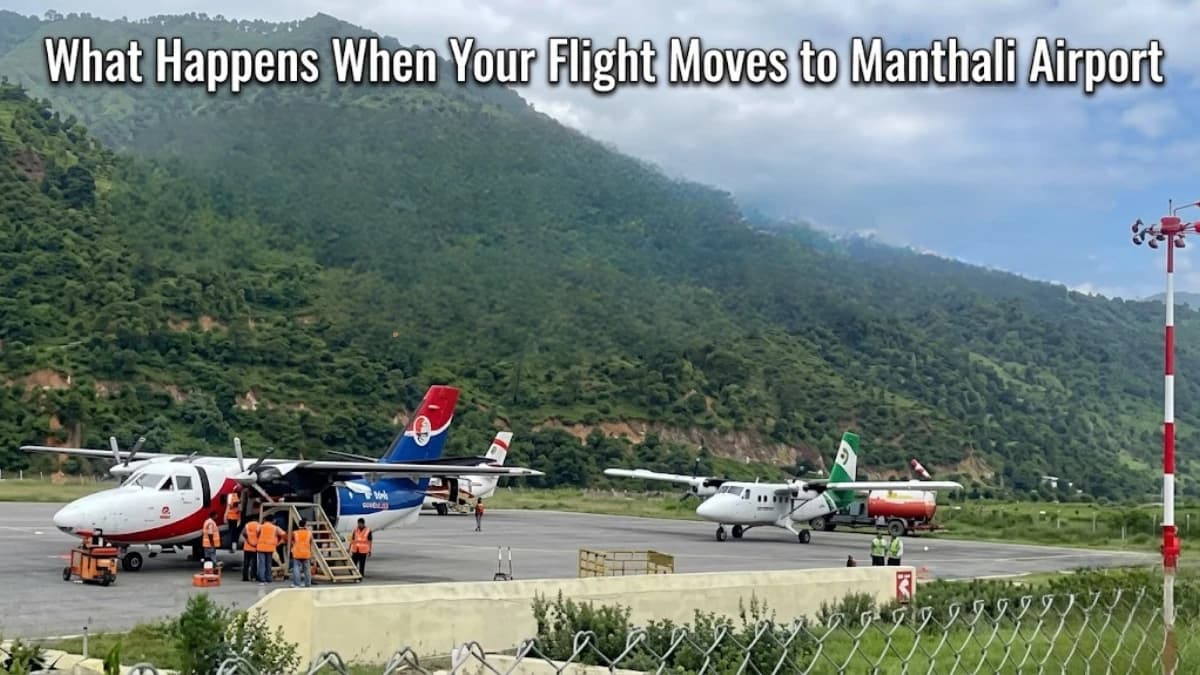
Manthali Airport is small. Very small. It has a single terminal building, a runway, and a parking area. There is no lounge. There is no coffee shop. There is no Wi-Fi. There is a waiting area with plastic chairs and a counter where your boarding pass is checked. If you are imagining Tribhuvan International's domestic terminal, with its restaurants and duty-free shops, Manthali is not that. It is a functional airstrip that exists to get you on a plane and into the mountains.
The check-in process is straightforward. Your trekking company handles the ticketing. You present your passport, receive your boarding pass, and wait. The aircraft, typically a De Havilland DHC-6 Twin Otter or similar turboprop, boards when the pilot confirms that Lukla weather is acceptable. If the weather is not acceptable, you wait. And wait. And sometimes return to Kathmandu and try again the next day.
The flight from Manthali to Lukla takes approximately twenty to twenty-five minutes, slightly shorter than the Kathmandu-Lukla flight because Manthali is closer to the Khumbu and at a higher starting altitude. The flight path crosses the middle hills and approaches Lukla from the south, offering views of the Himalayan range that are, if you are awake enough to appreciate them, spectacular.
What Your Trekking Company Handles
This is where the quality of your trekking company matters. A well-organised company manages every aspect of the Ramechhap diversion:
Advance notice. You receive information about the diversion before departure, either at booking or in the pre-trek briefing. No surprises.
Ground transport. The vehicle from Kathmandu to Manthali is arranged and paid for. You do not need to find a taxi at one AM.
Flight rebooking. If flights are cancelled due to weather, your company rebooks you on the next available flight. You do not need to navigate the airline's rebooking process yourself.
Contingency plans. If flights are cancelled for multiple days (rare but possible during bad weather), your company arranges alternatives, a different starting day, a helicopter charter shared with other groups, or an adjusted itinerary that preserves as much of the trek as possible.
A company that leaves you at Manthali Airport at five AM without clear communication and contingency plans is not a company you should have booked with. The diversion is a logistical challenge, not an emergency, and a good company treats it as routine because, for them, it is.
The Return: Lukla to Ramechhap or Kathmandu
The return flight at the end of your trek follows the same system. During diversion periods, your return flight lands at Manthali, and ground transport takes you back to Kathmandu. The return drive is in daylight, four to five hours through the middle hills with views that the pre-dawn outbound drive concealed. Many trekkers say the return drive is more enjoyable than the flight, because the landscape of Nepal's hill country, terraced fields, river valleys, roadside villages, is beautiful and provides a decompression from the high mountains.
Some trekkers choose the road route entirely, driving from Kathmandu to Phaplu or Salleri and trekking from there, bypassing the Lukla flight in both directions. This is the approach that our EBC by Road package uses: no flight, no diversion risk, no airport waiting. The road route adds a day but eliminates all flight-related uncertainty and saves two hundred to three hundred dollars per person.
Tips for the Ramechhap Diversion
Pack a small overnight bag separately. If you drive to Ramechhap the night before, you want a change of clothes, toiletries, and phone charger accessible without digging through your trek duffel.
Bring snacks and water for the drive. There are few stops on the night drive. A water bottle and some energy bars make the journey more comfortable.
Dress warmly for the airport. Manthali at five AM in October is cold. The terminal is not heated. A fleece and a warm hat make the waiting bearable.
Charge your devices fully before departure. No charging facilities at Manthali Airport.
Expect delays. Weather delays are common at Lukla regardless of which airport you depart from. Build buffer days into your itinerary, one day before and one to two days after the trek, to absorb flight cancellations without missing your international flight home.
Stay calm. The diversion system has operated for multiple seasons. Thousands of trekkers pass through Manthali every peak season without incident. The pre-dawn drive and the basic airport are inconveniences, not problems. The mountains do not care which airport you departed from. The trek begins the same way regardless.
The Perspective
The Ramechhap diversion is, in the end, a reminder of something that Nepal teaches in many ways: plans are suggestions, and the mountains set the schedule. You planned to fly from Kathmandu. You are flying from Ramechhap. The change is logistical, not existential. The Lukla runway is the same runway. The Khumbu valley is the same valley. The trek is the same trek. And the story you tell when you get home, "we drove through the night to a tiny airport I'd never heard of, flew over the Himalayas at dawn, and landed on a runway carved into a mountainside", is a better story than "we took a taxi to the domestic terminal."
The diversion is an inconvenience that becomes an anecdote. The anecdote becomes a memory. And the memory, like everything in Nepal trekking, is better than the plan.