Lukla, Pokhara, Jomsom, Simikot — everything about Nepal's domestic flights. Delays, costs, weight limits, cancellations, and how we handle rebooking for you.
Apr 03, 2026By Shreejan

Lukla, Pokhara, Jomsom, Simikot — everything about Nepal's domestic flights. Delays, costs, weight limits, cancellations, and how we handle rebooking for you.
Here is something nobody tells you before you book a trek in Nepal: the flight to the trailhead might be the most memorable part of your trip. Not always for the right reasons.
Nepal's domestic flights are small aircraft threading through mountain valleys, landing on airstrips that would make a European pilot resign on the spot. They're also the fastest way to reach most trekking regions. And they cancel. Often. Sometimes for days.
I've spent ten years managing these flights for our trekkers. My father dealt with them before me. Between us, we've seen every possible scenario — fog delays in Lukla, wind cancellations in Jomsom, three-day backups that turned Ramechhap into an unplanned camping trip. None of it ruined a single trek, because we plan for every outcome before you even arrive in Nepal.
This guide covers everything you need to know: which flights go where, what they cost, what happens when things go wrong, and how a good trekking company handles the chaos so you don't have to.
Not every trek requires a flight. The Annapurna Circuit and Langtang Valley Trek start with road journeys from Kathmandu or Pokhara. But several of Nepal's most popular routes depend on domestic flights to reach their trailheads , and understanding these flights is essential for planning your trip.
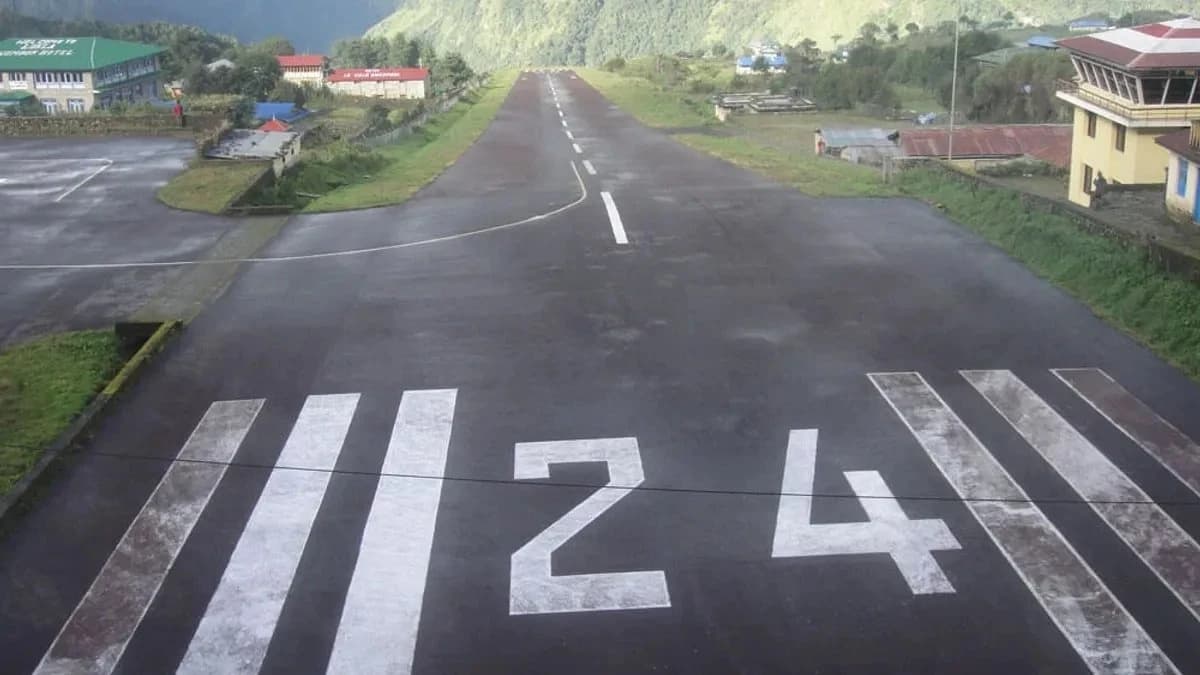
This is the flight. The one that makes travel documentaries and "world's most dangerous airports" lists. The runway at Lukla sits at 2,860 metres, is 527 metres long, slopes at a 12-degree gradient, and ends at a stone wall on one side and a cliff drop on the other. There is no go-around. You land, or you don't attempt it.
The flight takes about 30 minutes from Kathmandu's domestic terminal. On a clear morning, the views of the eastern Himalayas are extraordinary — Gauri Shankar, Numbur, and eventually the Khumbu peaks materialising through the aircraft window.
This is the gateway to the Everest Base Camp Trek, the Everest Three Pass Trek, and Island Peak Climbing. Roughly 50,000 trekkers fly this route each year during the spring and autumn seasons.
The honest truth about Lukla flights: they cancel frequently. Fog, cloud, crosswind , anything less than visual flight conditions and the tower closes operations. During peak season, a single bad weather day creates a backlog that can take two to three days to clear. I've seen trekkers stranded in Lukla for four days waiting for a return flight.
"We sat at Lukla airport for two days watching clouds roll in and flights get cancelled one after another. Our guide Pemba kept us calm, moved us to a lodge, and when the third day looked dodgy too, he arranged a helicopter split between four of us. We were back in Kathmandu by lunch." — Sarah, Manchester, after her EBC trek
Since 2019, most Lukla flights during peak season actually depart from Manthali airport in Ramechhap , not Kathmandu. This caught many trekkers off guard when it first changed, and it still confuses people.
Ramechhap is a 4-to-5 hour drive east of Kathmandu. Most trekkers leave Kathmandu at 2 or 3 in the morning to reach Manthali for early flights. It's not glamorous. The road is winding and the departure time is brutal. But there's a practical reason: Manthali sits lower and further east, meaning morning fog clears earlier than at Kathmandu's Tribhuvan Airport. The result is fewer cancellations and more reliable departures.
If you're trekking to Everest with us, we handle this transfer completely. Vehicle, driver, timing — you just need to set your alarm. For those who'd rather avoid the Lukla flight entirely, our Everest Base Camp Trek by Road (15 Days) reaches the same trailhead without any domestic flight at all.
The 25-minute flight between Nepal's two main cities crosses directly over the Himalayan foothills. On the right side of the aircraft (Kathmandu to Pokhara direction), you'll see Ganesh Himal, Manaslu, the Annapurnas, and Machhapuchhare in sequence. It's a mountain panorama that justifies the ticket price as a scenic flight alone.
Pokhara is the starting point for the Annapurna Base Camp Trek, the Ghorepani Poon Hill Trek, and several other Annapurna-region routes. Many trekkers also use it as a base for the Kathmandu-Pokhara-Chitwan-Lumbini Tour.
This route is far more reliable than Lukla. Cancellations happen occasionally in monsoon or heavy fog, but for most of the year, flights operate on schedule. The alternative is a 6-to-7 hour tourist bus or private vehicle , scenic but long.
The Jomsom flight is beautiful and terrifying in roughly equal measure. The aircraft follows the Kali Gandaki gorge — the deepest gorge on earth , between the Annapurna and Dhaulagiri massifs. Wind funnels through this gap every afternoon, which is why Jomsom flights operate only in the early morning. By 10 a.m., conditions are usually too rough to fly.
This route serves trekkers heading to the Upper Mustang Trek, one of Nepal's most culturally fascinating journeys. Wind cancellations are common, particularly in late spring when afternoon thermals start earlier in the day.
Western Nepal's remote treks require flights through Nepalgunj, a Terai city near the Indian border. From Nepalgunj, small aircraft fly to Simikot — the gateway to the Kanchenjunga region and remote Humla district , or to Tumlingtar and Suketar for eastern Nepal routes like the Makalu Base Camp Trek.
These are Nepal's least reliable flights. The airstrips are short, the weather windows narrow, and the aircraft small. Delays of two to three days are not unusual. We always build buffer days into itineraries for western Nepal treks precisely because of this.
Nepal has several domestic carriers. Not all fly every route, and fleet sizes are small compared to what you might expect. Here are the main ones:
Your trekking company will book the flight for you. We work with all carriers and choose based on schedule, availability, and , honestly — which airline has the best track record for a given route at a given time of year.
Prices vary by route, season, and whether you're booking a foreigner or Nepali fare (yes, there's a difference , foreigners pay more on most routes). Here's what to expect in 2025:
| Route | Duration | Foreign Fare (One Way) | Notes |
|---|---|---|---|
| Kathmandu–Lukla | 30 min | $180–$210 | Peak season prices higher. Return similar. |
| Ramechhap–Lukla | 20 min | $170–$200 | Slightly cheaper than KTM. Requires 4-5hr drive to Ramechhap. |
| Kathmandu–Pokhara | 25 min | $80–$130 | Buddha Air and Yeti most frequent. |
| Pokhara–Jomsom | 20 min | $115–$140 | Morning flights only. Wind cancellations common. |
| Kathmandu–Nepalgunj | 50 min | $130–$170 | Connecting point for western Nepal. |
| Nepalgunj–Simikot | 45 min | $180–$220 | Limited frequency. Buffer days essential. |
| Kathmandu–Tumlingtar | 35 min | $150–$190 | Gateway to Makalu and eastern Nepal. |
When you book a trek with us, domestic flights are included in your package price. You don't need to worry about booking separately, comparing airlines, or navigating the ticketing process — we handle all of it.
This is where domestic flights in Nepal differ sharply from international travel. Weight limits are strict, they're enforced, and they exist for a very practical reason: small aircraft at high altitude need precise weight calculations to operate safely.
For trekkers, this is rarely a problem. Your main duffel goes with the porter or yak caravan from the trailhead. You only need to get your day pack and a small bag to the starting point. But if you're carrying climbing gear for Island Peak or similar, plan ahead. We'll advise you on how to split your load.
On the Kathmandu-to-Lukla flight, sit on the left side for mountain views. On the return, sit on the right. For Kathmandu-to-Pokhara, the right side gives you the Himalayan panorama outbound. These small aircraft don't have assigned seats on every carrier, so arrive at the gate early and ask politely. It makes a difference.
This is the section that matters most. Because flights will cancel. Not might , will. If you're trekking to Everest during peak season, there's a meaningful chance that at least one of your flights (usually the return from Lukla) will be delayed by weather.
Here's what a cancellation looks like in practice:
You wake up at 5 a.m. at Lukla airport. The terminal is already crowded — 200 trekkers from a dozen companies, all hoping the cloud lifts. At 7 a.m., the first flight attempts to land. If it can't, operations are paused. By 9 a.m., if nothing has moved, the day is usually written off. Everyone goes back to their lodge. Tomorrow, the same thing, but now with today's passengers added to the queue.
"Our guide told us on Day 1: 'Build an extra day into your thinking for the return flight.' I thought he was being dramatic. He wasn't. We waited one extra day in Lukla and it was absolutely fine , had the best dal bhat of the whole trek at a little lodge near the airport." — James, Sydney
We don't panic when flights cancel, because we've already planned for it. Here's our approach:
The worst thing a trekking company can do is pretend flight delays don't happen. They do. The difference between a good experience and a bad one isn't whether the flight cancels , it's whether your company has a plan when it does.
Helicopter flights operate on most trekking routes and serve two purposes: scheduled scenic flights and emergency alternatives when fixed-wing flights cancel.
For the Lukla route, helicopter charters have become increasingly common. Companies like Simrik Air, Altitude Air, and Manang Air operate regular helicopter services between Kathmandu and Lukla. The flight takes about 40 minutes and is less weather-dependent than fixed-wing because helicopters can navigate through gaps in the cloud that a Twin Otter cannot.
Cost for a full charter: $2,000–$3,000 for the helicopter (not per person). With 4–5 passengers sharing, it's $400–$600 each. Some companies now offer scheduled helicopter seats at $300–$400 per person during peak season.
We don't push helicopter flights as a first option — they're expensive and fixed-wing is perfectly safe when the weather cooperates. But when you're stuck in Lukla with an international connection to catch, a helicopter is the reliable solution.
Nepal's domestic aviation has a troubled safety history. There have been fatal accidents, including the Yeti Airlines ATR 72 crash in Pokhara in January 2023 and the Tara Air Twin Otter crash near Jomsom in May 2022. These incidents are real, they're serious, and pretending they didn't happen would be dishonest.
What's also true: Nepal has made significant improvements in aviation safety regulation. The Civil Aviation Authority of Nepal (CAAN) has tightened maintenance standards, reduced the number of operating carriers, and improved pilot training requirements. The EU aviation blacklist, which once included all Nepali airlines, has been a driver for these reforms.
The STOL routes (Lukla, Jomsom, Simikot) carry inherent risk because of the terrain and weather conditions. Pilots who fly these routes are among the most skilled mountain aviators in the world , they have to be. The decision to fly or cancel is always made by the pilot and the tower, and cancellations happen precisely because safety is prioritised over schedule.
As a trekking company, we cannot eliminate the risk of domestic flying in Nepal. What we can do is work with reputable carriers, build alternatives into every itinerary, and give you honest information so you can make your own decision. Many trekkers who are nervous about the Lukla flight choose our road route to Everest Base Camp instead — and have an equally brilliant trek.
To help you plan, here's a quick breakdown:
| Trek | Flight Required? | Route |
|---|---|---|
| Everest Base Camp (12 Days) | Yes | Kathmandu/Ramechhap–Lukla (return) |
| EBC by Road (15 Days) | No | Road via Salleri/Phaplu |
| Everest Three Pass Trek | Yes | Kathmandu/Ramechhap–Lukla (return) |
| Island Peak Climbing | Yes | Kathmandu/Ramechhap–Lukla (return) |
| Annapurna Circuit | Optional | Pokhara–Jomsom one way (or road both ways) |
| Annapurna Base Camp | Optional | Kathmandu–Pokhara (or road/bus) |
| Langtang Valley | No | Road from Kathmandu (7-8 hours) |
| Manaslu Circuit | No | Road from Kathmandu to Soti Khola |
| Upper Mustang | Yes | Pokhara–Jomsom (return) |
| Makalu Base Camp | Yes | Kathmandu–Tumlingtar (return) |
| Kanchenjunga Base Camp | Yes | Kathmandu–Bhadrapur or Taplejung |
Nepal's domestic aviation has improved significantly in recent years, with stricter maintenance standards and pilot training requirements. The STOL routes (Lukla, Jomsom) carry higher inherent risk due to terrain, but pilots are highly experienced mountain aviators and flights cancel when conditions aren't right , that's safety working as it should. The Kathmandu-Pokhara route on larger ATR aircraft has an excellent safety record. We always give our trekkers honest information and offer road alternatives where they exist.
We rebook you on the next available flight. Our itineraries include buffer days for exactly this reason. If delays extend beyond the buffer and your international connection is at risk, we arrange helicopter transfer or road transport. This is why we require travel insurance that covers helicopter evacuation , it's not optional, it's essential.
Let your trekking company handle it. Domestic flight bookings in Nepal involve relationships with airline offices, group block bookings, and the ability to rebook quickly when cancellations happen. As an individual foreign traveller, you'll find it difficult to navigate the ticketing process, and you'll have no priority when rebooking is needed. All our trek packages include domestic flights.
Yes. Our Everest Base Camp Trek by Road (15 Days) reaches the same Khumbu trailhead via a scenic drive to Phaplu/Salleri, avoiding the Lukla flight entirely. It adds a couple of days to the itinerary but saves $350–$400 in flight costs and eliminates flight delay risk. Many trekkers tell us the drive through Nepal's hill country was a highlight they hadn't expected.
For peak season (October-November and March-May), Lukla flights should be booked 2–3 months in advance. They sell out. Pokhara flights are easier to get at shorter notice but booking 3–4 weeks ahead is wise during peak months. When you confirm your trek with us, we book your flights immediately as part of the package.
Domestic flights are one of those things that sound complicated until someone handles them for you. That's what we do. Every trek we operate includes flight bookings, airport transfers, backup plans for cancellations, and a team in Kathmandu monitoring weather and schedules on your behalf.
If you've got questions about flights, routes, or which trek suits your experience level, get in touch. We reply fast and we'll give you the same honest answers you've just read.
WhatsApp:+977 9810351300
Email:info@theeverestholiday.com
Browse all treks:www.theeverestholiday.com
Written by Shreejan Simkhada, CEO of The Everest Holiday and third-generation Himalayan guide. TAAN Member #1586. If you're reading this at 3 a.m. worrying about the Lukla flight, stop worrying and message us. We've done this thousands of times.