

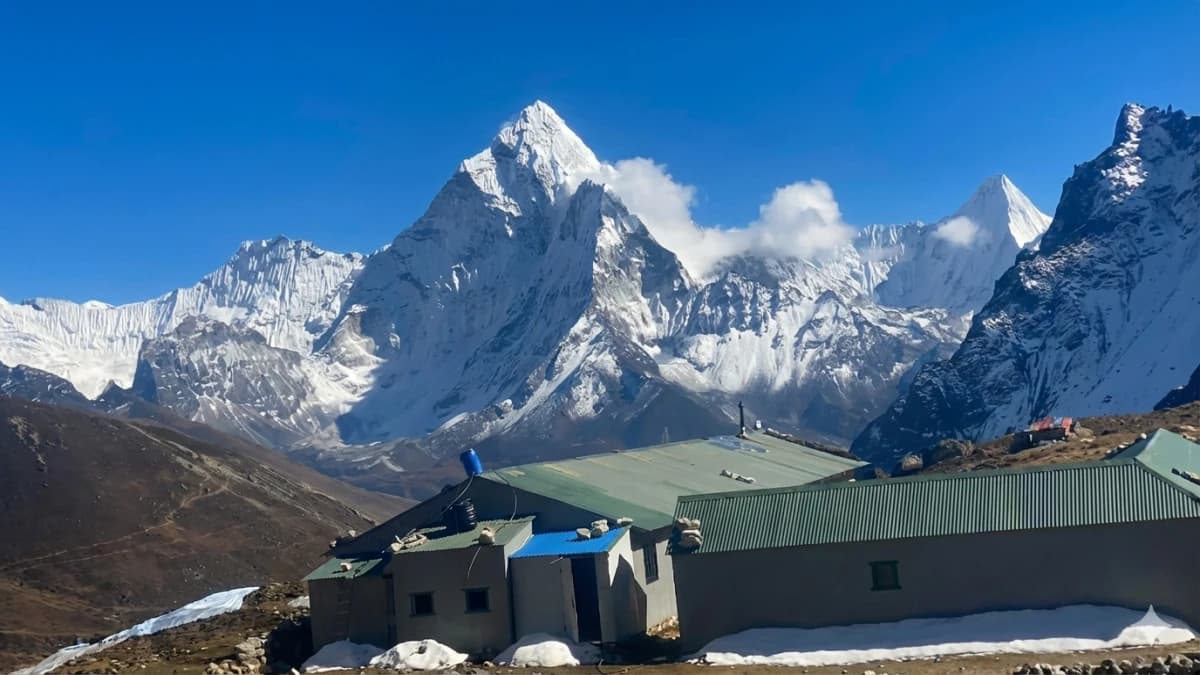
Short answer: Dzongla (4,830 m) is a tiny two-teahouse stop in a side valley below Cho La, where trekkers sleep before crossing the 5,420-metre pass that links the Everest Base Camp route with Gokyo. Most Everest Base Camp trekkers never see it, because it sits off the main trail. It is on our Everest Base Camp and Gokyo Lakes trek via Cho La.
Most EBC trekkers never see Dzongla. Their trail goes straight: Dingboche to Lobuche to Gorak Shep to Base Camp and back, a line drawn north through the Khumbu like a highway to the highest mountain on earth. Dzongla sits off that line, in a side valley to the west, at 4,830 metres on a rocky shelf beneath the Cho La pass. It is the overnight stop for trekkers crossing Cho La (the 5,420-metre pass that connects the Everest Base Camp route with the Gokyo Lakes route), and it is, by every account of trekkers who have been to both, one of the most dramatically situated camps on any trail in Nepal.
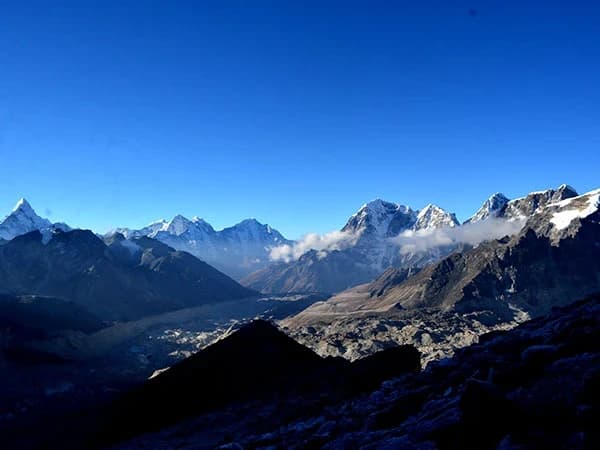
The valley that holds Dzongla is a glacial cirque, a bowl carved by ancient ice, ringed by peaks above six thousand metres, with the Cho La pass visible as a notch in the western wall. The settlement is two stone teahouses on a moraine flat, with no trees, no grass above the immediate surroundings, and no colour except the grey of rock, the white of snow on the surrounding peaks, and the blue of a sky that at 4,830 metres is darker and deeper than any sky you have seen below.
The experience of arriving at Dzongla, after a three-to-four-hour walk from Dingboche through increasingly barren terrain, is the thrill of arriving at the edge. The edge of habitation. The edge of the trail. The edge of what the human body can comfortably sustain. Beyond Dzongla, there is nothing but the pass, the glacier, and the descent to Gokyo on the other side. And the knowledge that tomorrow you will cross that pass, at 5,420 metres, over glacial ice, in conditions that demand an early start and may call for fixed ropes, gives the evening at Dzongla a particular intensity that the routine teahouse stops below cannot match.
Why Does Dzongla Exist as a Trekking Stop?
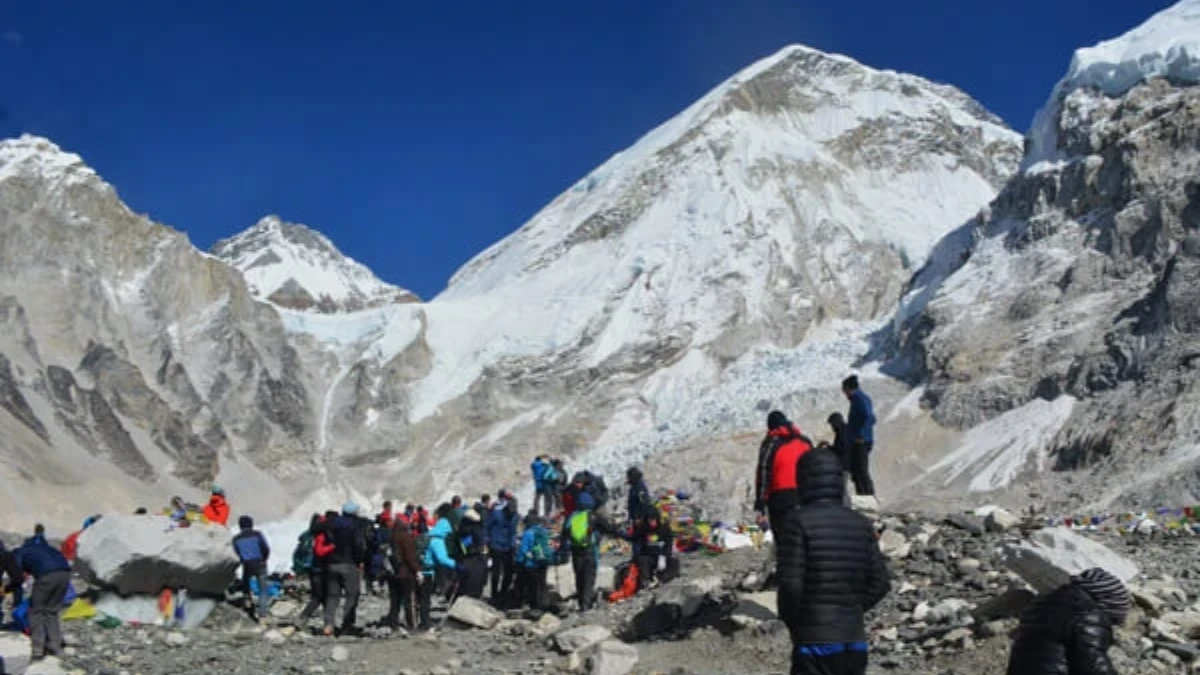
Dzongla exists because of Cho La. Without the pass, there would be no reason for a settlement at 4,830 metres in a side valley with no through-trail. But Cho La connects the two most popular trekking valleys in the Khumbu, the EBC route (Lobuche-Gorak Shep) and the Gokyo route (Gokyo Lakes-Gokyo Ri), and the connection transforms a linear out-and-back trek into a circuit. The Three Passes trek, the Everest-Gokyo combination, and any itinerary that visits both EBC and the lakes passes through Dzongla.
The crossing of Cho La is one of the technical highlights of Khumbu trekking. The pass involves a glacier crossing on the western side, actual ice that may need crampons or fixed ropes, depending on conditions, and a steep, rocky descent on the eastern side that demands concentration and sure footing. It is not a casual trail crossing like Thorong La on the Annapurna Circuit. It is a mountaineering day, abbreviated, accessible to experienced trekkers, but genuinely alpine in character.
Dzongla is where you prepare for that day. Where you check your gear, charge your headlamp, fill your water bottles, eat your last teahouse dal bhat before the pass, and try to sleep at an altitude where sleep is a series of gasping interruptions rather than rest. Related: Lungden: The High Camp Gateway to Renjo La Pass on the Everest Three Passes Trek.
How Do You Get to Dzongla?
From Dingboche (4,410 metres), the trail to Dzongla diverges from the main EBC route at Dughla (Thukla). While EBC trekkers continue north toward Lobuche, Cho La trekkers turn west and climb into the side valley that holds Dzongla. The walk from Dingboche takes three to four hours and gains 420 metres, moderate by Khumbu standards but demanding at this altitude.
The trail passes the memorial cairns at Thukla Pass, the same memorials that EBC trekkers pass on their way to Lobuche. The stones and prayer flags for climbers and Sherpas who died on Everest and the surrounding peaks are a sobering prelude to the high pass crossing ahead. Beyond the memorials, the trail branches, right for Lobuche and EBC, left for Dzongla and Cho La.
The Dzongla trail crosses moraine terrain, loose rock, glacial rubble, and frozen streams that reflect the peaks above. The landscape is austere. No vegetation. No birdsong. Just rock, ice, sky, and the sound of your breathing, which at 4,700 metres is the loudest thing you hear. The valley narrows as you approach Dzongla, and the peaks close in, Cholatse (6,440 metres) to the south, Arakam Tse (6,423 metres) to the northwest, and the ridge that holds Cho La directly ahead.
The Teahouses
Dzongla has two teahouses. Two. This is the complete accommodation infrastructure at 4,830 metres in a side valley that receives trekkers only during the crossing season. The teahouses are stone-built, tin-roofed, and cold in a way that makes the already-cold teahouses at Lobuche feel tropical by comparison. The rooms are small, barely wider than the two single beds they contain. The bathroom is outside, a walk across frozen ground in the dark that every Dzongla guest makes at least once per night and that nobody makes willingly.
The common room has a stove that burns dried yak dung. The stove is lit in the late afternoon and produces warmth that reaches approximately two metres in every direction. Beyond that radius, the common room temperature is the outside temperature, minus five to minus ten in October. Seating position relative to the stove determines comfort. Arrive early.
The food is dal bhat. The menu exists but the reality is dal bhat or noodle soup. Every ingredient was carried here on someone's back from Namche or Lukla, a journey of four to five days. The prices reflect this: among the highest on any trail in Nepal. The tea is hot. At 4,830 metres, hot tea is not a beverage preference. It is a survival strategy.
The Evening Before Cho La
The evening at Dzongla is preparation. Your guide briefs the group on tomorrow's crossing: departure at four or five in the morning (depending on conditions), expected crossing time of six to eight hours to Gokyo, what to carry (all warm layers, water, snacks, headlamp; your guide brings crampons if the conditions call for them), and the conditions on the glacier (your guide has already checked with guides who crossed today or has received radio reports).
The conditions matter. Cho La is weather-dependent in a way that most trail crossings are not. Fresh snow on the glacier makes the crossing significantly more difficult. Cloud or whiteout on the pass creates navigation risk on featureless terrain. And the glacier itself, which is not static but moving, with crevasses that shift from season to season, requires route-finding skills that your guide provides and that a solo trekker would not have.
If conditions are not suitable for crossing, heavy snowfall, high wind, poor visibility, your guide will delay. You may spend a second night at Dzongla waiting for the weather. This is not a failure. It is the judgment call that keeps you alive on a glacier at 5,420 metres, and it is one of the reasons we always trek with a licensed guide.
Sleep at Dzongla is worse than at any previous stop. The altitude, 4,830 metres, produces severe periodic breathing in most trekkers. The cold penetrates sleeping bags that were adequate at Dingboche. And the anticipation of tomorrow's crossing, the earliest start, the hardest day, the most technical terrain of the trek, keeps the mind active even when the body craves rest. Accept it. Nobody sleeps well at Dzongla. Everybody crosses Cho La the next morning regardless.
What Is It Like to Cross Cho La Pass?
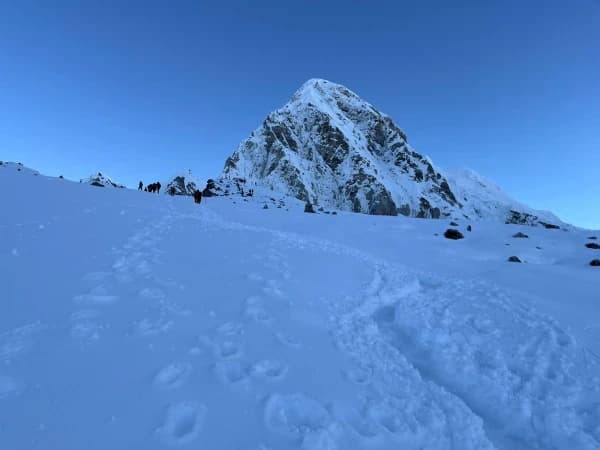
Four AM. Headlamp. Every layer. The trail climbs steeply from Dzongla in the dark, following cairns that your headlamp finds ten metres at a time. The climb to the base of the glacier takes approximately two hours. At the glacier's edge, you stop while your guide checks the conditions. Depending on the day, the slope may need fixed ropes, and crampons aren't always necessary.
The glacier crossing is the crux. Approximately forty-five minutes of walking on ice, actual ice, not frozen trail, with crevasses visible as dark lines in the headlamp light and the gradient steep enough that footing matters. Your guide leads, finding the route through the crevasse field. You follow, placing every step firmly, using the fixed ropes if they are in place, and ignoring the voice in your head that says "this is a glacier and I am a trekker, not a mountaineer."
The pass at 5,420 metres is marked by prayer flags and the specific, intense satisfaction of standing on a point that connects two valleys and two trekking routes. The view west, down to the Gokyo Lakes, turquoise against the brown moraine, is the reward. The view east, back the way you came, to the Khumbu Glacier and the peaks around EBC, is the farewell.
The descent to Gokyo takes three to four hours, steep, rocky, and demanding on tired legs and altitude-depleted coordination. By mid-afternoon, you arrive at Gokyo village (4,790 metres), on the shore of the third lake, and the crossing is complete. You have connected Everest and Gokyo. You have crossed a glacier. And the dal bhat at the Gokyo teahouse, the same dal bhat you have eaten every day for ten days, tastes like the finest meal of your life, because your body knows what it just did and is celebrating in the only language it has.
Who Stays at Dzongla?
Dzongla is not for every trekker. The standard EBC trek does not include it. The Cho La crossing adds two to three days to the itinerary, raises the technical difficulty significantly (glacier crossing, early start), and requires fitness and acclimatisation that the basic EBC route does not demand.
The trekkers who go to Dzongla are: Three Passes trekkers (crossing Renjo La, Cho La, and Kongma La in a single circuit). EBC-Gokyo combination trekkers (visiting both EBC and the Gokyo Lakes, connected via Cho La). And experienced Khumbu trekkers who have done the basic EBC route and want to see the region's other face, the turquoise lakes, the Ngozumpa Glacier, and the view from Gokyo Ri that many trekkers rate as the finest in the Khumbu.
For these trekkers, Dzongla is the price of admission. One cold night at 4,830 metres. One early morning on a glacier. One pass at 5,420 metres. And the reward, the Gokyo Lakes, the view from Gokyo Ri, the complete Khumbu experience, is a reward that the trekkers who pay the price unanimously agree was worth every shivering, sleepless, gasping minute at Dzongla.
Dzongla is the staging camp for Cho La Pass on the EBC with Gokyo Lakes Trek, which crosses Cho La from Dzongla to Thangnak. The Everest Three Passes Trek goes the other way on its 17-day route that crosses all three high passes in the Khumbu: you cross Cho La from Thangnak, reach Dzongla at the end of Day 9, then continue to Lobuche and Everest Base Camp.
Dzongla is cold, windy, and the gateway to Cho La Pass. The lodge is basic and the altitude is 4,830 metres. You will eat dinner in a down jacket and sleep in everything you own. But the morning view of Ama Dablam from the ridge behind the lodge is one of the finest in the Khumbu. Worth every shiver.
Dzongla is on our Everest Three Passes Trek.
WhatsApp:+977 9810351300
Email:[email protected]
Written by Shreejan Simkhada, CEO of The Everest Holiday and third-generation Himalayan guide. TAAN Member #1586.
Dzongla is the pass-night before Cho La. Our EBC, Gokyo Lakes & Cho La Pass Trek is private (your group only, no strangers), 2027 dates open, From USD $1699. WhatsApp us for tailored 2027 dates and current departures.
Staying Connected at Dzongla
Do not count on a signal here. Dzongla is a handful of lodges on an exposed shelf at 4,830 metres, and it sits in one of the quieter corners of the Khumbu, so mobile coverage on Ncell or Nepal Telecom ranges from weak to nothing at all. Some lodges sell or accept Everest Link wifi cards, the same network you will have used lower down at Namche or Gokyo, but up here it is slow, shared by everyone in the dining room, and often drops out entirely once the weather closes in. Treat any connection you do get as a bonus, not a given.
The sensible thing is to plan to be offline. Download your maps and any reading before you leave Gokyo or Lobuche, send the message home the night before that you will be out of contact for a day or two, and carry a power bank, because the morning you cross Cho La there is no charging and no signal, only the climb. Keep your phone and battery pack inside your jacket overnight, as the cold at Dzongla drains a charge faster than you expect.
 Chat with Shreejan