

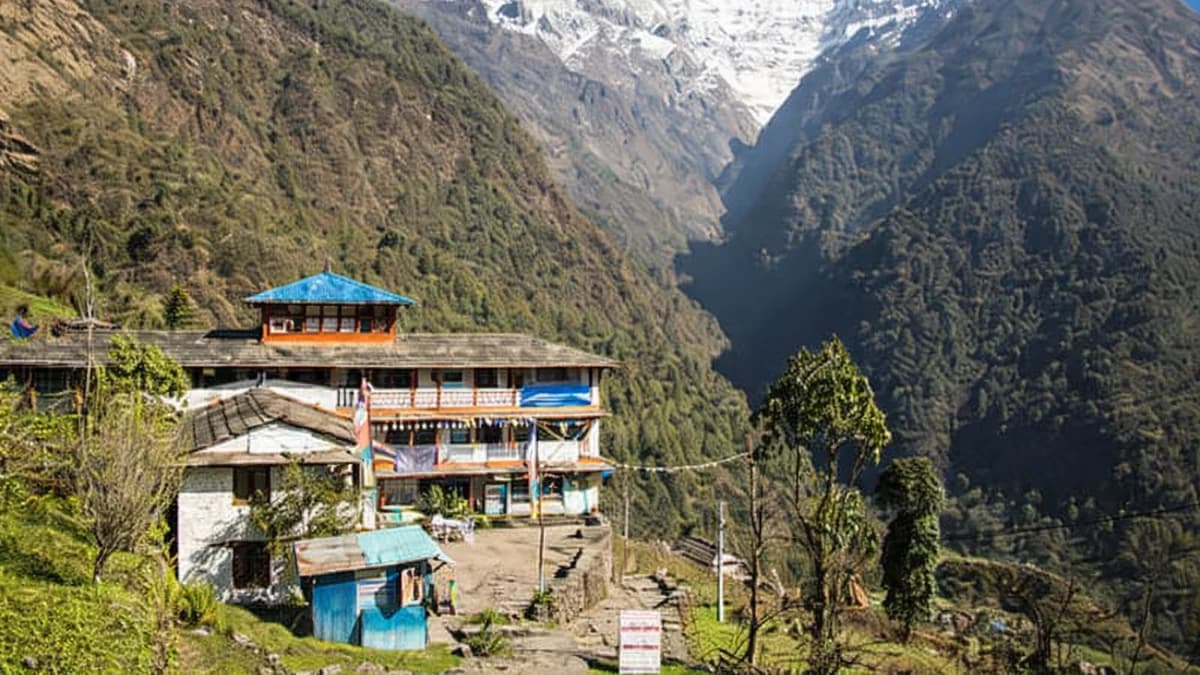
Short answer: Chhomrong (about 2,170 m) is the last big village before the Annapurna Sanctuary, with terraced fields below the south face of Annapurna and a stone staircase of more than two thousand steps that you go down on the way in and climb on the way out. It is the usual overnight before Bamboo. It is on our Annapurna Base Camp trek.
Written by Shreejan Simkhada, CEO of The Everest Holiday and third-generation Himalayan guide. TAAN Member #1586.
The stone steps down to Chhomrong are famous for two reasons: there are over two thousand of them, and they go down. Which means that tomorrow, or the day after, or whenever you return from the Annapurna Sanctuary, you will climb every one of them back up. This knowledge hangs over the descent like a weather forecast, not urgent, not immediate, but impossible to ignore. Your knees register each step with increasing commentary. Your guide walks ahead, unbothered, at a pace that suggests the steps are a minor inconvenience rather than a cardiovascular event. And then the village appears below you: terraced fields, slate rooftops, prayer flags, and the massive south face of Annapurna, white and implacable, rising directly above.
Chhomrong at a glance
| Altitude | About 2,170 m, on a hillside facing Annapurna South and Hiunchuli |
| Region | Annapurna Conservation Area (ACAP) |
| People | A Gurung village, the last permanent settlement before the Annapurna Sanctuary |
| Known for | The long stone staircase to the Chhomrong Khola, and the finest apple pie on the trail |
| On the trail | The gateway to Annapurna Base Camp; every trekker passes through twice |
| Trek it on | Annapurna Base Camp Trek, Ghorepani Poon Hill Trek |
Chhomrong lies within the Annapurna Conservation Area, managed by Nepal’s National Trust for Nature Conservation.
Chhomrong is the gateway. Everything above it is the Annapurna Sanctuary, a narrow valley that penetrates the inner ring of the Annapurna range and ends at the amphitheatre of base camp at 4,130 metres. Everything below it is the Gurung homeland: terraced farmland, rhododendron forest, and the gradual descent to the road at Nayapul. Chhomrong sits at the threshold between the cultivated world and the wild one, and the village reflects both: stone houses with television aerials, teahouses serving pizza alongside dal bhat, and farmers who tend their potato fields in the morning and serve trekkers in the afternoon.
At 2,170 metres, Chhomrong is low enough for comfortable breathing and warm enough for a single-layer evening. The altitude challenges of the Sanctuary: the breathlessness at Machhapuchhre Base Camp, the cold at ABC, are two days away. Chhomrong is the last place on the trail where the body feels entirely normal, where appetite is full, where sleep is deep, and where the warmth of the valley reminds you that the Himalaya contains gentleness as well as grandeur.
What Is Chhomrong Village Like?
Chhomrong is a Gurung village, one of the largest and most prosperous in the Annapurna foothills, rivalling Ghandruk in size and cultural significance. The houses are traditional Gurung construction: stone walls, slate roofs, wooden balconies, and south-facing orientation that maximises winter sun and minimises exposure to the monsoon rain that sweeps up the Modi Khola valley from June to September.
The village is built on a steep hillside, which means the walk from Upper Chhomrong to Lower Chhomrong involves, yes, more steps. The teahouses are concentrated in both the upper and lower sections, with the ACAP checkpoint at the boundary between them. The checkpoint is where your guide presents your ACAP permit and where your entry into the Annapurna Conservation Area is formally recorded.
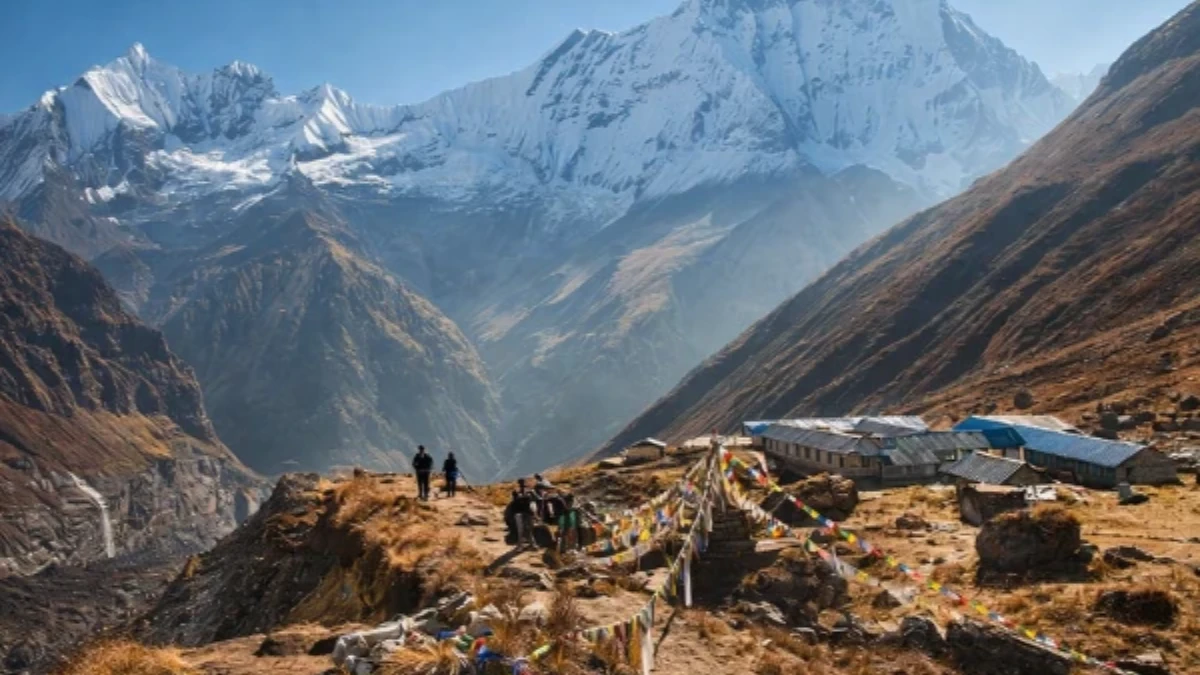
The views from Chhomrong are among the best of any village on the ABC trail. Annapurna South (7,219 metres) fills the northern horizon with a wall of rock and ice that is simultaneously beautiful and intimidating. Hiunchuli (6,441 metres) rises to the northeast. And Machhapuchhre, the Fish Tail, Nepal's sacred unclimbed peak at 6,993 metres, is visible to the east, its double summit catching the morning light in a way that explains why the Gurung consider it the home of Lord Shiva.
The Sanctuary Gateway
Above Chhomrong, the trail enters the Modi Khola gorge, a narrow valley flanked by the walls of Hiunchuli to the west and Machhapuchhre to the east. The gorge is the only entrance to the Annapurna Sanctuary, and the passage through it feels like entering a sacred space through a narrow door. The valley closes in. The walls rise on both sides. The forest becomes denser, the light dimmer, the sound of the river louder. And then, over two to three days of walking, the gorge opens into the Sanctuary itself, the vast, flat amphitheatre at the head of the Modi Khola, surrounded on all sides by peaks above six and seven thousand metres.
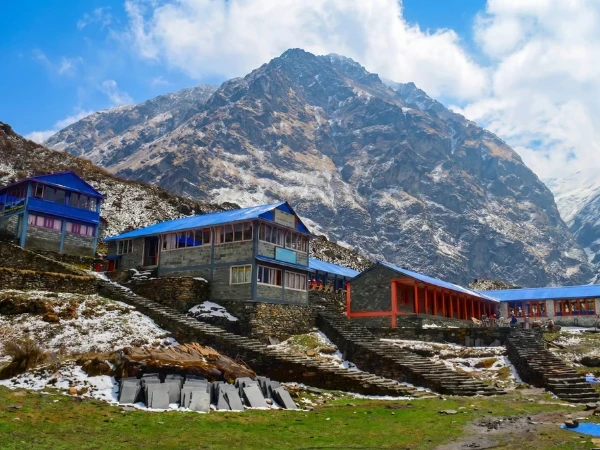
The Sanctuary is culturally sacred to the Gurung people. Before trekking tourism, it was considered a forbidden place, a domain of the gods, not meant for human habitation. The Gurung herders who grazed their animals at its edges treated it with reverence. The first foreign trekkers to enter the Sanctuary in the 1950s and 1960s were guided by Gurung men who were, in a real sense, opening their church to outsiders.
This cultural context is not visible on the trail, there are no signs explaining the Sanctuary's significance, no temple at the entrance, no ritual marking the passage from the inhabited world to the sacred one. But knowing it changes the experience. Walking through the gorge above Chhomrong is not just a trail section on the way to base camp. It is a passage into a place that was sacred before it was a trekking destination, and the awe that the Sanctuary inspires, when the amphitheatre opens and the peaks surround you on every side, is the same awe that the Gurung felt centuries ago, expressed in a different language but identical in its essence.
Where Should You Stay in Chhomrong?
Chhomrong has over a dozen lodges in both the upper and lower village. The best lodges, based on consistent trekker feedback, combine clean rooms, warm common areas, good food, and the mountain views that Chhomrong's position provides.
Upper Chhomrong lodges are closer to the trail from Ghandruk and tend to have better views of Annapurna South. Lower Chhomrong lodges are closer to the trail into the Sanctuary and tend to be newer. Both sections offer the standard teahouse experience: twin rooms, shared bathrooms, common room with stove, and a menu that includes both Nepali and Western dishes.
The food at Chhomrong's lodges is notably good by trekking standards. The village's relatively low altitude means fresh vegetables are available (grown in the terraced gardens visible from the trail), and several lodges serve specialities, fresh apple pie, homemade bread, and Gurung-style dishes, that elevate the teahouse dining above the noodle-and-dal-bhat baseline.
The Steps, A Practical Guide
The descent to Chhomrong from Tadapani or Ghandruk involves a steep drop to the Chhomrong Khola (river crossing) followed by a steep climb to the village. The total step count varies by route but is generally between fifteen hundred and two thousand steps down, then three hundred to five hundred up to reach the village.
The return, climbing from Chhomrong back up to the ridge, is the step section that every ABC trekker remembers. After three to four days in the Sanctuary, where the walking is relatively flat, the climb out of Chhomrong is a sharp reminder that the Annapurna foothills are as steep as the high mountains are high. The climb takes one to two hours and gains approximately three hundred metres. Trekking poles help enormously. Rest every twenty to thirty steps. Drink water. And console yourself with the knowledge that every trekker who has ever done ABC has cursed these steps, and every one of them would climb them again for what they found at the top.
What to Do in Chhomrong
On the way up to the Sanctuary, most trekkers pass through Chhomrong quickly, stopping for lunch or tea and continuing toward Sinuwa and the lower Sanctuary trail. On the return, a night in Chhomrong is more common and more worthwhile.
Walk through the village's traditional upper section, where the old Gurung houses are less influenced by trekking tourism. Visit the small gompa (Buddhist chapel) with its prayer wheels and butter lamps. Sit on a terrace and watch the sunset on Annapurna South, the light at Chhomrong is warmer and more golden than at altitude, and the mountain seems closer here than from base camp because the intervening valley creates a sense of intimacy that the Sanctuary's vastness does not.
If your legs can handle it, a short walk to the viewpoint above Upper Chhomrong provides a panorama that includes the Modi Khola gorge, the Sanctuary entrance, and the peaks above, a preview of where you are going or a retrospective of where you have been, depending on your direction.
And if your legs cannot handle anything, sit. Drink tea. Eat dal bhat. Watch the light change on the mountains. Let your body rest at an altitude where resting is actually possible, where the oxygen is sufficient, the temperature is comfortable, and the body can repair the damage that four days above three thousand metres has inflicted. Chhomrong is the place where the trek pauses, where the body recovers, and where the mind processes what it has seen in the Sanctuary before descending to the world where such things are described in words rather than experienced in silence.
Chomrong is the last major village before the Annapurna Sanctuary on the Annapurna Base Camp Trek. If you are planning the trek, our nine-day itinerary includes two nights in the area to manage the altitude gain properly.
WhatsApp:+977 9810351300
Email:[email protected]
Walking through Chomrong on the way to Annapurna Base Camp? Our Annapurna Base Camp Trek 9 Days covers the full Chomrong-to-ABC route. From USD 725, over 300 reviews on TripAdvisor, Google and Trustpilot, fully guided. Message us on WhatsApp for dates.
 Chat with Shreejan