
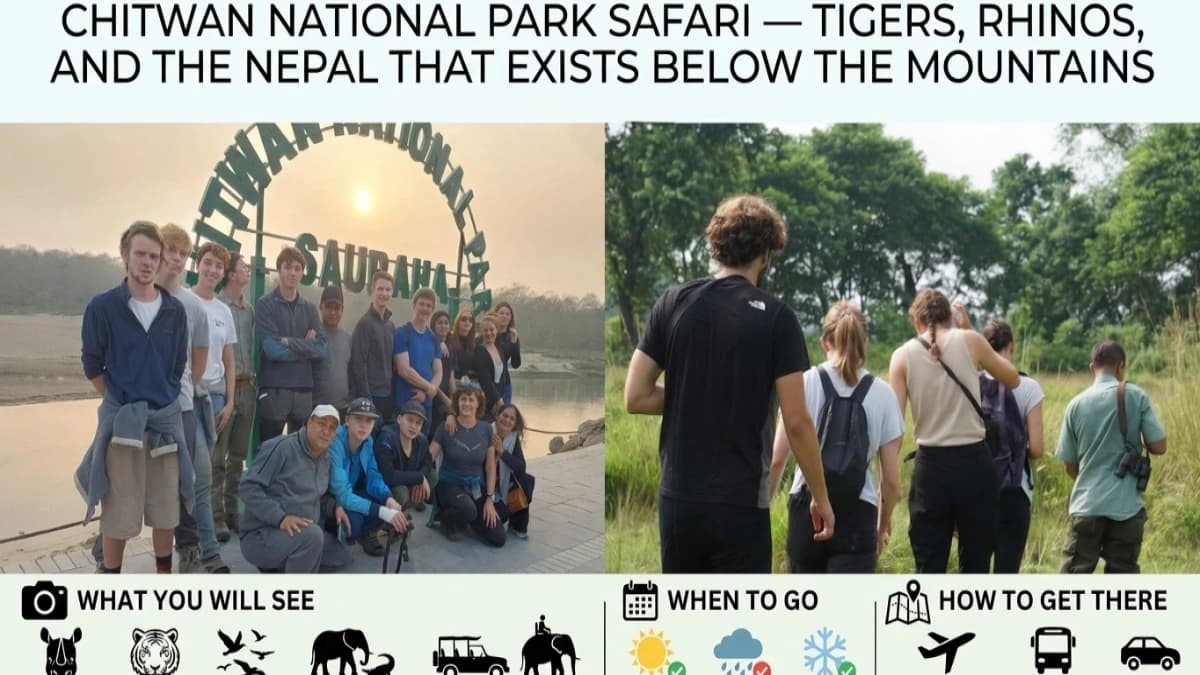
Nepal is not only mountains. South of the Himalayan foothills, where the land flattens into the Terai plains and the air turns thick and warm, a different Nepal waits: one of subtropical jungle, elephant grass taller than a house, and rivers where one-horned rhinoceroses wade through water the colour of milky tea while mugger crocodiles watch from the banks.
Chitwan National Park is this other Nepal. A UNESCO World Heritage Site since 1984, covering 952 square kilometres of sal forest, grassland, and riverine habitat that supports one of the highest densities of Bengal tigers in Asia, the second-largest population of greater one-horned rhinoceroses in the world, and over five hundred and fifty species of birds that make the park one of the most rewarding birdwatching destinations on the continent.
Most trekkers treat Chitwan as an afterthought: a two-day add-on at the end of a mountain trek. This is a mistake. Chitwan deserves to be treated as what it is: one of the great wildlife reserves of Asia, a place where the chance of seeing a wild rhinoceros is measured in hours rather than days, and where the jungle itself (dense, humid, alive with sound) provides an experience so different from the thin air and stone of the Himalayas that it feels like visiting a second country.
What wildlife can you see in Chitwan National Park?
Greater One-Horned Rhinoceros
Chitwan's most reliably spotted large mammal. The park holds over six hundred rhinos, the result of decades of conservation that brought the species back from the edge of extinction. On a jeep safari or a canoe ride along the Rapti River, encountering a rhino is not a possibility but a probability. They are enormous, primeval, and surprisingly fast when startled, which is why the guides insist on maintaining a respectful distance.
Bengal Tiger
Chitwan has approximately one hundred and twenty-eight tigers. Seeing one is not guaranteed, tigers are solitary, nocturnal, and masters of camouflage. But the odds are better here than almost anywhere in the world. Jeep safaris that enter the park at dawn, when tigers are returning to cover after a night of hunting, offer the highest probability. Even if the tiger remains hidden, the knowledge that you are walking through a landscape shared with apex predators sharpens every sense.
Birds
Five hundred and fifty species. Chitwan is one of the top birdwatching sites in Asia. The giant hornbill, a bird so improbable it looks like an evolutionary joke, nests in the sal forest. Kingfishers the colour of jewels perch on branches above the river. Eagles circle on thermals above the grassland. Even non-birdwatchers find themselves stopping to watch.
Elephants, Crocodiles, and More
Wild elephants are present but rarely seen, they tend to stay deep in the forest. Mugger crocodiles and the endangered gharial, a fish-eating crocodile with a long, narrow snout, are visible on the river banks. Spotted deer, wild boar, langur monkeys, and sloth bears complete the mammal list. The park is alive in a way that the high Himalayas, beautiful but ecologically sparse, cannot match.
What types of safari are available in Chitwan National Park?
Jeep Safari
The standard and most productive way to explore. Open-topped jeeps with an experienced driver and a naturalist guide enter the park at dawn and drive through the sal forest and grassland for three to four hours. The guide knows where the tigers have been seen recently, where the rhinos congregate, and which waterholes attract the most activity. Morning safaris, starting at six, are significantly better than afternoon safaris for large mammal sightings.
Canoe Safari
A dugout canoe drifts silently down the Rapti River. Crocodiles bask on sandbanks. Kingfishers dive from overhanging branches. Rhinos come to the river edge to drink. The silence of the canoe, no engine, no noise, allows you to approach wildlife at distances that a vehicle cannot match. The canoe trip typically lasts one to two hours and is combined with a short jungle walk on the far bank.
Jungle Walk
Walking through tiger territory on foot is an experience that no vehicle safari can replicate. The sounds are louder. The proximity is real. The adrenaline, knowing that the largest cat in Asia is somewhere in this forest, possibly watching you, is visceral. Jungle walks are conducted with trained guides who carry no weapons and rely entirely on knowledge of animal behaviour to keep the group safe. They are safe. But they do not feel safe, which is part of the point.
Tharu Cultural Experience
The Tharu people are the indigenous community of the Chitwan region. Their stick dance, performed in the evening by firelight, tells the story of their relationship with the jungle, the animals, the spirits, the seasons. Visiting a Tharu village and witnessing the dance adds a cultural dimension that purely wildlife-focused safaris miss.
When is the best time to visit Chitwan National Park?
October to March is the best period. The weather is dry, the grass has been cut or burned back (improving visibility), and the animals concentrate near water sources. November and February are optimal, pleasant temperatures, clear skies, and the highest probability of wildlife sightings.
April to June is hot, temperatures reach forty degrees, but the jungle is at its most active and the migratory birds are in residence. Monsoon (July to September) brings flooding, leeches, and reduced access. Most lodges close or reduce operations during peak monsoon.
How do you get from Kathmandu to Chitwan National Park?
Chitwan is roughly five hours by tourist bus from Kathmandu or four hours from Pokhara. Domestic flights operate to Bharatpur airport, twenty minutes from the park. Most trekkers combine Chitwan with a mountain trek, two days of safari after a twelve-day EBC trek, or between Kathmandu and Pokhara on the way to or from the Annapurna region.
Should you combine Chitwan safari with a Nepal mountain trek?
Mountains first, jungle second. After twelve days at altitude where the landscape is rock, ice, and silence, descending to the humid, green, sound-rich jungle of Chitwan creates a contrast so extreme it amplifies both experiences. The mountains feel higher in retrospect. The jungle feels more alive. And Nepal shows you what it really is: not a trekking destination that happens to have lowlands, but a country that stretches from tropical forest to the roof of the world, with wonders at every altitude.
Chitwan safari: pair with our Kathmandu-Pokhara loop. Our Kathmandu, Pokhara, Chitwan Tour (8 Days) is private (your group only, no strangers), 2027 dates open, From USD $949. WhatsApp us for tailored 2027 dates and current departures.
 Chat with Shreejan