
Nepal Travel Guide & Expert Trekking Tips
Can a Helicopter Land on Top of Mount Everest? What an Everest Helicopter Tour Really Does
One test pilot landed on Everest's summit in 2005. Tours and rescues can't. Here is how high helicopters really go, and what our one-day Everest helicopter tour does instead.

Written by Shreejan Simkhada, CEO of The Everest Holiday and third-generation Himalayan guide. TAAN Member #1586.
Short answer: only once. In May 2005 a test pilot landed a specially stripped helicopter on the summit. Tours and rescues can't. Our Everest helicopter tour takes you as close as is possible: a landing at Kala Patthar, 5,645 m, from US$1,905 per person for a full helicopter of 5. Ask me on WhatsApp.
People ask me this almost every week. Can a helicopter fly to the top of Everest? Can it land there? And if not, what does an Everest helicopter tour actually do? I am a Nepali guide and I run these tours, so here is the honest version, with the sources for the outside facts at the bottom.
Has a helicopter ever landed on Everest's summit?
Yes, once, and it was not a normal flight. On 14 May 2005 the French test pilot Didier Delsalle put a Eurocopter AS350 B3 on the summit at 8,848 m. The Fédération Aéronautique Internationale needed the skids to stay down for at least two minutes. He managed just under four minutes (3 minutes 50 seconds on the first touchdown). It is still the highest helicopter landing on record.
It was a test flight, not a service. The aircraft was a production helicopter stripped of weight, the pilot wore an oxygen mask, and he picked a day when bad weather had sent every climber down, so his rotor wash would not hit anyone. At the top the wind was about 65 knots and the air was around minus 35 degrees. He said the hardest part was that the ground drops away in every direction, so there is nothing to judge your height against. He flew from Lukla, and went again the next day when the first flight's recording seemed to have failed.
Nobody has made it a routine, and nobody sells it. Nepali rules do not allow helicopters to land on Everest, according to Outside magazine's 2025 report from base camp.
Why can't helicopters fly that high?
A helicopter's wings are its spinning blades, and they need air to push against. The higher you go, the thinner the air. At the summit the air is only a little over a third as dense as at sea level, so each blade gives far less lift. The engine suffers too, because it burns fuel with oxygen from that same thin air.
Pilots call the point where the engine can no longer give the power the rotor needs to hold the helicopter in a hover the hover ceiling. Load matters: the heavier the helicopter, the lower the ceiling. The AS350 B3 that landed on the summit is certified to 23,000 feet (about 7,010 m), so Everest was well beyond its normal limit. That is why Delsalle's flight needed a stripped aircraft, a skilled test pilot and a perfect day.
A tour helicopter carries passengers, fuel and baggage. It cannot do what a stripped test aircraft can, and no responsible operator would try.
How high can rescue helicopters go on Everest?
Higher than most people expect, but never to the top. Rescue pilots work on the lower mountain. In May 2025 a pilot flew a long-line rescue at Camp 3, about 7,300 m (24,000 feet), lifting a Czech climber with severe altitude sickness down to base camp. The helicopter hovered while the rescuers clipped him on to the line. It did not land. Above that, you are on your own, and Delsalle himself said some rescues are too dangerous to try. That is also why we tell every trekker and climber to take altitude seriously long before any helicopter is needed.
So what does an Everest helicopter tour actually do?
It takes you to the Khumbu, not to the summit. Here is how our one-day tour from Kathmandu runs, as set out on the package page.
- You fly out of Kathmandu's domestic terminal at first light, when the air is clearest.
- You pass Lukla, follow the Dudh Koshi valley, and fly over Namche Bazaar, Tengboche, Dingboche, Lobuche and Gorak Shep.
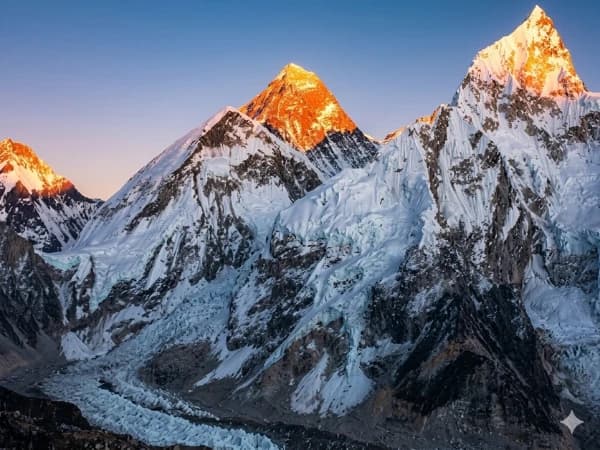
- You land at Kala Patthar, 5,645 m, for a few minutes on the ground (usually 5 to 7, because the air is so thin), with Everest, Lhotse and Nuptse in front of you. This is the closest viewpoint to the summit that visitors can reach by helicopter.
- On Standard and Luxury you stop at the Everest View Hotel, 3,880 m, on the way back. Standard has a break there for snacks and lunch, and Luxury includes lunch, snacks and soft drinks. Breakfast at the hotel is part of the package.
- You are back in Kathmandu in about 4 to 5 hours door to door.
Your pilot is also your guide. Oxygen is on board for the landing. For groups of three to five, the helicopter can land only two people at Kala Patthar at a time, so we fly to Pheriche first and the pilot takes you up in turns of two. Those shuttle flights are included.
It is weather-dependent and the pilot makes the final call. Please keep a spare day in Kathmandu. Our Everest helicopter tour price guide goes deeper on costs.
What does it cost, by group size?
A helicopter takes five guests, so the price per person is lowest for a group of five. These are per-person prices in US dollars from the package page. Luxury is private from 2 people.
| Group size | Budget | Standard | Luxury |
|---|---|---|---|
| 1 person | 9,285 | 10,250 | 10,265 |
| 2 people | 4,665 | 5,235 | 5,235 |
| 3 people | 3,125 | 3,555 | 3,560 |
| 4 people | 2,350 | 2,715 | 2,720 |
| 5 people (full helicopter) | 1,905 | 2,105 | 2,110 |
Groups of six or more need a second helicopter, so the per-person price goes back up. The package page has the full table for every group size from 1 to 20. Prices are confirmed at booking and can move a little with fuel.
Travelling alone or as a couple? A whole helicopter is a lot for one or two people. Our shared-seat helicopter tour puts you on the same morning flight as other travellers. The Budget seat is from US$2,200 and is a flight over the Khumbu without a landing. Standard from US$2,860 and Luxury from US$2,900 (solo) include the landing at Kala Patthar and breakfast, where the weather allows. See how the shared seat works.
Helicopter tour, mountain flight or trek?
These are three different ways to see Everest, and the right one depends on your time and budget.
| Mountain flight | Helicopter tour | Base camp trek | |
|---|---|---|---|
| Time | About 1 hour in the air | 4 to 5 hours | 12 days |
| Where you are | In the air, window seat | On the ground at Kala Patthar, 5,645 m | On foot to base camp |
| From (per person) | US$325 to 375 | US$1,905 (full helicopter of 5) | US$1,255 Budget, 2 to 4 people |
| Fitness | None | Short walk on uneven ground | Good fitness, several days at altitude |
If you only want to see Everest and have a free morning, the Everest mountain flight is US$375 for one person, US$345 each for 2 to 4, US$330 each for 5 to 8 and US$325 each for 9 or more. If you want to stand on the ground at that altitude without the trek, choose the helicopter. If you have the time, I think the 12-day Everest Base Camp trek is the better experience, because you earn the view and meet the people along the way. The trek is for 2 to 4 people on Budget at US$1,255 each. Standard is US$2,320. I wrote a longer comparison in Everest from the air: mountain flight, helicopter tour or trek.
Is it safe, and what about the weather?
Mountain flying is only as safe as the decisions around it. The pilot makes the final call on the day, and if conditions are not right we do not fly. The best months are October to November and March to April. December to February is very clear but cold, with the odd wind hold, and the monsoon months, June to mid-September, are best avoided. Ask any operator which aircraft they use and who the pilot is before you book. It is a fair question, and you should get a straight answer.
At 5,645 m the air holds roughly half the oxygen you are used to. You spend only a short time there, but move slowly, breathe deeply and stay close to the helicopter. If you have a heart or lung condition, speak to your doctor first. Buy travel insurance at home and check that it covers helicopter flights and altitude.
Frequently asked questions
Can a helicopter fly to the top of Mount Everest?
One has, once. In May 2005 a stripped-down test helicopter landed on the summit. Passenger tours and rescue flights do not go anywhere near it.
Can helicopters land on Everest?
Not in normal use. Landings happen at lower places such as Kala Patthar (5,645 m) on our tour. Rescue pilots have reached as high as Camp 3 but hover on a long line rather than land.
How close can a helicopter tour get to the summit?
You land at Kala Patthar, 5,645 m, which is the closest viewpoint visitors can reach by helicopter. The summit is still about 3,200 m higher. From the ground you see Everest, Lhotse and Nuptse in front of you.
How long does an Everest helicopter tour take?
About 4 to 5 hours door to door from Kathmandu, with 8 to 12 minutes on the ground at Kala Patthar. You are back in the city for lunch.
How much does an Everest helicopter tour cost?
From US$1,905 per person for a full helicopter of 5 on our Budget option. A single seat on the shared-seat tour starts at US$2,200 for the flight without a landing. See the table above for every group size.
Do I need to be fit?
No trekking fitness is needed. You should be able to walk a short distance on uneven ground at the landing site. Children and travellers over 70 take this tour.
What is the best time for an Everest helicopter tour?
October to November is the clearest. March to April is also good. Avoid June to mid-September, when cloud grounds the flights.
What happens if the weather stops the flight?
We reschedule you to the next available window, so please keep a spare day in Kathmandu.
Book your Everest helicopter tour
If you want to stand at Kala Patthar and see Everest in a single morning, tell me your dates and how many of you are travelling, and I will confirm the exact price and the best day. Message me on WhatsApp or see the Everest helicopter tour. Every booking helps fund free education for 70 children at our Nagarjun Learning Center in Saldum.
Last updated 12 November 2026.
Outside sources: Didier Delsalle's record landing, This Day in Aviation and Vertical; Camp 3 long-line rescue, Outside and Vertical; air density and hover ceiling, ScienceABC quoting the FAA Helicopter Flying Handbook.
Planning a trip to Nepal?
Drop us your details and tell us what you have in mind. We will put together a personalised plan and get back to you.
Take our free 2-minute quiz and get personalised recommendations based on your fitness, experience, and travel style.
Find your trekMore from the travel blog
All stories and guides Nepal Travel Guide & Expert Trekking TipsMakalu Mountain: Height, Location, Meaning and How to Reach Its Base CampWhere Makalu is, how tall it is, what the name means, who first climbed it, and how to walk to its base camp with a guide.
- Nepal Travel Guide & Expert Trekking TipsEverest Base Camp Altitude: How High Is EBC in Metres and Feet?Everest Base Camp is 5,364 m (17,598 ft) high. Here is the height of every stop on the trek, what it feels like, and how we help you adjust.
 Nepal Travel Guide & Expert Trekking TipsHow Long Is the Everest Base Camp Trek? 10, 12, 14 and 15 Days Compared (2027)How long is the Everest Base Camp trek? 12 days from Lukla: 8 up, 3 down, about 115 km. 10, 14, 15 and 18-day options compared, with 2027 prices from USD 1,255.