

You descend for four hours from the Larkya La pass, down steep scree, across loose rock, through terrain that demands every remaining ounce of concentration from a body that has been climbing since three in the morning. Your legs shake. Your knees complain. Your brain, still operating on the diminished oxygen of 5,160 metres, processes the trail with a delay that makes each step feel like a decision rather than an instinct. And then the trail levels. The scree gives way to grass. The grass gives way to alpine meadow. And Bhimtang appears, a broad, flat valley at 3,590 metres, ringed by mountains, carpeted in green, and so quiet after the wind and effort of the pass that the silence itself feels like a sound.
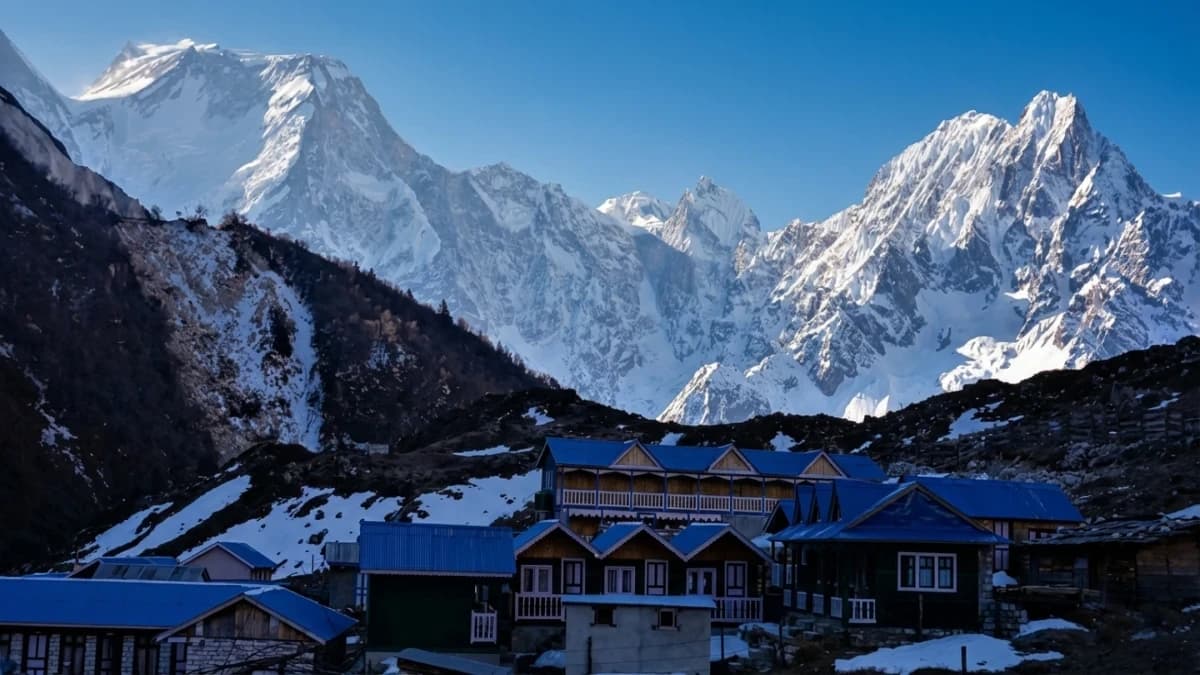
Bhimtang is the reward. Not a village in any conventional sense, there are no permanent houses, no shops, no school. Just a handful of stone teahouses on a grassy flat beside a glacial stream, with Manaslu's massive west face filling the northern sky and the Himalchuli range closing the valley to the south. The trekkers who arrive here have just crossed the most demanding pass on the Manaslu Circuit. They are tired in a way that the word "tired" does not adequately describe. And the flat, green, warm, oxygen-rich meadow of Bhimtang, after twelve hours of effort at extreme altitude, feels not just like a campsite but like the earth itself offering a place to lie down.
What Is Bhimtang Like After Crossing Larkya La?
The descent from the Larkya La to Bhimtang drops 1,570 metres, from 5,160 to 3,590. The altitude change is dramatic and the physiological effect is immediate. At the pass, your blood oxygen was seventy-five percent. At Bhimtang, it is eighty-eight percent. The headache that has been your companion since Dharamsala fades. Your appetite, absent for two days, returns with a force that surprises you. Your breathing, which has been conscious and laboured since 4,400 metres, becomes automatic again. Your body, denied adequate oxygen for three days, suddenly receives it, and the relief is physical, measurable, and profound.
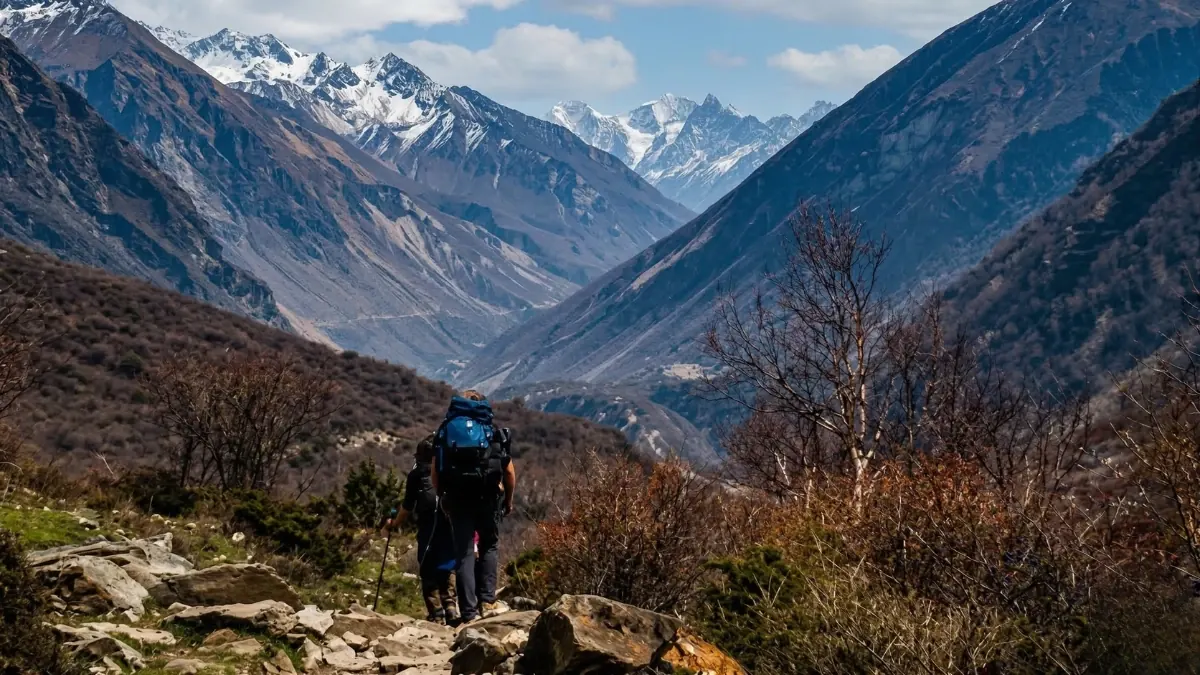
The emotional effect is equally immediate. The Larkya La crossing is the most demanding single day on the Manaslu Circuit, eight to ten hours of sustained effort in cold and altitude. The anxiety that builds before the crossing, will the weather hold, will my body handle it, will I make it, dissolves at Bhimtang into a specific, earned, non-transferable satisfaction. You made it. You crossed the pass. And the meadow that spreads before you, green and warm and flat after three days of grey, cold, and steep, is the physical manifestation of achievement.
The Setting
Bhimtang's position is extraordinary. The valley sits at the western foot of the Larkya La, at the head of the Dudh Khola drainage that flows south toward the Marsyangdi river and eventually to the Ganges. The landscape changes abruptly from the eastern side of the pass, the barren, brown, Tibetan-influenced terrain of the Budhi Gandaki gives way to the green, forested, Nepali landscape of the Marsyangdi. The transition happens within hours of the pass crossing, and by Bhimtang, the world is alpine meadow, grass, wildflowers in spring, and the particular softness of a valley that receives more rain than the dry valleys east of the pass.
Manaslu's west face dominates the northern view from Bhimtang. The mountain, 8,163 metres, the eighth highest in the world, is visible from many points on the Manaslu Circuit, but from Bhimtang the west face is seen in its full scale and severity. The face is steep, rock and ice at angles that make climbing routes visible as thin lines against the white, and in the afternoon light, when the sun illuminates the face while the valley below is in shadow, the contrast between the human-scale meadow and the mountain-scale wall above is one of the most powerful visual experiences on the circuit.
The Himalchuli range closes the valley to the south, a wall of seven-thousand-metre peaks that separates the Bhimtang valley from the Marsyangdi valley below. The peaks are closer and lower than Manaslu but no less impressive, their glaciated flanks catch the evening light in pinks and oranges that deepen to purple as the sun sets behind the western ridge.
The Teahouses
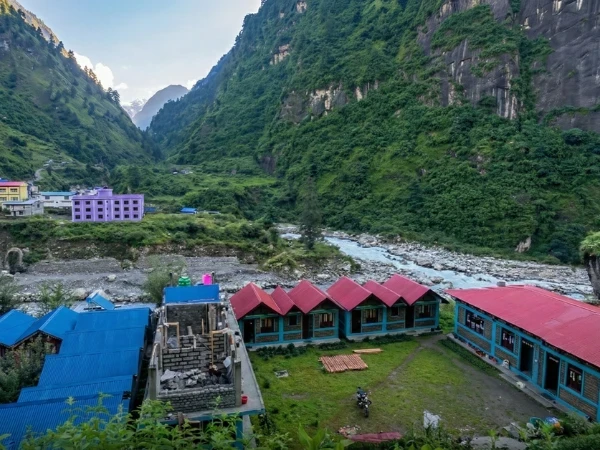
Bhimtang has three or four teahouses on the meadow flat. They are basic, stone walls, tin roofs, small rooms with two beds, but after Dharamsala (where the shelters are little more than emergency huts), they feel like luxury. The rooms are larger. The blankets are thicker. The common room stove burns wood rather than dung. And the menu, dal bhat, noodle soup, fried rice, and, at some teahouses, fresh vegetables from the kitchen garden, is more varied than the altitude-limited offerings above.
The common room at Bhimtang in the evening is one of the best social experiences on the Manaslu Circuit. The trekkers who arrive here on the same day have shared the same experience, the pre-dawn start, the darkness, the climb, the pass, the prayer flags, the descent. The shared experience creates an immediate bond. The conversation is open, honest, and animated by the relief of survival and the exhilaration of achievement. Stories are shared. Photographs are compared. And the dal bhat, which tastes better at Bhimtang than at any other stop on the circuit, is eaten with the specific appetite that twelve hours of effort and a 1,570-metre descent produce.
The altitude at 3,590 metres is comfortable for sleeping. The periodic breathing that disrupted sleep at Dharamsala and Samdo diminishes at Bhimtang. The oxygen is sufficient. The temperature is warmer, minus five to zero at night, compared to minus fifteen to minus twenty at Dharamsala. The sleeping bag that was barely adequate above is generously warm here. And the sleep, genuine, deep, uninterrupted sleep, is the final reward of the day. Related: Larkya La Pass: The High-Altitude Crossing at the Heart of the Manaslu Circuit.
The Morning
Dawn at Bhimtang is worth the early alarm, though after the three AM start of the Larkya La day, any alarm before seven feels punitive. The morning light hits Manaslu's summit first, a line of gold that spreads downward through the west face in a sequence that takes fifteen minutes. The meadow, covered in frost, sparkles in the early light. The glacial stream that runs through the valley catches the sun and turns from grey to silver to gold. And the mountains, Manaslu, Himalchuli, the unnamed peaks that ring the valley, emerge from the pre-dawn blue with a clarity that only high-altitude morning air can produce.
The walk from Bhimtang continues south, descending through forest to Tilije and eventually to Dharapani, where the Manaslu Circuit route meets the Annapurna Circuit. The descent from Bhimtang to Dharapani, two days of walking through increasingly lush terrain, losing altitude steadily, gaining oxygen with each step, is the Manaslu Circuit's gentle conclusion. The hardest day is behind you. The meadow was the transition. And the walk that follows, through rhododendron forest, across suspension bridges, past terraced fields that grow rice and maize in the warm lowland air, is the walk home.
Why Is Bhimtang a Special Stop on the Manaslu Circuit?
Bhimtang is not famous. It does not appear on "top ten" lists. It does not have a viewpoint that travel blogs describe as "the best sunrise in Nepal." It is a meadow with teahouses at the bottom of a pass that most trekkers cross in a state of exhaustion so complete that aesthetic appreciation is a luxury their bodies cannot afford.
And yet every trekker who has crossed the Larkya La remembers Bhimtang. Not for the view, though the view of Manaslu is extraordinary. Not for the food, though the dal bhat is exactly what the body needs. But for the feeling. The specific, irreducible, physiologically grounded feeling of arriving at a warm, green, flat, oxygen-rich place after the hardest day of your trekking life.
Bhimtang is where the Manaslu Circuit exhales. Where the altitude releases its grip. Where the body remembers what comfort feels like. And where the achievement of the Larkya La, which felt, at the summit, like an ending, reveals itself as a beginning. The beginning of the descent. The beginning of recovery. And the beginning of the specific, deep, earned contentment that comes from knowing you did something extraordinarily hard and that the hard part is over and that the green meadow beneath you and the white mountain above you will stay in your memory long after your muscles stop aching and your lungs stop remembering what five thousand metres felt like.
Bhimtang is the descent camp after crossing Larkya La Pass on the Manaslu Circuit Trek. The view of Manaslu from here is one of the best on the entire circuit.
Bhimtang is the reward for crossing Larkya La. After the hardest day on the Manaslu Circuit, you descend into a wide alpine valley with Manaslu behind you and a river running through green pastures ahead. The lodge is warm, the dal bhat tastes better than it has any right to after a 5,160-metre pass, and the relief of being on the other side is palpable.
Bhimtang is the night after Larkya La on our Manaslu Circuit Trek.
WhatsApp:+977 9810351300
Email:[email protected]
Written by Shreejan Simkhada, CEO of The Everest Holiday and third-generation Himalayan guide. TAAN Member #1586.
Bhimtang is the post-Larkya descent village. Our Manaslu Circuit Trek (12 Days) is private (your group only, no strangers), 2027 dates open, From USD $1,005. WhatsApp us for tailored 2027 dates and current departures.


 Chat with Shreejan