
Spring is the best time for the Annapurna Circuit. Rhododendron blooms, warm weather, Thorong La conditions. Month-by-month guide from a local expert.
Govt Regd. No.: 147653/072/073
Travel Agency Licence: 2838/072
Annapurna Circuit in Spring: Rhododendrons, Clear Skies and Why March to May Is Magic

Short answer: Spring, from March to May, is the second-best season for the Annapurna Circuit. Rhododendron forests flower in late March between about 2,500 and 3,000 m, the days are warmer than in autumn, and the views are good in the mornings, with more cloud in the afternoons. Thorong La (5,416 m) can still carry snow in March. Walk it in spring on our Annapurna Circuit trek.
The Annapurna Circuit in Spring: Rhododendrons, Thorong La, and the Road Nobody Talks About
By Shreejan Simkhada | The Everest Holiday | Updated April 2026
There's a moment in late March, somewhere between 2,500 and 3,000 metres on the Annapurna Circuit, when the trail passes through a rhododendron forest in full bloom. Red, pink, white, magenta. Trees 10 metres tall, covered so thickly in flowers that the branches bend. The forest floor carpeted in fallen petals. Sunlight filtering through in shafts. No photograph has ever done it justice.
This is why people trek the Annapurna Circuit in spring. Not because the weather is perfect (it isn't always). Not because it's the easiest season (autumn is more stable). But because for roughly six weeks in March and April, this trail becomes one of the most beautiful walks on the planet.
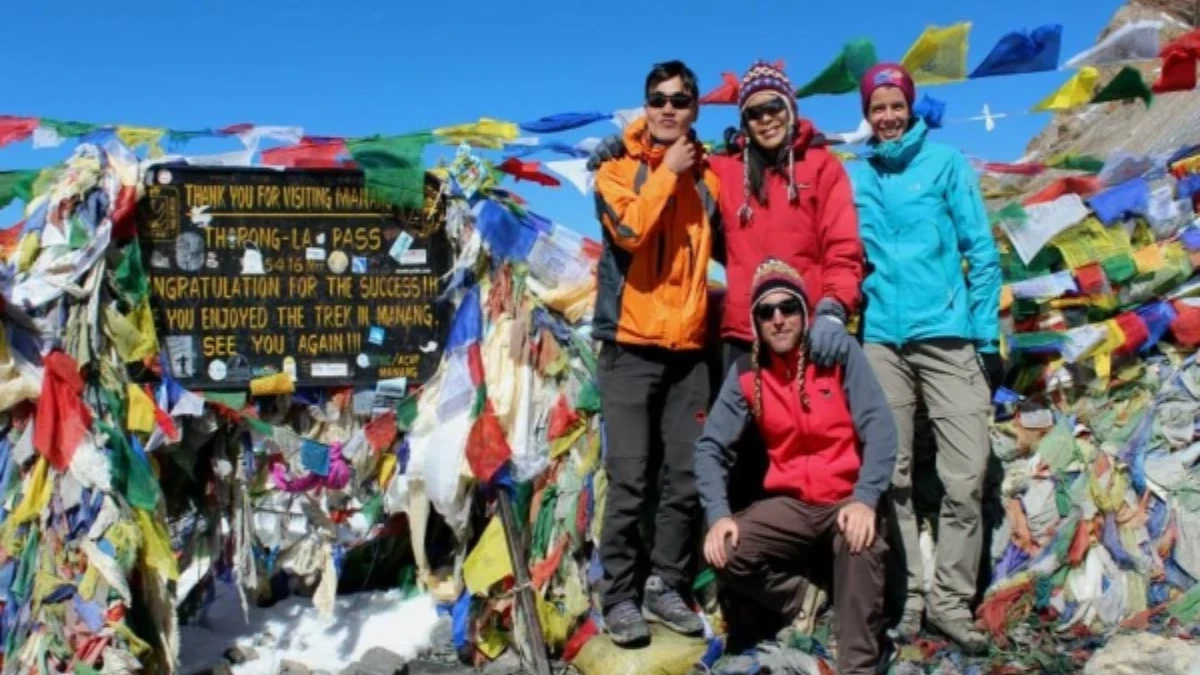
Our guides walk the Circuit many times, and they tell me the rhododendrons still take them by surprise every spring. You'd think they would be used to it. They are not.
But I need to be honest about the Circuit in 2026, because it's not the same trek it was 20 years ago. A road now parallels significant sections of the traditional trail. Some trekkers feel betrayed by this. I understand why. Let me tell you what's changed, what hasn't, and how we adjust our itinerary to give you the Circuit at its best.
Is spring a good time for the Annapurna Circuit trek?
The Circuit is a circumnavigation of the Annapurna massif, typically walked counter-clockwise from Besisahar (760m) up through the Marsyangdi Valley, over the Thorong La pass (5,416m), and down to Muktinath and Jomsom on the other side. You pass through five distinct climate zones: subtropical forest, temperate woodland, alpine meadow, high-altitude desert, and arid rain shadow. Spring treats each zone differently.
Lower sections (800-2,500m): Warm. March temperatures hit 20-25°C during the day. Lush, green, subtropical. Rice paddies, banana trees, terraced hillsides. You'll trek in a t-shirt and wonder why you brought a down jacket. Give it a few days.
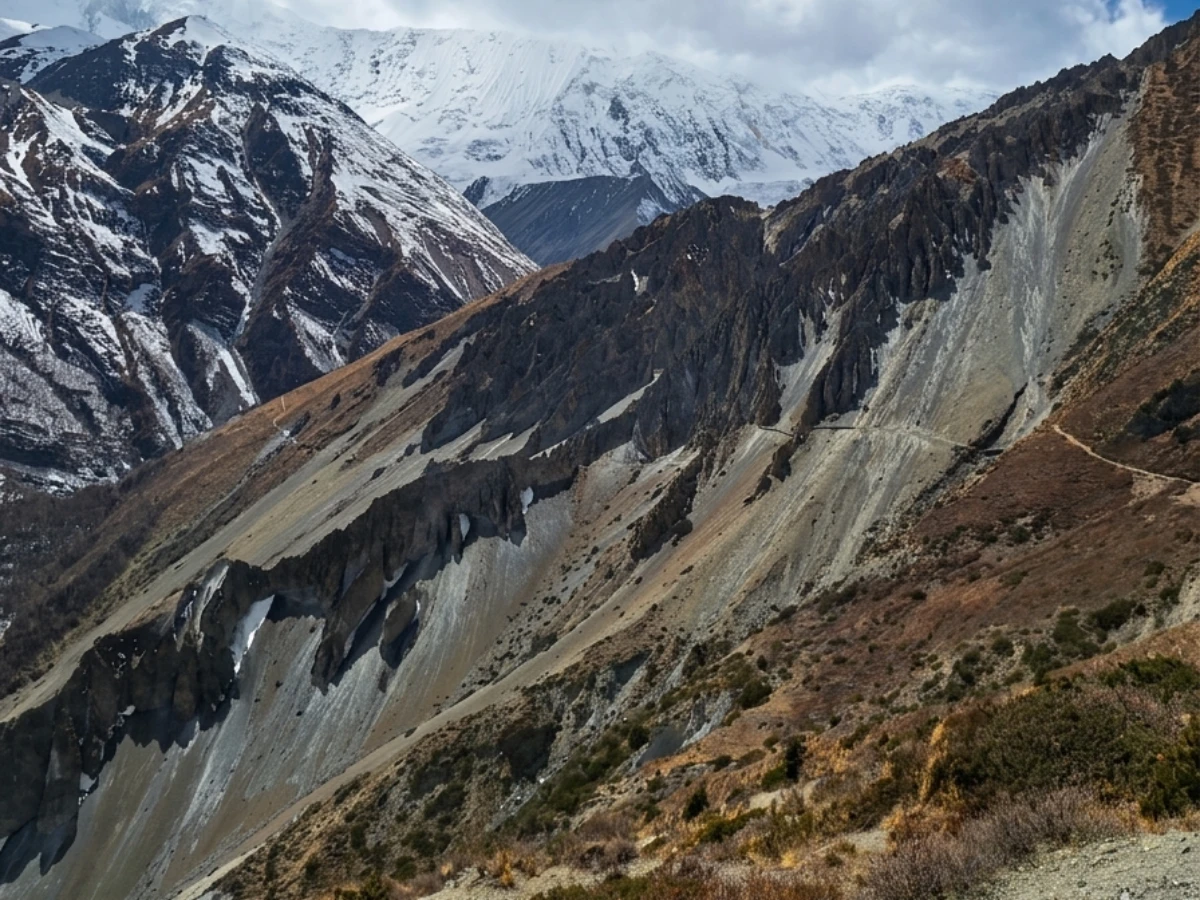
Middle sections (2,500-3,500m): This is the rhododendron zone, and in spring, it's extraordinary. The national flower of Nepal blooms from late February through April, peaking in mid-March to mid-April depending on altitude. The forests around Chame, Upper Pisang, and the approach to Manang are at their most spectacular. Temperatures are comfortable: 10-18°C daytime, 0-5°C at night.
Upper sections (3,500-5,416m): Cold, dry, dramatic. The landscape shifts to brown and grey. Alpine scrub gives way to bare rock and glacial moraine. The Annapurna range fills the sky: Annapurna II, III, IV, Gangapurna, Tilicho Peak. Spring snow on the peaks contrasts sharply with the brown valleys. Temperatures at Thorong La can hit -15 to -20°C at dawn, even in April.
Is March, April, or May best for the Annapurna Circuit?
March
The wild card month. Early March still carries winter's cold at high altitude. Thorong La can be snow-covered and genuinely challenging. I won't sugarcoat this: in early March, the pass crossing requires careful timing and possibly crampons if there's been recent snowfall. Groups do get turned back from Thorong La in early March. It happens, and safety comes first.
But mid-to-late March is beautiful. The rhododendrons begin blooming at lower altitudes. The days lengthen noticeably. Snow on the pass starts consolidating (becoming firmer and easier to walk on). Crowds are light: most trekkers wait for April.
March temperatures by altitude:
- Besisahar (760m): 18-25°C day, 8-12°C night
- Chame (2,670m): 10-16°C day, -2 to 3°C night
- Manang (3,540m): 6-12°C day, -8 to -3°C night
- Thorong La (5,416m): -10 to -5°C day, -20 to -15°C night
- Muktinath (3,710m): 5-10°C day, -6 to -2°C night
April
The ideal month. Full stop.
Rhododendrons peak between 2,000-3,500m. The trail is dry. Thorong La is crossable almost every day (barring exceptional weather events). Temperatures are moderate at all altitudes. Visibility is excellent. Pre-monsoon haze begins building toward month's end, but April generally delivers clear mountain views.
This is when I take my own family. That should tell you enough.
The downside: April is the busiest spring month on the Circuit. Not Everest-level crowds, though. The Annapurna Circuit has always been quieter than EBC, partly because it's longer (12-18 days versus 12 for EBC), partly because Thorong La intimidates people, and partly because the road situation has redirected some trekkers to the Annapurna Base Camp trek instead.
April temperatures by altitude:
- Besisahar: 22-28°C day, 12-16°C night
- Chame: 12-18°C day, 0-5°C night
- Manang: 8-14°C day, -5 to 0°C night
- Thorong La: -5 to 0°C day, -15 to -10°C night
- Muktinath: 8-14°C day, -3 to 2°C night
May
The monsoon approaches. You can feel it. The air gets heavier, hazier, stickier at lower altitudes. Afternoon thunderstorms become more frequent. By late May, the first monsoon rains arrive in the lowlands.
May is not ideal for the Circuit. It's doable in the first two weeks, but the weather becomes increasingly unpredictable. Thorong La can see afternoon snowstorms that appear from nowhere. The lower sections become hot and humid. Pre-monsoon cloud reduces mountain visibility.
I don't recommend starting the Circuit after May 5th unless you're comfortable with significant weather uncertainty. Our last spring departure is typically in the last week of April. Related: Annapurna Circuit Trek in Autumn: Why October and November Are Perfect.
What is the weather like on the Annapurna Circuit in spring?
| Location (Altitude) | March Daytime | March Night | April Daytime | April Night | May Daytime | May Night | Precipitation |
|---|---|---|---|---|---|---|---|
| Besisahar (760m) | 18-25°C | 8-12°C | 22-28°C | 12-16°C | 26-32°C | 16-20°C | Increasing. May = frequent afternoon rain |
| Dharapani (1,920m) | 14-20°C | 4-8°C | 16-22°C | 6-10°C | 20-26°C | 10-14°C | Moderate. Afternoon showers possible |
| Chame (2,670m) | 10-16°C | -2 to 3°C | 12-18°C | 0-5°C | 14-20°C | 4-8°C | Low in March-April. Increasing in May |
| Upper Pisang (3,310m) | 7-13°C | -5 to 0°C | 10-16°C | -2 to 3°C | 12-18°C | 2-6°C | Low. Rain shadow begins here |
| Manang (3,540m) | 6-12°C | -8 to -3°C | 8-14°C | -5 to 0°C | 10-16°C | -2 to 3°C | Very low. Arid valley climate |
| Thorong Phedi (4,525m) | 2-7°C | -12 to -7°C | 4-9°C | -10 to -5°C | 5-10°C | -8 to -3°C | Low, but snow possible year-round |
| Thorong La Pass (5,416m) | -10 to -5°C | -20 to -15°C | -5 to 0°C | -15 to -10°C | -3 to 2°C | -12 to -7°C | Snow possible any month. Wind chill extreme |
| Muktinath (3,710m) | 5-10°C | -6 to -2°C | 8-14°C | -3 to 2°C | 10-16°C | 0-5°C | Very low. Rain shadow side of range |
The Rhododendron Forests: What You're Really Here For
Nepal has 32 species of rhododendron. On the Annapurna Circuit, you'll encounter at least a dozen. They grow in a dense band between 2,000 and 3,500 metres, and in spring they create a spectacle that belongs in a fantasy film.
The key stretches:
Between Dharapani and Chame (2,000-2,700m): The rhododendrons here are tall trees, 8-12 metres, with deep red and pink blooms. The trail winds through them for hours. In mid-April, some stretches are so densely flowered that the canopy turns solid pink overhead.
Between Chame and Upper Pisang (2,700-3,300m): Higher altitude species. Smaller trees. White and pale pink blooms. Mixed with blue pine forests that smell extraordinary on warm afternoons. The views of Annapurna II through gaps in the rhododendron canopy are some of the finest on the entire Circuit.
The Manang Valley approach: Above 3,200m, rhododendrons thin out and give way to juniper and scrub. But isolated bushes still bloom, often with snow-capped peaks as backdrop. The contrast (scarlet flowers against white summits against blue sky) is almost too much.
Timing matters. Below 2,500m, rhododendrons peak in early-to-mid March. At 2,500-3,000m, they peak in late March to mid-April. Above 3,000m, late April. If you want to walk through the fullest bloom, aim for the second or third week of April, when the middle-altitude forests are at their peak and the weather is most stable.
What are conditions on Thorong La Pass in spring?
The Thorong La pass at 5,416m is the crux of the Circuit. It's the highest point, the most physically demanding day, and the section where weather can genuinely stop you.
In spring, conditions at Thorong La are generally good but variable. Here's the honest picture:
Early March: Snow on the pass is likely. The trail may be indistinct. We use experienced guides who've crossed in all conditions, but early March crossings require flexibility and sometimes additional equipment. It's not dangerous with a competent guide, but it's harder work than April.
Late March to April: The pass is typically clear of deep snow. The trail is well-defined. Hundreds of trekkers cross daily in peak season, creating a clear path. Wind is the main concern: Thorong La funnels wind from the Marsyangdi side, and gusts can be vicious. Start before dawn (3-4am from Thorong Phedi or High Camp) to reach the pass by 8-9am, before afternoon winds and cloud build.
May: The pass itself may be clear, but afternoon thunderstorms become a real risk. Lightning at 5,400m is not something you want to experience.
Pass day is usually 7-10 hours of walking: 1,000m of ascent from Thorong Phedi, then 1,600m of descent to Muktinath. It's the longest day of the trek. It's the day when altitude affects people most. And it's the day you absolutely must have a guide who'll turn you around if you're showing signs of serious altitude illness.
The Road: Let's Talk About It Honestly
This is the part where most Annapurna Circuit guides go quiet, and I think that's a disservice.
A road now runs from Besisahar to Manang on the eastern side of the Circuit, and from Jomsom down to Beni on the western side. It was built over the past 15 years to connect remote communities, and it has genuinely improved life for people who live here: access to hospitals, markets, schools. That matters.
But it has changed the trek itself. Significantly.
On some sections, the "trail" is now the road, or runs alongside it. Jeeps and motorcycles pass. Dust rises. The wilderness feeling diminishes. Some trekkers who walked the Circuit in the 1990s come back and feel heartbroken. I understand that feeling.
Here's what we do about it. Our Annapurna Circuit trek routes off the road wherever possible. Between Besisahar and Chame, there are traditional trail alternatives that run parallel to the road but above it, through villages and forests. They add modest elevation gain but keep you on dirt paths instead of gravel roads. Our guides know every alternative path.
Specifically:
- Besisahar to Dharapani: We drive this section. The lower road is the least scenic part of the Circuit, and walking it means two days on a dusty road. We drive to Dharapani and start walking from there. This cuts 2 days of road-walking without losing any of the good stuff
- Dharapani to Chame: Trail alternatives through Bagarchhap, Danagyu, and Timang that avoid the road almost entirely
- Chame to Manang: The upper trail via Pisang to Upper Pisang is entirely off-road and far more scenic than the lower road route through Lower Pisang. This is the section with the best rhododendron forests
- Thorong La to Muktinath: No road. Pure trail. This section is unchanged
- Muktinath to Jomsom: Road, but the landscape here is so dramatically different (arid, Tibetan, otherworldly) that most trekkers are too busy staring at the Kali Gandaki gorge to notice the jeeps
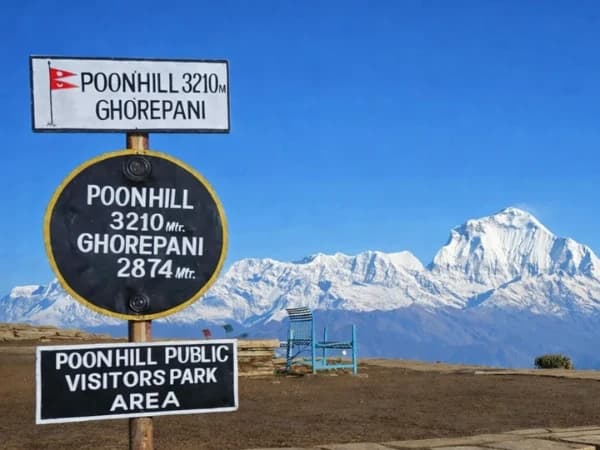
If road encroachment genuinely bothers you and you want a fully off-road Annapurna experience, consider our Annapurna Circuit with Tilicho Lake variation. The Tilicho detour takes you to one of the world's highest lakes (4,919m) on trails that no road will ever reach. Or look at the Annapurna Base Camp trek, which remains entirely on foot trail, or the Ghorepani Poon Hill trek, which is road-free and runs through some of the best rhododendron forest in the Annapurna region.
What festivals happen on the Annapurna Circuit in spring?
Spring in Nepal means Holi (the festival of colours, usually March), Ghode Jatra (horse festival), and various local celebrations. On the Circuit, the most notable is Losar (Tibetan New Year, sometimes February, sometimes March), particularly in the upper Manang Valley where the culture is Tibetan-influenced.
If you're in Manang during Losar, the village comes alive. Prayer flags go up. Monks perform ceremonies. Local chang (barley beer) flows. It's an unexpected cultural highlight that you'd never see on the Everest trail.
Holi is more of a lowland festival, and you'll encounter it in Besisahar or Kathmandu. Fair warning: people throw coloured powder and water at each other, including at tourists. Wear clothes you don't care about. It's joyful chaos.
What should I pack for the Annapurna Circuit in spring?
The Circuit's altitude range (760m to 5,416m) means you need gear for tropical heat AND extreme cold. This is the trickiest packing challenge in Nepal trekking.
- Sun protection: The lower sections in April are genuinely hot. Sunscreen, sun hat, and sunglasses are essential from day one, not just at altitude
- Insect repellent: Below 2,000m in spring, mosquitoes and leeches are present. Leeches particularly after rain. They're not dangerous but they're unsettling. DEET-based repellent or leech socks help
- Full cold-weather kit: For Thorong La and nights above 4,000m. Down jacket, thermal base layers, warm hat, gloves. Treat the pass day like winter mountaineering: dress for the cold end of the temperature range
- Rain gear: More important in spring than autumn. A waterproof jacket and pack cover are essential. Afternoon showers below 3,000m are common in April
- Trekking poles: Highly recommended for the 1,600m descent from Thorong La to Muktinath. Your knees will thank you
- Dust mask or buff: For road sections. Jeep traffic kicks up fine dust that's unpleasant to breathe
How We Run the Circuit in Spring
Our standard Annapurna Circuit trek is 14 days, optimised for spring conditions. We drive to Dharapani (skipping the road-heavy lower section), walk the upper trail through the best rhododendron forests, spend two acclimatisation days in the Manang Valley, cross Thorong La with an alpine start, and descend through Muktinath and the Kali Gandaki. We include a rest day in Manang because rushing the acclimatisation before a 5,416m pass is reckless.
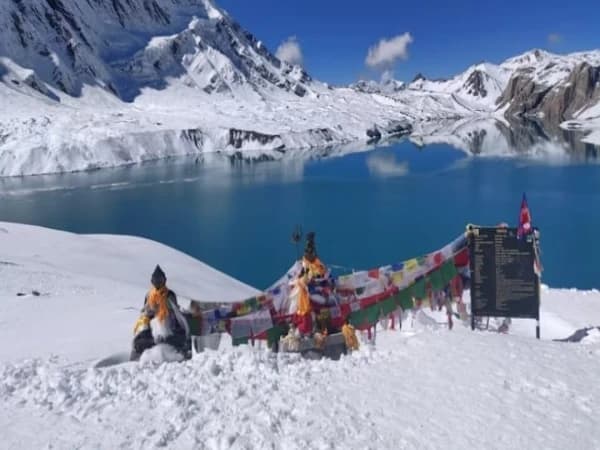
For trekkers who want more, the Circuit with Tilicho Lake adds 2-3 days and takes you to one of the most beautiful high-altitude lakes in the Himalayas. The lake sits in a natural amphitheatre surrounded by 7,000m peaks. In spring, the surface is often partially frozen, deep turquoise and white, reflecting the peaks above. It's a side trip that many people tell us was the highlight of their entire Circuit.
Spring departures run from early March through late April. We recommend mid-to-late March for rhododendron bloom at lower altitudes combined with stable pass conditions, or the second week of April for the overall best balance of weather, flowers, and trail conditions.
One Last Thing
The Annapurna Circuit is changing. The road is a reality. Some magic has been lost. I won't pretend otherwise.
But the rhododendron forests haven't changed. Thorong La hasn't changed. The ice lake at Tilicho hasn't changed. The view of Dhaulagiri from the Kali Gandaki, the world's deepest gorge, hasn't changed. The hospitality in Manang's teahouses hasn't changed. The moment when you crest Thorong La at dawn, breathing hard, freezing, exhausted, and see the entire Mustang Valley spread below you in golden light: that hasn't changed either.
Spring is when this trail is at its most alive. If you're considering it, let's talk.
WhatsApp: +977 9810351300
Email: [email protected]
Shreejan Simkhada is the CEO of The Everest Holiday and a third-generation Himalayan guide. TAAN Member #1586.
Spring Annapurna Circuit (Mar-May) is rhododendron season. Our Annapurna Circuit Trek (12 Days) is private (your group only, no strangers), 2027 dates open, From USD $1,175. WhatsApp us for tailored 2027 dates and current departures.
Planning a trip to Nepal?
Drop us your details and tell us what you have in mind. We will put together a personalised plan and get back to you.
Not sure which Nepal trek is right for you?
Take our free 2-minute quiz and get personalised recommendations based on your fitness, experience, and travel style.
Find Your Perfect Trek →Need Help? Call Us+977 9810351300orChat with us on WhatsApp
Related Trek Packages
Latest Travel Blogs
Christmas and New Year Treks from Pokhara 2026/27: 3 to 5 Days
<p>Short treks from Pokhara for Christmas and New Year 2026/27: Panchase 3 days, Poon Hill 4 days and Mardi Himal 5 days. Weather, snow, what is open, and prices by group size.</p>
Read More
Thamdanda and Surke: The Road Head for Everest Base Camp by Road
Thamdanda is the road head where our Everest Base Camp trek by road starts and ends on foot. How to get there from Phaplu and what the first walk to Paiya is like.
Read MorePoon Hill Trek Permits 2027: ACAP, TIMS, Cost and What You Need
Poon Hill needs two permits: ACAP at NPR 3,000 and a TIMS card at NPR 2,000. Who arranges them, where they are checked, SAARC rates and the 2027 trek prices.
Read More Chat with Shreejan