They are Nepal's two most iconic treks. Both take you to the foot of an eight-thousand-metre mountain. Both push you above four thousand metres into air that forces your lungs to work twice as hard. Both deliver views that reset your understanding of what the planet is capable of producing.
And they are completely different experiences.
Choosing between Annapurna Base Camp and Everest Base Camp is not about which is better — both are extraordinary. It is about which one matches who you are, how much time you have, what your body can handle, and what you want to carry away when the trek is over.
The Numbers
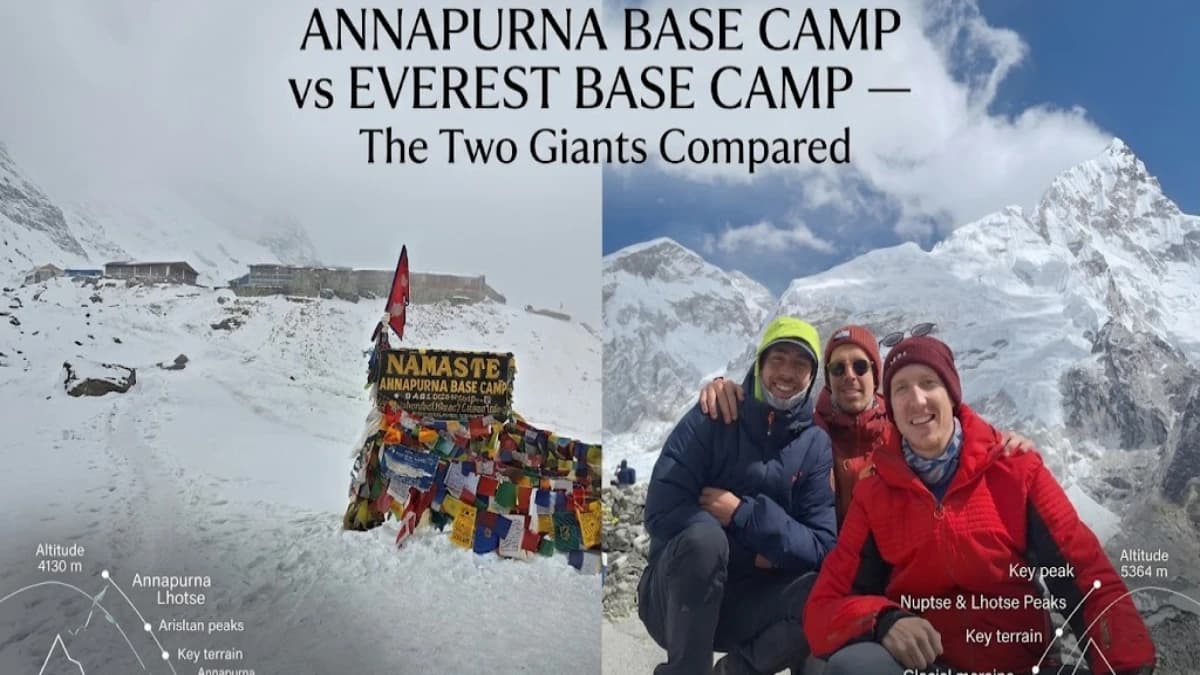
ABC: nine days, maximum altitude 4,130 metres, budget from four hundred and twenty-five dollars, no internal flights, difficulty three out of five.
EBC: twelve days, maximum altitude 5,364 metres (Kala Patthar 5,545m), budget from one thousand and seventy-two dollars, requires Lukla flight or fifteen-day road route, difficulty four out of five.
The differences are significant. Three fewer days. Twelve hundred metres less altitude. Six hundred and forty-seven dollars less cost. No flights. One full grade easier on the difficulty scale. On paper, ABC is the more accessible trek in every measurable dimension.
What EBC Gives You That ABC Does Not
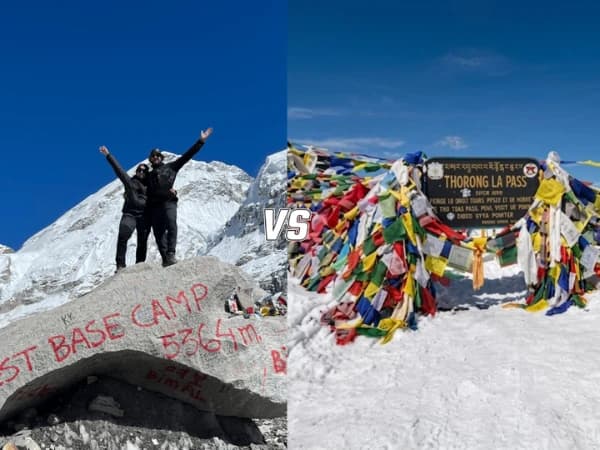
The name. Everest. The highest mountain on earth. There is a weight to that name — a gravity that transcends trekking and enters the broader human story of exploration, ambition, and the edges of what is possible. Standing at the base camp where expeditions prepare to attempt the summit, seeing the Khumbu Icefall towering above, knowing that you are at 5,364 metres at the foot of something that has defined human aspiration for a century — that carries meaning that no other trek can replicate.
Extreme altitude. EBC takes you into a physiological zone that ABC does not reach. Above five thousand metres, the air holds roughly half the oxygen of sea level. Your body adapts in ways that are tangibly, viscerally noticeable — the breathlessness, the headaches, the strange clarity of thought that thin air sometimes produces. This is not comfortable. But it is an experience of your own physical limits that lower-altitude treks cannot provide.
Kala Patthar at sunrise. 5,545 metres. The most famous mountain viewpoint on earth. Watching the sun light the summit of Everest in gold while you stand higher than any mountain in Europe is a moment that justifies every difficult day that preceded it.
The Khumbu region itself. Sherpa culture. Tengboche Monastery with its chanting and incense. Namche Bazaar — the hillside market town that is one of the most remarkable settlements in the Himalayas. The infrastructure and teahouse quality on the EBC route are the best of any high-altitude trek in the world.
What ABC Gives You That EBC Does Not
The sanctuary. Annapurna Base Camp sits inside a natural amphitheatre, a ring of peaks above seven thousand metres that surrounds you on every side. You do not look at the mountains from a distance. You stand inside them. The perspective is immersive in a way that EBC, where you look across a glacier toward Everest, cannot match.
Landscape diversity on the approach. The trail to ABC passes through Gurung villages, rhododendron forests (spectacular in spring bloom), bamboo groves, and open moraine. The vegetation changes with every thousand metres of altitude. The EBC trail above Namche is comparatively uniform, rock, moraine, and glacial terrain from Tengboche to base camp.
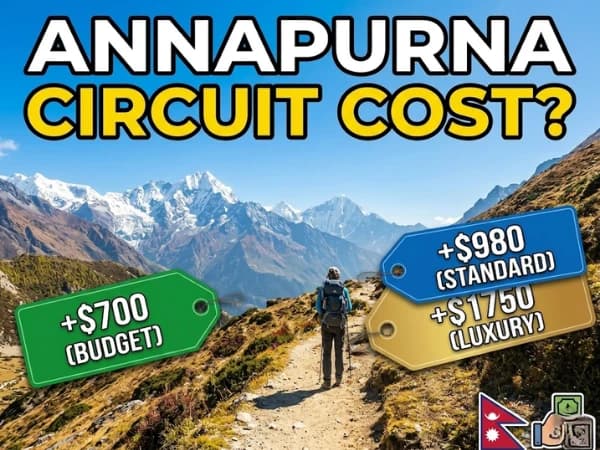
Cost efficiency. ABC at four hundred and twenty-five dollars is less than half the price of EBC at one thousand and seventy-two. No internal flights save an additional two hundred to three hundred and fifty dollars. The total cost difference, including flights and extras, can exceed a thousand dollars per person.
Accessibility. Nine days versus twelve. No flights versus Lukla's cancellation lottery. Moderate altitude versus extreme altitude. For trekkers with limited time, limited budget, or limited confidence about high altitude, ABC delivers a world-class Himalayan experience without the barriers that EBC erects.
Gentle altitude. At 4,130 metres, ABC is below the threshold where altitude sickness becomes a serious risk for most acclimatised trekkers. The headaches, the nausea, the sleep disruption that are common above five thousand metres on EBC are largely absent at ABC.
The Scenery, Honestly Compared
EBC's scenery is dominated by scale. Everest. Lhotse. Nuptse. The Khumbu Icefall. The landscape is austere and monumental, rock, ice, and sky. The beauty is in the overwhelming size of everything around you and the knowledge of where you are standing in the geography of human ambition.
ABC's scenery is dominated by enclosure. The sanctuary wraps around you. The peaks are not distant, they are the walls of the room you are in. The beauty is in the intimacy of the relationship between you and a landscape that holds you rather than one you look at from below.
Neither is objectively superior. They serve different aesthetic desires. EBC is a cathedral with a towering spire. ABC is a cathedral with an embracing nave. Both are sacred. Both are magnificent. Both make you feel small in ways that are profoundly different.
Who Should Choose Which
Choose EBC if Everest is the dream. If the name matters. If you want the physical challenge of extreme altitude. If you have twelve to fifteen days and the budget. If you want the best teahouse infrastructure in Nepal. If Kala Patthar at sunrise is on your life list.
Choose ABC if you have nine days. If you want to spend less. If altitude sickness concerns you. If you value landscape diversity over a single iconic peak. If you want the most dramatic mountain amphitheatre in the Himalayas. If standing inside the mountains appeals more than standing at the foot of one.
Choose both if you can. They complement each other perfectly, different experiences in different regions that together provide the most complete picture of what the Nepal Himalayas have to offer. Many trekkers do ABC first and EBC the following year, or the other way around. The first trek creates the appetite. The second satisfies a different part of it.
The mountains do not compete with each other. They exist in parallel, each offering what the other cannot, each rewarding the trekker who chooses them with something that no photograph, no story, and no comparison article can fully convey. The only way to know is to walk.