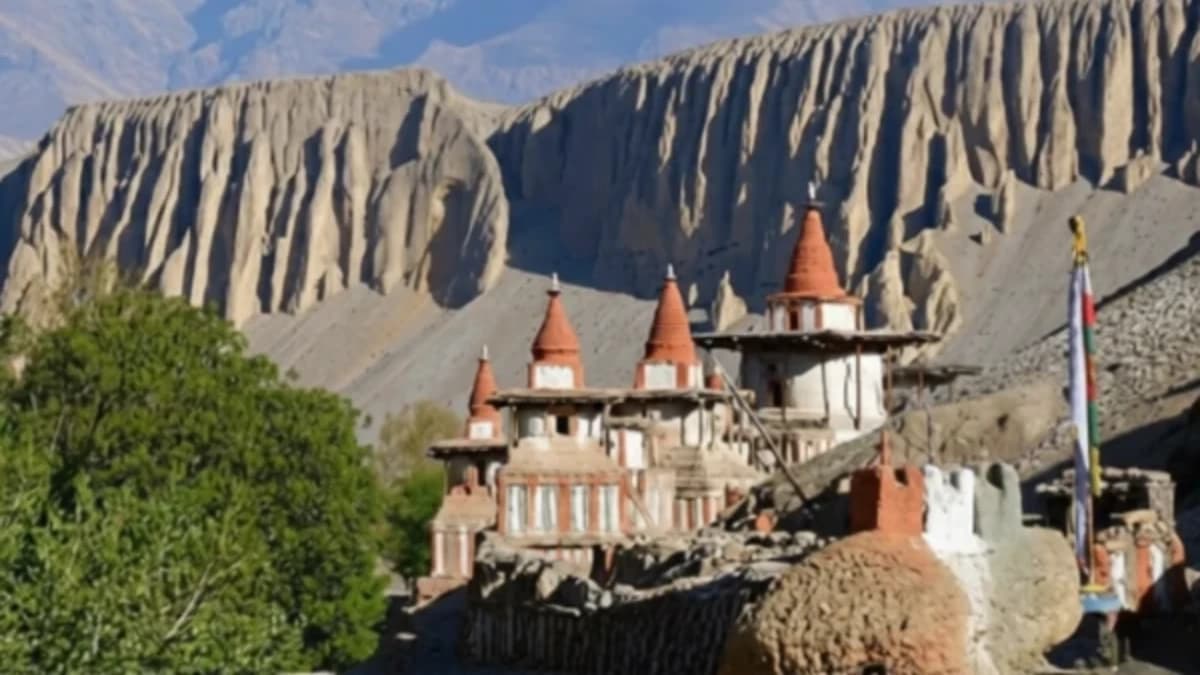
The kingdom of Lo was closed to foreigners until 1992. For centuries, the walled city of Lo Manthang, perched at 3,840 metres behind the Annapurna and Dhaulagiri ranges, existed in a bubble of time that the modern world could not penetrate. When the gates finally opened, what the first visitors found was not a ruin or a museum but a living medieval civilisation: a king on a throne, monks debating in courtyards, farmers tending barley fields irrigated by systems designed eight hundred years ago, and a landscape so unlike the rest of Nepal that it appeared to have been transplanted from another planet.
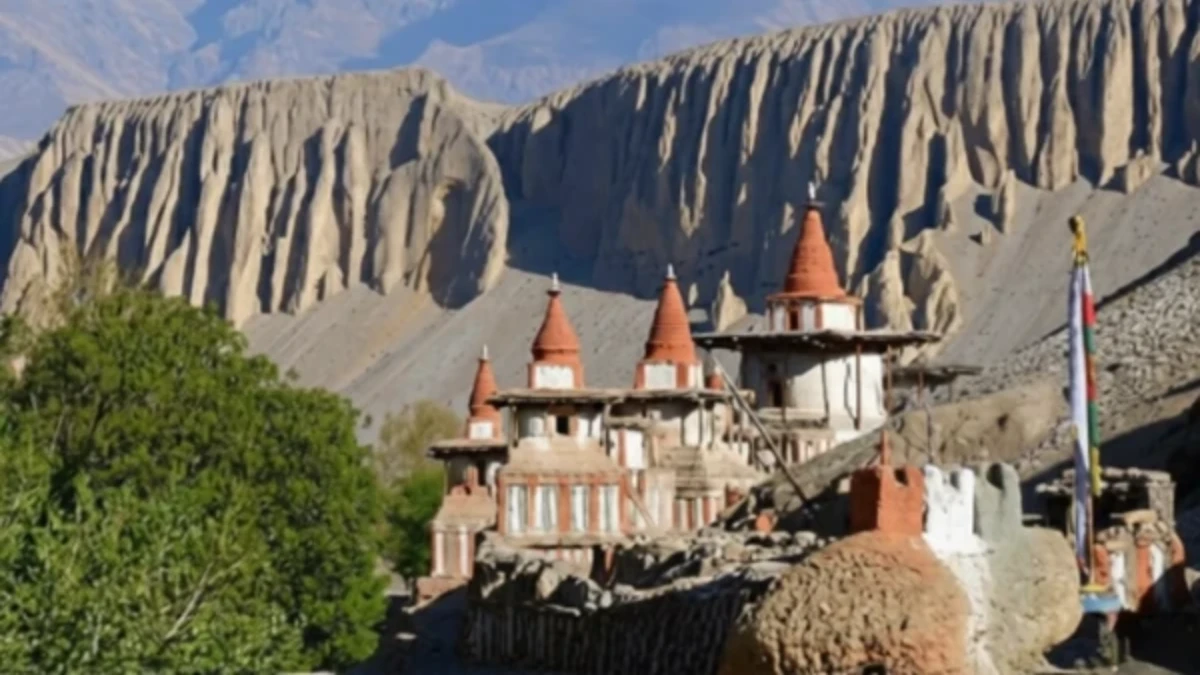
The red cliffs of Dhakmar. The wind-carved caves of Chosar, their walls painted with Buddhist murals that predate anything in Kathmandu by centuries. The arid, ochre desert stretching north toward Tibet under a sky of unrelenting blue. And the wind: the constant, howling, dust-carrying wind that sculpts the canyons and shapes the lives of everyone who lives in them.
Upper Mustang is not a trek for people who want comfortable teahouses and well-maintained trails. It is a trek for people who want to walk through a door in the Himalayas and find themselves somewhere that feels less like Nepal and more like the far edge of the habitable world.
What Makes Upper Mustang Unlike Anywhere Else in Nepal?
Nepal is green. The Himalayas, as most trekkers experience them, are a world of forests, rivers, glaciers, and peaks draped in snow. The vegetation is lush. The rivers are full. The atmosphere is moist.
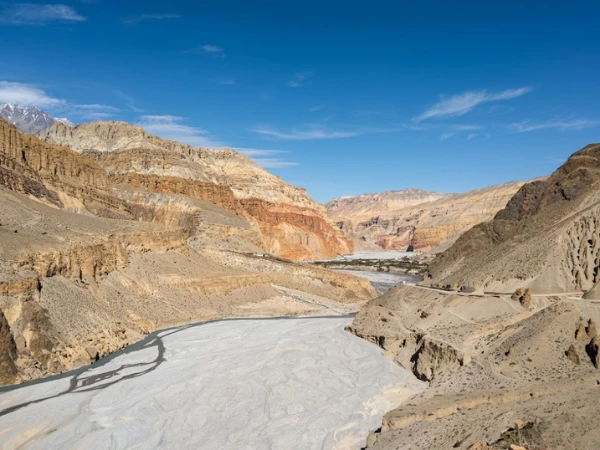
Upper Mustang is none of these things. It sits in a rain shadow behind the Annapurna-Dhaulagiri barrier, the highest wall of mountains on earth, that blocks the monsoon completely. While the rest of Nepal drowns from June to September, Mustang bakes under blue sky. The annual rainfall is less than two hundred millimetres. The landscape is desert, red rock, eroded cliffs, dry riverbeds, and dust. The vegetation is sparse: juniper scrub, occasional willow, irrigated patches of barley and buckwheat that exist only because human ingenuity channelled glacial meltwater through stone aqueducts centuries ago.
The effect on a trekker accustomed to Nepal's green abundance is disorienting. You walk through a landscape that looks like Utah or Jordan or the surface of Mars. The colours are red, ochre, brown, and white against a sky of such deep, saturated blue that it looks digitally enhanced. Shadows are sharp. Light is harsh. And the silence, broken only by wind and the occasional prayer flag snapping from a rooftop, is the silence of a place where humans are guests and geology is the host.
How much does the Upper Mustang trek cost and how long is it?
Fifteen days. Maximum altitude 3,840 metres at Lo Manthang. Budget from one thousand two hundred and ninety-two dollars. Requires a restricted area permit of fifty US dollars per day. Registered agency and licensed guide required, no minimum group size since 22 March 2026. Difficulty four out of five, moderate to challenging, more cultural than physical. Best season: June to September, the only major Nepal trek that is optimal during monsoon.
When is the best time to trek Upper Mustang?
This is the detail that transforms Mustang from an off-season consolation into a deliberate choice. When every other major trek in Nepal is closed or miserable from June to September, rain, mud, leeches, cancelled flights, zero visibility, Upper Mustang is at its finest. The rain shadow means dry trails, warm temperatures, clear skies, and comfortable walking conditions.
Trekking Mustang in summer means you avoid the autumn crowds entirely. The trails are empty. The teahouses are welcoming. And the knowledge that you are walking through sunshine while the rest of Nepal is under water adds a particular satisfaction that other treks cannot provide.
What is there to see in Lo Manthang, the walled city?
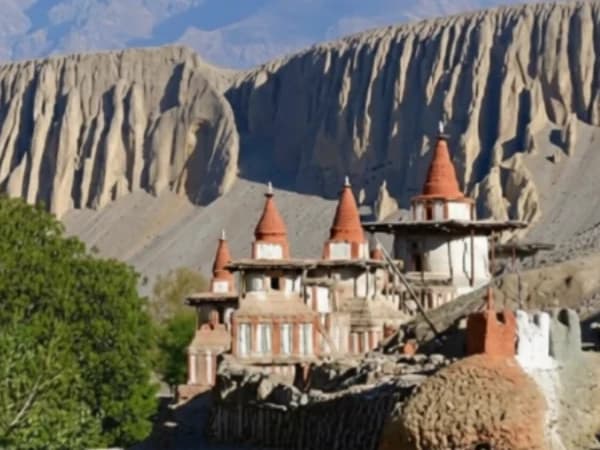
The destination of the trek is the walled city of Lo Manthang, capital of the kingdom of Lo, home to approximately one thousand people, and one of the last medieval walled cities in the world that is still continuously inhabited.
The city wall is whitewashed and crumbling. The alleys inside are narrow enough to touch both sides. The monastery, Thubchen Gompa, contains Buddhist paintings from the fifteenth century that are being painstakingly restored by an international team. The former royal palace sits at the centre, a modest structure by Western standards but the seat of a dynasty that governed this valley for six hundred years.
The king of Mustang, the Gyelpo, abdicated his formal political authority when Nepal abolished the monarchy, but he remains a deeply respected cultural figure. If you are fortunate with timing, you may see him walking through the alleys of his capital, greeted by residents who bow their heads not out of obligation but out of genuine reverence for a lineage that stretches back to the fourteenth century.
What is the Tiji Festival in Upper Mustang?
If you can time your trek to coincide with the annual Tiji festival, typically held in late May, you will witness one of the most extraordinary cultural events in the Himalayas. Three days of masked dances performed by monks in the courtyard of the monastery, accompanied by long horns, cymbals, and chanting. The dances tell the story of a deity battling a demon to save the kingdom from drought, a narrative that resonates with particular force in a landscape where water has always been the difference between life and death.
The entire population of Lo Manthang gathers for the festival. Farmers, monks, children, the elderly, all watching dances that have been performed in this courtyard for centuries. Outsiders are welcome. The atmosphere is celebratory and solemn simultaneously, a combination that only genuine ritual can produce.
What are the cave monasteries of Chosar?
North of Lo Manthang, near the Tibetan border, the cliffs contain thousands of caves, some natural, some carved by human hands over millennia. Many were used as dwellings. Some were used as meditation retreats. A few contain wall paintings of such extraordinary beauty and antiquity that their existence was unknown to the outside world until researchers gained access to Upper Mustang in the late nineteen nineties.
The paintings in the Chosar caves predate the art in Kathmandu's oldest temples. They depict Buddhist deities, mandalas, and narrative scenes in pigments made from minerals ground from the surrounding cliffs, the same red and ochre that colour the landscape. Seeing them requires a guide who knows the cave locations, a head torch, and the willingness to crawl through narrow passages that open into chambers decorated with art that has waited eight hundred years for someone to look at it.
What Are the Practical Realities of Trekking Upper Mustang?
The restricted area permit of fifty US dollars per day is the primary cost barrier. It exists to limit visitor numbers, and it works. Mustang receives a fraction of the trekkers that visit Everest or Annapurna, and the cultural and environmental preservation that results is directly visible.
Accommodation is basic. Lo Manthang has a few comfortable lodges. The smaller settlements along the trail, Kagbeni, Ghiling, Tsarang, offer simple teahouse rooms. The food is Tibetan-influenced, thukpa (noodle soup), momos, tsampa (roasted barley flour), and yak butter tea that tastes like no other beverage on earth.
The wind is a daily companion. It rises in the late morning and blows hard through the afternoon, funnelling through the Kali Gandaki gorge with enough force to lean into. Walking in the morning and sheltering in the afternoon is the standard rhythm. The wind is not a nuisance. It is the sculptor of every cliff, every cave, every canyon in Mustang. Without it, the landscape would not exist in the form that makes it extraordinary.
Who should do the Upper Mustang trek?
Trekkers who want culture as much as landscape. Mustang is as much a historical and spiritual journey as a physical one. The monasteries, the caves, the walled city, the living Tibetan Buddhist tradition, these are the substance of the trek, not just the backdrop.
Trekkers who want to walk in summer when other options are closed. Mustang in July is one of Nepal's great secrets, warm, dry, clear, and essentially private.
Anyone who reads the phrase "the last forbidden kingdom" and feels something stir. Because the phrase is not marketing. Lo Manthang was forbidden. The caves were hidden. The paintings were unknown. And now, for fifty US dollars per day and fifteen days of walking, the door is open. What waits behind it has been waiting for a very long time.
See the full itinerary on our Upper Mustang Trek (10 days) page.
Upper Mustang is Nepal's last forbidden kingdom and the closest thing to Tibet you can experience without crossing the border. The walled city of Lo Manthang, the cave monasteries, the wind-carved cliffs: it is a landscape and culture that exists nowhere else on earth. The $50/day restricted area permit keeps visitor numbers low, which is exactly why it feels the way it does.
See our Upper Mustang Trek for the full itinerary, permit details, and pricing.
WhatsApp:+977 9810351300
Email:[email protected]
Written by Shreejan Simkhada, CEO of The Everest Holiday and third-generation Himalayan guide. TAAN Member #1586.
Upper Mustang is Nepal's last forbidden kingdom. Our Upper Mustang Trek (10 Days) is private (your group only, no strangers), 2027 dates open, From USD $1290. WhatsApp us for tailored 2027 dates and current departures.
 Chat with Shreejan