

Update, 7 October 2026: The road up the Rasuwa and Trishuli valley to Syabrubesi has been closed since the 26 August flood, so Langtang is not accessible at present. Everything else in this guide describes a normal May. We check 48 hours before departure; if the road is not open we move your dates free.
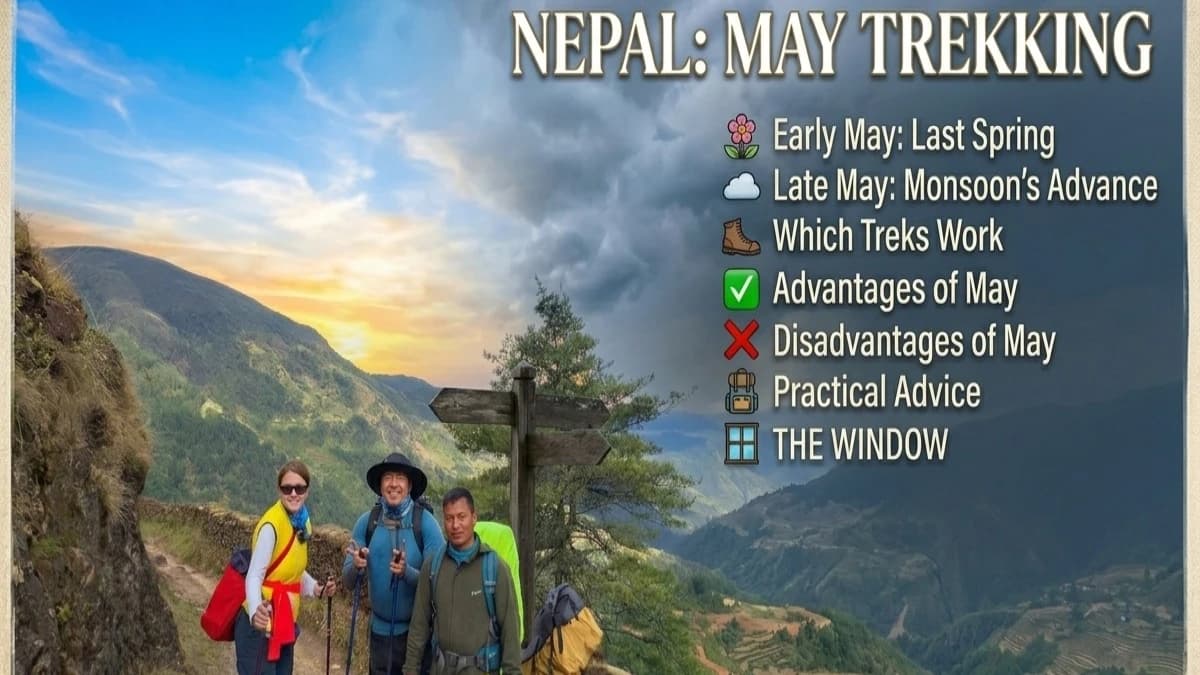
May in Nepal is a dare. The monsoon is coming: you can feel it in the air, which thickens with humidity in the afternoons, and in the clouds that build along the southern horizon like a slow-motion invasion. The rhododendrons are past their peak but still blazing on the higher slopes. The teahouse owners are calculating their last weeks of income before the rains shut everything down. And the trekkers who are still on the trails, fewer each week as May progresses, are walking through a Nepal that is simultaneously at its most lush and its most uncertain.
May is the shoulder month at the end of spring. Early May (the first two weeks) still belongs to the spring trekking season. The weather is largely stable, the trails are open, and the trek itself is good to excellent. Late May, the final two weeks, belongs to the monsoon's advance guard. Afternoon showers become daily. Cloud cover increases. Visibility drops. And the specific, day-by-day progression from "fine trekking weather" to "monsoon weather" varies each year by a week or more, making late May a calculated gamble that some years pays handsomely and some years does not.
What Is Early May Trekking Like in Nepal?
The first two weeks of May are, for many experienced trekkers, the ideal time to be in Nepal. The autumn crowds are eight months away. The spring crowds, which peak in late March and April, have thinned. The trails are quiet. The teahouses are available. And the landscape is green in a way that autumn, for all its clear skies, cannot match.
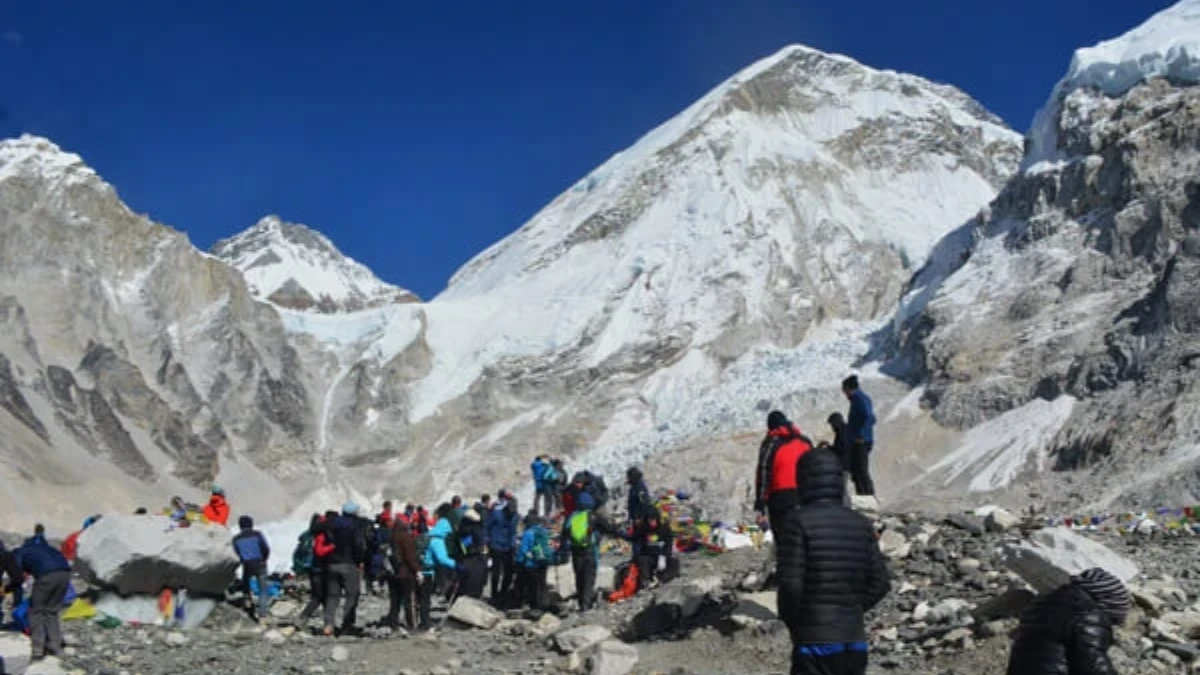
Temperatures are warmer than autumn at all altitudes. At Namche Bazaar (3,440 metres), daytime temperatures in early May reach eight to twelve degrees Celsius, compared to zero to five in October. At Gorak Shep (5,164 metres), daytime temperatures hover around zero to three degrees, compared to minus five to minus ten in autumn. The warmer temperatures make the teahouse stay more comfortable, less huddling around stoves, less sleeping in every layer you own, less of the bone-deep cold that characterises high-altitude November nights.
The mornings are typically clear. Views of the peaks are excellent until mid-morning, when clouds begin to build. By early afternoon, the upper mountains are often obscured. By late afternoon, brief showers are possible. The pattern, clear dawn, cloudy afternoon, possible evening rain, is the signature of pre-monsoon weather and defines the trekking rhythm: start early, reach your destination by noon, spend the afternoon in the teahouse.
Rhododendrons bloom at different altitudes through the spring, and in early May, the highest blooms, at 3,500 to 4,000 metres, are still displaying. The forests on the trail to Tengboche, the hillsides above Ghorepani, and the valleys of the Langtang are flushed with red, pink, and white. Spring flowers at altitude are one of Nepal's great spectacles, and early May catches the tail end of the show.
Late May: The Monsoon's Advance
Around the middle of May, the exact date varies by several days each year, the weather shifts. The pre-monsoon pattern of afternoon clouds intensifies. Showers become more frequent, heavier, and earlier in the day. The humidity at lower altitudes becomes oppressive. And the high passes, Thorong La on the Annapurna Circuit, Cho La in the Khumbu, begin to receive afternoon snow that makes crossing increasingly risky.
Late May is not impossible. It is unpredictable. A trekker who starts an EBC trek on May 15 may have ten days of acceptable weather with only minor afternoon showers. Or they may hit the monsoon's early arrival and walk through rain from Dingboche onward. The mountains do not consult the calendar.
The practical effects of late May weather on trekking are significant. Visibility decreases, the panoramic views that define the EBC and Annapurna experiences are more likely to be cloud-filled. Trail conditions deteriorate, sections that are dusty and stable in October become muddy and slippery. Leeches appear at lower altitudes (below 2,500 metres) as the moisture increases. And the psychological experience changes, walking in intermittent rain with limited views is a fundamentally different feel from walking in sunshine with sharp mountain panoramas.
Which Nepal Treks Work Best in May?
Everest Base Camp: Early May is good. The trail to EBC is well-established, teahouses are open, and the acclimatisation profile does not depend on weather. Views from Kala Patthar at sunrise are often clear even when afternoon clouds build. Late May becomes risky for views but the trail itself remains passable. The Lukla flights, which are weather-dependent, face increasing delays as May progresses, making the road route to EBC a more reliable option.
Annapurna Circuit: Early May is feasible but warming. The eastern approach from Besisahar is increasingly hot and humid at lower altitudes. Thorong La is crossable in early May but afternoon snow on the pass becomes a factor. Late May is inadvisable for the full Circuit, the combination of heat at low altitude, rain in the middle sections, and potential snow on the pass makes the trip compromised.
Annapurna Base Camp: The shorter ABC trek works well in early May. The trail is at moderate altitudes, the rhododendron forests are beautiful, and the base camp at 4,130 metres is low enough that weather disruption is less severe than on higher routes. Late May brings rain and leeches to the lower sections.
Langtang Valley: Excellent in early May. The valley is at moderate altitude, the warm temperatures make the trip comfortable, and the trail passes through beautiful forest. Late May brings rain to the approach but the upper valley, being drier, remains more pleasant than lower routes.
Upper Mustang: The best May option. Mustang sits behind the Annapurna and Dhaulagiri ranges in a rain shadow. While the rest of Nepal gets wetter through May, Mustang stays dry. The landscape, desert canyons, painted caves, ancient walled cities, is at its most vivid in the warm, clear weather. May in Upper Mustang is genuinely excellent.
Manaslu Circuit: Possible in early May but the restricted area permit and the teahouse availability may be limited as the season winds down. The Larkya La pass at 5,160 metres can receive late-season snow. Not recommended for late May.
The Advantages of May
Fewer trekkers. The trails are significantly quieter than in October or early April. Teahouse availability is excellent, no competition for rooms, no need to rush to secure accommodation. Your guide has more flexibility with the itinerary because the trail is not congested.
Warmer temperatures. The cold that makes October and November nights at altitude genuinely miserable is largely absent in May. You carry fewer warm layers. The sleeping bag can be lighter. The evenings in teahouses are more comfortable.
Lower costs. Some companies offer shoulder-season discounts in May. Flights to Kathmandu are cheaper than peak-season rates. The combination of lower costs and fewer crowds makes early May particularly attractive for budget-conscious trekkers.
Lush landscape. The vegetation is at its greenest and most dramatic. The contrast between the green valleys and the white peaks is more striking than in autumn, when the vegetation is drier and browner. Photographers often prefer the spring colour palette.
Wildflowers. Early May at altitude brings wildflowers that autumn does not, gentians, primulas, and the last of the rhododendrons. The alpine meadows above 3,500 metres are carpeted with colour in a way that the drier autumn landscape cannot match.
The Disadvantages of May
Haze and cloud. Even in early May, the atmosphere carries more moisture than in autumn. The clean skies that make October and November the classic trekking months are replaced by a softer, hazier quality. Views are still excellent, especially at sunrise and in early morning, but the razor-sharp clarity of autumn is absent.
Afternoon weather. Rain showers in the afternoon become increasingly likely through May. This is manageable, start early, walk in the morning, rest in the afternoon, but it limits flexibility. The leisurely afternoon walk that autumn allows is replaced by a more disciplined schedule.
Unpredictability. Autumn weather in Nepal is remarkably stable and predictable. May weather is the opposite, each day may bring different conditions, and the transition from spring to monsoon can happen within a few days. This unpredictability makes planning more difficult and outcomes less certain.
Heat at lower altitudes. The approach valleys, Jiri, Besisahar, Syabrubesi, are genuinely hot in May. Temperatures at 1,000-2,000 metres reach twenty-five to thirty degrees Celsius with high humidity. The first days of many treks are sweaty, uncomfortable, and at odds with the mountain trip that lies ahead.
Leeches. Below 2,500 metres, leeches emerge as the moisture increases. They are harmless but psychologically distressing. Long socks, leech repellent, and the knowledge that they disappear above 2,500 metres help manage the trip.
What Should You Know About Trekking Nepal in May?
Start early each day. On the trail by six or seven in the morning. The best weather and the best views are before noon. Reach your teahouse by early afternoon and accept that the rest of the day may be cloudy or wet.
Carry good rain gear. A waterproof jacket and pack cover are essential, not optional. Quick-dry clothing throughout. A waterproof stuff sack for your sleeping bag and electronics.
Book the first two weeks of May for the best weather. If your dates extend into the second half of May, choose a route in a rain shadow area (Upper Mustang) or a route where views are a bonus rather than the main attraction (Langtang, where the valley and village experience compensate for cloudy peaks).
Be flexible. May weather rewards adaptability. If your guide suggests changing the itinerary to chase a weather window, an early start, a diverted route, an extra rest day, trust the suggestion. The guide has done this in May before. You have not.
Manage expectations. If you need the postcard-perfect, clear-sky, every-peak-visible experience, trek in October. May offers a different beauty, greener, warmer, softer, more intimate, but it does not guarantee the panoramic clarity that defines autumn trekking. The trekker who embraces May on its own terms has an excellent time. The trekker who compares every cloudy afternoon to an imagined October morning will be disappointed.
The Window
May is a window that is closing. Each day, the monsoon advances a little further north from the Bay of Bengal. Each afternoon, the clouds are a little thicker, the air a little heavier, the rain a little more committed. By the first of June, the window is closed, the monsoon has arrived, the trails are wet, and the trekking season is definitively over until September.
Walking through Nepal in May is walking through a landscape in transition. The dry certainty of the post-monsoon season is months away. The wet chaos of the monsoon is days away. And in between, in that narrowing gap between seasons, the mountains are green and warm and quieter than at any other time of year, and the trekker who steps into that gap walks through a Nepal that most visitors never see.
The gamble is the weather. The reward is the solitude. And the calculation, whether the quieter trails and warmer temperatures and lush landscapes are worth the risk of afternoon cloud and occasional rain, is one that every May trekker must make for themselves. Early May almost always rewards the gamble. Late May requires luck. And luck, in the Himalayas, is a currency that the mountains control.
May departures available on the EBC Trek, ABC Trek, and the Upper Mustang Trek, which is best in May-June.
May is the last good trekking window before the monsoon arrives in early June. The rhododendrons are finishing, the days are warm, the trails are quiet, and the mountains are still visible most mornings. By the second week of June, the rain starts and does not stop until September. If you have May dates, use them.
We run treks through the end of May. Ask us which routes work best in late spring.
WhatsApp:+977 9810351300
Email:[email protected]
Written by Shreejan Simkhada, CEO of The Everest Holiday and third-generation Himalayan guide. TAAN Member #1586.
May trekking is the last clean window before monsoon. Our Everest Base Camp Trek (12 Days) is private (your group only, no strangers), 2026 dates open, From USD $1399. WhatsApp us for tailored 2026 dates and current departures.

 Chat with Shreejan