
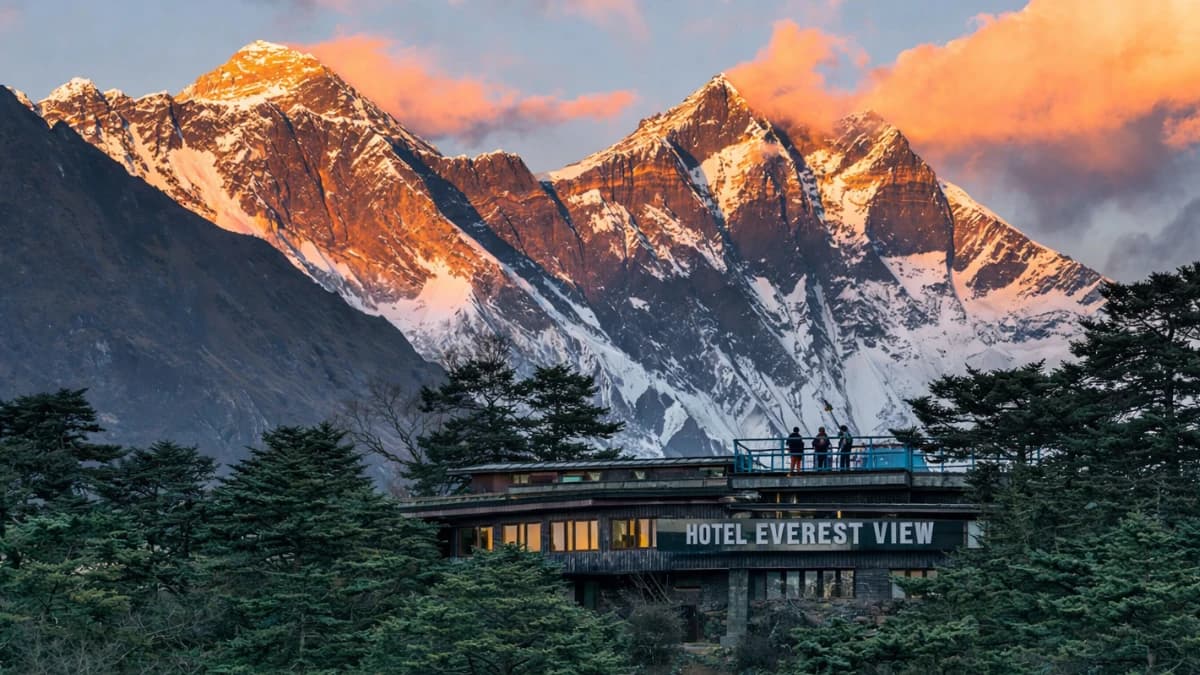
There is a hotel at 3,880 metres in the Khumbu region of Nepal that serves Japanese green tea in porcelain cups, offers oxygen on demand through bedside piping, and charges four hundred dollars per night for a room with a view that would justify four thousand. The Everest View Hotel sits on a ridge above Namche Bazaar, facing directly north toward the peaks of Everest, Lhotse, Nuptse, and Ama Dablam, and it has been doing so since 1971, when a Japanese consortium built it for reasons that combined commercial ambition with something close to madness.
The hotel was conceived by Takashi Miyahara, a Japanese entrepreneur who believed that the view of Everest from this particular ridge was the most beautiful sight on earth and that people would pay significant money to see it from a comfortable bed. He was right about the view. The commercial viability took longer to prove: the hotel's early decades were plagued by the logistical impossibility of running a luxury establishment in a place that receives its supplies by yak and its electricity from a small hydroelectric plant that sometimes works.
Today the Everest View Hotel is listed in the Guinness Book of World Records as the highest-placed hotel in the world. This claim requires some qualification: there are hotels in Peru, Bolivia, and Tibet at similar or higher altitudes, but the Guinness listing specifies "luxury hotel," and in that category, the Everest View's combination of altitude, amenities, and view remains unmatched. It is, in the most literal sense, a place where comfort meets the edge of human habitation.
How Do You Get to the Everest View Hotel?
The hotel is a ninety-minute to two-hour walk from Namche Bazaar, climbing steadily through rhododendron and juniper forest on a trail that most EBC trekkers walk on their acclimatisation day. The trail is well-maintained, clearly marked, and offers progressively expanding views of the Khumbu valley as you gain altitude. At 3,880 metres, the hotel appears on the ridge like an architectural non sequitur: a proper building with glass windows and a terrace, surrounded by prayer flags and the sort of landscape that normally houses nothing more permanent than a stone shelter.
Most trekkers arrive at the Everest View Hotel as day visitors rather than overnight guests. The acclimatisation hike from Namche on Day 4 of the EBC trek passes directly by the hotel, and stopping for tea on the terrace is one of the great rituals of the Khumbu. You sit in a wooden chair at 3,880 metres, hold a hot cup in both hands, and look at a panorama that includes four of the ten highest mountains on earth. The tea costs about five dollars. The view is free. The combination is worth every step of the climb from Namche.
What Can You See from the Everest View Hotel?
Superlatives are the enemy of accurate description, but accuracy requires them here. The view from the Everest View Hotel terrace is one of the finest mountain panoramas on earth.
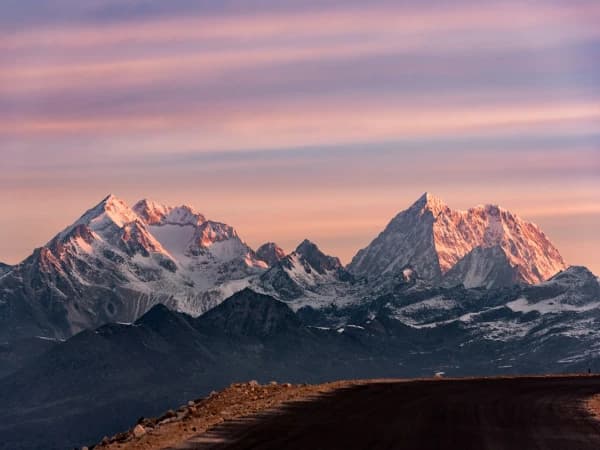
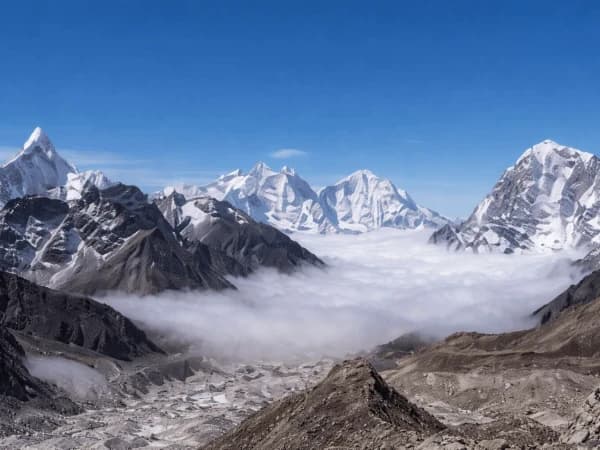
Directly north, Everest rises behind the massive wall of Nuptse and Lhotse. On clear mornings, and October mornings in the Khumbu are almost always clear, the summit pyramid catches the early light while the valleys below remain in shadow. The scale is difficult to process. Everest is thirty-three kilometres away, but at 8,849 metres, it dominates the skyline with a presence that distance cannot diminish.
To the right of Everest, Lhotse's south face, one of the most formidable walls in Himalayan climbing, catches the light in a cascade of ice and exposed rock. Lhotse is the fourth-highest mountain on Earth, and from this angle it appears as Everest's shoulder, which is geologically accurate, the South Col connects the two mountains at 7,906 metres.
To the left, Ama Dablam rises in perfect pyramidal symmetry, the mountain that climbers call the Matterhorn of the Himalaya. At 6,812 metres, it is modest by Khumbu standards, but its shape is so aesthetically perfect that it appears on more postcards and calendar photographs than any other Himalayan peak.
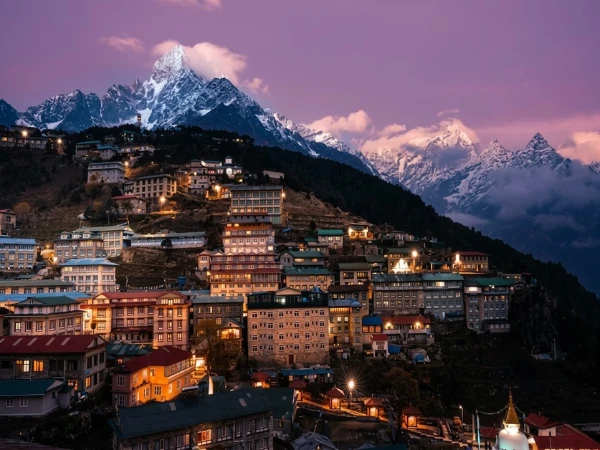
Below and in front of you, the Khumbu valley drops away in terraces of forest and stone, with the rooftops of Namche Bazaar visible as tiny silver rectangles among the green. Prayer flags on the ridge snap in the constant wind, their colours, blue, white, red, green, and yellow, bright against the grey-brown of the mountainside.
Photographers will spend an hour on the terrace and still feel they have not captured it. The panorama is too wide for a single frame. Stitched panoramas come closer but lose the depth. The only adequate recording device is memory, and even memory edits the experience, smoothing the wind, warming the air, and removing the slight headache that altitude provides as a reminder of where you are.
What Is It Like to Stay Overnight at the Everest View Hotel?
Overnight stays at the Everest View Hotel are possible and offer something that the day visit cannot: sunrise and sunset over the Himalayas from a warm room with glass windows.
Rooms are modest by international hotel standards, clean, heated (a significant luxury at 3,880 metres, where most teahouses are unheated), with proper beds and blankets rather than the thin mattresses and sleeping bags of the trail. Some rooms have en-suite bathrooms. Hot water is available but limited. Electricity is intermittent. Wi-Fi exists on paper.
The hotel's most unusual amenity is its oxygen supply system. Pipes run to each room, delivering supplemental oxygen on demand for guests who experience altitude discomfort. At 3,880 metres, this is a precaution rather than a necessity for most acclimatised visitors, the altitude is well within the range that healthy trekkers manage without assistance. But for guests who fly directly to the hotel from Kathmandu by helicopter (this is done, the hotel has a helipad), the oxygen is genuinely useful. Flying from 1,400 metres to 3,880 metres in forty-five minutes skips the acclimatisation process entirely, and supplemental oxygen provides temporary relief while the body catches up.
Dinner is surprisingly tasty. The kitchen produces Japanese and Nepali dishes with ingredients that arrive by porter from Namche. You can eat tempura in a warm room with a view of Everest through the dining room's glass. Such an experience is a luxury that the trail does not otherwise offer.
The price, currently three hundred to four hundred US dollars per night for a double room with meals, places the Everest View Hotel firmly in the luxury category by Nepal trekking standards, where most accommodation is ten to thirty dollars per night. For the trekker on a standard EBC itinerary, the price is difficult to justify when a comfortable teahouse in Namche with the same view (slightly lower angle, slightly less dramatic) costs a twentieth of the price. For the visitor who has flown in specifically for the experience, or for the trekker celebrating a special occasion, the overnight stay gives you a different combination of altitude, comfort, and spectacle that does not exist anywhere else on earth.
The History
The hotel's history is a story of Japanese ambition and Himalayan reality finding an uneasy equilibrium.
Construction began in 1971, supervised by Japanese engineers and built by Sherpa labourers using materials carried up from Namche on human backs and yak trains. The original concept was a proper hotel, glass windows, heated rooms, a restaurant, a bar, at an altitude where such things did not exist and where the logistics of creating them bordered on the absurd. Every windowpane, every piece of furniture, and every appliance had to be carried from the airstrip at Lukla (itself accessible only by the world's most terrifying airport) along the same trail that trekkers walk.
The hotel opened in 1971 and immediately struggled. The combination of extreme altitude, expensive logistics, difficult access, and a limited market (trekkers who both wanted luxury and could afford it were a small group in the 1970s) made profitability elusive. The hotel closed and reopened multiple times. Different operators attempted different strategies. The building deteriorated and was renovated. Repeatedly.
The current operation is stable if not exactly flourishing. The hotel serves primarily as a destination for day visitors (the tea terrace generates reliable income) and a niche offering for overnight guests who want the specific see it provides. Its listing in Guinness World Records generates publicity that its marketing budget could not. And the view, which has not changed since 1971 and will not change until the Himalayas erode, remains its unassailable competitive advantage.
The Acclimatisation Hike
For EBC trekkers, the Everest View Hotel is not primarily a hotel. It is a waypoint on the most important day of the trek, the acclimatisation day in Namche.
The hike from Namche to the Everest View Hotel gains approximately 440 metres of altitude. You walk up, your body registers the reduced oxygen, and you walk back down to sleep at 3,440 metres. The "climb high, sleep low" principle in action. The hotel provides a convenient and comfortable turning point, a place to rest, drink tea, and use proper toilets before descending.
The trail continues beyond the hotel to Khumjung (3,790 metres) and Khunde (3,840 metres), two of the oldest Sherpa villages in the Khumbu. Khumjung has a school founded by Sir Edmund Hillary and a monastery that claims to house a yeti scalp, a dubious but entertaining relic. The full acclimatisation circuit, Namche to Everest View Hotel to Khumjung to Khunde and back to Namche, takes four to five hours and provides excellent altitude exposure along with cultural immersion in traditional Sherpa village life.
Your guide will monitor your symptoms during this hike. How do you feel at 3,880 metres? Is the headache manageable? Are you eating? Are you walking steadily? The answers to these questions inform the next five days of the trek. A trekker who handles the acclimatisation hike well is likely to acclimatise well at higher altitudes. A trekker who struggles may need additional rest or a modified itinerary. The Everest View Hotel, with its terrace and its tea and its impossible view, is where this assessment happens, in a setting that makes altitude medicine feel like a holiday.
What Do You Need to Know Before Booking?
Location: Syangboche ridge, 3,880 metres, approximately 90 minutes' walk above Namche Bazaar. GPS: 27.8133°N, 86.7197°E.
Access: walk from Namche Bazaar (the only option for trekkers) or helicopter from Kathmandu to the Syangboche airstrip (seasonal, expensive, primarily used by non-trekking visitors).
Day visit: no reservation needed. The terrace is open to all visitors. Tea, coffee, and light meals are available. Expect to pay five hundred to one thousand Nepali rupees for tea or coffee (four to eight dollars). Cash only, no card facilities.
Overnight: reservation recommended during peak season (October-November, March-April). Rates vary by room type and season. Contact the hotel directly or through your trekking company. Includes dinner and breakfast.
Best time to visit: early morning for the clearest views. By mid-morning in peak season, clouds begin to build from the south and may partially obscure the lower peaks by afternoon. Sunrise from the terrace, if you are staying overnight, is the premium experience.
What to bring: warm layers (the terrace is windy), sunglasses (the UV at 3,880 metres is intense), a camera, cash, and the willingness to sit quietly for longer than you planned. The view has a way of captivating you. People arrive intending to spend twenty minutes and leave an hour later, still not ready to turn their back on Everest.
The Irony
The Everest View Hotel was built so that people could see Everest without climbing it. They could choose the helicopter option without even trekking. It was a shortcut to the sublime, a way to purchase the view without earning it through altitude and effort.
But the irony is that the trekkers who appreciate the hotel most are not the ones who fly in. They are the ones who walk. The trekkers who have spent three days climbing from Lukla or the roadhead, who have felt the first headache of altitude at Namche, who have lain awake in a cold teahouse wondering whether the trek was a good idea, these are the people for whom the Everest View Hotel terrace is a revelation. It's not because of the luxury, which is modest. Not because of the tea, which is ordinary. But because of the context. You have earned the view. Your legs carried you here. Your lungs adapted to the thin air. And now you sit in a wooden chair at 3,880 metres and look at the highest mountain on earth with the specific appreciation that only effort can create.
The hotel sold comfort. What it delivers to the trekker who arrives on foot is perspective. On the mountains. On the effort. The strange and wonderful fact is that you are sitting at nearly four thousand metres above sea level, drinking tea, looking at Everest, and feeling, despite the headache, despite the breathlessness, despite everything your body is telling you about the altitude, exactly where you are supposed to be.
Visit the Everest View Hotel on our Everest View Trek (7 days), which includes a stop at this iconic hotel.
The Everest View Hotel at 3,880 metres serves coffee with a view of the highest mountain on earth. It is absurd and it is wonderful. The rooms are heated by yak-dung stoves, the Wi-Fi is slow, and the sunset turns Everest gold. If you want one night of genuine Himalayan luxury on your EBC trek, this is the place.
We can add a night at the Everest View Hotel to any of our Everest region treks. It is a short detour from Namche Bazaar.
WhatsApp:+977 9810351300
Email:[email protected]
Written by Shreejan Simkhada, CEO of The Everest Holiday and third-generation Himalayan guide. TAAN Member #1586.
The Everest View Hotel is a side-stop on EBC. Our Everest Base Camp Trek (12 Days) is private (your group only, no strangers), 2027 dates open, From USD $1399. WhatsApp us for tailored 2027 dates and current departures.
 Chat with Shreejan