

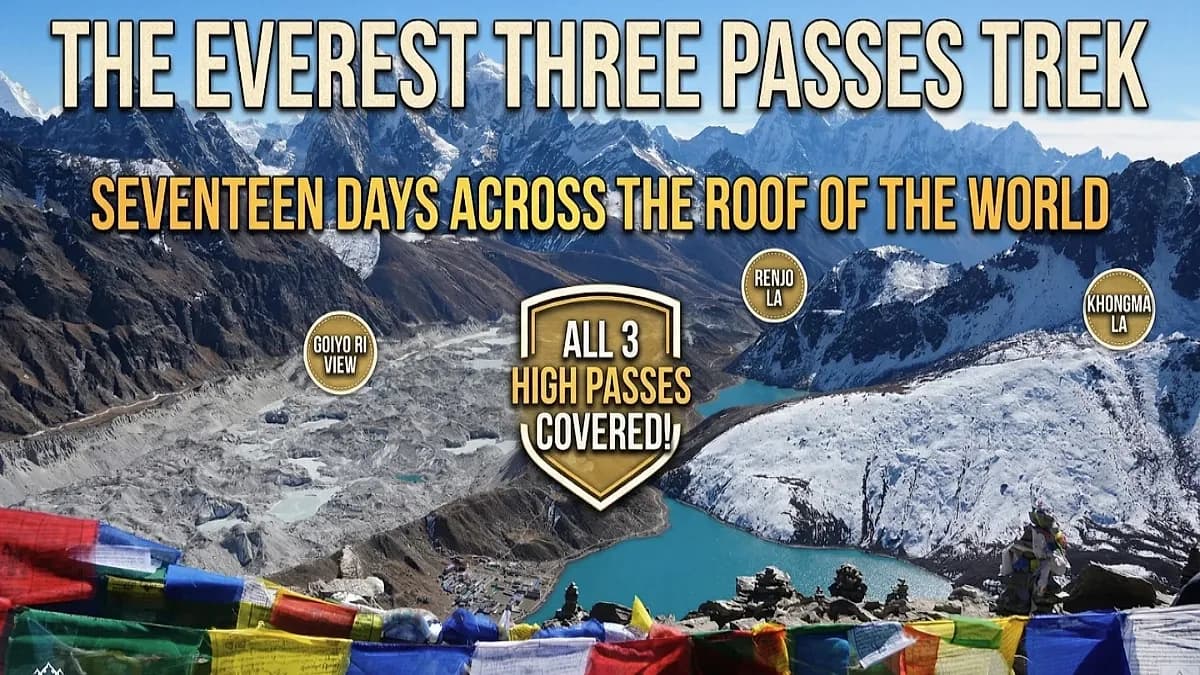
There is a moment on the Renjo La (the first of three passes, at 5,360 metres) when you look back at the trail you have climbed and forward at the trail you have yet to walk and realise, with a clarity that thin air sometimes provides, that you have committed yourself to something that cannot be done halfway. The pass behind you is too high to recross casually. The pass ahead is higher still. And between them lies the Khumbu: a landscape of ice and rock and silence so vast that the word "wilderness" feels inadequate.
The Three Passes trek is not the Everest Base Camp trek with extra days bolted on. It is a fundamentally different proposition: a seventeen-day traverse that crosses three high passes above 5,300 metres, visits both Everest Base Camp and the Gokyo Lakes, and demands a level of physical and mental commitment that the standard EBC route does not approach. It is Nepal's ultimate trekking challenge. And for those who complete it, it is Nepal's ultimate trekking reward.
What are the three passes on the Everest Three Passes Trek?
Renjo La: 5,360 metres
The first pass, crossed on Day 6 from Lungden (4,500 metres) to Gokyo (4,790 metres), about eight hours. The climb is technically straightforward, a steep zigzag up rocky terrain. The summit view, Everest, the Gokyo Lakes below, the Ngozumpa Glacier stretching to the horizon, is the panorama that makes the effort worth it. The descent to Gokyo loses about 570 metres.
Cho La, 5,420 metres
The middle pass, crossed on Day 9 from Thangnak (4,700 metres) to Dzongla (4,830 metres), about six hours. It is the most technical of the three: a steep snow and ice slope that may need fixed ropes depending on conditions. Crampons are not always necessary, but your guide carries them for when the surface calls for them, and decides the safest line on the day. The summit plateau is a moonscape of ice and rock, and the descent drops to Dzongla on the Khumbu side.
Kongma La: 5,535 metres
The last pass and the highest of the three, crossed on Day 13 from Lobuche to Chhukung (4,730 metres), six to eight hours. By then your body has been at altitude for nearly two weeks and fatigue is cumulative. It is steep, technical in places, and relentless. Loose rock. Exposed scrambling. A glacier crossing that requires concentration and nerve. The summit is narrow and wind-blasted, with views of Makalu, Lhotse, and the upper Khumbu. The descent to Chhukung loses about 800 metres, long and knee-punishing over rough moraine.
How long is the Everest Three Passes Trek and how much does it cost?
Seventeen days. Maximum altitude 5,545 metres at Kala Patthar. Three passes above 5,300 metres. Budget from USD 1,649. Difficulty five out of five, the most demanding standard trek in Nepal. Not suitable for first-time trekkers. Previous high-altitude experience strongly recommended. Requires twelve to sixteen weeks of dedicated physical training.
Who should attempt the Everest Three Passes Trek?
Experienced trekkers who have completed at least one trek above four thousand metres, EBC, Annapurna Circuit, Manaslu, or equivalent, and who want to push further. Athletes with excellent cardiovascular fitness who have trained specifically for multi-day high-altitude exertion. Trekkers who define their best trips not by comfort but by challenge.
It is not for beginners. It is not for undertrained optimists. It is not for people whose primary motivation is a photograph at base camp. The Three Passes demands everything the Khumbu has to ask of a human body, and it gives everything the Khumbu has to offer in return.
What is the day-by-day itinerary for the Everest Three Passes Trek?
The route follows the standard EBC trail from Lukla to Namche Bazaar, then turns west to Thame and Lungden for the Renjo La (Day 6), the first pass, before dropping to Gokyo.
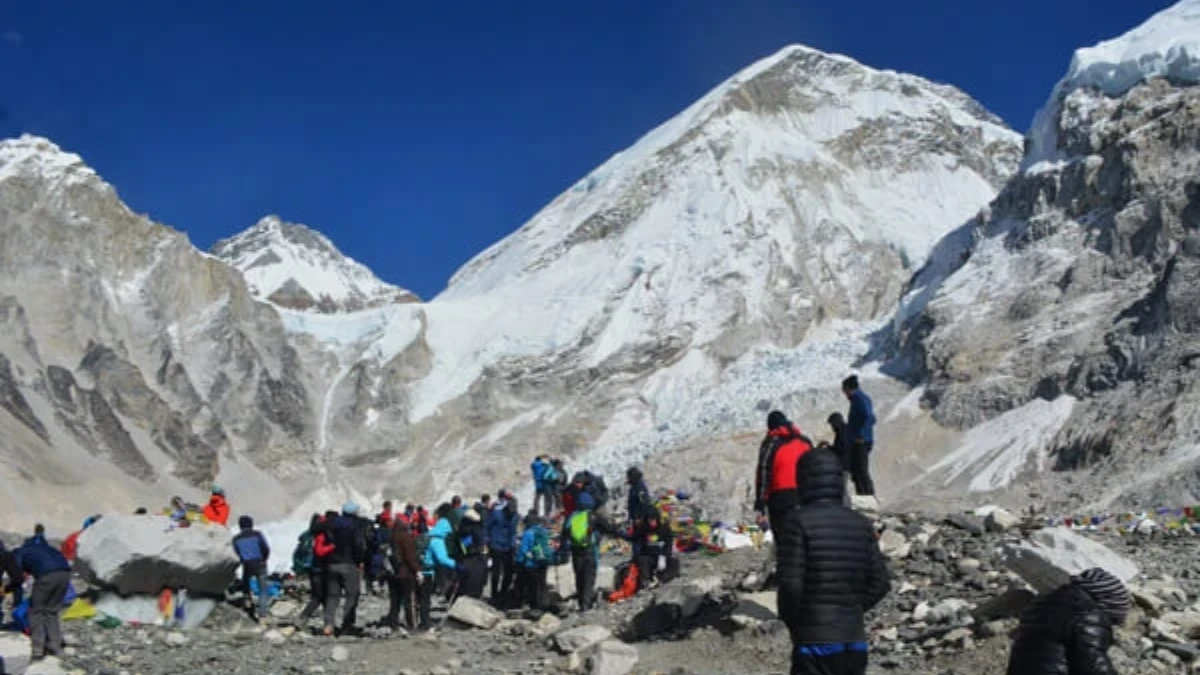
Two days at the turquoise lakes, including the dawn climb to Gokyo Ri at 5,357 metres, provide both rest and one of the finest viewpoints in the Himalayas. From Gokyo the route goes by Thangnak and crosses the Cho La (Day 9) to Dzongla, then on to Lobuche, Everest Base Camp and Kala Patthar (Days 10 to 12), the same summit day as the standard EBC trek.
From Lobuche, the last pass is the Kongma La (Day 13), which leads down to Chhukung, and the route then returns by Tengboche and Namche Bazaar to Lukla.
The result is a complete circuit of the upper Khumbu, every major valley, every iconic viewpoint, and three of the highest trekking passes on earth, linked into a single continuous journey.
How difficult is the Everest Three Passes Trek?
The passes are hard individually. Any one of them would be the highlight of a standard trek. Doing three in seventeen days, with the cumulative altitude exposure, the physical fatigue, and the mental demand of sustained effort above five thousand metres, is qualitatively different from doing one.
Recovery time is minimal. After Renjo La, you descend to Gokyo and get one rest day, spent climbing Gokyo Ri. After Cho La, you go on to Lobuche, Everest Base Camp and Kala Patthar. After Kongma La, you still have three days of walking down to Lukla. The trek does not offer the luxury of extended rest between its hardest days.
Weather dependency is extreme. Each pass requires a window of clear weather to cross safely. One day of bad weather can delay a crossing by two days, and with three passes, the probability of at least one weather delay is significant. Flexible scheduling and buffer days are not optional. They are essential.
And the cold. Above five thousand metres for the better part of a week, with nighttime temperatures reaching minus twenty and wind chill pushing lower, the Three Passes is a sustained encounter with cold that even experienced trekkers find testing.
Is the Everest Three Passes Trek worth it?
Everything. Every view that the Khumbu has to offer is on this route. Kala Patthar at sunrise, the most famous mountain view in the world. The Gokyo Lakes, turquoise glacial water at about 4,790 metres. Gokyo Ri, four eight-thousanders visible simultaneously. The Cho La glacier, ice and rock and silence. The Kongma La summit, Makalu and Lhotse framed against a sky so deep blue it approaches black.
And the internal experience, the knowledge that you walked across the roof of the world for seventeen days, crossed three passes that most people will never see, and discovered something about your own capacity that cannot be discovered any other way, is the thing that stays long after the photographs fade and the muscles recover.
The Three Passes trek is not the best trek in Nepal for most people. But for the people it is for, and they know who they are, it is the best trek in the world.
See the full 17-day itinerary on our Everest Three Passes Trek page.
The Everest Three Passes Trek is the hardest standard trek in Nepal and the most rewarding. Three passes above 5,000 metres, both Everest Base Camp and Gokyo Lakes, and seventeen days of walking through terrain that makes the standard EBC trek look like a warm-up. If you want everything the Khumbu has to offer in one expedition, this is it.
See our Everest Three Passes Trek (17 days).
WhatsApp:+977 9810351300
Email:[email protected]
Written by Shreejan Simkhada, CEO of The Everest Holiday and third-generation Himalayan guide. TAAN Member #1586.
Three Passes is our 17-day Everest mega-route. Our Everest Two Passes Trek (15 Days) is private (your group only, no strangers), 2026 dates open, From USD $1699. WhatsApp us for tailored 2026 dates and current departures.
 Chat with Shreejan