

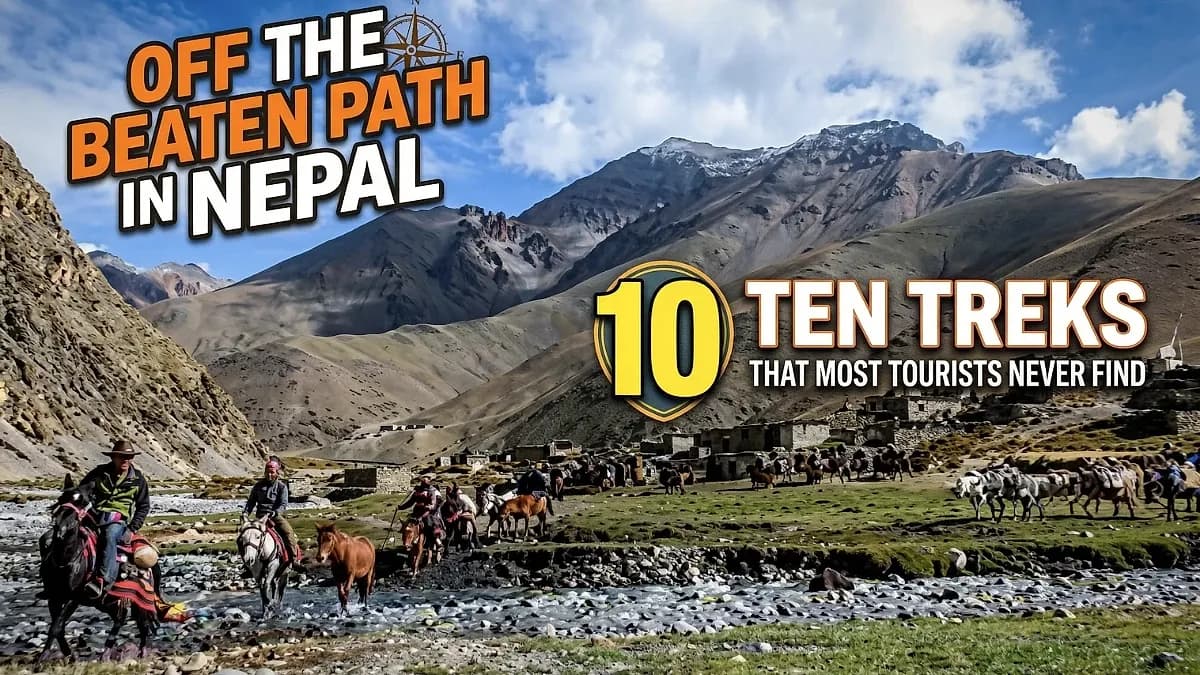
Ninety percent of Nepal's trekkers walk three routes: Everest Base Camp, the Annapurna Circuit (or ABC), and Langtang. These are magnificent treks: extraordinary, life-changing, and worth every step. They are also, during peak season, crowded. The queue at the suspension bridge below Namche. The competition for teahouse rooms in Manang. The Instagram-identical photographs from Poon Hill at sunrise. The trip is extraordinary, but it is also shared with hundreds of other trekkers who read the same guidebook and booked the same season.
Nepal has a different offer for the trekker who wants solitude, novelty, and the specific thrill of walking through mountains that other tourists have not discovered, or have discovered and not yet popularised. These are treks where the teahouses are emptier, the trails are quieter, the cultural encounters are more intimate, and the likelihood of standing alone in a mountain landscape with nobody visible in any direction is not a hope but a certainty.
Some of these treks require restricted area permits. Some require camping. Some require a willingness to accept simpler accommodation and less English-speaking infrastructure. All of them reward the trekker who ventures beyond the familiar routes with an experience of Nepal that the popular trails, for all their grandeur, cannot provide.
1. Upper Mustang: The Last Forbidden Kingdom
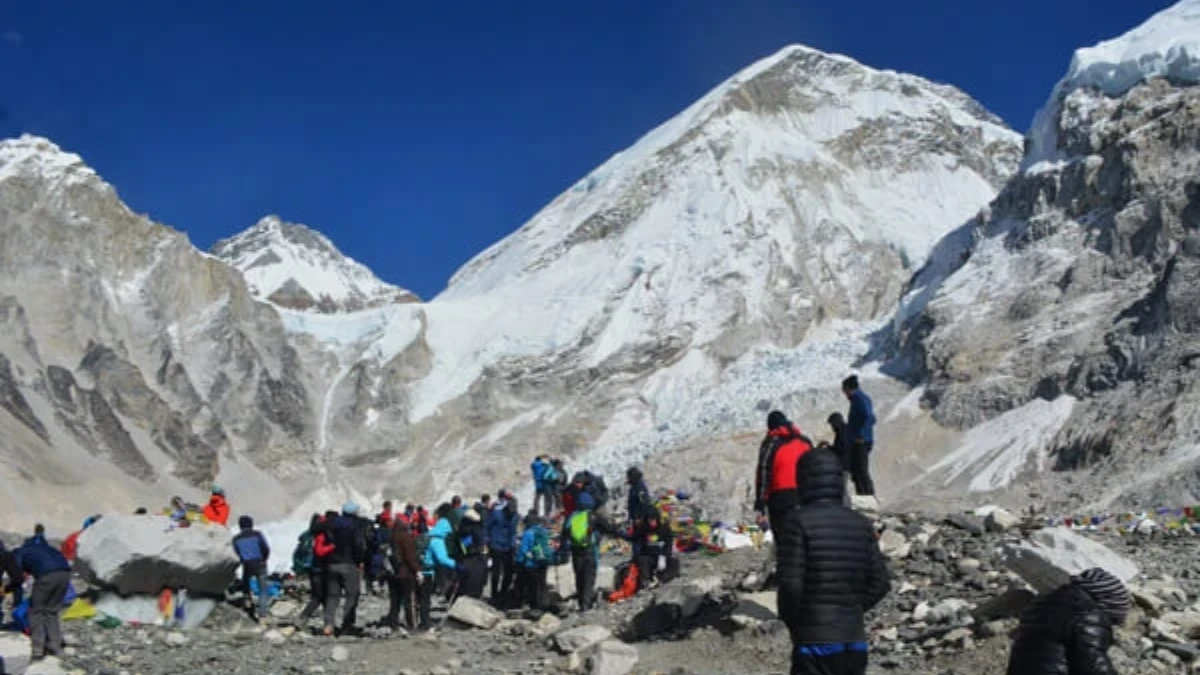
Upper Mustang was closed to foreigners until 1992 and still requires a restricted area permit that costs fifty US dollars per day. This price is a deliberate filter, it limits visitor numbers to fewer than three thousand per year, preserving one of the most extraordinary landscapes and cultures in the Himalaya.
Beyond the gateway town of Kagbeni, the trail enters a desert canyon landscape that looks nothing like the green valleys of the Khumbu or Annapurna. Red and ochre cliffs. Eroded pillars of sedimentary rock. Wind-sculpted formations that resemble a Martian landscape. And at the end of the trail, the walled city of Lo Manthang, the capital of the ancient Kingdom of Lo, where the royal palace, four monasteries, and a medieval culture survive in a state of preservation that time and isolation have maintained for centuries.
The caves of Upper Mustang, some containing Buddhist murals dating to the fourteenth century, are among the most significant archaeological discoveries in the Himalaya. The sky burial sites. Hindus regard the ammonite fossils (shaligram) in the riverbed as sacred. The annual Tiji festival at Lo Manthang, where monks in masks dance for three days in the palace courtyard. The Upper Mustang trip is both the most challenging and rewarding trip in Nepal.
How remote is the Kanchenjunga Base Camp trek?
Kanchenjunga, the world's third-highest mountain at 8,586 metres, straddles the Nepal-India border in the country's far northeast. The trek to its base camp, north or south, or a circuit combining both, is one of the most remote major treks in Nepal. The region receives fewer than two thousand trekkers per year. Teahouse accommodation exists on the main route but is basic. Some sections require camping.
The approach from Taplejung passes through dense subtropical and temperate forests, across high passes, and through Limbu and Rai villages where traditional culture is less influenced by tourism than in the Khumbu or Annapurna regions. The mountain itself, when it finally appears in full view, is massive, a wall of ice and rock that makes Everest look elegant and restrained by comparison.
The Kanchenjunga Conservation Area is a restricted zone requiring a permit and a licensed guide. The minimum group of two was removed on 22 March 2026. The remoteness is real, if something goes wrong, evacuation takes longer than on popular routes. But for experienced trekkers who want to see the third-highest mountain in conditions of genuine wilderness, Kanchenjunga is unmatched.
What makes Tsum Valley a sacred Buddhist trek?
Accessed from the Manaslu Circuit route, Tsum Valley is a sacred Buddhist valley that was closed to foreigners until 2008. The valley runs north toward the Tibetan border, flanked by peaks above 7,000 metres, and is home to a Tibetan-heritage community that practices a form of Buddhism little influenced by the outside world.
The trail passes through forests, across high bridges, past mani walls that are among the longest in Nepal, and into a landscape of stone villages, monastery ruins, and ancient meditation caves. The Mu Gompa, a nunnery at 3,700 metres, is one of the most spiritually powerful locations in the Nepal Himalaya.
Tsum Valley can be combined with the Manaslu Circuit for a three-to-four-week trek that covers both the circuit and the sacred valley. The restricted area permit for Manaslu covers Tsum as well. Teahouse accommodation is available but basic. The cultural immersion, authentic, intimate, and untouched by mass tourism, is the primary draw.
Can you see snow leopards on the Dolpo trek?
Made famous by Peter Matthiessen's "The Snow Leopard" (1978) and Eric Valli's film "Himalaya" (1999), Dolpo is Nepal's most remote trekking region. Upper Dolpo requires a restricted area permit of fifty US dollars per day (the same as Upper Mustang) and is accessible only on foot, there are no roads, no airstrips in the upper region, and no teahouses on most of the route. This is a camping trek in genuine wilderness.
The landscape is trans-Himalayan, high-altitude desert, turquoise lakes (Phoksundo Lake is one of Nepal's deepest at 145 metres in the 2004 survey), and a culture that is more Tibetan than Nepali. The inhabitants of Upper Dolpo still practise sky burial. The monasteries are centuries old. The yak caravans that cross the high passes carry goods exactly as they have for generations.
Snow leopard sightings, while rare, do occur, Dolpo is one of the best habitats for the species in Nepal. Blue sheep (bharal) are common, and the combination of wildlife, landscape, and cultural isolation makes Dolpo the ultimate off-the-beaten-path trek for those with the time, budget, and expedition tolerance to reach it.
How does Makalu Base Camp compare to Everest Base Camp?
Makalu (8,485 metres) is the world's fifth-highest mountain, and its base camp trek receives a fraction of EBC's visitors despite offering comparable mountain scenery in a setting of greater wilderness. The approach from Tumlingtar, reached by flight from Kathmandu, passes through the Arun Valley, one of Nepal's most biodiverse regions, before climbing to the Makalu-Barun National Park and the base camp at 4,870 metres.
The Barun Valley, which leads to Makalu's base camp, is considered one of the last intact ecosystems in the Nepal Himalaya. The forest is old-growth. The wildlife includes red pandas, musk deer, and Himalayan tahr. The mountain views, Makalu's brutal south face, Everest visible to the west, and Kanchenjunga to the east, are comparable to anything in the Khumbu.
Can you add Nar Phu Valley to the Annapurna Circuit?
A side valley off the Annapurna Circuit route, Nar-Phu was closed to foreigners until 2003 and still requires a restricted area permit (ninety dollars for the first week). The valley runs north from the Circuit trail near Koto into a landscape of high-altitude desert, Tibetan villages, and glacial peaks that rivals Upper Mustang for dramatic beauty.
The villages of Nar (4,110 metres) and Phu (4,080 metres) are stone-built communities perched on cliffs above the valley floor, with monasteries, prayer flags, and a way of life that feels centuries removed from the Circuit trail below. The return to the Circuit via the Kang La pass (5,322 metres) provides a challenging but spectacular connection back to the main route.
Nar-Phu can be added to an Annapurna Circuit trek as a four-to-five-day side trip, making it one of the most accessible restricted-area experiences in Nepal.
Is Pikey Peak a good short trek for Everest views?
At 4,065 metres, Pikey Peak is not high. It is not famous. It is not in any "top ten treks" list. But it provides a panoramic view of the Everest range, from Makalu to Cho Oyu, with Everest prominent in the centre, that rivals the view from Kala Patthar without the two-week trek required to get there.
The trek starts from Dhap (a seven-hour drive from Kathmandu) and takes three to four days. The trail passes through Sherpa villages, rhododendron forests, and alpine meadows. The maximum altitude is manageable for most trekkers. The cost is a fraction of the EBC trek. And the solitude is near-total, Pikey Peak receives perhaps a few hundred trekkers per year.
The Dalai Lama reportedly called the view from Pikey Peak "one of the most beautiful places in the world." Whether or not the attribution is accurate, the view is.
Is Ruby Valley a good cultural village trek in Nepal?
Ruby Valley sits between the Langtang and Manaslu regions, in the shadow of the Ganesh Himal range. The trek, seven to ten days, passes through mid-hill country that is authentically rural Nepal: Tamang villages, terraced farmland, rhododendron forests, and mountain views that appear and disappear as the trail winds through the hills.
The valley gets its name from the rubies historically mined in the region. Today, the mining is minimal, but the name persists, and the landscape justifies any amount of precious nomenclature. The tour is a cultural trek rather than an altitude trek, the maximum elevation is around 4,500 metres, the villages are welcoming, and the trip is about walking through Nepal's rural heartland rather than pushing toward a high-altitude goal.
9. Rara Lake, Nepal's Largest Lake
Rara Lake sits at 2,990 metres in the far northwest of Nepal, the most remote major trekking destination in the country. The lake, Nepal's largest, covers an area of ten square kilometres and is surrounded by coniferous forest in a setting that looks more like Switzerland than South Asia. The water is an extraordinary blue, deep, clear, and cold, surrounded by hills that turn gold in autumn and white in winter.
Reaching Rara requires either a flight to Jumla (intermittent, weather-dependent) followed by a two-to-three-day trek or a very long overland journey from Kathmandu. The remoteness is absolute. Tourist infrastructure is minimal, camping is often required. But the lake itself, in its setting of forest and mountain, is one of the most beautiful natural features in Nepal.
Is Khopra Ridge a quieter alternative to Poon Hill?
A relatively new trekking route that branches off the Ghorepani-Poon Hill trail and climbs to Khopra Ridge (3,660 metres) and Khayer Lake (4,500 metres), a sacred lake in a high-altitude cirque surrounded by Annapurna peaks. The trek takes five to seven days and offers views comparable to ABC with a fraction of the trekkers.
Community lodges along the route provide comfortable accommodation, and the income stays in the local community. The ridge walk from Khopra to Khayer Lake, across alpine meadows with Dhaulagiri and the Annapurna range visible in every direction, is one of the finest day walks in the Annapurna region.
The Choice
The popular routes are popular for good reasons, they deliver extraordinary experiences with well-developed infrastructure that makes them accessible to many different trekkers. Choosing an off-the-beaten-path alternative is not a rejection of EBC or Annapurna. It is an expansion, a recognition that Nepal's mountains are vast enough to contain experiences that the familiar routes, for all their magnificence, cannot provide.
Solitude changes what mountains mean. A view shared with two hundred trekkers is beautiful. The same view, shared with nobody, with just the wind and the prayer flags and the specific silence of high altitude, is something else. Something that the word "beautiful" does not cover. Something that requires the word that Nepali does not distinguish from "beautiful," "good," or "right": ramro. The mountains are ramro. The silence is ramro. The choice to walk where others have not walked, to identify the trail that the guidebook omits, the valley that the Instagram algorithm has not yet discovered, the mountain that stands above six thousand metres with nobody at its base, is rare in a way that the trekker who goes there understands and the trekker who does not never quite will.
For off-the-beaten-path treks, see our Manaslu Circuit, Lower Dolpo, Kanchenjunga, and Tsum Valley routes.
Nepal has more off-the-beaten-path treks than beaten-path ones. The problem is not finding them. The problem is that they require restricted area permits, experienced guides who know trails that are not on maps, and the willingness to sleep in village homes instead of teahouses. If that sounds like your kind of adventure, we specialise in exactly this.
Tell us what you are looking for and we will suggest a trail that nobody else is on.
WhatsApp:+977 9810351300
Email:[email protected]
Written by Shreejan Simkhada, CEO of The Everest Holiday and third-generation Himalayan guide. TAAN Member #1586.
Off-the-beaten-path Nepal? Try Ruby Valley. Our Ruby Valley Trek (9 Days) is private (your group only, no strangers), 2026 dates open, From USD $409. WhatsApp us for tailored 2026 dates and current departures.

 Chat with Shreejan