

You can photograph most of what happens outside a Nepali temple during a festival, but not inside the main shrine and not during a religious ceremony, and you should never point a camera at a person at prayer without asking. The one written rule from a temple's own managing body is this: the Pashupati Area Development Trust says photography is prohibited inside the main sanctum and during religious ceremonies, while the exterior, the ghats and public areas may be photographed respectfully. Everywhere else, the rule is a mix of published notices, local custom and plain good manners, and I have tried to separate the three below.
Written by Shreejan Simkhada, CEO of The Everest Holiday, from a family of three generations of family guides. TAAN Member #1586. Last updated 4 October 2026. Temple rules are from the Pashupati Area Development Trust (PADT), and fees, customs and festival background are from the Nepal Tourism Board (NTB) pages. Where something is our own guides' practice rather than a published rule, I say so. This guide is about how to behave and photograph; the festival dates live in our separate guides.
Can you photograph festivals and rituals in Nepal?
Yes, with limits. Festivals in Nepal are community events and visitors are normally welcome to watch, but a festival is also worship, and the rules of the temple or stupa still apply on the busiest day of the year. The only photography rules published by a site's own managers are PADT's for Pashupatinath. They say photography is strictly prohibited inside the main sanctum and during religious ceremonies, that visitors may photograph the exterior, ghats and public areas respectfully, and that drone photography needs prior written permission from PADT.
For every other place, the safest working rule, and the one our guides follow, is this. Ask before you photograph a person. Put the camera down during prayer, chanting and offerings. If you are unsure, ask your guide or the person in charge. If someone says no, say thank you and move on. Our guides' practice is not a legal rule, but it has never got a guest into trouble.
Our broader Nepal travel etiquette guide covers greetings, food and trail manners, and our trek photography guide covers the mountains and cameras, so I do not repeat them here.
What do the main temples and stupas charge, and what rules are published?
These are the foreign-visitor fees from the NTB heritage-site entry fee table. The Board says its information comes from the departments concerned, so check at the gate. The right-hand column is what we know about photography and behaviour. Where it says "none found", there is no published rule we know of, so ask on the day.
| Site | Foreign visitor fee (NTB) | Published photography or behaviour rule | Our guide |
|---|---|---|---|
| Pashupatinath Temple | NPR 1,000 per day per entry | PADT: no photography inside the main sanctum or during religious ceremonies; exterior, ghats and public areas may be photographed respectfully; drones need prior written permission; modest dress; shoes off before any shrine; non-Hindus not permitted in the main sanctum | Pashupatinath guide |
| Kathmandu Durbar Square (with Tribhuvan Museum) | NPR 1,000 | No official rule found. Our guide says no photographs of the Kumari | Kathmandu Durbar Square guide |
| Swayambhu Stupa | NPR 200 | None found | Swayambhunath guide |
| Boudha Stupa | NPR 400 | None found | Boudhanath guide |
| Changunarayan Temple | NPR 300 | None found | Changu Narayan guide |
| Patan Durbar Square (with Patan Museum) | NPR 1,000 | None found | Patan guide |
| Bhaktapur Durbar Square | US$ 18 or NPR 1,800 | None found | Bhaktapur guide |
One note on Pashupatinath. The NTB table adds that tourists can view the temple from the back premises. If you want the full picture of what non-Hindus can and cannot see there, our Pashupatinath guide goes through it, including the places where the official sources disagree.
I also looked for a national rule on photography at monuments. The Department of Archaeology website lists the Ancient Monument Preservation Act (2013) and the Ancient Monuments Preservation Rules (2046), but I make no claim about what they say on photography or filming. If you want to film commercially or shoot a documentary, the Department's public email is [email protected] and you should ask them rather than rely on a blog.
How should you behave at a Hindu temple during a festival?
The NTB culture page gives the basics in two sentences: before entering a temple or a house you will often be asked to take off your shoes, and some temples are forbidden to non-Hindus. It adds that the right hand is considered pure and is used to eat, pay, give and receive. PADT is more specific for Pashupatinath: modest and traditional dress, no shorts or sleeveless tops, shoes off before any shrine, and the main sanctum is closed to non-Hindus, who can observe from the surrounding ghats.
From our guides' experience, on a festival day:
- Expect to wait. Crowds are larger and queues are slower. Our Pashupatinath guide quotes NTB as saying the complex is crowded on Teej and on every Ekadashi, and that Maha Shivaratri is its most important festival. If you only have one afternoon, do not plan three sites.
- Accept the boundary. If you are told the inner shrine is for Hindus only, that is the end of it. Do not argue at the gate. The courtyards and the architecture are usually open to everyone.
- Dress for the strictest rule. PADT's rule is the strictest, so I tell guests to wear long trousers or a long skirt and a covered top, and to carry a light scarf. Shoes that slip on and off help.
- Walk clockwise. Hindu, Buddhist and Jain traditions circumambulate a shrine or sacred site clockwise, keeping the sacred object on the right. The only exception it gives is during last respects to the dead at a cremation or funeral, when the traditional circumambulation is counter-clockwise. So if you see mourners going the other way, they are doing it on purpose.
- Keep to public areas when you photograph. PADT's own wording is "respectfully", and I read that as no close-ups of worshippers without asking.
For Dashain, NTB says that during the ninth day (Nawami) a large number of animals are officially sacrificed at Hanuman Dhoka, and that this is attended by officials, invitees and visitors, and that the Taleju Temple, which is normally out of bounds, is open to the public on that day. Thousands of animals are slaughtered during Dashain, primarily on the eighth and ninth days. This is part of the festival and not something to criticise, and you do not have to watch. If you choose to attend, ask your guide first, stay at the back, and do not photograph the animals, the priests or the families without permission. The same applies to Hindu rituals at a family's home or a village shrine: you are a guest.
How should you behave at a Buddhist stupa or monastery?
Walk clockwise around the stupa, mani walls and prayer wheels, with the sacred object on your right. The direction for circumambulation is the same across Hindu, Buddhist and Jain traditions, and a prayer wheel is most often spun clockwise because that is the direction in which the mantras are written, the direction of the sun across the sky. Our travel etiquette guide explains why this matters to people who pray there, and I will not repeat it.
Beyond direction, the NTB shoe rule applies: before entering a temple or a house you will often be asked to take off your shoes. Our guides' practice at monasteries, which is not a published rule, is to keep your voice low, to ask a monk or a caretaker before you photograph inside, and to turn off flash. There is no official photography rule for the Khumbu monasteries that we know of, so ask on the day.
For festivals, the best-known on the Everest trek is Mani Rimdu. It is a 19-day festival celebrated by Buddhists in the Everest region, held at three monasteries (Tengboche, Chiwong and Thame), in the tenth month of the Tibetan lunar calendar, which falls between October and November. It says the festival consists of thirteen acts of ceremony, dance and drama, and calls it the biggest event of the year for the Sherpas of the Khumbu. The same site says Tengboche gets about 15,000 visitors a year and, in peak season, about 600 a week. Ask your guide which of the 19 days are open to visitors. If you are trekking in that window, ask your guide to check with the monastery before you plan around it. Our Tengboche guide describes the monastery, and our Tiji festival guide has a short note that applies everywhere: you are a guest at someone else's most important event, so look more than you photograph.
Should you photograph a cremation, an animal sacrifice or the Kumari?
My advice is no to all three unless you have asked and been told yes by the people involved.
- Cremations. PADT lists the cremation ghats at Pashupatinath (Aryaghat, Bhasmeshwar Ghat and Khadal, plus an electric cremation house) and says ghats may be photographed respectfully. A cremation is a funeral and the family is grieving, so do not point a camera at the family. Our Pashupatinath guide has the rules our guides give every guest.
- Animal sacrifice. See the Dashain notes above. NTB says visitors attend the official Nawami ceremony at Hanuman Dhoka. That does not make it a photo opportunity.
- The Kumari. Our Kathmandu Durbar Square guide says photography of the Kumari herself is forbidden. Treat it as the rule our guides follow. NTB describes the Kumari chariot procession during Indra Jatra as a day when crowds gather to catch a glimpse of her, so expect crowds, narrow streets and pushing.
What should you do if someone offers you tika, food or colour?
Tika. NTB describes tika as a dab of red vermilion mixed with yogurt and rice, received from elders with blessings during Dashain, and says that on the tenth day people move around with rice tika on their foreheads, visiting relatives. Elders place the same mixture of rice, yogurt and vermilion on the foreheads of younger relatives. If a family offers you tika, I think it is a kindness, and I would accept it with a smile and use your right hand to receive anything they hand you, per the NTB note above. If you are not sure whether it is appropriate in that setting, ask your guide quietly first.
Deusi-Bhailo songs. NTB says it is traditional during Tihar to go from house to house singing Tihar songs and bestowing blessings, and that the residents give money in return. Young children go from house to house singing and dancing, and receive money and traditional food such as sel roti. If a group comes to your teahouse or hotel, you will normally be expected to give something. There is no published figure for how much, so ask your guide what is usual in that village.
Holi. Holi celebrates the arrival of spring and falls on the full moon of Phalguna, known in Nepal's hills as Phagu Purnima. There is no published etiquette for visitors, so this is our guides' practice. Coloured powder and water get thrown at strangers, including tourists, and in Kathmandu, particularly around Thamel, you may be coloured even if you are not taking part. Wear clothes you do not mind losing, put your camera in a sealed bag, and take out contact lenses. If you do not want to be coloured, say so politely and stay indoors for the day. Do not throw colour at anyone who has not joined in, and keep it away from faces, especially eyes.
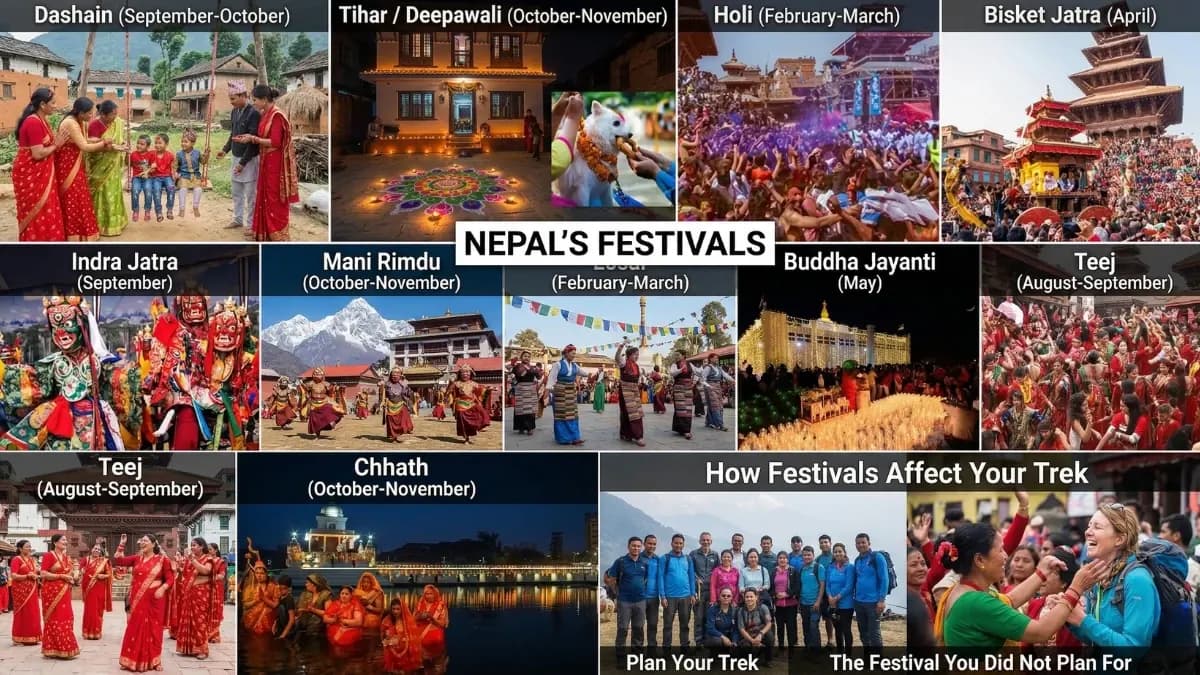
What is each festival, and what are the manners?
This table keeps the festival facts short and sourced, and the third column is how our guides behave. I do not give 2026 dates here, because they move with the lunar calendar; the dates and closures are in our Dashain 2026 and Tihar 2026 guides and in our festival calendar.
| Festival | About the festival | Manners (our guides' practice) |
|---|---|---|
| Dashain | The longest Hindu festival in Nepal, traditionally two weeks (15 days), honouring the goddess Durga; tika from elders; animal sacrifice at Hanuman Dhoka on the ninth day. | Ask before photographing a family tika or any sacrifice; expect Kathmandu to be quiet because many people travel home |
| Tihar | Five days honouring crows, dogs, cows and oxen, then brothers and sisters; Laxmi Puja is the evening of lamps; Deusi-Bhailo songs house to house | Do not step on or move lamps and offerings at doorways; carry a little cash for singing groups |
| Holi | Spring festival on the full moon of Phalguna, Phagu Purnima in Nepal's hills | Protect your camera; consent matters; politely say no if you want to stay clean |
| Bisket Jatra | Held on 14 April (13 April in leap years) in Bhaktapur and Thimi, follows the solar calendar; Bhairava's chariot, a tug of war between the upper and lower parts of town, a pole about 25 m tall | Stay clear of the chariot and the rope teams; it is crowded and physical |
| Indra Jatra | Eight days in September, a pine pole raised at Basantapur Square, the Kumari's chariot through Kathmandu, Lakhay masked dancers, Akash Bhairab's head displayed at Indra Chowk | No photographs of the Kumari herself; arrive early for the chariot day |
| Mani Rimdu | A 19-day festival at Tengboche, Chiwong and Thame in the tenth Tibetan month (October to November); thirteen acts of ceremony, dance and drama | Ask before photographing monks or dancers; check with the monastery which days are open to visitors |
| Losar | Tibetan New Year; in Nepal it is celebrated as Gyalpo Losar (Sherpa and Tibetan), Sonam Losar (Tamang and Hyolmo) and Tamu Losar (Gurung); khapse and chang are traditional | Walk clockwise, keep your voice low, and ask before photographing monks |
| Buddha Jayanti | Full moon of Vaisakha (April or May); lamps, flowers and incense, white clothing; Buddha was born at Lumbini | Our Swayambhunath and Boudhanath guides cover crowds; do not step over offerings |
| Teej | Hartalika Teej is in the month of Bhadrapada, three days; women wear red and green and visit Shiva temples, particularly Pashupatinath, which is crowded on Teej | Women at prayer are not scenery; ask before photographing, and keep out of the way of groups |
| Chhath | Three days; devotees wade into rivers and ponds at sunset and dawn, with lamps set afloat; worshippers are almost exclusively women, with most men watching; celebrated in the Terai, including Janakpur | Stay on the bank, keep a distance, and ask before photographing anyone in the water |
For the Gosaikunda pilgrimage on Janai Purnima, which is a festival in a very different setting, read our Gosaikunda guide. For the Bhaktapur festival setting, read our Bhaktapur guide.
Can you use a drone, flash or a long lens at a festival?
Drones. At Pashupatinath, PADT says drone photography requires prior written permission. Don't fly a drone near any temple, stupa or crowd, and ask the Civil Aviation Authority of Nepal and the site's managers first.
Flash. There is no published flash rule for any of the sites in the table that we know of. Our guides' practice is no flash in a shrine, a monastery or a ceremony, and to ask before you use it anywhere indoors.
Long lenses. A long lens lets you photograph a ceremony from a distance, which can be respectful at a funeral ghat or a festival crowd, but it can also feel like spying. If the people you are photographing can see you, the same rule applies: ask first. We know of no rule on lenses.
Will festivals disrupt your travel plans?
NTB says that around Dashain the population of Kathmandu is greatly reduced as many people head home to other parts of the country. In our experience that means crowded buses and flights before the main days, a quiet capital during them, and guides and porters who may want leave to be with their families. Tihar disrupts less. Our Dashain and Tihar guides have the 2026 dates, closures and what they mean for trekking, and I would use them rather than guess from this page.
On the trail, festivals are usually a welcome addition: teahouse owners cook more, villages are decorated and your guide may be invited to join a family. If you want a festival in your trip, the best plan is to tell us your month and let us tell you which festivals could fall in it. Dates move every year with the lunar calendar, so we check them against our live guides before we confirm.
How can The Everest Holiday help?
A good guide explains who is who, what is being offered and where you can stand, and that is most of the etiquette. Our private one-day UNESCO World Heritage Site tour includes an English-speaking guide and a private vehicle. On the Budget tier you pay entrance fees yourself; the Standard tier adds lunch, all heritage entrance fees and government taxes. Our 7-day Kathmandu and Pokhara tour includes Kathmandu's heritage sites on the way. Tell us if you want a particular festival or an evening ceremony in the plan. Kathmandu hotels are not included in any of our trek tiers, so we quote them separately.
Our trek-and-tour deposit is 10%, and it is non-refundable. If you need to change your dates, we offer free rescheduling with at least 72 hours' notice, to any date within one year. Prices are in US dollars, paid in cash or by card, and a card payment of the balance carries a 3.5% charge.
Related reading: Pashupatinath, Swayambhunath, Changu Narayan, the seven UNESCO zones, and first time in Kathmandu.
Sources
- Pashupati Area Development Trust, FAQ and visitor page: pashupati.gov.np/contact/ and pashupati.gov.np, read 4 October 2026.
- Nepal Tourism Board, heritage site entry fees: ntb.gov.np heritage-site-entry-fees, read 4 October 2026.
- Nepal Tourism Board, culture of Nepal: ntb.gov.np/en/plan-your-trip/about-nepal/culture, read 4 October 2026.
- Nepal Tourism Board festival pages: Dashain, Tihar, Indra Jatra and Chhat Parva, read 4 October 2026. I use their descriptions only, not the dates printed on those pages.
- Department of Archaeology, Nepal: doa.gov.np (lists the Ancient Monument Preservation Act 2013 and Rules 2046).
WhatsApp: +977 9810351300
Email: [email protected]
We have over 300 reviews on TripAdvisor, Google and Trustpilot. Every booking helps fund our Nagarjun Learning Center.
Written by Shreejan Simkhada, CEO of The Everest Holiday, from a family of three generations of family guides. TAAN Member #1586.
 Chat with Shreejan