Nepal trip from India — no visa needed, land border crossings, flights from Delhi/Mumbai, costs in INR, best treks for Indians. Complete budget guide.
9 Days
20
169 reviews
Annapurna Base Camp - 9 Days
Starts From
US$425

Nepal trip from India — no visa needed, land border crossings, flights from Delhi/Mumbai, costs in INR, best treks for Indians. Complete budget guide.
By Shreejan Simkhada | April 2026
I grew up in Kathmandu hearing Hindi songs on the radio, eating dal that tastes almost the same as what you'd eat in Varanasi, and celebrating festivals that India celebrates too. Nepal and India aren't just neighbours. We're family. And yet, many Indian travellers still think of Nepal as a distant international destination requiring complicated planning.
It's not. Nepal is the closest, cheapest, and easiest international trip you can take from India. No visa. No currency exchange hassles. No language barrier. You can leave Delhi in the morning and be eating momos in Kathmandu by evening. You can leave Gorakhpur by bus and cross into Nepal the same afternoon.
I'm Shreejan Simkhada, CEO of The Everest Holiday, a family-run trekking company in Kathmandu. My family has been in the Himalayan tourism business since the 1960s. We guide hundreds of Indian travellers every year, and I know exactly what you're looking for: affordability, good food, reliable service, and an adventure that doesn't require a fortune or a foreign visa.
This guide is everything you need. Costs in INR. Border crossings explained. Treks ranked for Indian beginners. No visa complications. Let's get into it.
Indian nationals do not need a visa to enter Nepal. This is the biggest advantage you have over every other nationality. While American, European, and Australian tourists queue at immigration and pay USD $30-100 for a visa, you walk through with an ID proof.
What you need at the border or airport:
That's it. No application forms. No photographs. No fees. No advance booking. You show your ID, they stamp you in, and you're in Nepal.
Important note: If you're flying into Kathmandu, airlines may ask for a passport at check-in even though Nepal doesn't require one from Indians. To avoid hassle at the airport counter, carry your passport. For land border crossings, a voter ID is sufficient and widely accepted.
For children: Carry a birth certificate along with a parent's ID. If travelling without both parents, carry a consent letter from the absent parent.
Multiple Indian cities have direct flights to Kathmandu's Tribhuvan International Airport. It's shorter than most domestic Indian flights.
| From | Flight Time | Approximate Cost (INR, Return) | Airlines |
|---|---|---|---|
| Delhi (DEL) | 1 hr 30 min | ₹8,000-15,000 | IndiGo, Air India, Nepal Airlines, Buddha Air |
| Mumbai (BOM) | 2 hr 45 min | ₹10,000-18,000 | IndiGo, Air India |
| Kolkata (CCU) | 1 hr 15 min | ₹6,000-12,000 | IndiGo, Nepal Airlines, Buddha Air |
| Bangalore (BLR) | 3 hr (usually via Delhi) | ₹12,000-20,000 | IndiGo, Air India |
| Varanasi (VNS) | 45 min | ₹5,000-10,000 | Buddha Air (seasonal) |
From Kolkata, it's barely longer than flying to Mumbai. From Delhi, it's the same as flying to Goa. Booking 3-4 weeks ahead on IndiGo usually gives the best fares. Budget carriers run regular sales where Delhi-Kathmandu drops below ₹4,000 one way.
Land border crossings are the budget option and genuinely the more adventurous way to enter Nepal. There are several crossing points, and each connects to a different part of India.
Sonauli/Belahiya (from Varanasi/Gorakhpur/Lucknow): The most popular crossing for North Indian travellers. Take a train or bus to Gorakhpur (or Varanasi), then a local bus to Sonauli border (about 3-4 hours from Gorakhpur). Cross to the Nepal side (Belahiya), then take a tourist bus to Kathmandu (8-9 hours) or Pokhara (6-7 hours via Lumbini). Total cost from Varanasi: approximately ₹800-1,500.
Raxaul/Birgunj (from Patna/Bihar): Best if you're coming from Bihar or eastern UP. Train to Raxaul, walk across the border to Birgunj, then bus to Kathmandu (6-7 hours). This route goes through Hetauda and the winding Tribhuvan Highway -- stunning scenery but the road is rough.
Kakarbhitta (from Siliguri/Darjeeling/Northeast India): Best for travellers from West Bengal, Sikkim, or the northeast. Bus or shared jeep from Siliguri to the Kakarbhitta border (1-2 hours), then cross and take a bus to Kathmandu (12-14 hours) or fly from Bhadrapur airport to Kathmandu (45 minutes, approximately ₹5,000-8,000).
Nepalgunj (from Lucknow/Western UP): Less commonly used by tourists, but useful if you're heading directly to western Nepal, Bardia National Park, or starting the Great Himalayan Trail from the west.
Honest warning about land borders: The crossings are chaotic. Not dangerous, just busy and confusing, especially at Sonauli. Touts will offer you taxis, buses, and "special deals." Ignore them. Walk through the border, find the government bus stand on the Nepal side, and buy a ticket there. If you're arriving late in the day, spend a night in Bhairahawa (the nearest Nepal town) and travel fresh in the morning. Night buses on mountain roads aren't worth the risk.
The Nepali rupee (NPR) is pegged to the Indian rupee at a fixed rate of NPR 1.6 = INR 1. This means ₹100 Indian = NPR 160.
Indian rupees are widely accepted in Nepal, especially in border towns, Kathmandu tourist areas, and Pokhara. However, there are some rules:
Notes of ₹100 and below are accepted everywhere. ₹10, ₹20, ₹50, ₹100 -- no problem.
₹200, ₹500, and ₹2,000 notes are NOT accepted in Nepal. This catches a lot of Indian travellers off guard. Nepali shopkeepers and banks won't take high-denomination Indian notes. Carry ₹100 notes if you want to use INR, or exchange at a bank for Nepali rupees.
ATMs in Nepal dispense Nepali rupees. Your Indian debit card (Visa/Mastercard) works at most ATMs in Kathmandu and Pokhara. Withdrawal limit is usually NPR 10,000-35,000 per transaction. ATM fees are NPR 500 (about ₹310) per withdrawal.
UPI does not work in Nepal. Google Pay, PhonePe, and Paytm won't work here. Carry cash or use your debit/credit card at larger shops and hotels.
| Item | Cost (INR) |
|---|---|
| Hotel in Kathmandu (budget) | ₹500-1,000/night |
| Hotel in Kathmandu (mid-range) | ₹1,500-3,000/night |
| Dal bhat at local restaurant | ₹100-180 |
| Meal at tourist restaurant | ₹300-700 |
| Plate of momos (8-10 pieces) | ₹80-150 |
| Cup of tea (chiya) | ₹15-30 |
| Bottle of water (1L) | ₹20-30 |
| Beer (650ml Everest/Gorkha) | ₹200-350 |
| Taxi in Kathmandu | ₹100-300 |
| Nepal SIM card with data | ₹200-400 |
| Poon Hill Trek (6 days, all-inclusive) | ₹37,000 (from $599) |
| ABC Trek (9 days, all-inclusive) | ₹55,000 (from $899) |
| EBC Trek (12 days, all-inclusive) | ₹70,000 (from $1,133) |
| Category | Budget (INR) | Mid-Range (INR) |
|---|---|---|
| Return flight (Delhi-KTM) | ₹8,000-12,000 | ₹12,000-15,000 |
| OR Land border (train+bus) | ₹1,500-3,000 | ₹3,000-5,000 |
| Trek (6-day Poon Hill) | ₹37,000 | ₹37,000 |
| Kathmandu hotel (3 nights) | ₹1,500-3,000 | ₹4,500-9,000 |
| Food in Kathmandu (3 days) | ₹600-1,200 | ₹1,500-3,000 |
| Local transport | ₹500-1,000 | ₹1,000-2,000 |
| SIM card, miscellaneous | ₹500-1,000 | ₹1,000-2,000 |
| Total (by air) | ₹48,100-58,200 | ₹57,000-68,000 |
| Total (by land) | ₹41,600-49,200 | ₹48,000-58,000 |
Under ₹50,000 for an international trekking holiday. Name another country where that's possible. You can't do Ladakh for that price with a guide and porter included.
Indian travellers often compare Nepal trekking with Ladakh, Himachal, or Uttarakhand. Here's an honest comparison.
No permits required for most treks. In India, treks in Ladakh, Sikkim, and parts of Himachal require Inner Line Permits, Protected Area Permits, or military clearances. In Nepal, your trekking permits are included in our package price. No bureaucratic queues, no photocopies, no waiting.
Better trail infrastructure. Nepal's popular trekking routes have established teahouse systems. You sleep indoors, eat hot meals, and drink tea at every stop. Many Indian Himalayan treks require camping, which means carrying tents, food, and cooking equipment -- or paying significantly more for a supported camping trek.
International experience, domestic comfort. Nepal feels familiar to Indian travellers. The food is similar (dal, rice, roti, vegetables, pickles). Hindi is widely understood in Kathmandu and tourist areas. The culture has deep connections to India. But it's still a different country with its own character, its own mountains, and its own magic. You get the thrill of international travel without the disorientation.
Higher mountains, better views. Eight of the world's fourteen 8,000-metre peaks are in Nepal. The views from even the easiest Nepali treks are on a different scale from anything in the Indian Himalayas. Standing at Annapurna Base Camp (4,130m) with 8,091-metre Annapurna I towering above you is a sight that no Indian trek can match. Not because India's mountains aren't beautiful, but because Nepal's are simply taller and closer.
If you've never trekked before, or your experience is limited to weekend hikes near hill stations, here's where to start.
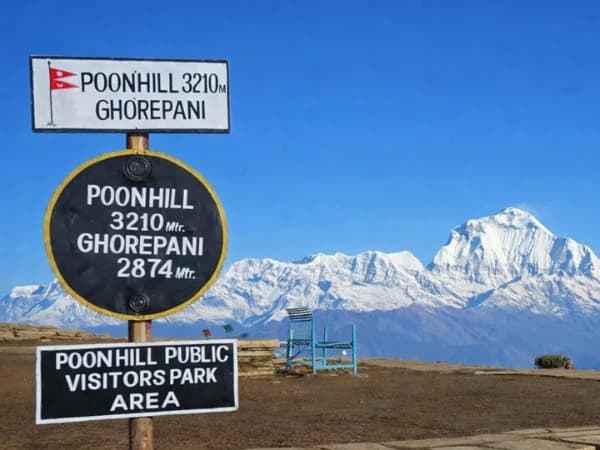
Our 6-Day Poon Hill Trek is the most popular trek for Indian first-timers. Maximum altitude 3,210 metres, well-maintained trail, comfortable teahouses, and a sunrise viewpoint that reveals the entire Annapurna and Dhaulagiri range. Walking 4-6 hours per day, manageable for anyone with basic fitness.
From: ₹37,000 (USD $599) all-inclusive
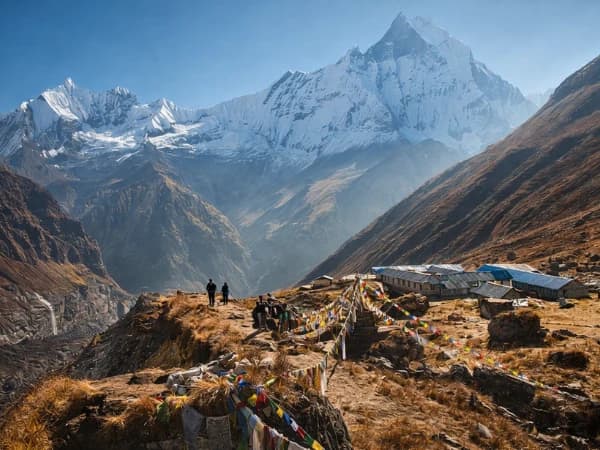
Our 9-Day ABC Trek is the next step up. You walk into a natural amphitheatre surrounded by Annapurna I, Machhapuchhre (Fishtail), Hiunchuli, and a ring of peaks over 7,000 metres. Maximum altitude 4,130 metres. The stone steps on the lower trail are hard on the knees, but the reward at the top is extraordinary.
From: ₹55,000 (USD $899) all-inclusive
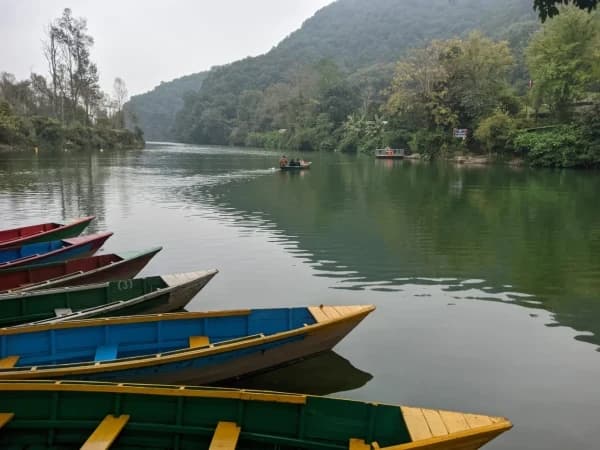
If you're not ready for a trek, our Kathmandu-Pokhara Tour gives you Nepal's two most iconic cities without any strenuous walking. Temples, lakes, mountain views, local food, and cultural experiences. Perfect for families with elderly parents or young children.
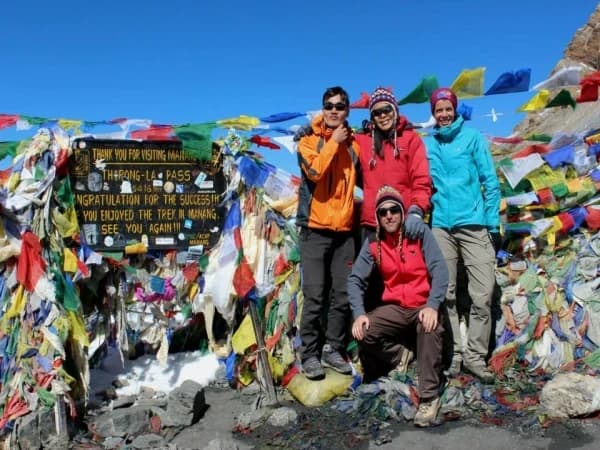
For more experienced trekkers, our Annapurna Circuit Trek is one of the world's great long-distance walks. You circle the entire Annapurna massif, crossing the Thorong La pass at 5,416 metres. The landscape changes from subtropical jungle to high-altitude desert. This is for trekkers who've already done multi-day hikes and want a serious Himalayan challenge.
From: ₹80,000 (USD $1,299) all-inclusive
This is the question I get most from Indian travellers: "Will I get Indian food?"
Yes. Easily. Nepali and Indian cuisines share deep roots. Dal bhat is the national dish of Nepal just as it's a staple across North India. You'll find dal, rice, roti, sabzi, achar (pickle), and curries everywhere. The flavours are slightly different -- Nepali food tends to use less oil and fewer spices than North Indian cooking -- but it's familiar and satisfying.
In Kathmandu and Pokhara, there are dozens of Indian restaurants serving everything from South Indian dosas to North Indian butter chicken. Thamel has multiple vegetarian-friendly restaurants. Pure vegetarian food is easy to find throughout Nepal.
On trek, teahouses serve dal bhat, noodle soup, fried rice, pasta, and sometimes eggs. Meat is available at lower altitudes but the variety decreases as you go higher. If you're vegetarian, you'll have no issues at all -- dal bhat is vegetarian by default, and it's the most nutritious meal available on the trail.
Jain travellers: Finding strictly Jain food (no onion, no garlic, no root vegetables) is harder in Nepal. It's possible in Kathmandu at Indian restaurants, but on trek it's very difficult. Talk to us before booking and we'll work out a plan with the teahouses along your route.
Muktinath temple, at 3,710 metres in the Mustang district, is one of the holiest Vaishnavite sites in the world. It's sacred to both Hindus and Buddhists. The temple contains a natural gas flame burning alongside a water spring -- fire and water together, which Hindus consider a miracle.
Thousands of Indian pilgrims visit Muktinath every year, most of them flying to Jomsom and driving or walking to the temple. But Muktinath is also on the Annapurna Circuit trek route, which means trekkers can visit one of the world's holiest sites as part of their Himalayan adventure. Few other treks in the world combine physical challenge with spiritual significance in this way.
If Muktinath is your primary goal, we can design a dedicated pilgrimage itinerary: fly to Jomsom, drive to Muktinath, spend a day at the temple, and trek back through the Kali Gandaki gorge. It's a 5-6 day trip.
Pashupatinath Temple in Kathmandu is Nepal's most important Hindu temple and a UNESCO World Heritage Site. For Indian travellers, it's deeply familiar -- a Shiva temple on the banks of a holy river (the Bagmati), with ghats, sadhus, and evening aarti. It feels like Varanasi's quieter cousin.
Entry to the main temple compound is free for Indians and Nepalis (foreign tourists from other countries pay NPR 1,000). The evening aarti at Pashupatinath is smaller than Varanasi's but more intimate and atmospheric. Come at 6pm, sit on the opposite bank of the Bagmati, and watch.
Most Indian travellers visit Pashupatinath on their first or last day in Kathmandu. Combine it with Boudhanath Stupa (20 minutes away), which is the largest stupa in Nepal and a centre of Tibetan Buddhism.
Nepal and India share many festivals, though they're often celebrated slightly differently.
Dashain (Dussehra): Nepal's biggest festival. Same roots as Indian Navratri/Dussehra but celebrated differently. Tika (vermillion and rice blessing) is central. If you're in Nepal during Dashain (October), you might be invited to receive tika from a Nepali family. Accept. It's a genuine honour.
Tihar (Diwali): Nepal's festival of lights, celebrated around the same time as Diwali. Dogs are worshipped on one day (Kukur Tihar) and given garlands. Crows and cows are honoured on other days. It's Diwali with Nepali character.
Holi: Celebrated with the same colour-throwing enthusiasm as in India, though Nepal uses the Bikram Sambat calendar so the date sometimes differs by a day.
Shivaratri: Thousands of Indian sadhus cross the border to celebrate Maha Shivaratri at Pashupatinath. It's one of the largest gatherings of sadhus outside India. If you time your trip for Shivaratri (usually February-March), the experience is extraordinary.
Indian SIM cards work in Nepal near the border areas (Sonauli, Raxaul, Kakarbhitta) on roaming, but the charges are high and the signal drops off quickly as you move into Nepal.
Better option: buy a Nepali SIM card. Available at Kathmandu airport and phone shops everywhere. Ncell is the most popular choice. A SIM with 10-20GB data costs NPR 500-800 (₹310-500). You'll need your passport or voter ID for registration. Coverage in Kathmandu and Pokhara is excellent. On trek, coverage exists on lower parts of popular routes but becomes patchy and disappears at higher altitudes.
WhatsApp and Instagram work normally on Nepali data. Video calling works in Kathmandu and Pokhara.
Many Indian travellers skip travel insurance for Nepal trips. Don't. A helicopter evacuation from the trekking regions costs ₹3-5 lakh. Hospital treatment for altitude sickness or injury can cost ₹50,000-2,00,000. Without insurance, you're paying this from your pocket.
Indian insurance companies offering Nepal trekking cover include Bajaj Allianz, ICICI Lombard, and HDFC ERGO. Check that your policy specifically covers: trekking above 3,000 metres, helicopter evacuation, and medical treatment in Nepal. Many standard travel policies exclude adventure activities -- read the fine print.
Budget approximately ₹1,000-3,000 for a 2-week policy with adequate trekking cover. It's the cheapest part of your trip and the most important if something goes wrong.
Check out our Plan Your Trip page for a complete overview of options, seasons, and costs. We book with just a 10% deposit, so you can lock in your dates without paying the full amount upfront.
As a neighbour, family, and fellow Hindi speaker, I understand what Indian travellers want: value for money, good food, reliable service, and an honest experience without hidden charges. That's exactly what we provide.
Nepal is waiting. It's closer than you think, cheaper than you'd expect, and more beautiful than you can imagine.
Got questions? I answer every message personally.
WhatsApp: +977 9810351300
Email: info@theeverestholiday.com
Shreejan Simkhada is the CEO of The Everest Holiday and a third-generation Himalayan guide. TAAN Member #1586.