
Kathmandu's Thamel district at eight in the evening is a sensory storm. Neon signs for trekking agencies stacked three high on every building. Touts calling from doorways, "Everest trek, best price, you come look." Music leaking from rooftop bars. The smell of momos frying somewhere close. And in the middle of it, a traveller with a backpack and a dream, trying to figure out which of the three thousand registered trekking companies, and the unknown number of unregistered ones, is going to give them the thrill of a lifetime rather than the worst financial decision of their trip.
Most trekking companies in Nepal are honest. Most guides are professional. Most treks go exactly as planned. But the exceptions exist, and they prey specifically on first-time visitors who do not know the difference between a legitimate operator and a shopfront with a printer and a convincing smile.
This is not a paranoia guide. It is a practical one, written by someone who runs a trekking company and who has spent years watching competitors behave in ways that damage the entire industry.
Are cheap Thamel walk-in trek deals a scam?
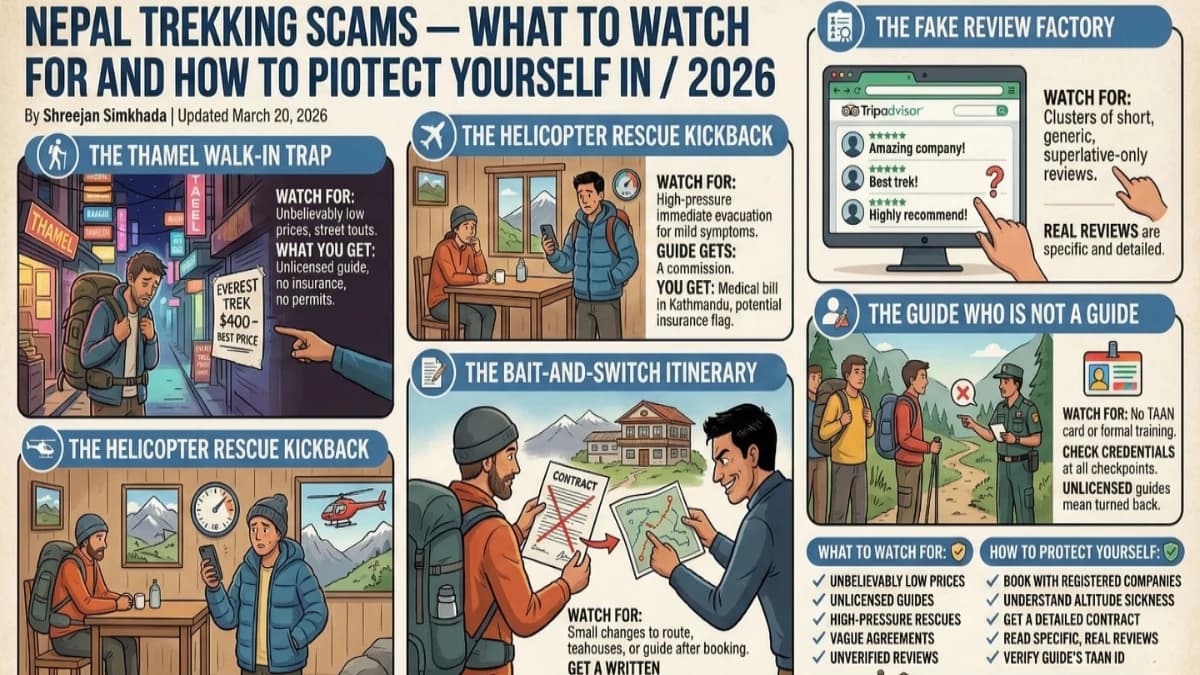
The most common scam is also the most straightforward. A tout approaches you on the street or in your hotel lobby. They offer an EBC trek for four hundred dollars, roughly half what established companies charge. The price sounds incredible. You are tired from your flight. You want the decision made. You pay.
What you get for four hundred dollars: an unlicensed guide who may or may not know the trail. A porter who is paid so little that they abandon the trek on Day 3. Basic permits that may not pass all checkpoints. No insurance for the guide, which means no evacuation support if something goes wrong. Teahouses booked on the spot rather than in advance, which in peak season means sleeping in the dining room.
The four-hundred-dollar trek is not a bargain. It is a different product entirely from a properly organised, fully licensed expedition. The trail is the same trail. But the infrastructure surrounding you, the safety net that you do not see working until the moment you need it, is either there or it is not.
Why do some Nepal guides fake helicopter rescues?
This is the scam that damages Nepal's reputation most severely. A guide or teahouse owner tells a trekker with mild altitude symptoms that they need immediate helicopter evacuation. The trekker, frightened and disoriented at high altitude, agrees. The helicopter arrives. The trekker is flown to Kathmandu. The insurance company is billed three to six thousand dollars. The guide or referring party receives a commission, sometimes five hundred dollars, sometimes more.
The trekker arrives at the hospital and is told they had a headache that would have resolved with an extra rest day and more water. Their insurance company flags the claim. Future premiums for Nepal trekking insurance rise. Some insurers withdraw from Nepal entirely.
How to protect yourself: book with a company that pays guides proper salaries, not commissions. Understand altitude sickness symptoms before you leave home. If a guide suggests evacuation, ask questions, what specifically is wrong, have we tried descending on foot, is this genuinely urgent. A legitimate emergency will be obvious. A manufactured one will not survive questioning.
Can a Nepal trek itinerary be downgraded after booking?
You book a twelve-day EBC trek with a specific itinerary, specific teahouses, and specific inclusions. You arrive in Kathmandu and the company tells you there has been a "small change." The route is slightly different. The teahouses are "similar quality." A few inclusions have been removed. The guide you were promised is "unavailable" and has been replaced by someone with less experience.
This is not always a scam, genuine changes due to weather, trail conditions, or staffing do occur. But when the changes consistently downgrade the experience while maintaining the price, it is bait-and-switch. The trek you paid for is not the trek you receive.
Protection: get a written, detailed contract before paying any deposit. The contract should specify the itinerary day by day, the teahouses by name where possible, the inclusions and exclusions, the guide's name and qualifications, and the circumstances under which changes may be made. If the company refuses to provide a written contract, that is your answer about whether to book with them.
The "Everything Included" That Excludes Everything
A company advertises "all-inclusive" at an attractive price. You arrive to discover that "all-inclusive" means accommodation and a guide. Meals are extra, three to five dollars per meal, three meals a day, twelve days. That is over a hundred dollars not included in the "all-inclusive" price. Permits are extra. Transport to the trailhead is extra. The sleeping bag and down jacket you were told would be provided are available for an additional rental fee.
By the time you add the extras, the "cheapest" company is the same price as the more expensive one that genuinely included everything from the start, except now you have already paid your deposit and committed your dates.
Protection: ask specifically what "included" means. Request a written list of every item covered by the price and every item that costs extra. Compare the total cost, not the headline price, across multiple companies. The company with the higher headline price and no extras is often cheaper than the company with the lower headline price and a list of supplements.
How can I spot fake Nepal trekking company reviews?
Some companies generate fake reviews on TripAdvisor and Google. The signs are recognisable once you know what to look for: a cluster of short, vague, superlative-heavy reviews posted within a few days of each other. "Amazing company! Best trek ever! Highly recommend!" from accounts that have one review and no profile photo. Different names, same writing style, same grammatical patterns.
Genuine reviews are longer, more specific, and mention details, guide names, specific trail situations, particular teahouses, weather events, that only someone who was actually there would know. They appear over months and years, not in clusters. And they occasionally include mild criticism, because no real experience is perfect.
Protection: read reviews carefully. Sort by date. Look for specificity. Check reviewer profiles, do they have other reviews of other businesses in other countries? A reviewer who has reviewed restaurants in London, a hotel in Bangkok, and a trekking company in Nepal is almost certainly a real person. A reviewer who has reviewed one trekking company and nothing else may or may not be.
How do I verify a Nepal trekking guide is licensed?
A licensed guide is required in most trekking areas under the Nepal Tourism Board rule from April 2023 (the Everest (Khumbu) region does not enforce it locally, but we always trek with a licensed guide), so any guide you use should come from a TAAN-registered company. This created a market for unlicensed individuals posing as certified guides. They carry no TAAN identification, have no formal training, and have no connection to any registered company, but they charge the same rates as legitimate guides and promise the same experience.
The consequences are practical, not theoretical. In many areas, checkpoints can verify your "guide's" credentials. If they fail verification, your trek may be over. The money you paid is gone. And you are standing at a checkpoint with a person who lied to you about their qualifications.
Protection: ask for the guide's TAAN ID number before departure. Ask for the company's TAAN membership number and government registration number. Verify both on the TAAN website. If either cannot be provided or verified, do not proceed.
How Do You Recognise a Legitimate Nepal Trekking Company?
They have a physical office in Kathmandu, not just a website. They provide TAAN and government registration numbers without hesitation. They have reviews on multiple independent platforms spanning multiple years. They respond to enquiries with specific, detailed, personalised answers, not copy-paste templates. They provide written contracts with clear inclusions and exclusions. They name your guide and provide their qualifications before you arrive. And they do not pressure you to book immediately with artificial urgency.
Nepal's trekking industry is overwhelmingly honest. The families who run the best companies have been doing this for decades, their reputation is their livelihood, and they protect it fiercely. The scams exist at the margins, operated by people who care about this season's profit rather than next decade's reputation.
Knowing the difference is not difficult. It requires asking questions, reading carefully, and trusting the instinct that tells you when something feels wrong. In a country as welcoming as Nepal, the vast majority of interactions are genuine. The few that are not become obvious the moment you start looking closely.
We are a government-registered company (Reg: 147653, TAAN #1586) with over 300 reviews on TripAdvisor, Google and Trustpilot. Browse our treks or contact us directly to plan your trip safely.
Most trekking scams in Nepal have one thing in common: the trekker chose the cheapest operator they could find. Cheap means underpaid guides who supplement with helicopter commissions. Cheap means no insurance when something goes wrong. Cheap means a "guide" who is actually an unlicensed porter pretending to be a guide. The scams are real. The way to avoid them is simple: book with a licensed, TAAN-registered company and verify the registration number before you pay.
Our TAAN registration is #1586. You can verify it on the TAAN website. We are happy to answer any questions about how we operate.
WhatsApp:+977 9810351300
Email:[email protected]
Written by Shreejan Simkhada, CEO of The Everest Holiday and third-generation Himalayan guide. TAAN Member #1586.
Avoid trekking scams: book direct, no broker. Our Everest Base Camp Trek (12 Days) is private (your group only, no strangers), 2026 dates open, From USD $1399. WhatsApp us for tailored 2026 dates and current departures.
 Chat with Shreejan