
In the courtyard of a small monastery above Tengboche, a trekker reaches out and spins a prayer wheel. Clockwise. The monk nearby smiles. The trekker feels welcomed, warmed, culturally connected.
At the next monastery, a different trekker reaches out and spins a prayer wheel. Counterclockwise. The monk's face changes. Not anger, something closer to sadness. The trekker does not notice. They walk on, uploading a photograph of themselves spinning the wheel, captioned "connecting with local culture."
Prayer wheels spin clockwise. Always clockwise. The direction follows the path of the sun and the flow of sacred text inscribed inside. Spinning one backwards is not a minor faux pas. In the belief system of the people whose country you are visiting, it reverses the prayers. It undoes the accumulated spiritual merit of everyone who spun it correctly before you.
Nobody tells you this in the airport. Nobody mentions it in the trekking brochure. But knowing it, and the dozen other cultural courtesies that make the difference between a tourist who is tolerated and a traveller who is welcomed, transforms your experience of Nepal from surface to substance.
How do you greet people in Nepal?
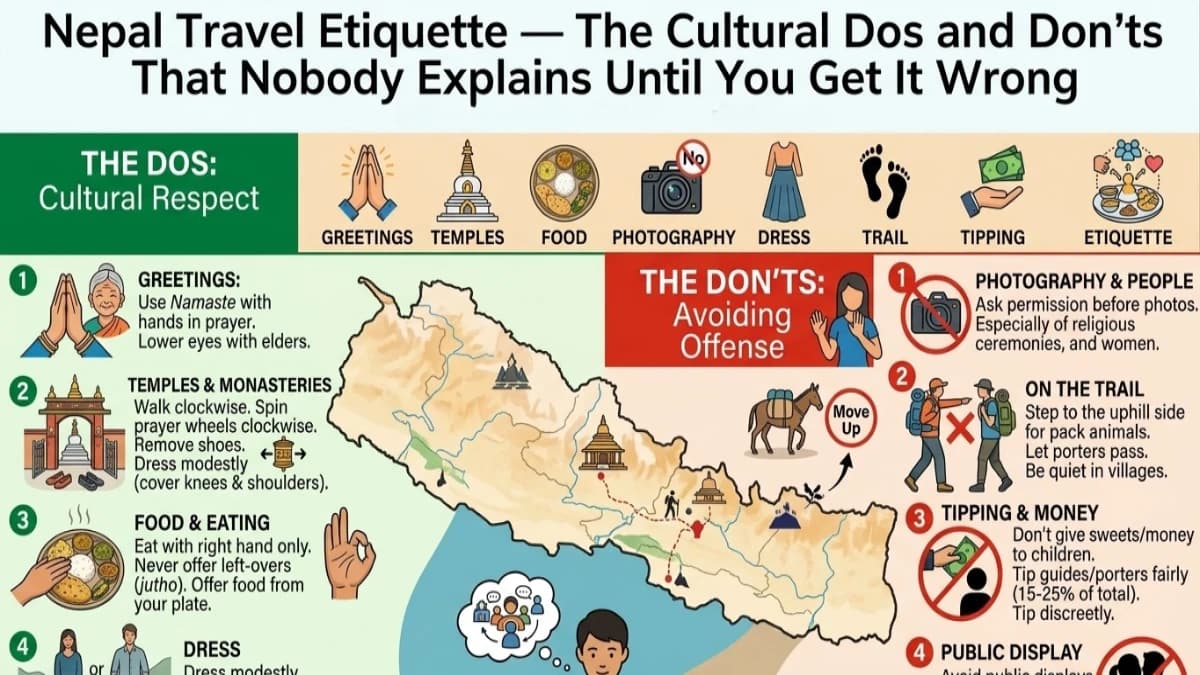
Namaste. Palms together, slight bow, eye contact. It means "the divine in me recognises the divine in you", though in practise it functions like "hello" and is used as casually. Say it to everyone. Teahouse owners. Children on the trail. Your guide every morning. Strangers you pass on the path. The response is always warm. Nepali people light up when a foreigner greets them in their language, even with just one word.
Handshakes are common in business settings and with younger urban Nepalis. In rural mountain communities, the villages you walk through on every trek, namaste with palms together is more appropriate than extending a hand, particularly with elders and women.
What are the rules for visiting Nepal temples and monasteries?
Remove your shoes before entering any temple, monastery, or home. This is non-negotiable. The threshold is a boundary between sacred and mundane space. Your boots carried you across the trail. They do not enter the place where people pray.
Walk clockwise around stupas, mani walls, and prayer wheels. Always clockwise, keeping the sacred object on your right side. This applies to Buddhist sites throughout Nepal and is the single most commonly violated cultural rule by foreign trekkers who do not know it.
Ask before photographing inside monasteries. Some allow it. Some do not. Some allow photographs without flash. Your guide will know the specific rules for each site. When in doubt, lower the camera and ask.
At Hindu temples, non-Hindus are often restricted from entering the inner sanctum. Respect the boundary. The exterior courtyards and architecture are usually open to all visitors and are often more visually impressive than the interior anyway.
What are the eating and dining etiquette rules in Nepal?
Use your right hand for eating and for giving and receiving items. The left hand is considered impure in both Hindu and Buddhist Nepali culture. If you are left-handed, make an effort to use your right hand for social interactions even if you eat with your left, the gesture is noticed and appreciated.
Do not touch other people's food or water bottles with your mouth. "Jutho", the concept of ritual contamination through saliva, is deeply embedded in Nepali dining culture. Do not drink directly from a shared water bottle. Pour the water into your mouth without touching the rim. Do not taste food from a communal pot. These rules relax in tourist-oriented teahouses where staff are accustomed to foreign habits, but observing them shows respect.
Accept food and drink offered by hosts with both hands or with your right hand. When a teahouse owner or a village family offers you tea, and they will, frequently, and with genuine generosity, receive the cup with both hands and a slight nod. The gesture of receiving with both hands signals gratitude and respect.
Do you need permission to photograph people in Nepal?
Always ask before photographing a person. Always. Monks in monasteries, children in villages, women at water taps, elderly people on benches. A gesture toward your camera with a questioning expression is universally understood. Most people will smile and pose. Some will decline. Respect the decline immediately and without argument.
Never photograph a funeral or cremation ceremony without explicit permission. At Pashupatinath, photography of the cremation ghats from the far bank of the river is generally accepted. Close-up photographs of grieving families are not. The line between respectful observation and intrusive documentation is thin. When unsure, lower the camera.
Photographing military installations, police checkpoints, and certain government buildings is prohibited. Your guide will tell you if you are near one.
What should you wear when trekking in Nepal?
Nepal is conservative. Not restrictively so, in Kathmandu and Pokhara, casual Western clothing is fine. But in rural mountain communities, where traditional values are stronger, modest dress shows respect.
Shoulders and knees should be covered when visiting temples, monasteries, and traditional villages. On the trekking trail, standard trekking clothes, long trousers, T-shirt or long sleeve, are appropriate and sufficient. Shorts are acceptable on the trail between villages but less appropriate when walking through settlements.
At teahouses, whatever trekking clothes you are wearing is fine. Nobody expects you to dress up for dinner at four thousand metres.
What is the trail etiquette for trekking in Nepal?
Let pack animals pass. Mules, yaks, and donkeys carry supplies along the same trails you walk. They are heavy, they move slowly, and they do not stop. When you hear bells behind you, pack animals wear bells to warn of their approach, step to the uphill side of the trail and let them pass on the downhill side. This prevents you from being knocked off a narrow path by an animal carrying eighty kilograms.
Greet everyone you pass. A namaste or a smile to every person on the trail, trekker, porter, villager, costs nothing and creates warmth. Nepal's trails are shared spaces. The courtesy of acknowledgment makes them friendlier for everyone.
Do not give sweets, money, or pens to children along the trail. This well-intentioned habit creates begging behaviour, teaches children to approach strangers for gifts, and undermines the efforts of communities and schools to educate children about self-sufficiency. If you want to help, donate to the village school through your trekking company.
How much should you tip guides and porters in Nepal?
Tipping is expected for guides and porters at the end of your trek. It is not expected at restaurants, though rounding up or leaving ten percent is appreciated at tourist-oriented places. It is not expected at teahouses along the trail, you pay the menu price and that is sufficient.
Bargaining is normal in markets and non-fixed-price shops. It is not appropriate in restaurants, teahouses, or any establishment with printed prices. The first price in a Thamel shop is negotiable. The dal bhat price on a teahouse menu is not.
How should you treat porters and teahouse staff in Nepal?
The rules above are practical. The deeper etiquette is attitudinal. Nepal is not a theme park designed for your entertainment. It is a country where real people live real lives in conditions that most trekkers cannot fully comprehend from inside a Gore-Tex jacket. The teahouse owner who cooks your dinner at five thousand metres earns in a month what you spent on your flight. The porter who carries your bag walks the same trail you do with five times the weight and a fraction of the gear.
See them. Thank them. Learn their names. Ask about their families. Listen when they speak. The etiquette that matters most in Nepal is not about which hand to use or which direction to spin a wheel. It is about recognising that the people who make your trek possible are not servants or scenery. They are the reason you are here, and the least you owe them is the respect of paying attention.
Learn more about Nepali customs on any of our treks and tours. Our guides explain local culture as you walk.
Nepal etiquette is simple once you know it. Eat with your right hand. Remove shoes before entering homes. Do not point your feet at people or religious objects. Walk clockwise around stupas and mani walls. Say "namaste" with your hands together. Accept tea when offered. These small gestures earn genuine respect and warmer interactions than any amount of money.
Our guides brief every guest on cultural etiquette before the trek begins. It makes the whole experience richer.
WhatsApp:+977 9810351300
Email:[email protected]
Written by Shreejan Simkhada, CEO of The Everest Holiday and third-generation Himalayan guide. TAAN Member #1586.
Nepal travel etiquette: covered in our pre-trek briefing. Our Everest Base Camp Trek (12 Days) is private (your group only, no strangers), 2026 dates open, From USD $1399. WhatsApp us for tailored 2026 dates and current departures.

 Chat with Shreejan