

Mera Peak (6,476m) is the highest trekking peak in Nepal and the most popular first 6,000-metre summit. The good news: you do not need mountaineering experience. The bad news: you do need to be genuinely fit. An eight-week training plan bridges the gap between regular hiking fitness and the specific demands of a fourteen-day expedition at extreme altitude.
What Does Mera Peak Actually Require?
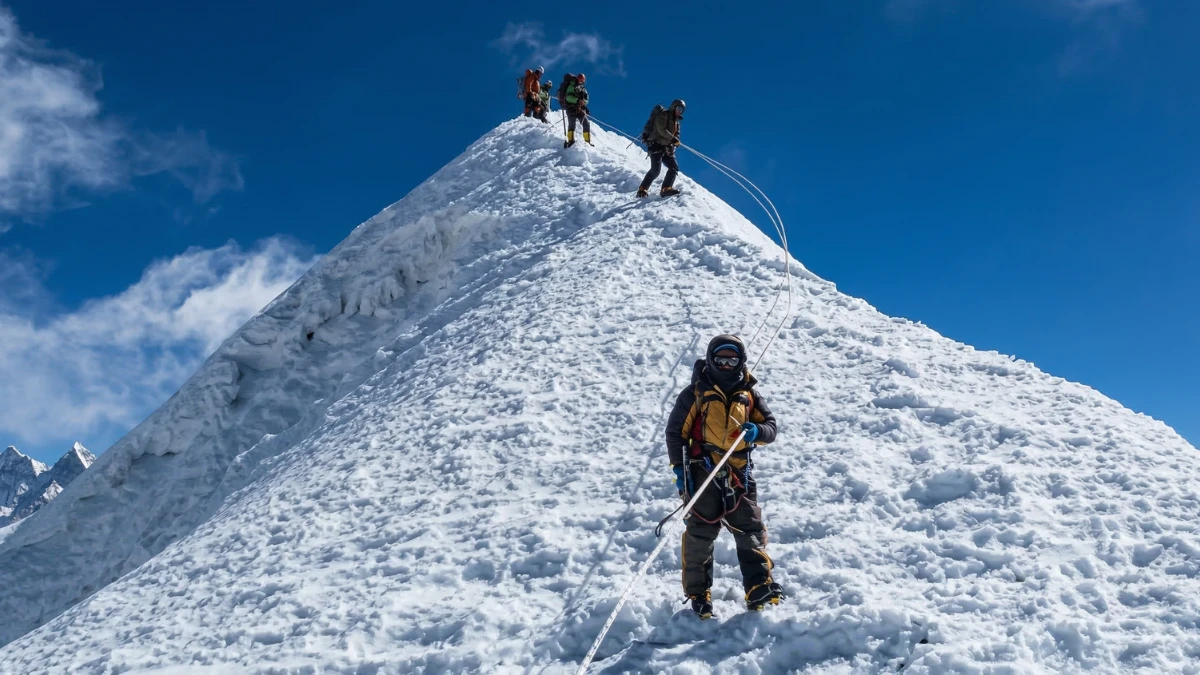
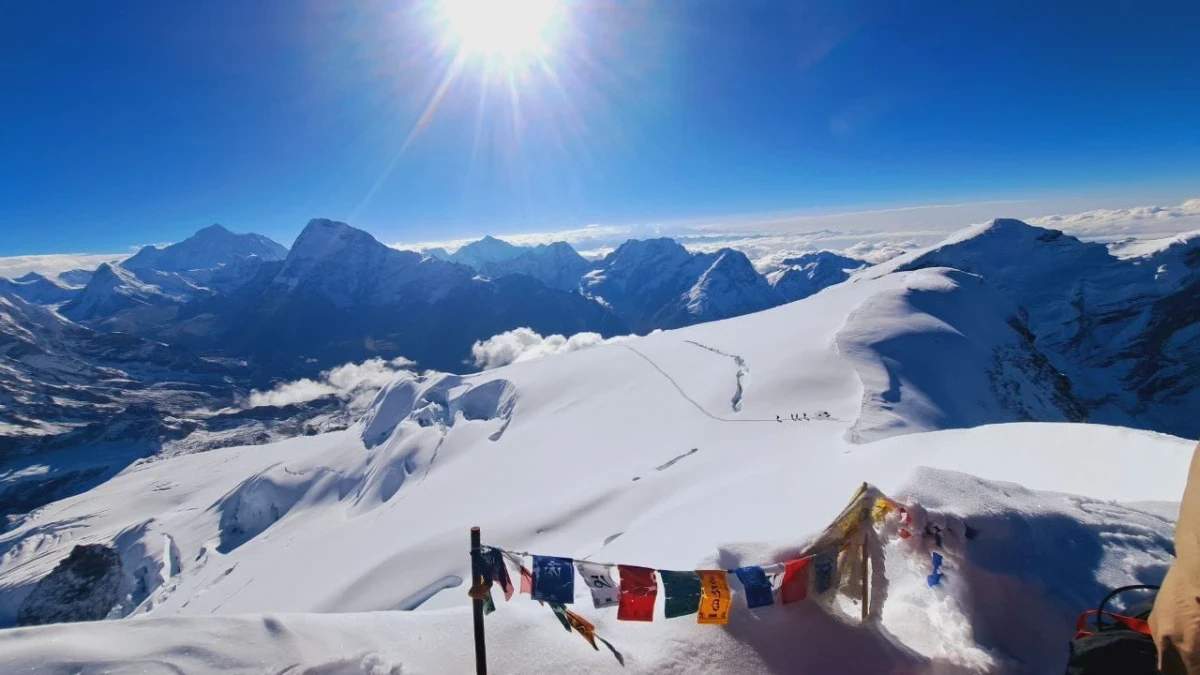
The Mera Peak climb is fourteen days from Lukla. The first eight days are trekking through the Hinku Valley to high camp (5,800m). The summit day is a six to eight-hour climb on a moderate snow slope using crampons, an ice axe, and a fixed rope. Then you walk back.
The physical demands:
- Cardiovascular endurance: You need to walk five to seven hours per day for eight consecutive days at increasing altitude, then climb 600 metres at extreme altitude on summit day.
- Leg strength: The Hinku Valley approach involves steep terrain with a heavy pack (6 to 8 kg daypack above high camp).
- Core stability: Cramponing on a 30-degree snow slope requires balance and core engagement.
- Mental endurance: Summit day starts at 1:00 or 2:00 in the morning. You walk in darkness, in extreme cold, at 60 percent of sea-level oxygen. Every step above 6,000 metres is a conscious effort.
Week 1-2: Build the Base
Goal: Establish a walking routine and assess your current fitness.
Monday/Wednesday/Friday: Walk 8 to 10 km on flat to moderate terrain. Pace: conversation-comfortable. This is about building the habit, not pushing limits.
Tuesday/Thursday: Strength training (45 minutes). Focus on legs and core:
- Squats: 3 sets of 15
- Lunges: 3 sets of 12 per leg
- Step-ups (on a bench or stairs): 3 sets of 15 per leg
- Planks: 3 sets of 45 seconds
- Dead bugs: 3 sets of 10 per side
Saturday: Long walk of 12 to 15 km on hilly terrain. This is your weekly endurance builder.
Sunday: Rest or light stretching.
Week 3-4: Add Weight and Hills
Goal: Introduce a weighted daypack and increase elevation gain.
Change: Add a 5 kg daypack to all walks. Find the steepest hill or longest staircase in your area and make it your training ground. Walk up and down repeatedly for 30 to 45 minutes on hill days.
Monday/Wednesday/Friday: 10 to 12 km with 5 kg pack, including at least 300 metres of elevation gain per session.
Tuesday/Thursday: Strength training. Add:
- Romanian deadlifts: 3 sets of 12 (builds hamstrings for steep descents)
- Calf raises: 3 sets of 20 (essential for cramponing)
- Side planks: 3 sets of 30 seconds per side
Saturday: Long walk of 15 to 18 km with pack, hilly terrain. Target 500+ metres elevation gain.
Week 5-6: Simulate Trek Conditions
Goal: Build multi-day endurance and increase pack weight.
Change: Increase pack to 7 kg. Walk on consecutive days (Saturday + Sunday) to simulate the fatigue of multi-day trekking.
Monday/Wednesday/Friday: 12 to 14 km with 7 kg pack, hilly terrain.
Tuesday/Thursday: Strength training. Add:
- Single-leg squats (pistol squats or Bulgarian split squats): 3 sets of 8 per leg
- Farmer carries: 3 sets of 40 metres with heavy weights
Saturday: 18 to 20 km with pack, 600+ metres elevation gain.
Sunday: 12 to 15 km with pack (tired legs are the point).
Week 7-8: Peak and Taper
Week 7, peak week: Your hardest training week. Three walks of 14+ km with pack, one long walk of 22+ km on the weekend, strength training twice. This week should leave you tired. That is the point: you are teaching your body to perform when fatigued.
Week 8, taper: Reduce volume by 40 percent. Walk three times, 8 to 10 km each. One easy strength session. Rest. Sleep well. Pack your bags. Your body is building fitness from the recovery, not the exercise. Arrive in Nepal fresh, not exhausted.
What About Altitude Training?
Unless you live above 2,000 metres, you cannot effectively train for altitude at home. Altitude tents and masks provide marginal benefit for the cost. The good news: the Mera Peak itinerary includes eight days of trekking through the Hinku Valley, which provides progressive altitude exposure. By the time you reach high camp (5,800m), you have spent a week acclimatising.
What you CAN train for: the ability to exercise at high heart rates for extended periods. Hill repeats, stair climbing, and sustained cardio at 70 to 80 percent of your maximum heart rate simulate the cardiovascular stress of walking at altitude. If you can sustain a brisk uphill pace for sixty minutes without stopping, your cardiovascular system will cope with 5,800 metres.
How Do You Know If You Are Ready?
At the end of Week 7, do this test: walk 20 kilometres on hilly terrain with a 7 kg pack, including at least 600 metres of elevation gain. If you finish tired but functional, able to eat dinner, sleep and walk again the next morning, you are ready for Mera Peak.
If you finish destroyed, unable to walk the next day, with knee pain, blisters or complete exhaustion, you need more training time. Add two to four weeks and repeat the test.
What Climbing Skills Do You Need?
None before arrival. Your guide teaches crampon technique and basic rope skills at high camp (5,800m) the day before the summit attempt. The summit slope is a moderate snow field, not a vertical ice wall. You walk up it with crampons, using an ice axe for balance, clipped to a fixed rope. The technique is taught in thirty minutes and practised on a gentle slope before the real climb.
Our Standard and Luxury packages include all climbing gear: crampons, ice axe, harness, helmet, and climbing boots. You do not need to buy any technical equipment.
Common Training Mistakes
Training too hard, too late. Starting an aggressive programme two weeks before departure causes injuries and fatigue. Eight weeks is the minimum. Twelve weeks is better if you are starting from a low fitness base.
Running instead of walking. Running builds cardiovascular fitness but not the specific muscle endurance that trekking demands. Walking uphill with a pack for four hours uses different muscles and energy systems than running for sixty minutes. Train by walking.
Ignoring descents. The descent from Mera high camp to Khare is steep and hard on the knees. Train for downhill by walking down hills and stairs with a pack. Your quadriceps need eccentric strength, the ability to control your weight while your muscles lengthen, which uphill training alone does not build.
Skipping rest days. Fitness improves during recovery, not during exercise. Two rest days per week is not laziness. It is how your body consolidates the training stimulus. Overtrained legs on summit day is worse than undertrained legs.
See the full itinerary and pricing on our Mera Peak Climbing (14 Days) page.
WhatsApp:+977 9810351300
Email:[email protected]
Written by Shreejan Simkhada, CEO of The Everest Holiday and third-generation Himalayan guide. TAAN Member #1586.
8-week Mera Peak training plan: pair with our 2027 dates. Our Mera Peak Climbing (14 Days) is private (your group only, no strangers), 2027 dates open, From USD $3499. WhatsApp us for tailored 2027 dates and current departures.
 Chat with Shreejan