

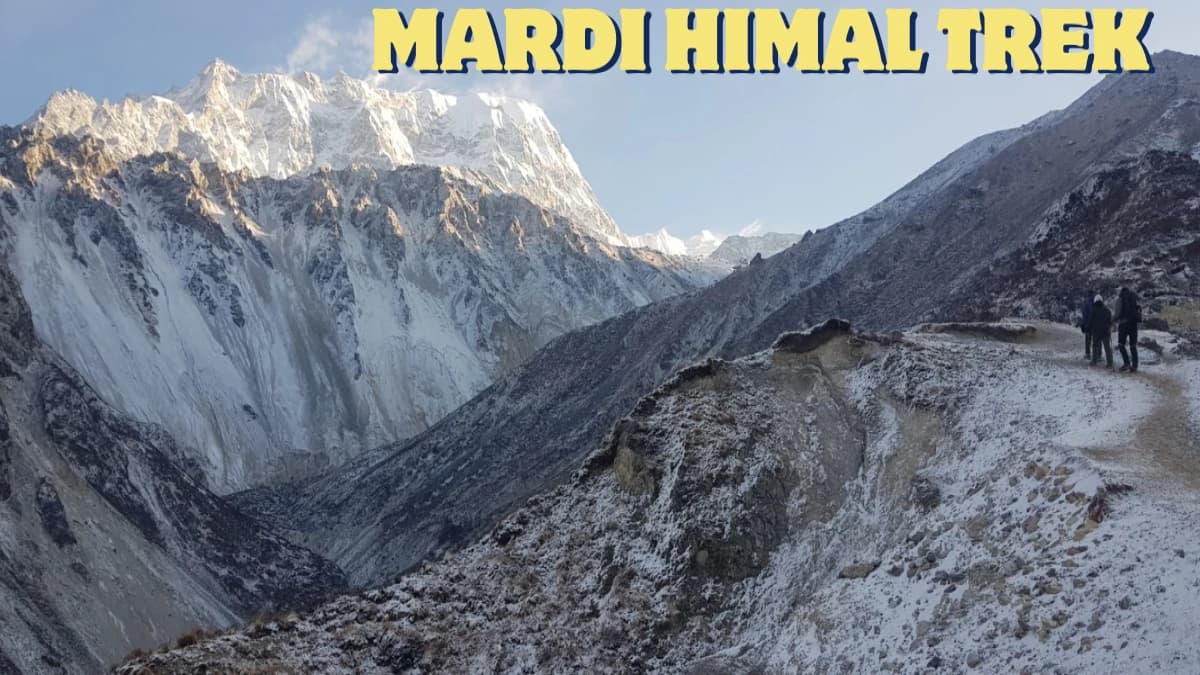
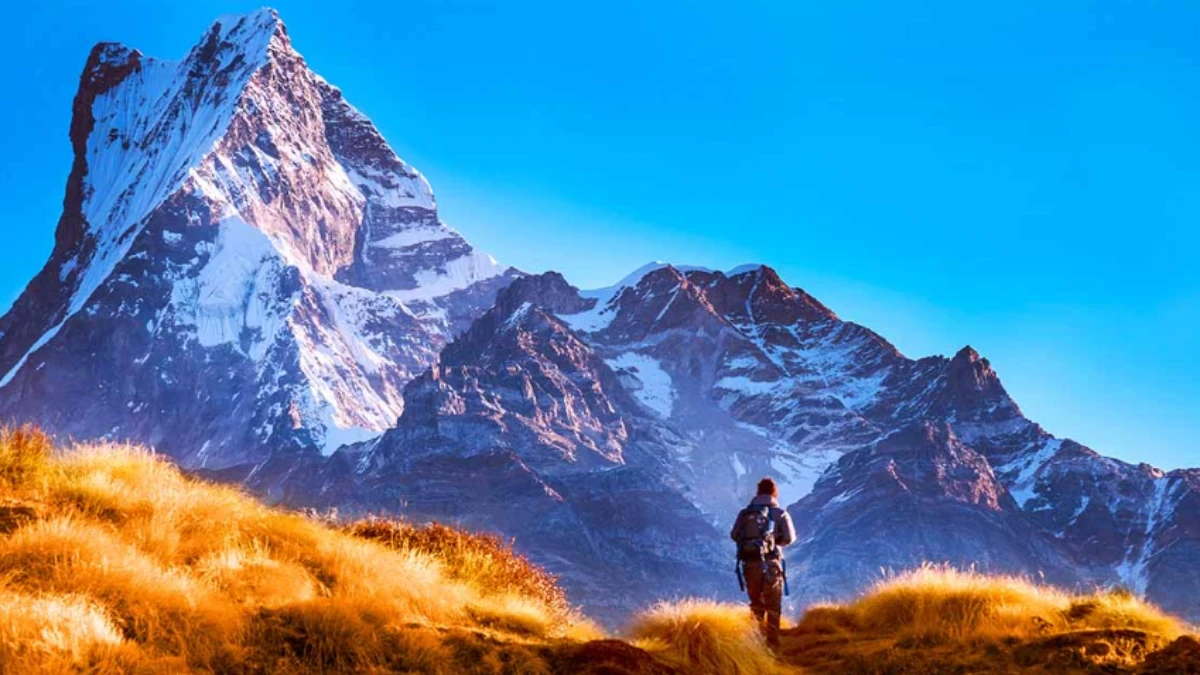
Machhapuchhre does not allow climbers. The sacred Fishtail mountain, 6,993 metres of ice-fluted granite rising above the Annapurna range like a blade, has been closed to mountaineering since 1964, when the Nepalese government declared it too holy to summit. The only expedition that ever came close, a British team in 1957, turned back fifty metres from the top out of respect for the local Gurung community's belief that the gods live there.
You cannot climb Machhapuchhre. But you can walk to its feet. And the trail that takes you there (the Mardi Himal trek, seven days through forest and ridgeline up to Mardi Himal Base Camp at 4,500 metres, where the mountain's north face fills your entire field of vision) is the trek that Nepal's trekking industry has been quietly trying to keep to itself.
Not literally. Nobody is hiding Mardi Himal. But while fifty thousand trekkers walk to Everest Base Camp and thirty thousand walk to Annapurna Base Camp each year, Mardi Himal receives a fraction of those numbers. The trail is not in most guidebooks. The teahouses are small. The infrastructure is developing rather than developed. And the experience: a ridge walk above the clouds with Machhapuchhre so close it fills the sky, is one of the finest in Nepal.
Why is the Mardi Himal trek different from other Nepal treks?
Most Nepal treks follow valleys. You walk along rivers, through gorges, up between walls of mountain that tower above on either side. The landscape is magnificent but the perspective is always the same, you are at the bottom, looking up.
Mardi Himal follows a ridge. From the second day onwards, you walk along the spine of a mountain, with valleys dropping away on both sides and the peaks of the Annapurna range spreading before you in a panorama that changes with every step. The perspective is not bottom-up but level, you are among the mountains, not beneath them. On clear mornings, when cloud fills the valleys below and the peaks rise above like islands in a white ocean, the feeling is closer to flying than walking.
How many days is Mardi Himal and what does it cost?
Seven days. Maximum altitude 4,500 metres at Mardi Himal Base Camp. Budget from USD 454. No internal flights, the trek starts from Pokhara, reached by road or short flight from Kathmandu. Permits: ACAP and TIMS. Difficulty three out of five, moderate, suitable for fit first-timers. Related: Annapurna Base Camp Trek: The Mountain Amphitheatre That Changes How You See the World.
What is the Mardi Himal trek day-by-day itinerary?
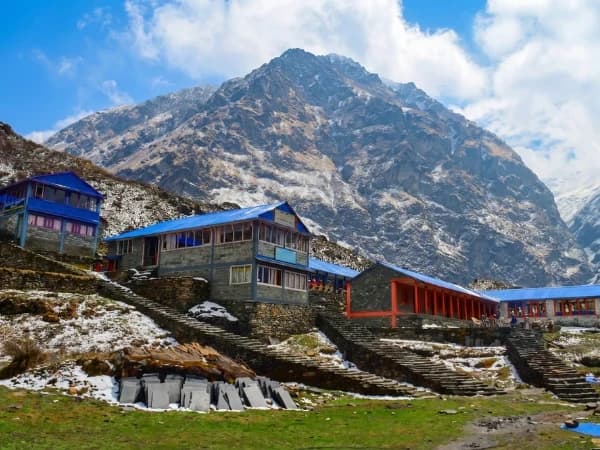
The first day drives from Pokhara to Kande and walks through forest to Australian Camp, a ridge at 2,060 metres that earned its name from a group of Australian trekkers who liked the view so much they stayed for a week. The view justifies the name. Machhapuchhre and Annapurna South dominate the northern horizon. The sunset turns them pink and gold and impossible.
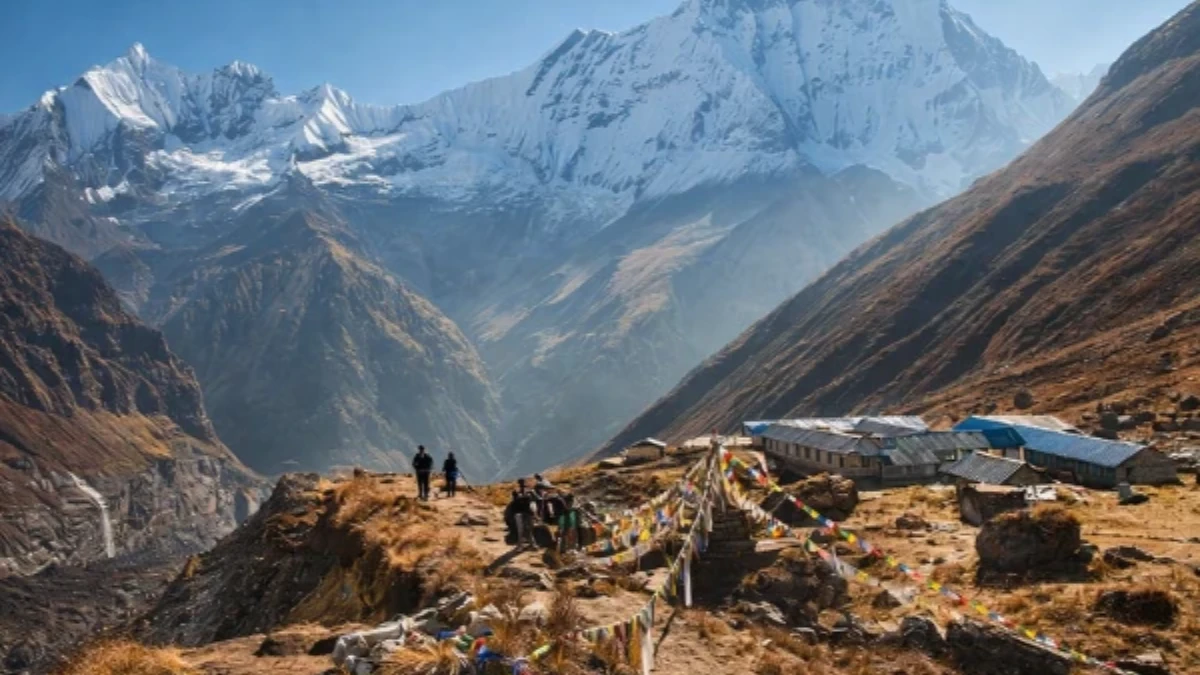
The second and third days climb through rhododendron forest, ancient trees draped in moss, their branches thick enough to walk along, their flowers, in spring, blooming in waves of crimson that make the forest floor look like it is on fire. The trail is steep in places, muddy after rain, and quiet. Birdsong replaces the sound of other trekkers. Red pandas live in this forest. You will not see them. But you will see their territory and understand why they chose it.
Above the tree line, the landscape opens. The ridge narrows. The views expand until they encompass the entire Annapurna range, Annapurna I, Annapurna South, Hiunchuli, and Machhapuchhre, each one closer than the last as you walk north along the ridge toward the high camp.
Mardi Himal High Camp at 3,580 metres is a handful of basic shelters perched on the ridge with Machhapuchhre's north face directly ahead, so close that the ice seracs are visible, so large that your neck aches from looking up. The sunrise here, light creeping down the ice wall as the sky shifts from black to indigo to gold, is among the finest views in the Annapurna region.
The descent retraces the ridge, drops into the forest, and returns to Pokhara by road. Seven days. Simple logistics. No flights. No permits beyond the standard ACAP and TIMS.
Is the Mardi Himal trek suitable for beginners?
First-time trekkers who want something more adventurous than Poon Hill but less extreme than Everest Base Camp. The altitude, 4,500 metres, is high enough to feel the thin air but low enough that serious altitude sickness is uncommon.
Trekkers who dislike crowds. Mardi Himal's limited teahouse infrastructure keeps numbers naturally low. On most days in shoulder season, you will encounter only a handful of other groups. The silence is genuine.
Photographers. The ridge walk with Machhapuchhre filling the frame is a composition that rewards every focal length from ultra-wide to telephoto. The morning cloud inversions, valleys filled with white while peaks rise above, produce images that professional landscape photographers travel thousands of miles to capture.
Trekkers with seven days. Mardi Himal fits neatly into a week, making it combinable with a few days in Pokhara or Kathmandu. It is the optimal trek for people whose schedules do not allow the twelve days of EBC or the twelve days of the Annapurna Circuit.
And anyone, genuinely anyone, who wants to see Machhapuchhre from a distance so close that the mountain stops being a view and starts being a presence. Something that occupies not just your eyes but your peripheral vision, your sense of scale, and the quiet part of your mind that understands when it is in the company of something extraordinary.
Is Mardi Himal trek better than Annapurna Base Camp?
Both treks are in the Annapurna region. Both reach similar altitudes. Both offer views of Machhapuchhre. But the experiences are fundamentally different.
ABC walks into a bowl, the sanctuary, surrounded by peaks on all sides. The approach is through a valley, following a river, enclosed by forest. The payoff comes at the end when the valley opens into the amphitheatre. The journey is linear. The destination is the reward.
Mardi walks along a ridge, exposed, open, with views from the second day onwards. There is no single payoff moment because the entire trek is the payoff. Every step on the ridge reveals a slightly different angle on the same mountains. The journey is the reward.
If you want the dramatic reveal, the moment when the sanctuary opens before you, choose ABC. If you want sustained, evolving beauty from start to finish, a trek where the view never stops, choose Mardi. If you have time for both, do Mardi first and ABC second. The contrast will make both better.
See the full itinerary on our Mardi Himal Base Camp Trek (7 days) page.
Mardi Himal is the trek Nepal does not want you to know about. Seven days, low cost, nobody on the trail, better Machhapuchhre views than ABC.
WhatsApp:+977 9810351300
Email:[email protected]
Written by Shreejan Simkhada, CEO of The Everest Holiday and third-generation Himalayan guide. TAAN Member #1586.
The two places that define the route each have their own guide: Mardi High Camp (3,580 m), where you sleep on the ridge, and Mardi Himal Base Camp (4,500 m) at the top.
Mardi Himal: the trek the industry undersells. Our Mardi Himal Base Camp Trek (7 Days) is private (your group only, no strangers), 2026 dates open, From USD $454. WhatsApp us for tailored 2026 dates and current departures.

 Chat with Shreejan