

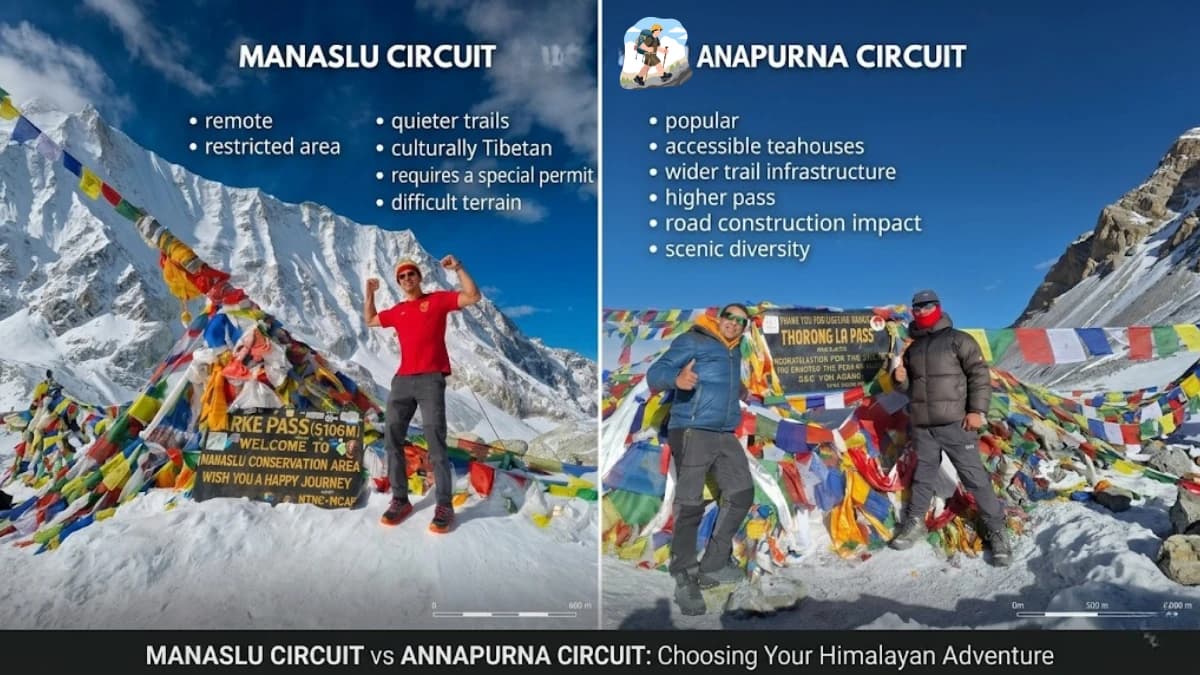
The Annapurna Circuit built Nepal's reputation as the world's greatest trekking destination. For three decades (from the late 1970s to the early 2010s) it was the trek. Two hundred kilometres around the Annapurna massif, through every ecological zone the Himalaya contains, over the Thorong La pass at 5,416 metres, and down through the deepest gorge on earth. Guidebooks called it the best long-distance walk in the world. They were not wrong.
Current status, September 2026: the Manaslu Circuit is temporarily closed after a September flood damaged bridges near Namrung, while the Annapurna Circuit is open and running normally. Please check our up-to-date trail status before you book either one.
Then the road came. Starting in the early 2000s, road construction along the Annapurna Circuit's eastern approach from Besisahar began converting trail into road, village by village, kilometre by kilometre. By 2015, a jeep could drive from Besisahar to Manang, eliminating the lower sections of the trek or, for trekkers who still walked them, adding dust, traffic, and the sound of engines to a trail that had been defined by silence and footsteps.
The Manaslu Circuit, meanwhile, was waiting. Opened to foreign trekkers in 1991 but restricted by permit costs and minimum group requirements, Manaslu remained quiet while the Annapurna Circuit grew crowded and then began to shrink. Today, the Manaslu Circuit is what many experienced trekkers call the trek that the Annapurna Circuit used to be: a complete circumnavigation of a major Himalayan peak, through remote valleys, over a high pass, with teahouse accommodation and cultural diversity, and without the roads.
What is the Annapurna Circuit trek like now?
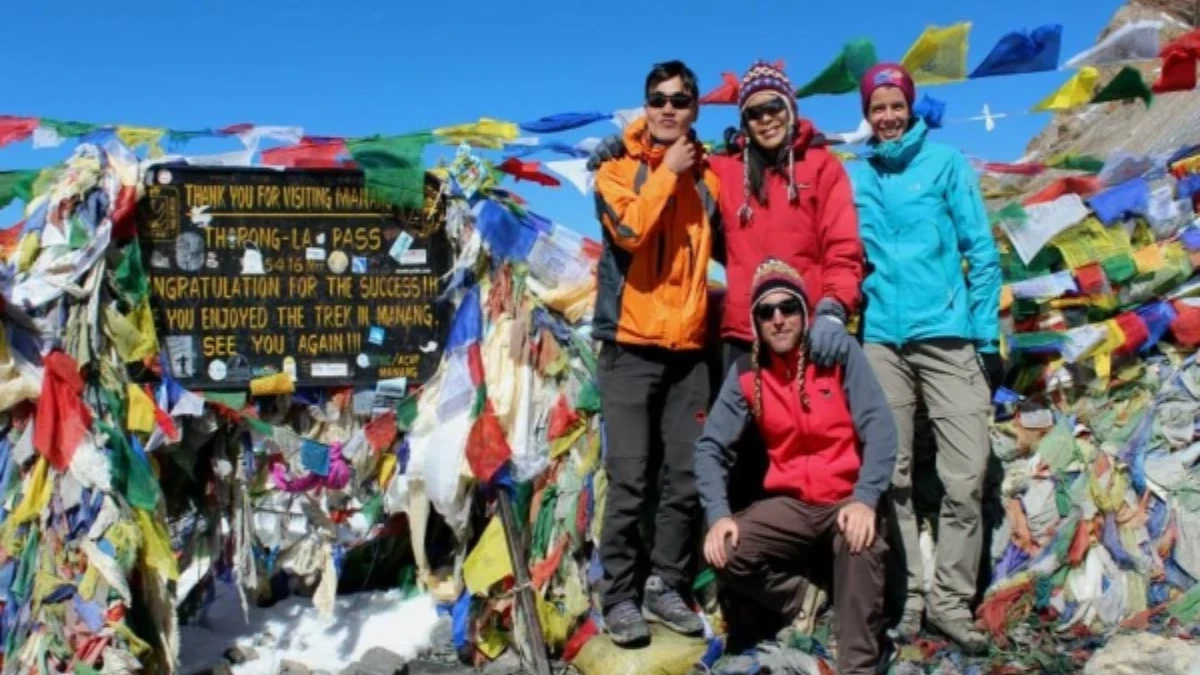
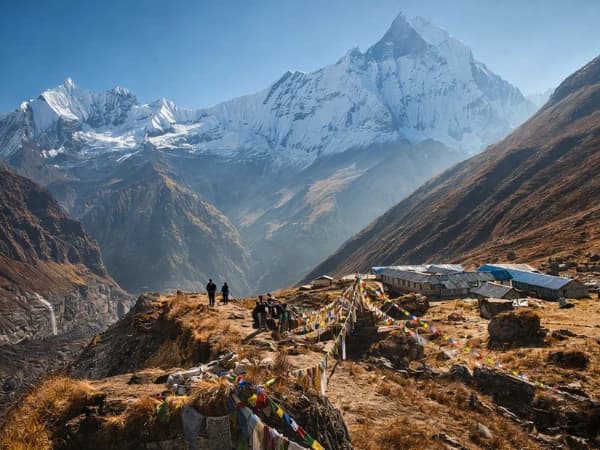
The Annapurna Circuit remains a serious trek. The upper sections, from Manang through Thorong La to Muktinath and down through the Kali Gandaki, are unchanged. The landscape above 3,000 metres is as dramatic as it ever was. Thorong La at 5,416 metres is still the highest pass on any major trekking route in Nepal. The transition from the lush eastern approach to the desert west is still one of the great ecological journeys on foot.
What has changed is the lower eastern section. The road from Besisahar to Chame (and increasingly beyond) means that the first five to seven days of the classic Circuit, the subtropical forests, the river gorges, the gradual climb from lowland to highland, are now walked alongside or on a road. Many trekkers skip this section entirely, taking a jeep to Chame or even Manang and walking only the upper Circuit. This reduces the trek from eighteen to twenty-one days to twelve to fourteen, but it also removes the gradual approach that gave the Circuit its distinctive character.
The sections below the road are still walkable, the old trail exists in many places alongside or above the road, but the trip is fundamentally different from walking a trail where the only sounds are footsteps, birdsong, and river water. Dust from passing vehicles, the noise of engines in narrow valleys, and the visual intrusion of road infrastructure change the character of the approach.
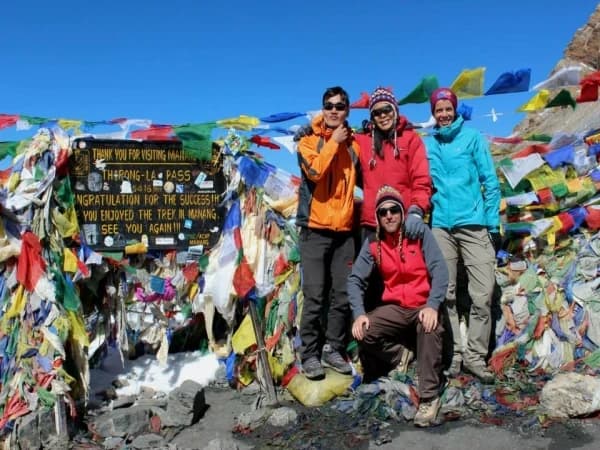
Above Manang, the Circuit is largely unchanged. The trail to Thorong La does not have a road and is unlikely to get one, the terrain above 4,000 metres is too extreme. The experience of crossing Thorong La, the pre-dawn start, the endless scree, the prayer flags at the pass, the descent to Muktinath, remains one of the great single days in Himalayan trekking.
Is the Manaslu Circuit still remote and uncrowded?
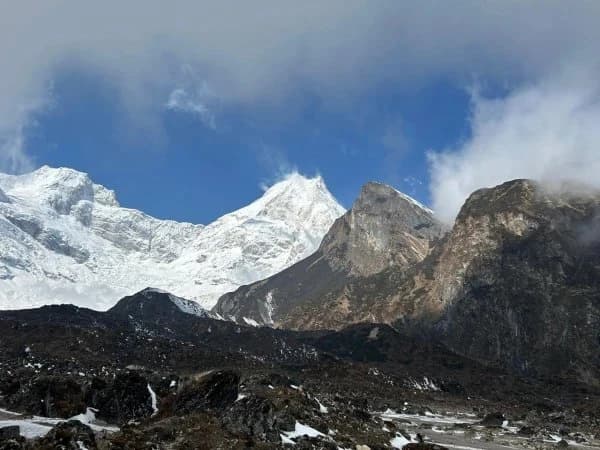
The Manaslu Circuit is a 177-kilometre trek around Manaslu, the world's eighth highest mountain at 8,163 metres. The route follows the Budhi Gandaki valley north from Soti Khola, through increasingly remote territory, over the Larkya La pass at 5,160 metres, and south through the Marsyangdi valley to Dharapani, where it joins the Annapurna Circuit route.
The restricted area permit, one hundred dollars per person per week in peak season, seventy-five dollars in other months, and the requirement for a licensed guide have kept visitor numbers low. The minimum group of two was scrapped on 22 March 2026. The Manaslu Circuit receives approximately six to eight thousand trekkers per year, compared to the Annapurna Circuit's thirty thousand or more. The result is a trail that feels genuinely remote, quieter teahouses, fewer trekkers on the path, and a relationship with the landscape that the Annapurna Circuit's busier sections cannot offer.
The trail has no road. The Budhi Gandaki valley is too narrow and too steep for road construction in the upper sections. Below Jagat, a road exists and is slowly extending, but above Jagat, the trail is walking-only and will remain so for the foreseeable future. This is the Manaslu Circuit's greatest asset, a guarantee of trail purity that the Annapurna Circuit can no longer make.
Which is harder, Thorong La or Larkya La pass?
Thorong La (5,416m): Higher, longer, and more demanding. The approach from Thorong High Camp or Thorong Phedi is a sustained climb through scree and snow, starting in the dark at three or four in the morning. The pass itself is a broad, windswept saddle with prayer flags. The descent to Muktinath is steep and long. Total summit day: ten to fourteen hours. The altitude, over 5,400 metres, is seriously demanding. Acute mountain sickness is common. The day is the most physically challenging on any standard Nepal trek.
Larkya La (5,160m): Lower by 256 metres, a significant difference at extreme altitude. The approach is from Dharamsala (Larkya Base Camp, 4,460m), and the climb to the pass is steep but shorter than Thorong La's approach. The pass provides spectacular views of Manaslu's north face and the Himalchuli range. The descent is steeper than Thorong La's western side and includes sections of loose rock that require careful footing. Total summit day: eight to twelve hours. The lower altitude makes Larkya La more manageable for trekkers concerned about extreme altitude.
The difference matters. For trekkers who found Thorong La's 5,416 metres on their limit, or who are concerned about pushing above 5,000 metres, Larkya La's 5,160 metres offers a high pass experience with a slightly wider safety margin. Both passes are serious. Both require proper acclimatisation. But Larkya La's lower altitude translates to measurably more available oxygen at the critical point.
Which has better scenery, Manaslu or Annapurna Circuit?
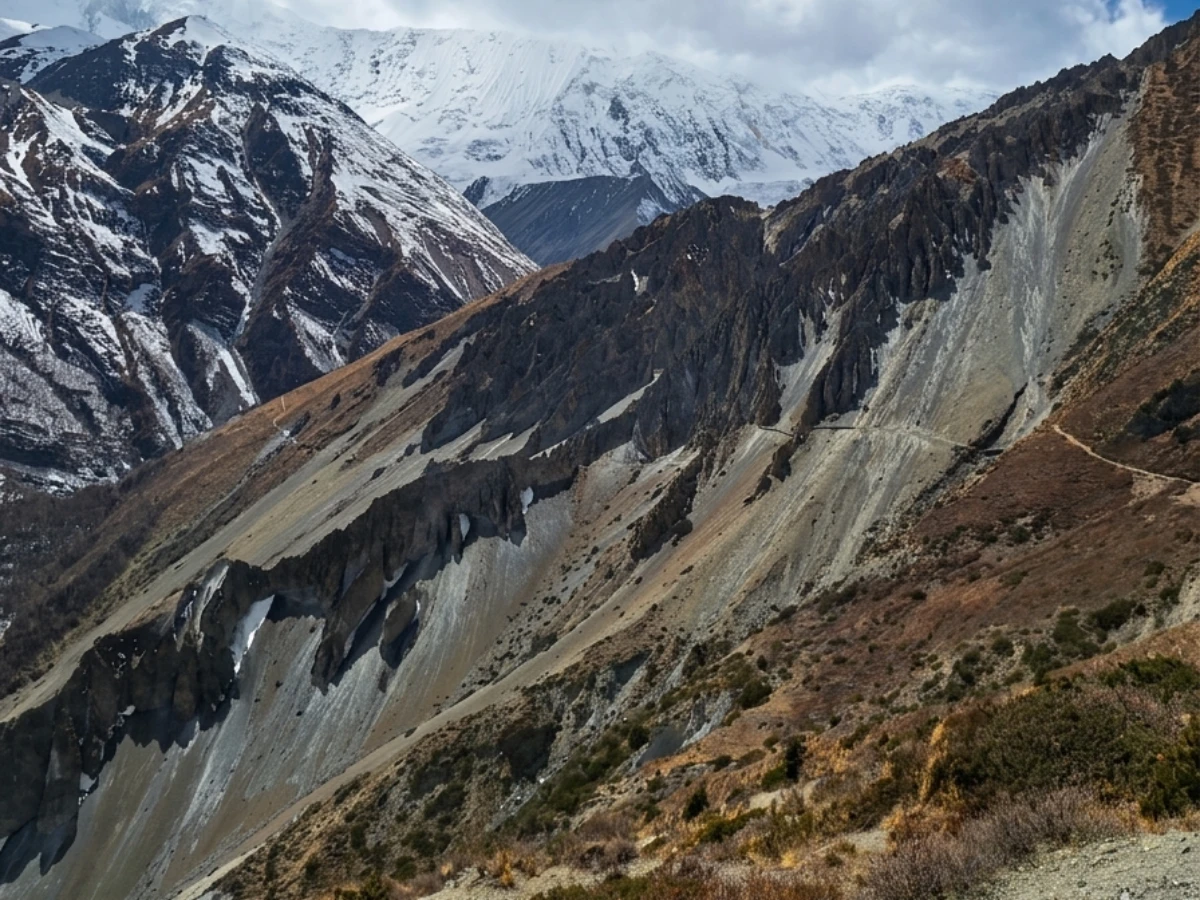
The Annapurna Circuit's scenery is defined by variety. The eastern approach passes through rice paddies, subtropical forest, temperate forest, alpine meadow, and high-altitude desert, more ecological zones in a single trek than most countries contain. The western descent through the Kali Gandaki offers the deepest gorge on earth, apple orchards, and the trans-Himalayan landscape of lower Mustang. The Circuit's scenery changes daily, often dramatically.
The Manaslu Circuit's scenery is wilder and more consistently mountainous. The Budhi Gandaki valley is narrower and steeper than the Marsyangdi. The gorge sections, particularly between Jagat and Deng, are dramatic in a vertigo-inducing way that the Annapurna Circuit's wider valleys do not replicate. Above Samagaon, the landscape opens into a broad glacial valley with Manaslu's massive north face dominating the view, one of the most imposing mountain walls in the Himalaya.
The Annapurna Circuit has more variety. The Manaslu Circuit has more wildness. If you want a cinematic tour of every Himalayan landscape, the Annapurna Circuit delivers. If you want sustained immersion in high mountain terrain that feels untouched by tourism infrastructure, the Manaslu Circuit delivers. Related: Annapurna Circuit vs Annapurna Base Camp: Two Treks That Share a Name and Almost Nothing Else.
Which trek has more authentic Tibetan culture, Manaslu or Annapurna?
Both circuits pass through culturally diverse communities, but the character differs.
The Annapurna Circuit crosses through Gurung, Manangi, Thakali, and Mustangi communities, a cultural transect from Hindu-influenced lowlands to Buddhist-influenced highlands. The villages are well-established trekking stops with developed infrastructure (bakeries, gear shops, restaurants with diverse menus). The cultural immersion is rich but has been shaped by decades of tourism.
The Manaslu Circuit passes through Gurung, Tibetan, and Nubri communities. The upper Budhi Gandaki valley, particularly Samagaon and Samdo, is culturally Tibetan, with monasteries, prayer flags, and a way of life that is less influenced by tourism than the Annapurna Circuit's equivalent communities. The teahouses are simpler. The menus are more limited. The interactions with local people feel more spontaneous and less transactional.
The Nubri and Tsum valleys (the latter accessible as a side trip from the Manaslu Circuit) are among the most culturally intact Tibetan-heritage communities in Nepal, places where the monasteries are active centres of worship rather than tourist attractions, and where the arrival of a trekking group is still an event rather than a routine.
Duration and Difficulty
Annapurna Circuit: Twelve to twenty-one days depending on starting point. The full classic walk from Besisahar takes eighteen to twenty-one days. The abbreviated version (jeep to Chame or Manang) takes twelve to fourteen days. Difficulty: moderate to challenging, with Thorong La day being the crux.
Manaslu Circuit: Twelve to sixteen days, and our own Manaslu Circuit package runs twelve days. There is no shortcut, the trail must be walked from the beginning. The consistent duration is both a limitation (you need two and a half to three weeks) and an advantage (the gradual approach ensures excellent acclimatisation). Difficulty: challenging, similar to the Annapurna Circuit overall, with Larkya La day slightly less demanding than Thorong La but the trail sections below the pass more rugged and demanding than the Annapurna Circuit's equivalent. Related: The Annapurna Circuit After the Roads: What Changed, What Remains, and Why It Still Matters.
How much does Manaslu vs Annapurna Circuit cost?
Part of the cost difference is the permits. The Annapurna Circuit's ACAP entry fee is set by the Nepal Tourism Board, and Manaslu's restricted-area permit by the Department of Immigration; our full trek-by-trek breakdown is in our guide to Nepal trekking permits.
The Manaslu Circuit is more expensive than the Annapurna Circuit for two reasons: the restricted area permit (one hundred dollars per week in peak season, versus the Annapurna Circuit's ACAP permit at NPR 3,000 for foreign nationals and NPR 1,000 for SAARC nationals, roughly twenty and seven US dollars) and the slightly longer average duration. With us, a budget Manaslu Circuit starts from around eight hundred dollars per person and a budget Annapurna Circuit from around seven hundred and twenty dollars, and on both the price per person falls as your group grows.
The restricted area permit no longer requires a minimum group of two, that rule having been scrapped on 22 March 2026, so a solo trekker can now be permitted with a guide and a registered agency. This is a practical consideration for solo travellers who may find the Annapurna Circuit's flexibility (no minimum group size) more convenient.
Which is less crowded, Manaslu or Annapurna Circuit?
This is the decisive difference for many trekkers. The Annapurna Circuit, even with the road reducing some sections, receives thirty thousand or more trekkers per year. The Manaslu Circuit receives six to eight thousand. During peak season (October), the busiest sections of the Annapurna Circuit (Thorong La approach, the trail above Manang) feel crowded. The busiest sections of the Manaslu Circuit feel like a gentle stream of trekkers.
The difference in atmosphere is palpable. On the Annapurna Circuit, you are aware of being on a popular route, other trekkers at every teahouse, competition for rooms in peak season, a social atmosphere that some enjoy and others find intrusive. On the Manaslu Circuit, you may walk for hours between encountering other trekking groups. The teahouses have space. The trail has silence. The mountains have your attention undivided.
Which should I choose, Manaslu or Annapurna Circuit?
Choose the Annapurna Circuit if: you want maximum ecological variety, you are comfortable with some road sections on the lower approach (or plan to jeep past them), you have twelve to fourteen days (abbreviated) or eighteen to twenty-one days (full), you want well-developed tourist infrastructure with diverse menus and comfortable teahouses, or you are trekking solo without a partner for the restricted area permit.
Choose the Manaslu Circuit if: you want a quieter, wilder trek with no road sections, you have fourteen to eighteen days, you value cultural authenticity and are comfortable with simpler accommodation and menus, you want to cross a high pass with slightly less altitude stress than Thorong La, or you have done the Annapurna Circuit and want to see the Himalaya's next great circuit route.
Choose both if: you have a month and want to understand why Nepal's circular treks, the complete circumnavigation of a major peak, with its slow reveal of every face and every valley, are the format that the Himalaya was designed for. The Annapurna Circuit is the classic. The Manaslu Circuit is the future classic. Walking both is walking the full range of what circular trekking in Nepal can offer, from the trail that built the industry to the trail that is quietly redefining it.
Compare both on our trip pages: Manaslu Circuit (12 days) and Annapurna Circuit (12 days).
Manaslu is wilder. Annapurna Circuit is more varied. Manaslu has fewer people. Annapurna Circuit has better teahouses. Manaslu costs more because of the restricted area permit. Annapurna Circuit has Thorong La. Manaslu has Larkya La. Both passes are above 5,000 metres. Both treks are extraordinary. I have guided both hundreds of times and I genuinely cannot pick a favourite.
We run both treks. Ask us which one suits your fitness, budget, and what you want from the experience.
WhatsApp:+977 9810351300
Email:[email protected]
Written by Shreejan Simkhada, CEO of The Everest Holiday and third-generation Himalayan guide. TAAN Member #1586.
Manaslu vs AC? Manaslu is the deeper experience. Our Manaslu Circuit Trek (12 Days) is private (your group only, no strangers), 2026 dates open, From USD $799. WhatsApp us for tailored 2026 dates and current departures.

 Chat with Shreejan