

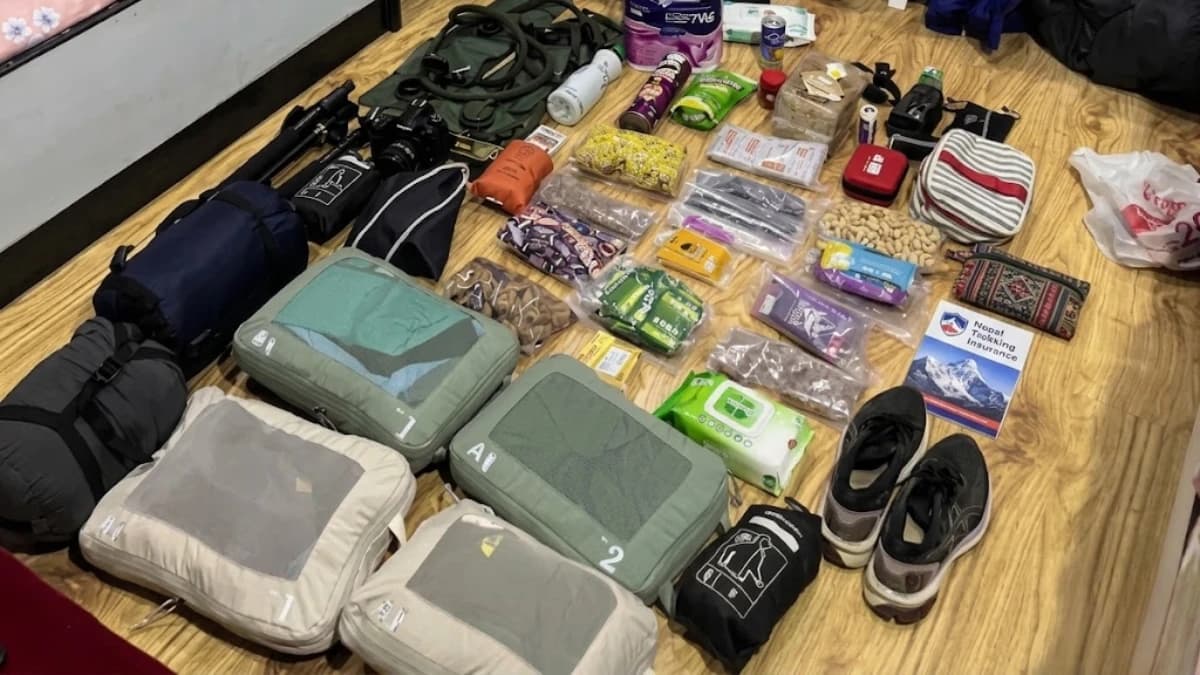
The Manaslu Circuit is not the Annapurna Circuit. It is not the EBC trail. The teahouses are simpler. The menus are shorter. The trail passes through sections where the nearest settlement is a day's walk in either direction and the nearest road is three days behind you. The remoteness that makes the Manaslu Circuit extraordinary also makes packing for it consequential: what you forget in Kathmandu stays forgotten, because there is no gear shop in Samagaon and no rental outlet in the Budhi Gandaki gorge.
This packing list is built from the specific demands of the Manaslu Circuit: the altitude (up to 5,160 metres at the Larkya La), the duration (fourteen to eighteen days), the climate range (subtropical forest to glacial pass), and the limited resupply opportunities that the restricted route provides.
What essential gear do I need for the Manaslu Circuit Trek?
Trekking boots. Waterproof, ankle-high, broken in with at least fifty kilometres of walking before Nepal. The Manaslu Circuit includes river crossings, muddy forest trails, rocky moraine, and potential snow on the Larkya La approach. The boots must handle all of these. Break them in completely: a blister on Day 2 of an eighteen-day trek in a remote valley where replacement boots do not exist is a serious problem, not an inconvenience.
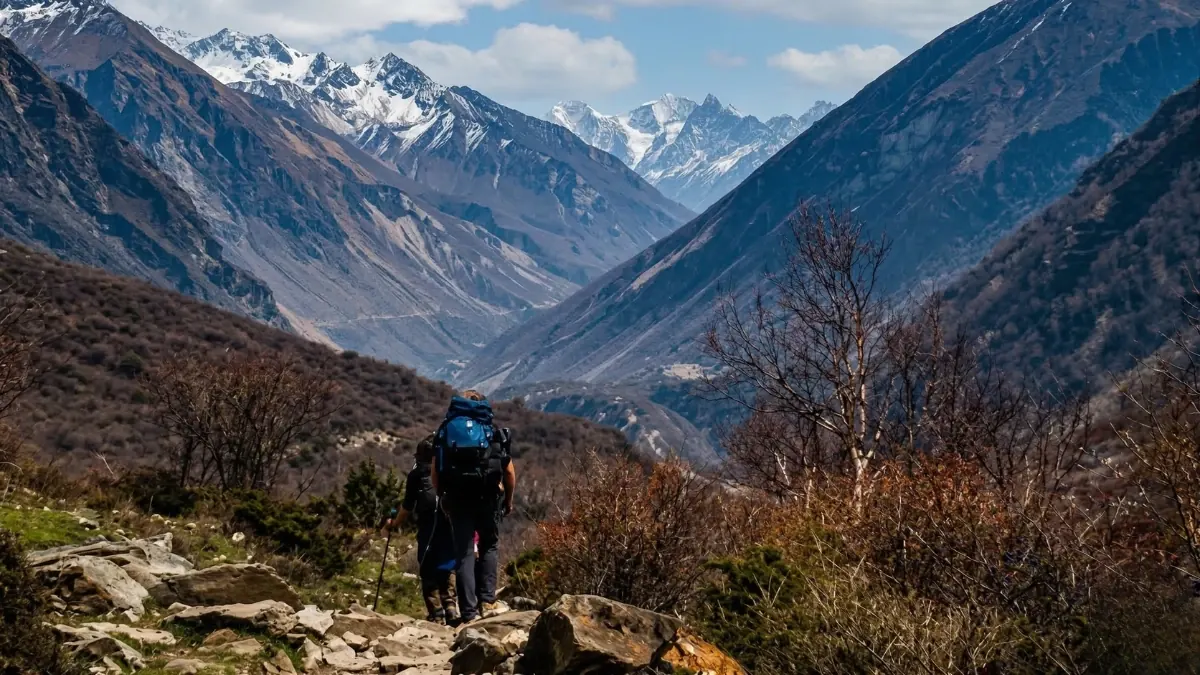
Sleeping bag. Rated to minus fifteen Celsius minimum, minus twenty preferred. The teahouses on the Manaslu Circuit provide blankets but they are thinner and fewer than on the EBC route. At Dharamsala (Larkya Base Camp, 4,460 metres), the night temperature drops to minus fifteen to minus twenty in peak season. Your sleeping bag is your primary warmth system from Samagaon onwards. Bring your own or rent a high-quality bag in Kathmandu; check the rating and fill quality before accepting a rental.
Down jacket. Six hundred to eight hundred fill power, rated to minus ten or below. This becomes your permanent outer layer from Samagaon onwards: worn from mid-afternoon until morning, at dinner, in the teahouse common room, and inside your sleeping bag on the coldest nights. Pack size matters, a compressible down jacket that fits in a stuff sack saves duffel space.
Waterproof shell jacket. Gore-Tex or equivalent membrane. The Manaslu Circuit's lower sections (below Jagat) pass through forest that can receive rain in any season, and the Larkya La can experience snow at any time of year. The shell jacket is your emergency layer, it may not come out for days, but when it does, it is the most important garment you own.
Water purification. The Manaslu Circuit has fewer "Safe Drinking Water" stations than the EBC or Annapurna routes. You need your own purification system, chlorine dioxide tablets (Aquamira, Katadyn), a SteriPEN, or a filter bottle (Grayl, LifeStraw). Carry enough tablets for the entire trek plus a backup method. Buying bottled water on the Manaslu Circuit is both expensive (prices increase with remoteness) and environmentally damaging (no recycling infrastructure exists).
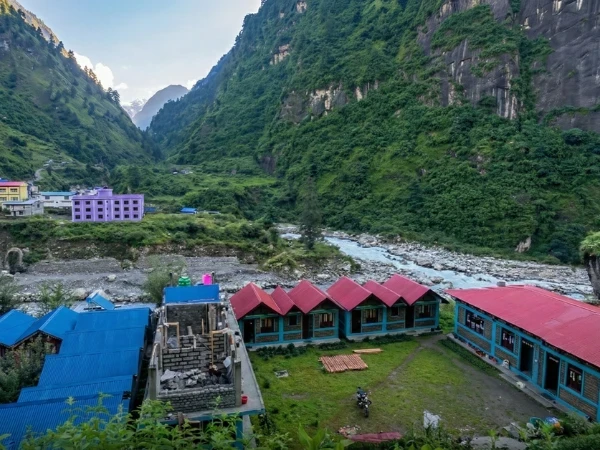
What clothing layers should I pack for the Manaslu Circuit?
Base layers: Two to three merino wool or synthetic long-sleeve tops. One to two short-sleeve T-shirts for the lower, warmer sections. Two pairs of thermal leggings for sleeping and high-altitude layering. No cotton, the Manaslu Circuit's climate ranges from humid subtropical forest to freezing high-altitude desert, and cotton's inability to wick moisture makes it dangerous at both ends.
Mid layers: One fleece jacket (lightweight, breathable) for everyday trail warmth. The down jacket (listed above) for evenings and high altitude. Some trekkers carry a lightweight synthetic insulated jacket as a mid-layer between the fleece and the down, useful for the Larkya La day when layering flexibility is critical.
Trousers: Two pairs of trekking trousers with zip-off legs. Quick-dry, stretchy, durable. The zip-off feature is genuinely useful on the Manaslu Circuit, the lower sections are warm enough for shorts, the upper sections require full-length trousers, and the transition can happen within a single day.
Waterproof overtrousers: Lightweight, packable. Less critical than the shell jacket but important for sustained rain in the lower forest sections or snow on the Larkya La.
Socks: Four to five pairs of merino wool trekking socks. One to two pairs of thin liner socks for blister prevention. One pair of warm sleeping socks (thick wool or fleece). Socks are the item most frequently under-packed, wet socks at altitude are miserable, and drying time above 4,000 metres is measured in days, not hours.
Underwear: Three to four pairs of merino or synthetic quick-dry underwear. A sports bra (for women) that is comfortable under a pack for eight hours.
Extremities
Gloves: Thin liner gloves (for walking in mild cold and operating cameras). Thick insulated gloves or mittens (for the Larkya La and high-altitude mornings). Mittens are warmer than gloves but less dexterous, the choice depends on whether warmth or camera operation is your priority at minus fifteen degrees.
Headwear: Warm beanie that covers ears. Sun hat with brim (for the lower, sunnier sections). Buff or neck gaiter (for face and neck protection in wind and cold). On the Larkya La, the combination of beanie, buff pulled over nose, and hood provides the face coverage that wind chill at 5,160 metres demands.
Sunglasses: UV400 protection, Category 3 or 4 lens. Essential above the tree line where UV intensity is dramatically higher than at sea level. Snow blindness, sunburn of the cornea, is painful and debilitating and entirely preventable with proper sunglasses. Carry a retaining strap so they do not blow off on the pass.
Camp shoes: Lightweight sandals, Crocs, or flip-flops for teahouse evenings. Your feet need to breathe after hours in boots. Weight: minimal. Comfort value: enormous.
Gear
Daypack: Twenty-five to thirty-five litres. Carries your water, snacks, camera, rain jacket, fleece, and personal items during the day while the porter carries your duffel. Hip belt and chest strap for stability on rough terrain. Side pockets for water bottles.
Duffel bag: Sixty to eighty litres. This is what the porter carries. Waterproof or with a waterproof liner (dry bag or heavy-duty bin liner). Maximum weight: twelve to fifteen kilograms, check your company's policy and pack within it.
Trekking poles: Highly recommended. Adjustable, collapsible. Poles reduce knee strain on descents (the Manaslu Circuit has significant descents in the Budhi Gandaki gorge), improve balance on rough terrain, and provide stability on the Larkya La's loose rock and snow. Rent in Kathmandu for a dollar or two per day if you do not own them.
Headlamp: Essential. With spare batteries (cold-drained batteries die fast). Used for pre-dawn starts (particularly the Larkya La crossing, which begins at three or four in the morning), for finding the toilet at night, and for power cuts in teahouses. LED, one hundred lumens minimum.
Power bank: 20,000mAh minimum. Charging facilities on the Manaslu Circuit are limited and expensive, some teahouses above Samagaon charge five hundred rupees or more per device. A power bank eliminates this cost and ensures your phone and camera stay charged. Charge the power bank fully in Kathmandu and at every opportunity along the trail.
What first aid and toiletries should I pack for the Manaslu Circuit?
First aid kit: Paracetamol, ibuprofen, loperamide (anti-diarrhoeal), oral rehydration salts, Compeed for blisters, adhesive plasters, antiseptic wipes, wound closure strips, antihistamines. Prescription medications: ciprofloxacin or azithromycin (for bacterial gastroenteritis, get a prescription before departure), acetazolamide/Diamox (discuss with your doctor for altitude prophylaxis).
Sunscreen: SPF 50+. Apply every two hours above the tree line. The UV at 5,000 metres is up to seventy-five percent stronger than at sea level. Sunburn at altitude is fast, severe, and compounds the discomfort of altitude sickness.
Lip balm: With SPF protection. Lips crack and split at altitude in the dry air, prevention is easier than treatment.
Hand sanitiser: Alcohol-based. Use before every meal when hand-washing facilities are unavailable.
Toilet paper: Carry your own supply. Teahouses provide some, but availability decreases with altitude and remoteness. A roll in a zip-lock bag in your daypack ensures you are never without.
Wet wipes: For personal hygiene when showers are unavailable, which, above Samagaon, is most of the time.
Microspikes or light crampons: Recommended for the Larkya La in early or late season when ice and snow on the approach and descent are possible. Your guide will advise on conditions, but having them available prevents a last-minute problem on pass day.
What documents and cash do I need for the Manaslu Circuit?
Passport: Original, with at least six months validity. Kept in a waterproof pouch. Copies (paper and digital) stored separately.
Permits: Your trekking company handles these, but verify before departure that your restricted area permit, TIMS card, and national park/conservation area entry permits are in hand.
Insurance documentation: Policy number, emergency contact number, coverage confirmation. Keep paper copies in your daypack and digital copies on your phone.
Cash: Nepali rupees, enough for the entire trek. There are no ATMs on the Manaslu Circuit. Budget five thousand to ten thousand rupees per day for personal expenses (hot drinks, snacks, charging, tips). Carry more than you think you need, running out of cash in a place with no banks is a problem with no solution.
What should you not bring on the Manaslu Circuit Trek?
Cotton clothing. Jeans. Heavy books (use a Kindle or phone). Excessive electronics. More than two changes of clothes for any layer. Full-size toiletries (decant into travel bottles). Valuables you cannot afford to lose. Expectations of comfort above 4,000 metres.
The principle: every gram in your duffel is carried by another human being over the same terrain you walk. Pack what you need. Leave what you want. And remember that the Manaslu Circuit's remoteness is its gift, the absence of gear shops is the absence of civilisation, and the absence of civilisation is why you came.
For the full Manaslu packing list and what we provide, see our Manaslu Circuit Trek page. We provide a sleeping bag rated to minus fifteen and a down jacket free on every tier, Budget included, and a duffel bag as well on the Standard and Luxury packages.
The Manaslu packing list is similar to the Everest list with one critical difference: you need more cold-weather layers. The Larkya La crossing at 5,160 metres is exposed and windy, and the descent on the other side can be icy. Pack for the pass, not the teahouse.
We provide a free sleeping bag and down jacket on every tier of our Manaslu Circuit Trek, and a duffel bag as well on the Standard and Luxury packages. That covers the most expensive items.
WhatsApp:+977 9810351300
Email:[email protected]
Written by Shreejan Simkhada, CEO of The Everest Holiday and third-generation Himalayan guide. TAAN Member #1586.
Manaslu packing list: pair with our 2026 dates. Our Manaslu Circuit Trek (12 Days) is private (your group only, no strangers), 2026 dates open, From USD $799. WhatsApp us for tailored 2026 dates and current departures.

 Chat with Shreejan