

Island Peak (6,165m) and Mera Peak are the two summits most first-time Himalayan climbers choose between, and the Nepal Mountaineering Association, which issues the permit for both, classes each of them as a trekking peak rather than an expedition peak. Island Peak is the harder of the two (a steeper summit ridge, more exposed sections, and a genuine crevassed glacier crossing), but still achievable for fit trekkers with no previous climbing experience. The difference between standing on the summit and turning back is preparation.
What Does Island Peak Demand Physically?
The Island Peak expedition (14 days) combines the EBC trek approach through the Khumbu with a two-day climb from Island Peak Base Camp (5,087m) to the summit (6,165m). You trek for eight days, acclimatise, then climb. The physical demands are layered:
- Trek fitness: Eight days of walking 10 to 14 km per day at 3,000 to 5,000 metres, identical to the EBC trek.
- Summit fitness: A 1,100-metre climb from base camp to summit in one day, starting at 1:00 am, taking 8 to 12 hours round trip.
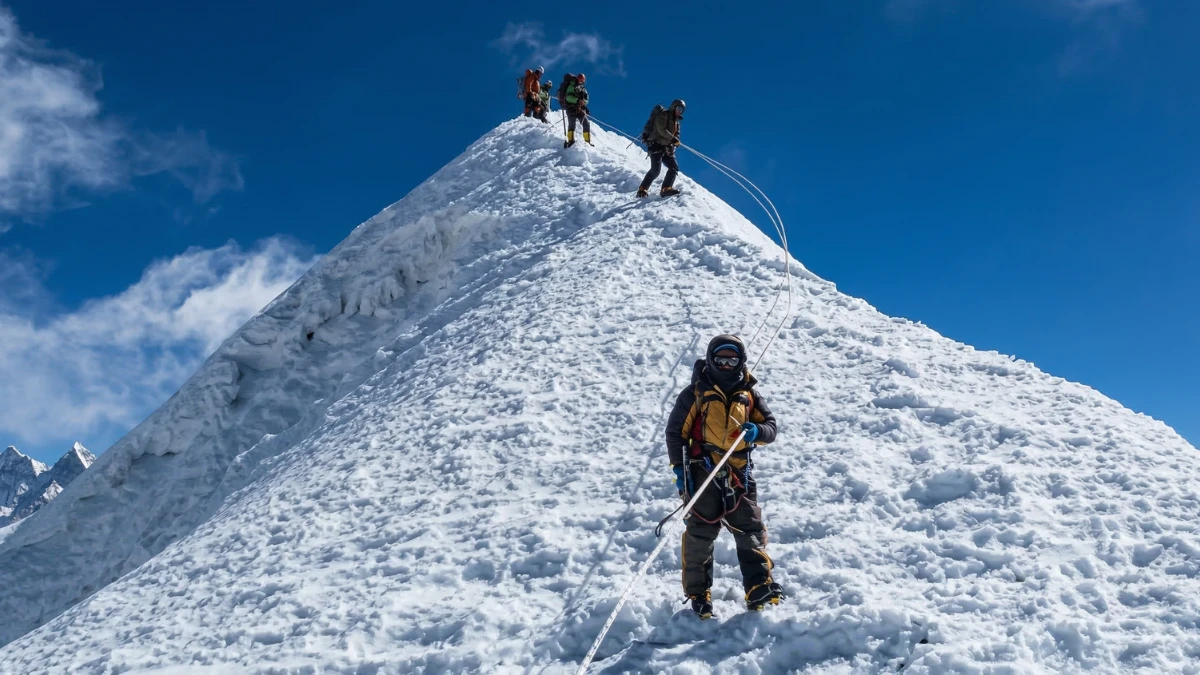
- Technical fitness: Cramponing on 40 to 50-degree ice for the final headwall. Fixed ropes with jumar ascenders. Balance on a narrow summit ridge with exposure on both sides.
- Cold tolerance: Summit temperatures of minus 20 to minus 30 at 2:00 in the morning. Your body must generate heat while climbing at extreme altitude.
How Is Island Peak Different from Mera Peak?
| Factor | Island Peak (6,165m) | Mera Peak (6,476m) |
|---|---|---|
| Technical difficulty | Harder (steep headwall, ridge) | Easier (snow slope) |
| Summit slope angle | 40-50 degrees | 25-35 degrees |
| Crevasse risk | Yes (roped glacier crossing) | Minimal |
| Exposure | High (narrow summit ridge) | Low (broad summit plateau) |
| Approach trek | EBC route (well-serviced) | Hinku Valley (remote) |
| Summit day duration | 8-12 hours | 6-8 hours |
| Success rate | Lower, because of the headwall | Higher |
Island Peak's lower success rate reflects the technical sections, not the altitude. The headwall below the summit turns back trekkers who freeze on the fixed ropes or run out of energy on the steep ice. Training specifically for these demands significantly improves your odds.
8-Week Training Plan
Weeks 1-2: Cardiovascular Base
Walk or hike five times per week, 8 to 12 km per session, on hilly terrain. Add a 5 kg daypack from Day 1: you will carry weight every day on the expedition. One long walk per weekend: 15 km with 400+ metres elevation gain. Strength training twice per week: squats, lunges, step-ups, planks, and calf raises (3 sets of 15 each).
Weeks 3-4: Strength and Stairs
Increase pack weight to 7 kg. Find the tallest building or steepest staircase you can access and climb it repeatedly for 30 to 45 minutes per session, twice per week. This specifically trains the muscles used on the Island Peak headwall: calves, quads, and glutes working against gravity at steep angles.
Add: Romanian deadlifts (3x12), single-leg step-ups onto a high box (3x10 per leg), and farmer carries (3x40m heavy). Weekend walk: 18 km with pack, 500+ metres gain.
Weeks 5-6: Endurance and Back-to-Back Days
Saturday + Sunday back-to-back: 18 km Saturday, 14 km Sunday, both with 7 kg pack. This teaches your body to perform on tired legs, exactly what summit day demands after eight days of trekking.
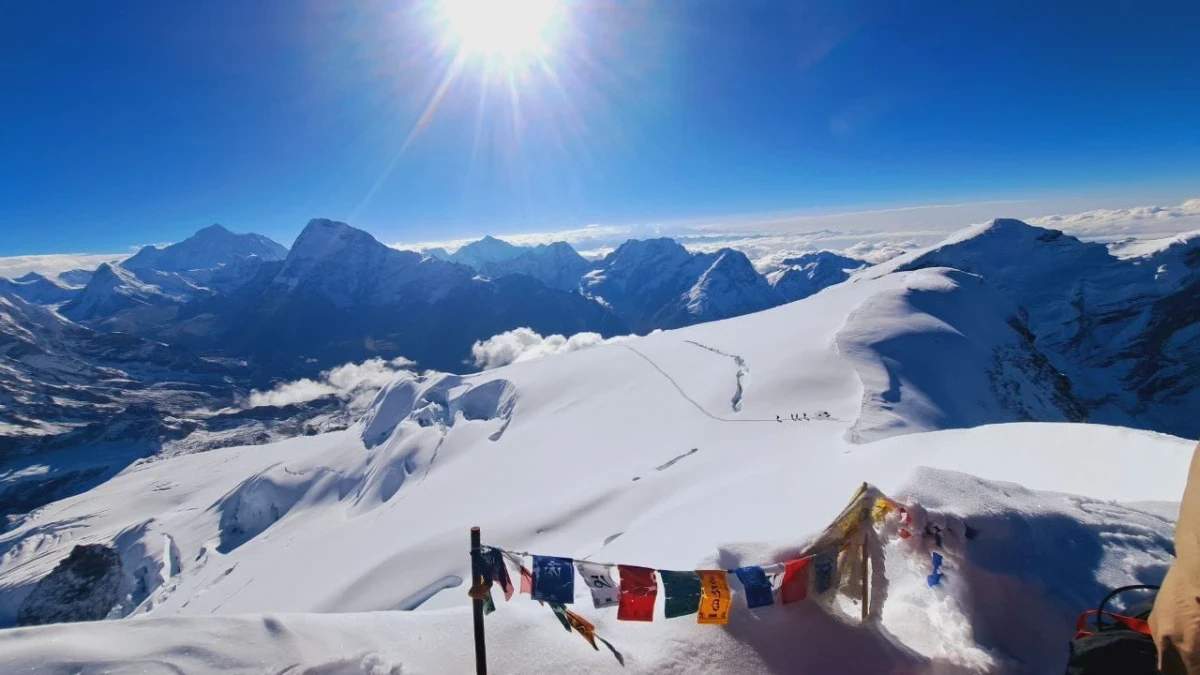
Add grip strength training: hang from a bar for 30 seconds, 5 sets. You will grip jumar handles and fixed ropes on summit day, and cold hands with weak grip strength is a common reason for turning back.
Weeks 7-8: Peak and Taper
Week 7: Hardest week. Three 14+ km walks, one 22+ km weekend walk with 700+ metres gain, two strength sessions. Finish the week tired.
Week 8: Taper. Three easy 8 km walks, one light strength session. Rest, sleep, and pack. Arrive in Nepal fresh.
Do You Need Climbing Practice?
Helpful but not essential. If you have access to an indoor climbing wall, spend two to three sessions learning basic footwork on steep terrain. If you can do an introductory ice climbing course, even better: it teaches you how crampons grip ice and how to trust your feet on steep angles.
One thing is worth knowing before you start training, because it changes what you are training for. On our expedition you climb with one climbing Sherpa to one trekker on summit day, rather than as a shared rope team. That matters more than any single week of a training plan. On a shared rope your pace is the rope's pace, and a climber who is slower than the group turns back whether or not they had the fitness to continue. One to one means you are judged on your own legs, and it means somebody is watching your hands on the jumar at three in the morning instead of watching four people at once.
Your guide teaches all necessary techniques at Island Peak Base Camp: crampon walking, jumar use, fixed rope technique, and self-arrest with an ice axe. Most successful Island Peak summiteers learn these skills on the mountain, not at home. But prior exposure removes the fear factor, which matters at 2:00 in the morning on a headwall with 500 metres of exposure below you.
The Two Things Almost Everybody Under-Trains
Every training plan you will find online, including the one above, is built around going up. Two things that turn people back on Island Peak are not about going up at all.
The first is descending. You summit at first light and then you have to get all the way back down to base camp on legs that have already done eleven hours, down the same headwall you came up, on fixed ropes, with a descender. Going down is where knees give out and where most of the accidents on trekking peaks actually happen. Almost nobody trains for it, because walking downhill feels easy at sea level and does not feel easy at all after a 1:00 am start at 6,000 metres. Put deliberate descent into your training from Week 3: find the steepest hill you have, walk down it with your loaded pack, and do it repeatedly rather than treating the way down as the rest after the way up.
The second is cold hands. The training plan above has you hanging from a bar for grip strength, which is right, but grip is only half of it. At minus 25 in the dark you also need enough dexterity to clip a carabiner, work a jumar and adjust a harness while wearing gloves you cannot take off. Practise those movements with your actual summit gloves on, in the cold, before you leave home. It sounds trivial and it is the difference between a two-minute rope transition and a ten-minute one, and ten minutes repeated across a summit day is a turnaround.
What Gear Do You Need to Train With?
During training, use the same boots you will trek in. Breaking in boots during the expedition guarantees blisters. Walk at least 50 kilometres in your trekking boots before departure. Add a daypack weighted to 7 kg for all training walks from Week 3 onwards: your summit day pack will weigh 5 to 8 kg with water, snacks, camera, and warm layers.
The Fitness Test
At the end of Week 7: walk 20 km on the steepest terrain available with a 7 kg pack, including 700+ metres of elevation gain. Then the next morning, climb your training staircase for 30 minutes with the same pack.
If you complete both days tired but functional, you are ready. Island Peak will still be the hardest thing you have ever done, but you will have the fitness to handle it.
What About Altitude Acclimatisation?
The Island Peak approach follows the EBC trekking route through the Khumbu. You spend eight days walking from Lukla (2,860m) to Chhukung (4,730m), with acclimatisation stops at Namche Bazaar and Dingboche. By the time you reach Island Peak Base Camp, you have spent over a week at progressively higher altitudes.
This built-in acclimatisation is one of Island Peak's advantages over mountains that require separate acclimatisation treks. You arrive at base camp with your body already adjusted to 5,000 metres. The final 1,100 metres to the summit on climb day is still a massive effort, but your body has the oxygen-carrying capacity to support it.
If you have climbed Mera Peak previously, you know how your body responds to 6,000 metres. If this is your first 6,000-metre peak, respect the altitude and trust the acclimatisation schedule. Pushing to the summit with a headache or nausea is not brave. It is the fastest route to failure or evacuation.
The Himalayan Rescue Association, which has run a volunteer aid post in the Khumbu since the 1970s, gives the same advice every season and it has never changed: altitude illness is treated by going down, and no amount of fitness protects you from it. Train hard for this climb. Do not train yourself into believing you can push through a headache at 6,000 metres, because those are different things and the mountain does not care how many stairs you climbed.
See our Island Peak Climbing (14 Days) for the full expedition itinerary. All climbing gear, guide, and permits are included.
WhatsApp:+977 9810351300
Email:[email protected]
Written by Shreejan Simkhada, CEO of The Everest Holiday and third-generation Himalayan guide. TAAN Member #1586.
Trained and ready for Island Peak? Our Island Peak Climbing 14 Days includes NMA-licensed climbing guide, full technical gear, fixed ropes, and proper EBC acclimatisation. From USD 3,499 per person. WhatsApp us for expedition dates.
 Chat with Shreejan