

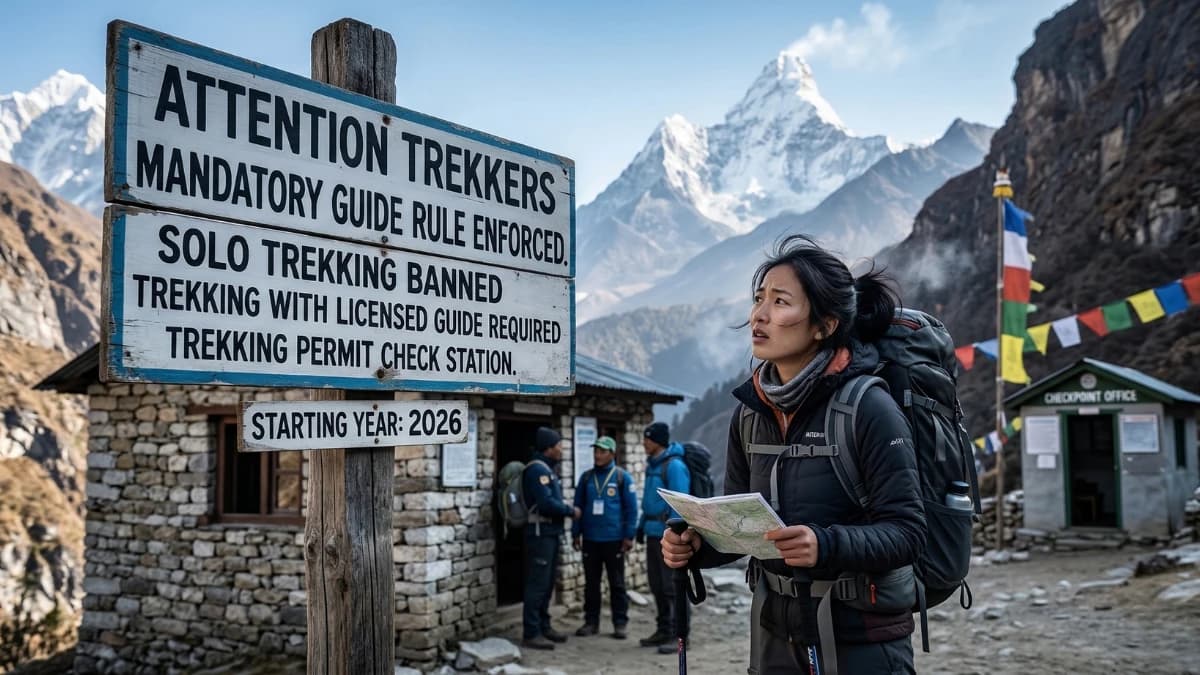
The rumour travels faster than the regulation. In hostels in Bangkok, in travel forums, in Reddit threads that grow longer by the hour, "Nepal has banned solo trekking." The statement is repeated with varying degrees of accuracy, indignation, and confusion, and the result is that thousands of potential trekkers receive the wrong message at the wrong time and either cancel their plans or arrive in Kathmandu without understanding what the rule actually means.
Here is what the rule says. Here is what it does not say. And here is why, despite the initial frustration it caused among independent travellers, it has made Nepal trekking safer, more sustainable, and, for the people whose livelihoods depend on it, more just.
What does Nepal's licensed-guide rule actually require in 2027?
A licensed guide is required in most trekking areas under the Nepal Tourism Board rule from April 2023, and the listed restricted routes such as Manaslu, Tsum, Upper Mustang and Nar Phu also need an agency-issued TIMS card. The Everest (Khumbu) region does not enforce it locally, but we always trek with a licensed guide. On every trek we run, the guide holds a valid trekking guide licence from the Department of Tourism and carries identification, and the company holds a government tourism licence and TAAN membership.
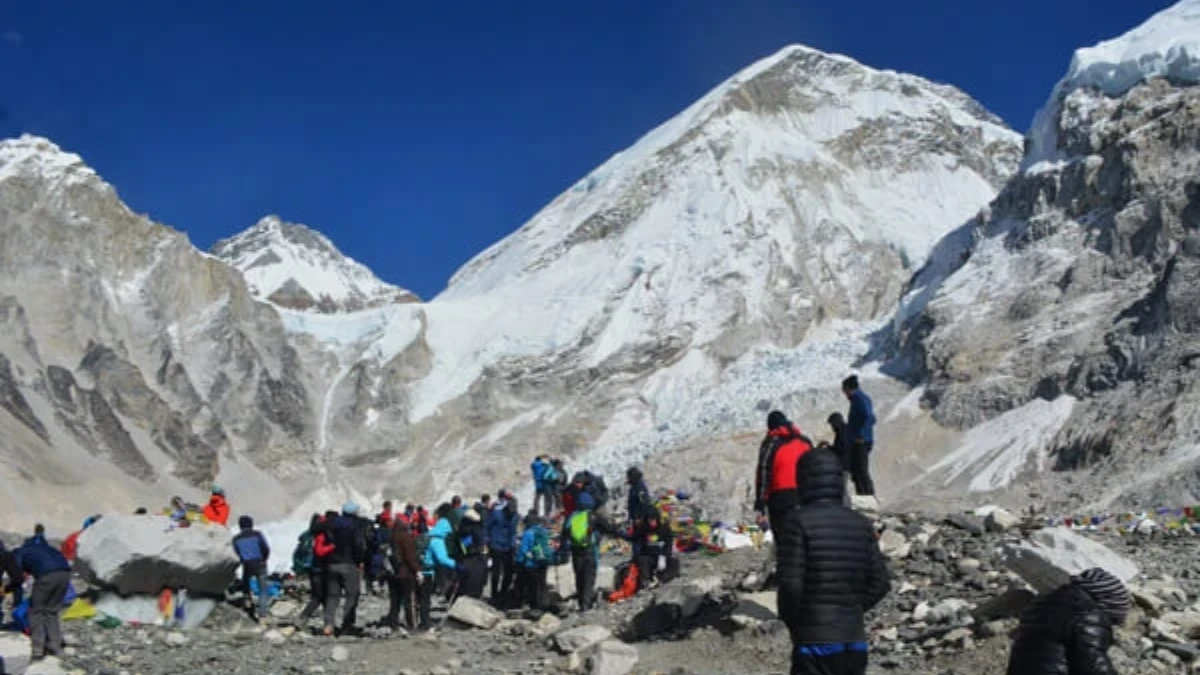
On the listed restricted routes (Manaslu, Tsum, Upper Mustang, Nar Phu, Dolpo, Humla Limi and Kanchenjunga) the licensed guide and agency requirement is compulsory. Everywhere else, the Nepal Tourism Board rule requires a licensed guide in most areas, and we always trek with one.
Enforcement varies by area, and the Everest (Khumbu) region does not enforce the rule locally. Restricted-area permits can only be obtained through a registered agency.
Is solo trekking in Nepal completely banned under the 2027 guide rule?
It does not ban solo travel. A solo trekker, one person, travelling alone, is perfectly welcome. They simply need a guide. The rule requires professional accompaniment, not group travel.
A solo trekker books with a company, is assigned a guide (and, on our luxury tier, a porter), and walks the trail with professional support. They are still solo in the meaningful sense, they chose to come alone, they experience the trek on their own terms, and the solitude of the mountain adventure is preserved. What changes is that they have a trained professional beside them who knows the trail, monitors their health, and provides a safety net that solo trekkers previously lacked.
The rule does not require joining a group. Private treks, one trekker with one guide, are perfectly legal and common. The cost is higher than sharing a guide with a group, but the independence is preserved.
The rule does not apply outside national parks and conservation areas. Short hikes near Kathmandu, walks in the Kathmandu Valley, and day trips to places like Nagarkot or Dhulikhel do not require a guide. The regulation covers the established trekking routes within protected areas, which is where the vast majority of trekking occurs.
Why did Nepal introduce the licensed-guide requirement for trekking?
The motivation is not bureaucratic overreach or revenue extraction. It is safety. Specifically, the accumulation of incidents over two decades that demonstrated a clear pattern: unguided foreign trekkers were disproportionately involved in disappearances, altitude sickness emergencies, navigation errors, and deaths on Nepal's trails.
Between 2010 and 2022, the Nepal government documented a steady stream of incidents involving solo, unguided trekkers who got lost in poor weather, who developed severe altitude sickness with nobody to recognise the symptoms, who fell on exposed trails with nobody to call for help, and who died in circumstances that a guide's presence would likely have prevented.
The search and rescue operations for these incidents consumed enormous local resources, police, military, helicopter crews, village volunteers, and the costs were borne by the Nepali government and the mountain communities, not by the trekkers or their insurance companies (which many did not have).
The licensed-guide rule addresses this directly. A trained guide monitors altitude symptoms, carries emergency communication, knows alternate routes in bad weather, and makes the critical decisions, descend, rest, evacuate, that an inexperienced trekker alone may not make in time.
The Economic Dimension
There is a second motivation that the government does not hide: employment. The trekking industry is a major employer in Nepal's mountain communities. Guides, porters, teahouse owners, and transport operators depend on trekking season for their annual income. The growth of independent, unguided trekking, facilitated by GPS apps, online trail descriptions, and a backpacker culture that valorised going it alone, was gradually hollowing out the guiding profession.
A trekker who walks to Everest Base Camp without a guide contributes to the teahouse economy but not to the guiding economy. A trekker with a guide contributes to both. The licensed-guide rule means that the benefits of foreign tourism reach the people who maintain the trails, manage the risks, and carry the economic burden of living in one of the most remote inhabited environments on earth.
This is not exploitation. Guide pay is set against a published band: TAAN puts a trekking guide at twenty-five to thirty-five dollars a day on standard routes, and thirty-five to fifty on high-altitude and restricted-area treks, before the guide's own food and lodging. The employment this creates supports families, funds education, and sustains communities that have no other significant income source.
The Rule That Changed in March 2026, and Why Everyone Confuses the Two
There are two separate rules here and almost every article online runs them together. The first is the licensed-guide requirement, in force since April 2023 (with the agency requirement on restricted routes) and unchanged. The second is the restricted-area minimum, and that one changed this year.
Until March 2026, a restricted-area permit could not be issued to one person. Upper Mustang, Manaslu, Nar Phu, Kanchenjunga, Tsum and Dolpo all required a minimum of two trekkers on the permit, so a solo walker was either paired with a stranger or paid a surcharge to cover the empty place. On 22 March 2026 the Department of Immigration scrapped that minimum. A single trekker can now hold a restricted-area permit in their own name.
What did not change is the guide and the agency. Only a registered agency can file a restricted-area permit, and a licensed guide is still mandatory, so this is not a route to walking Upper Mustang alone. What it means is that you no longer need a second person to exist before the permit can be issued.
This matters more than it sounds, because a good number of operators have not updated their own pages. If a company tells you the law still forces a minimum of two trekkers on Manaslu or Kanchenjunga, that page was written before March 2026; the legal two-person rule is gone, although some operators still set their own small-group minimum for cost reasons. You can check the current position with the Department of Immigration, who issue the permits, and the fee schedule with TAAN.
How does the licensed-guide rule change your Nepal trek in 2027?
In practice, the licensed-guide rule changes very little about the trek itself for anyone who was planning to book with a company anyway, which, for safety and logistics reasons, most trekkers were.
If you were planning to trek independently, arriving in Kathmandu with a map and a pack and walking into the mountains alone, the rule changes everything. You now need a company. You need a guide. You need permits that only a registered company can obtain.
The cost increase is modest. A guide for a twelve-day Everest Base Camp trek adds roughly three hundred to four hundred and twenty US dollars in total to what an independent trekker would have spent on accommodation, food and permits alone. Given that the guide also handles all logistics, teahouse booking, permit processing, transport arrangement, emergency response, the added cost purchases convenience as well as safety.
The loss of independence is real but nuanced. You walk at a pace guided by professional judgment rather than personal impulse. You follow an itinerary designed for safe acclimatisation rather than ambitious speed. You eat where your guide books rather than where whim dictates. For some trekkers, this feels restrictive. For most, it feels like having a knowledgeable friend who happens to know every stone on the trail.
The Ongoing Debate
Not everyone agrees with the rule. Independent travellers argue that experienced trekkers should be allowed to assess their own risk. Critics point out that the rule benefits guiding companies financially and question whether safety was the primary motivation. Some argue that enforcement is inconsistent, checkpoints are not present on every trail, and some trekkers still slip through without guides on less-monitored routes.
These are fair points. The rule is imperfect. Enforcement is imperfect. The balance between safety and freedom is a genuine philosophical tension that does not have a clean resolution.
But the practical reality is clear: the rule exists and it is enforced in most areas, though not locally in the Khumbu region. Trekkers who plan to visit Nepal in 2027 should plan on a guide from a registered company. Those who accept this and book accordingly will have an excellent experience. Those who resist it and try to circumvent the system will spend their trek worrying about the next checkpoint instead of looking at the mountains.
The Himalayas were here before the rule and they will be here after it. What the rule changes is not the mountains but the margin of safety between you and them. Whether that margin is welcome or unwelcome depends on your perspective. Whether it saves lives is not in doubt.
All our trek packages include a licensed guide.
A licensed guide is required in most trekking areas under the Nepal Tourism Board rule from April 2023, and on restricted routes such as Manaslu and Upper Mustang an agency-issued TIMS card is compulsory too. In practice a guide makes the trek safer and a good deal richer, which is why most people were hiring one anyway.
All our treks include a licensed guide, and we think that is the right thing to do.
WhatsApp:+977 9810351300
Email:[email protected]
Written by Shreejan Simkhada, CEO of The Everest Holiday and third-generation Himalayan guide. TAAN Member #1586.
Trekking solo? Every trek we run includes a licensed guide. Our Everest Base Camp Trek (12 Days) is private (your group only, no strangers), 2027 dates open, From USD $1399. WhatsApp us for tailored 2027 dates and current departures.
 Chat with Shreejan