
Last updated 2 October 2026. The temperature and rainfall tables below are published station averages, not forecasts, and I name the source of every table. Above Dingboche there is no station data, so I describe the trail from what our guides see, not from a number.
The short answer: from Namche upwards the Everest trail is a cold-nights, mild-days route in every month except the monsoon, and the real choice is how cold you want your nights and how many other trekkers you want at breakfast. October and the first half of November are the driest and clearest. March and April are warmer and busier. December to February is cold, quiet and (at the top) mostly shut. June to mid-September is wet, and I would not send a client then.
Below is the month-by-month detail: the numbers, what they feel like on the trail, how Lukla flights behave, what to pack and who should not go in which month. If you are still deciding between seasons, my best time to trek to Everest Base Camp guide is the decision page and this one is the weather behind it. If you already know your month and want the trek itself, it is our Everest Base Camp trek, 12 days, from US$1,399 Budget, US$2,785 Standard and US$4,999 Luxury.
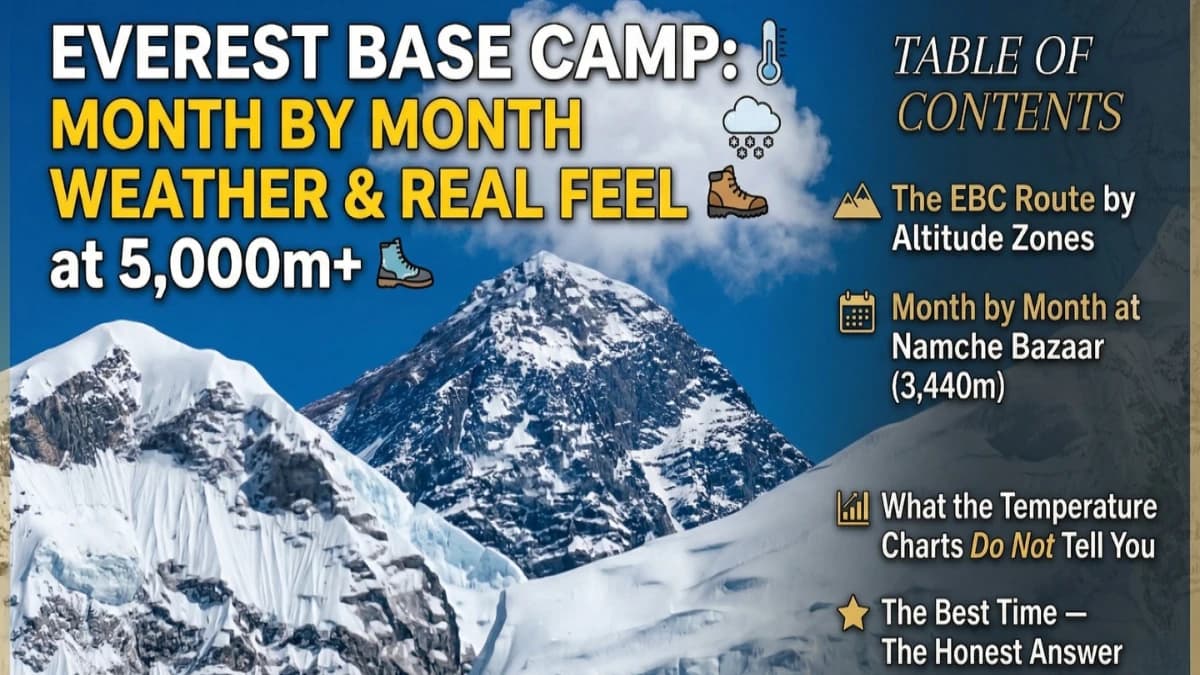
What is the weather at Everest Base Camp, month by month?
There is no weather station at Base Camp that publishes a long record, so I use the four stations along the route that do have one: Lukla (2,786 m), Namche Bazaar (3,450 m), Tengboche (3,857 m) and Dingboche (4,410 m, modelled data, not an instrument record). The station heights differ by a few metres from the village heights used on our itineraries. Each cell is the average daily high, then the average daily low, in degrees Celsius.
| Month | Lukla 2,786 m | Namche 3,450 m | Tengboche 3,857 m | Dingboche 4,410 m (modelled) |
|---|---|---|---|---|
| January | 8.3 / -2.9 | 6.9 / -8.5 | 3.7 / -9.7 | 1.0 / -15.3 |
| February | 8.9 / -1.6 | 6.4 / -6.5 | 4.0 / -9.7 | 1.5 / -14.2 |
| March | 13.3 / 2.6 | 9.6 / -3.0 | 8.0 / -6.1 | 4.7 / -10.5 |
| April | 16.6 / 5.7 | 12.8 / 0.8 | 12.1 / -4.0 | 8.5 / -7.0 |
| May | 16.7 / 8.0 | 14.3 / 3.7 | 13.8 / -1.2 | 11.1 / -3.5 |
| June | 17.7 / 12.3 | 15.6 / 5.9 | 14.6 / 3.2 | 13.7 / 1.1 |
| July | 18.4 / 13.2 | 15.8 / 7.8 | 14.1 / 4.3 | 13.0 / 2.9 |
| August | 18.6 / 12.9 | 16.2 / 7.5 | 14.1 / 3.5 | 12.6 / 2.3 |
| September | 18.6 / 11.6 | 14.6 / 5.9 | 13.0 / 2.2 | 11.5 / 0.3 |
| October | 16.8 / 7.4 | 12.5 / 1.2 | 12.0 / -1.7 | 8.9 / -5.3 |
| November | 13.8 / 2.4 | 9.1 / -3.8 | 8.1 / -6.9 | 5.3 / -11.0 |
| December | 11.1 / -0.5 | 7.6 / -7.1 | 6.0 / -7.5 | 3.2 / -13.4 |
Sources: Lukla, Nepal Department of Hydrology and Meteorology (DHM) 1991 to 2020 normals. Namche, FAO FAOCLIM database. Tengboche, FAO and the Australian National University record. Dingboche, which is a computer model of the location, so treat it as a guide, not a measurement. The sources for all four tables are listed in the notes at the end.
The rainfall side of the picture is just as telling. Total precipitation per month, in millimetres, from the same sources:
| Month | Lukla (mm) | Namche (mm) | Tengboche (mm) | Dingboche (mm, modelled) |
|---|---|---|---|---|
| January | 15.3 | 43 | 22.0 | 9 |
| February | 17.2 | 20 | 14.1 | 8 |
| March | 45.3 | 31 | 27.2 | 12 |
| April | 58.7 | 26 | 25.2 | 13 |
| May | 127.6 | 39 | 34.0 | 16 |
| June | 324.8 | 129 | 142.2 | 64 |
| July | 529.8 | 226 | 245.0 | 140 |
| August | 641.8 | 206 | 237.4 | 151 |
| September | 419.0 | 140 | 159.5 | 71 |
| October | 102.9 | 57 | 72.1 | 31 |
| November | 6.2 | 11 | 3.0 | 2 |
| December | 0.5 | 24 | 0.6 | 3 |
Two things jump out. First, at Lukla the four months June to September deliver about 84 per cent of the year's 2,289 mm (calculated from the DHM figures). Second, November is nearly dry at every station, which is why a clear, cold November is not luck but the climate. October is the wetter edge of the good season, and that is the month where a late storm can still surprise you.
Which months are best for Everest Base Camp?
October and November for the driest skies, March and April for the warmest days. At Gorak Shep, the last settlement below Base Camp at 5,164 m, the best trekking times are the same: spring (March and April) and autumn (October and November). It also says that in autumn competition for beds in the lodges can be intense. Our own crowd notes agree, and they are in the table below.
| Month | What it is like on the trail | Crowds | Would I send a client? |
|---|---|---|---|
| January | Coldest month on every station above. Clear and very cold. Some high lodges shut. | Very low | Only if cold and solitude are the point |
| February | Same cold as January, with Dingboche lows still near -14 degrees (modelled). | Very low | Same as January |
| March | Cold early in the month, warming. Spring season begins. | Building | Yes, with a warm sleeping bag. See EBC in March |
| April | Warm days, rhododendrons below Namche, strong views. Second busiest month. | High | Yes. See EBC in April |
| May | Warmest trekking month, hazier afternoons, rain building at Lukla (127.6 mm). | Moderate | Yes, start early each day. See EBC in May |
| June | Monsoon. Lukla 324.8 mm. | Very low | No |
| July | Monsoon. Lukla 529.8 mm. | Very low | No |
| August | Wettest month. Lukla 641.8 mm. | Very low | No |
| September | Monsoon clearing, but Lukla still 419.0 mm. Green hills. | Building late in the month | Late September only, with spare days |
| October | The first properly dry month after the monsoon. Peak season. | Very high | Yes. See EBC in autumn |
| November | Almost no rain, colder nights. Quieter as the month goes on. | High, then easing | Yes. See EBC in November |
| December | Dry and cold. Early December is the sweet spot of the quiet months. | Low | Yes, if you pack for it |
The crowd and "would I send" columns are our own judgement from running Everest treks since 2016, not station data. The weather columns are the numbers above.
What is Everest Base Camp weather like in the monsoon?
Wet, cloudy and unreliable for flying. At Lukla, June to September brings 324.8, 529.8, 641.8 and 419.0 mm of rain per month. The trail is slippery, the big views sit behind cloud for days and the flights are the weak link. Visibility problems close Lukla's Tenzing-Hillary Airport 50 per cent of the time in the monsoon, with a consequent cancellation of 50 per cent of flights. That is the reason I would not plan an Everest trek in those months.
What is the weather like in October?
October is the month most people choose, and the numbers explain why. Lukla is down to 102.9 mm, Namche to 57 mm and Dingboche (modelled) to 31 mm, from several hundred in the monsoon. Daytime highs are comfortable: 16.8 degrees at Lukla, 12.5 at Namche. Nights are where it starts to bite, with Namche near 1.2 degrees, Tengboche at -1.7 and Dingboche at about -5.3.
The honest weak spot is the last week. Two of the last few autumns have seen the tail of a Bay of Bengal cyclone clip Nepal in late October, with a few days of cloud and fresh snow high up, and Lukla flights grounded. That is our experience, written down in my best-time guide, and not a station statistic. It is not every year and not a reason to skip October, but it is a reason to keep a spare day or two at the end. For the whole month, see Everest Base Camp in autumn.
What is the weather like in November?
Dry, clear and colder. Lukla gets 6.2 mm for the month, Tengboche 3.0 and Dingboche (modelled) 2. The cold arrives fast: Namche drops to -3.8 at night and Dingboche to about -11. Our guides' experience, as I wrote in the best-time guide, is that nights at Gorak Shep in the second half of November fall to around minus ten or colder. That is guide experience, not an instrument reading, because I have no station source that high.
The trade for the cold is space. The second half of November is quieter, lodges have beds and the views stay clear. Our full November piece is EBC in November. If you are thinking about this November specifically, I keep a separate live guide, trekking Nepal in November 2026.
What is the weather like from December to February?
Dry and very cold. December has 0.5 mm of rain at Lukla and 0.6 mm at Tengboche, and January and February are only a little wetter, so snow, when it comes, is the story and not rain. Highs at Tengboche are 3.7 to 6.0 degrees and lows are -7.5 to -9.7. At Dingboche the modelled lows run from -13.4 in December to -15.3 in January. I have no station that goes higher, and the cold above Dingboche will be harder.
The wider facts matter as much as the temperatures. From December to February at Gorak Shep trekking is possible, but most accommodation is closed, trails are snow-covered and the cold is very intense. On a winter trip I would want to know which lodge you sleep in each night before you fly. Read the full picture in EBC in winter. Early December is the gentlest of the cold months, and I keep it separate from January and February in my head.
What is the weather like in March, April and May?
March is cold at the start and warms steadily: Namche lows go from -3.0 in March to 0.8 in April and 3.7 in May, and Dingboche's modelled lows go from -10.5 to -7.0 to -3.5. Rain stays low until May, when Lukla reaches 127.6 mm, the first sign of the build-up to the monsoon. April is the sweet spot for warmth and flowers, and the busiest month after October. May is the warmest walking of the year, but hazier by afternoon, so plan to be walking by early morning.
Month-by-month detail is in EBC in March, EBC in April and EBC in May.
How cold does it get at each stop on the trail?
This is the table I wish more sites showed, because you sleep at a stop, you do not sleep in an average. Here are the stops on our 12-day itinerary with the altitude we use, and the nearest station. For stops with no station, the table says so.
| Day | Stop (our itinerary) | Altitude | Nearest cited data |
|---|---|---|---|
| 1 | Phakding | 2,860 m | Lukla (2,786 m) |
| 2 to 3 | Namche Bazaar (2 nights) | 3,440 m | Namche (3,450 m) |
| 4 | Tengboche | 3,860 m | Tengboche (3,857 m) |
| 5 to 6 | Dingboche (2 nights) | 4,410 m | Dingboche, modelled |
| 7 | Lobuche | 4,940 m | No station. Colder than Dingboche. |
| 8 | Base Camp via Gorak Shep | 5,364 m (Base Camp) | No station. Gorak Shep is 5,164 m. |
| 9 | Kala Patthar sunrise, down to Pangboche | 5,545 m | No station. |
Altitudes are from our live package itinerary. "Colder than Dingboche" is a physical fact about altitude, not a number I can give you. What I can say from the guides' side is the second half of November, when nights at Gorak Shep drop to around minus ten or colder, and in winter the lodge numbers shrink.
Will the Lukla flight run in my month?
There is no published month-by-month cancellation rate for Lukla. What I can give you is the published guidance and what our own tickets show.
| Window | What to expect at Lukla | Where the fixed-wing flight leaves from |
|---|---|---|
| Monsoon, June to September | About half of flights cancelled. Rain at Lukla 324.8 to 641.8 mm a month. | Normally Kathmandu |
| Late September to 30 November | Drying through October, almost dry in November. Delays still happen from cloud and wind. Peak season, so one bad day creates a backlog that can take two or three days to clear. | Ramechhap (Manthali), roughly 25 September to 30 November |
| December to mid-March | Very little rain. I have no verified winter delay pattern, so ask me about your dates. | Normally Kathmandu |
| Mid-March to mid-May | Rain rising through April and May. Peak season backlog risk. | Ramechhap (Manthali), roughly 15 March to 15 May |
Why mornings? The runway sits at 2,860 m, is 527 m long and ends at a cliff (our flight guide). The wind is usually from the north-east in the early morning, then swings south-west from mid to late morning, and the airport regularly closes from then. A sudden loss of visibility closes it at once, because pilots land by sight and there is no go-around. That is why a delay of a few hours so often becomes a cancellation.
The Ramechhap windows are set by Nepal's aviation authority, not by us, and they can shift. They mean a pick-up between midnight and 2 am and a four to five hour drive. Helicopters fly Kathmandu to Lukla direct. Our full flight guide, Nepal domestic flights for trekkers, has the fares, the baggage rules and the delay plan. The rule I give every client: never book your international flight the same day as your Lukla return, and leave 24 hours, or 48 if you can.
What is the wind, sun and shade like?
Temperature tables hide the swing in a single day. In sun at midday you walk in a shirt, and in shade or wind you reach for a jacket within minutes. At the lodge, once the sun leaves the valley, the temperature drops quickly. Layers you can add and remove are worth more than one heavy coat.
The sun itself is a health issue. The World Health Organization's fact sheet on ultraviolet radiation says UV levels increase with altitude because thinner air absorbs less, and that they are highest under cloudless skies but can be high even with cloud cover. On the Everest trail that means sunscreen, a hat and proper sunglasses every day, including grey ones.
What should I pack for each season?
This is advice from running the route, not data. What changes by season is the sleeping bag, the layers and the traction.
| Season | What matters most |
|---|---|
| October and November | Down jacket for dawn and evening. A warm sleeping bag for Dingboche and above. Warm gloves and a hat. |
| December to February | Everything above, plus a bigger down layer and warm liners. Ask me about traction for snow-covered trails. Expect closed lodges. |
| March to May | A lighter down jacket is enough by late April, but March nights are cold. Sun protection and a rain shell. |
| Monsoon (not recommended) | Full rain gear, leech socks for the lower trail, and patience at the airport. |
On our Everest Base Camp trek we lend a down jacket and a sleeping bag (see the package page for what each tier includes), so the cold is a comfort question and not an extra cost. The full kit list is on the trek page.
When should you NOT trek to Everest Base Camp?
Skip June to mid-September if views and reliable flights matter to you. Skip January and February if you are a first-time trekker, hate the cold, or need working lodges at the top. Skip peak October if crowds spoil a walk for you, and consider mid-November or April instead. Skip March if cold nights worry you, because the modelled lows at Dingboche are still about -10 degrees. And skip any month if your schedule leaves no spare day at the end, because weather turns a missed flight into a missed connection, not a bad trek.
Is the Everest region open right now?
As at 29 September 2026, the date of my latest status update, the Everest region was open and unaffected by the late-August Rasuwa flood and the late-September rain, which hit other river systems. This can change, so I keep the live position region by region on my late-September floods travel update and on which treks are open after the Rasuwa flood, and I recheck before every departure.
What does the trek cost and how do I book?
Prices do not change with the month. The 12-day Everest Base Camp trek is US$1,399 Budget, US$2,785 Standard and US$4,999 Luxury for one person, with a lower price per person for larger groups. Budget has no porter. Standard has one porter for two trekkers. Luxury has a dedicated porter for each trekker and a return helicopter to Lukla. Kathmandu hotels are not included in any trek tier. A 10 per cent deposit holds your dates and the balance is paid in Kathmandu. Plans change? You can reschedule for free, with at least 72 hours' notice, to any date within one year. The deposit itself is not refunded if you cancel.
Tell me your dates on WhatsApp, +977 9810351300, or email [email protected], and I will tell you what that week usually does, including the years it went wrong.
Sources: Nepal Department of Hydrology and Meteorology (Lukla, 1991 to 2020), FAO (Namche Bazaar and Tengboche), the Australian National University (Tengboche) and the World Health Organization (UV and altitude). Dingboche figures are modelled.
About The Everest Holiday
We are a family company in Kathmandu, three generations of Himalayan guides, registered in 2016 and a member of the Trekking Agencies' Association of Nepal, number 1586. When you book with us you deal with the family, not a call centre.
Every booking helps fund our Nagarjun Learning Center. We fully run the centre at Saldum, where 70 children learn with a teacher I pay for personally.
If you would like to walk it with us, here is our 12-day Everest Base Camp trek with dates and prices for 2027.
Written by Shreejan Simkhada, CEO of The Everest Holiday and third-generation Himalayan guide. TAAN Member #1586.
 Chat with Shreejan